
A custom metal part costs $50 to $300 or more for a single CNC machined prototype, and $15 to $50 per unit at batches of 100 to 500. Tooling-based processes such as die casting, forging, stamping and metal injection molding run $0.05 to $10 per part at high volume, but need $3,000 to $150,000 or more in tooling first.
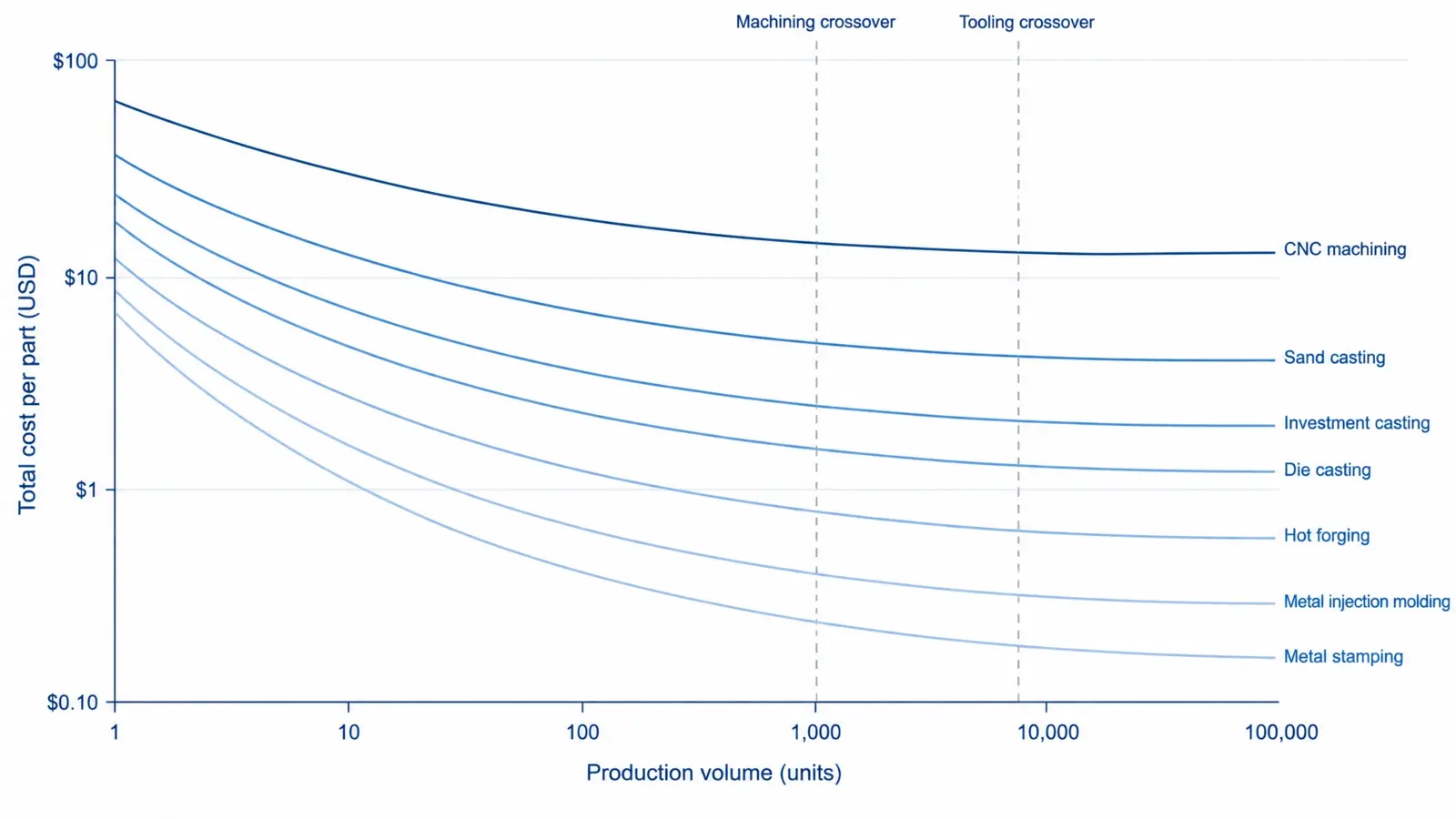
Process choice moves the price more than anything else. The same geometry can swing 2x to 10x depending on whether you machine it or tool it. Machining wins from 1 to roughly 1,000 units. Above about 5,000 units, tooling wins.
In 2026 the unit price is no longer the number that matters. Section 232 tariffs, elevated metal prices and longer offshore pipelines mean you have to compare total landed cost instead.
You have a part in mind. A bracket, a housing, a shaft, a stamped clip. The first question is always the same one: what will this cost?
There is no single answer, and that is not evasion. Two parts of the same weight in the same alloy can differ in price by five to ten times, because metal part manufacturing is not one process. It is seven or eight quite different ones, each with its own tooling bill, its own sweet spot for volume, and its own lead time.
Picking the wrong one is the most expensive mistake a buyer makes. It happens constantly, usually by default: someone machines 20,000 parts because machining is what they used for the prototype.
This guide prices every major process side by side so you can find the right one for your volume. For per-part machining detail, see our CNC machining cost guide. If you are weighing up buying your own equipment instead, see CNC machine costs. This page is the hub that ties those together and sets machining against casting, forging, stamping and MIM.
Key takeaways
- Prototypes are expensive per piece and that is normal. One CNC machined part costs $50 to $300 or more because setup and programming land on a single unit. The same part at 500 units drops to $18 to $35.
- Process choice beats every other lever. It changes per-part cost by 2x to 10x on identical geometry. Nothing else on this list comes close.
- Tooling is the dividing line. Below roughly 1,000 units, avoid it. Above roughly 5,000, embrace it. Between the two, get a real break-even calculation rather than guessing.
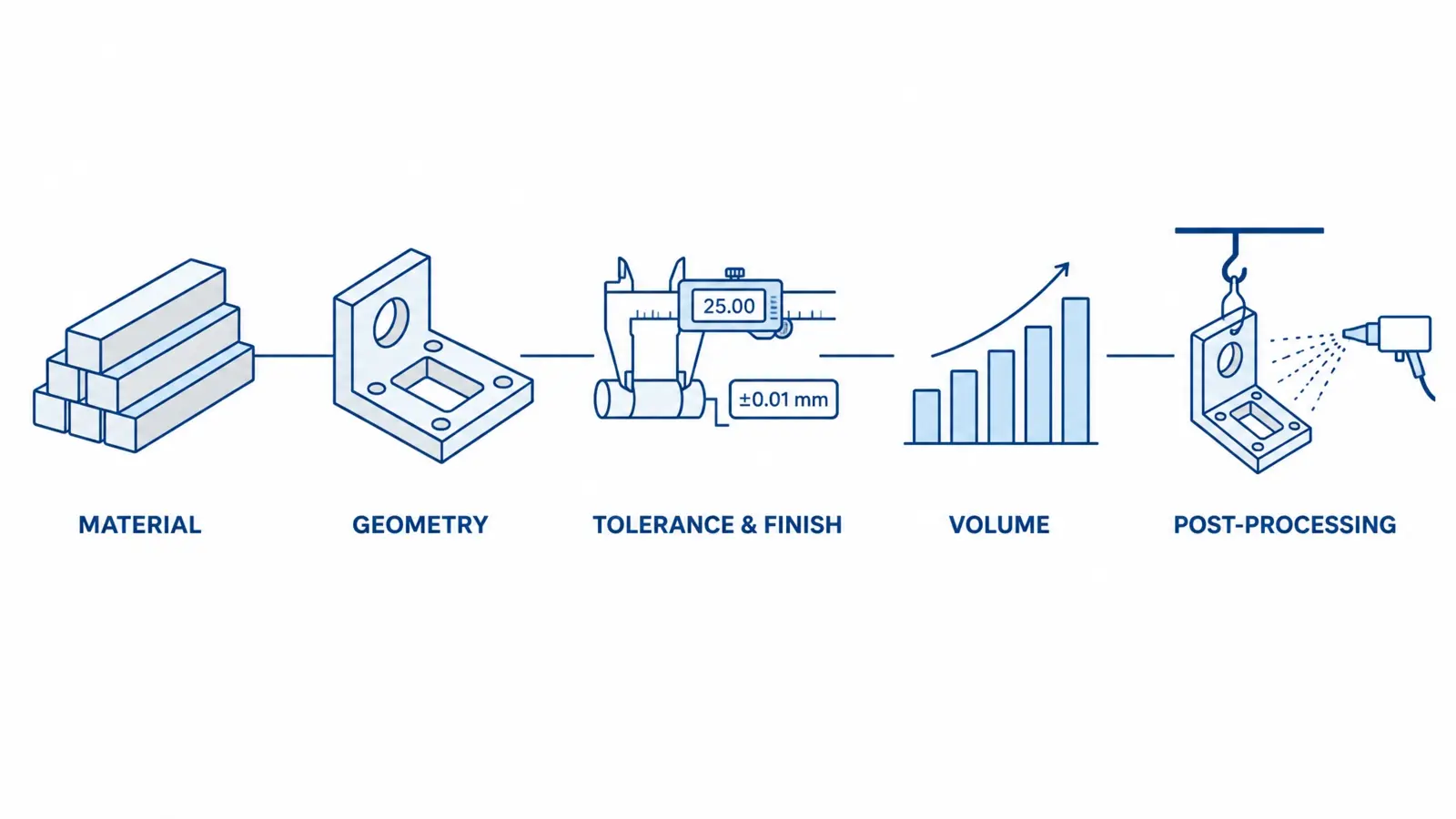
- Five drivers apply to every process: material, geometry, tolerances and finish, volume, and post-processing.
- Tight tolerances are the quiet budget killer. Moving one feature from standard to precision can multiply the machining time for that feature several times over. Specify tight only where the part functionally needs it.
- Hidden costs add 15 to 30% on top of the quoted price when vendor coordination, quality documentation, inventory carrying and scrap are not managed in one place.
- 2026 changed the offshore maths. Section 232 tariffs now reach finished parts, not just raw metal, so an offshore quote that looks 40% cheaper often is not.
What 2026 tariffs and material prices mean for your part cost
Trade policy and metal prices now sit inside every quote, and both moved sharply during 2026. Any pricing guide that ignores them is describing a market that no longer exists.
Section 232 has reached finished parts
Tariffs on imported steel and aluminum articles doubled from 25% to 50% in June 2025. The bigger change for part buyers came in April 2026, when the framework was rewritten to apply to the full value of covered articles rather than only their metal content, and to pull a long list of derivative products into scope. Derivative articles substantially made of steel or aluminum generally face 25% on full customs value.
That matters because a finished machined housing or a die cast enclosure is a derivative product. The tariff is no longer a line item on the metal inside your part. It can apply to the invoice.
A further proclamation on 1 June 2026 modified the April framework again. It cut some categories to 15%, added others at 25%, lowered the US-content threshold for the reduced 10% rate from 95% to 85%, and gave USMCA-qualifying goods from Canada and Mexico a rule where the 25% applies only to non-US content, subject to a 15% floor. In August 2026 the Bureau of Industry and Security proposed adding fourteen more derivative categories, including parts of heat exchange units and certain electric conductor cables.
The practical takeaway is uncomfortable but simple. Your exposure depends on your specific HTS classification, your metal origin, and which annex your product sits in, and the annexes have changed four times in eighteen months. Get your classification confirmed by a licensed customs broker rather than assuming a headline rate applies to you.
Metal prices are high, volatile, and no longer a background assumption
LME aluminum broke $3,100 per tonne in January 2026, a four-year high, and has traded around $3,250 to $3,350 through the third quarter. Producer prices tell the sharper story. In June 2026 the US producer price index for aluminum mill shapes was up 52.4% year over year, with steel mill products up 16.9%, according to the Associated General Contractors of America.
There is a small piece of good news in the latest data. Aluminum mill shapes eased month over month in July and August 2026, so the peak may be behind us. Elevated is not the same as still climbing.
For anyone quoting a production run longer than about 90 days, this argues for either locked material pricing or an explicit escalation clause. Quoting a twelve-month programme against a spot price has been a painful decision for the last two years.
Reshoring is changing who can actually quote you
The Fabricator's 2026 forecast projects US metal fabrication production growth of 5.5% this year, against 2.19% in 2025. Foreign import share of the US finished steel market fell through late 2025. Domestic capacity is busier, which affects lead times as well as prices.
What this means for your budget
- Compare landed cost, never unit price. A $5.00 offshore part can land at $7.50 to $9.00 once tariffs, freight, duties and inventory overhead are counted.
- Treat material cost as a variable. Lock pricing beyond 90 days, or negotiate escalation.
- Confirm your tariff position in writing. Classification drives the rate, and the rules have moved repeatedly through 2026.
What determines the cost of a custom metal part
Five drivers shape every quote: material, geometry, tolerances and finish, volume, and post-processing. They apply whether the part comes off a mill, out of a die, or under a press. Understanding them is the fastest way to tell whether a quote makes sense.
Material
Metal choice hits cost three ways: price per kilogram, how easily the metal can be worked, and whether it is a stock item or a special order. Aluminum is usually the cheapest route for both machining and casting. Carbon and mild steel are strong and cheap to buy but harder to cut. Stainless costs more per kilogram and also slows the machine down and wears tooling faster, so it is penalised twice. Titanium, brass, bronze and specialty alloys each carry their own premium.
Meco runs ten metal families in house: aluminum, carbon steel, alloy steel, stainless, brass, bronze, copper, zinc, magnesium and titanium, with tungsten carbide available through MIM and powder metallurgy.
Geometry and complexity
Complex parts cost more in every process, but for different reasons. In machining, complexity is time: more features, deeper pockets, tighter internal corners, more setups. In casting it is mould design, draft angles, wall thickness and defect risk. In forging it is die cost and the number of forming stages. In stamping it decides whether you need a simple blanking die or a multi-station progressive tool.
Tolerances and surface finish
Precision always costs. Standard machining tolerances around 0.05 mm carry almost no premium. Pull that to 0.01 mm or tighter and you are buying slower cutting speeds, more inspection, and a higher scrap rate. Tightening a single feature from standard to precision can multiply the time spent on that feature several times over.
Finish works the same way. As-machined or as-cast is free. A fine Ra 0.4 μm finish, polishing, or cosmetic plating is a secondary operation with its own cost and its own lead time. For how finish callouts translate into process choices, our surface finish chart maps the ranges each process actually holds.
The single most effective cost control available to you is free: tighten only what the part needs, and leave the rest at standard. This is what a DFM review is for, and it typically takes 15 to 30% out of a part.
Volume and tooling amortisation
Volume is the most powerful lever in the whole model. Every process has fixed costs, setup, programming, tooling, first-article inspection, and those costs get divided by however many parts you order.
A $200 machining setup adds $200 to one prototype. It adds $0.40 to each part in a 500-piece batch. A $30,000 die adds $30 per unit at 1,000 parts and $0.30 per unit at 100,000. That arithmetic is the whole reason process selection matters.
Post-processing
Most metal parts are not finished when they come off the primary machine. Heat treatment for hardness or stress relief, surface finishing such as anodising, powder coating, plating or painting, deburring, and final inspection with documentation all add cost. Budget $3 to $50 or more per part depending on process and size. For one common case, see how much powder coating costs.
Treat finishing as part of the unit cost from the start. It is the line most commonly forgotten and then discovered late.
How much does CNC machining cost per part?
Simple aluminum parts run $10 to $50 each, mid-complexity parts $50 to $200, and complex precision parts $200 to $500 or more, with price falling steeply as volume rises.
CNC machining is where most custom metal parts begin. No tooling, complete design freedom, excellent accuracy, and a design you can change tomorrow without writing off an investment. For prototypes, low volume, and anything still evolving, it is usually the right answer.
Those ranges are North American. Machining rates in Asia run roughly 40 to 60% lower, though the gap narrows considerably once freight, duties, tariffs and quality management are added.
The hourly rates behind the per-part numbers: a 3-axis mill runs $30 to $75 per hour in North America. 4-axis and 5-axis centres run $75 to $200 or more. Turning sits at $50 to $110. Setup and programming is $50 to $1,000 per job, and because it is fixed, it is the entire explanation for the table below.
| Order quantity | Cost per part | What dominates the price |
|---|---|---|
| 1 prototype | $150 to $300+ | Setup and programming |
| 10 units | $45 to $80 | Setup spread across the batch |
| 100 units | $25 to $50 | Machine time and material |
| 500 units | $18 to $35 | Cycle time, bulk material |
| 1,000+ units | $15 to $30 | Time to price casting or stamping instead |
Machining is the right process from 1 to about 1,000 units. Past that, a tooled process usually wins. Where exactly the lines cross depends on geometry, material and the tooling bill for the alternative.
How much does die casting cost per part?
Die cast parts run $1 to $10 per unit at production volume, on tooling of $5,000 to $150,000 or more, which makes die casting most efficient above about 5,000 units.
Die casting is the high-volume workhorse. Once the die exists, parts come out fast and dimensionally consistent. The trade is that you pay for the die before you see a single good part.
Tooling runs from around $5,000 for small, simple zinc parts to $150,000 or more for large, complex aluminum dies. Zinc tooling is cheaper to run and lasts longer because it operates at a lower temperature. After tooling, per-part cost collapses: $1 to $10 for small and medium aluminum parts, often less for zinc.
The switch is worth real money. A bracket machined from 6061 at $6.00 per part can land near $2.35 as a die casting at 10,000 units, and the tooling pays back well inside the first production year.
Meco runs presses from 25T to 800T, producing parts from 1 gram to 5,000 grams in aluminum (ADC12, A360, A380, AlSi12, AlSi10Mg), magnesium (AZ91D, AM50, AS41) and zinc (Zamak 2, 3, 5 and 27). For how the process works and what it will and will not hold, see the die casting process step by step and what a die actually is.
| Cost element | Typical range | Notes |
|---|---|---|
| Die tooling, aluminum | $15,000 to $150,000+ | Driven by size and cavity count |
| Die tooling, zinc | $5,000 to $80,000 | Lower running temperature extends die life |
| Per part, 5,000+ units | $1 to $10 | Falls further past 50,000 |
| Secondary machining | $2 to $15 per part | Threads, critical bores, tight faces |
| Tooling and samples | 6 to 14 weeks | Production afterwards is seconds per part |
How much does sand casting cost per part?
Sand cast aluminum runs roughly $10 to $50 per part at 100 to 1,000 units, on patterns costing only $500 to $7,500.
Sand casting asks for far less tooling than die casting, which makes it viable at quantities where a die simply cannot be justified. It also handles larger parts and a much wider range of metals: aluminum (A356, ZL101), steel, stainless, brass and bronze.
Material sets the floor. Aluminum sits near $1.50 per pound, carbon steel $0.50 to $1.00, stainless $2.50 to $5.00. Add pattern cost, labour, finishing and machining of critical surfaces on top.
The break-even against die casting is worth doing properly. A part at $12 with a $4,000 pattern versus $8 with a $32,000 die crosses over near 7,000 units. Below that, sand casting is cheaper overall even though every individual part costs more. For process detail, see what is sand casting.
How much does investment casting cost per part?
Investment cast parts run $10 to $100 or more per unit, on wax dies of $600 to $30,000, and are most economical at 500 to 50,000 units.
Investment casting sits between sand and die casting. Better finish and accuracy than sand, higher cost and slower cycles than die. Its real argument is near net shape: it is the right answer when the alternative is removing most of a billet.
Here is the arithmetic on a stainless 316 valve body of about 350 grams, at 1,000 pieces.
Machined from billet, that part runs $45 to $65 per unit. Most of that is material you pay for and then cut into chips, plus multiple setups and long cycles.
As an investment casting with machining only on the sealing faces and threaded ports, it runs $18 to $30. The build-up: $3 to $5 raw material including sprue allocation, $2 to $4 wax and ceramic shell, $6 to $12 casting labour and overhead, $5 to $8 secondary machining, and $8 to $12 of die amortisation on a $8,000 to $12,000 wax die. At 10,000 pieces that last line falls to about $1.00.
The saving is not in the casting. It is in the 60 to 70% of machining time that no longer has to happen.
| Cost element | Typical range | Notes |
|---|---|---|
| Wax injection die | $600 to $30,000 | Cavity count and complexity |
| Per part, 500 to 5,000 | $10 to $60 | Highly material dependent |
| Per part, 5,000+ | $5 to $40 | Tooling amortised, material and labour dominate |
| Secondary machining | $3 to $15 per part | Mating faces, threads, tight bores only |
| Tooling and samples | 6 to 12 weeks | Shell building is the slow step |
How much does forging cost per part?
Small and medium forged parts run $3 to $50 per unit at volume, on dies of $10,000 to $100,000 or more, and become competitive above roughly 1,000 units for hot forging.
Forging produces the strongest parts of any process. The grain flow created during forming gives fatigue and impact performance that cast or machined-from-billet equivalents cannot match, which is why it is standard for safety-critical parts in automotive, aerospace and heavy equipment.
Useful per-kilogram benchmarks: carbon steel forgings $1.50 to $5.00 per kg, alloy steel $5.00 to $15.00 per kg, excluding secondary machining.
Turning that into a part price, take a 4140 alloy steel connecting rod finishing at about 800 grams.
The billet has to be around 1.0 kg, because flash loss takes 15 to 20% and scale another 1 to 3%. At $8 to $12 per kg that is $8 to $12 of material. A two-impression die runs $20,000 to $35,000, which at 5,000 units is $4 to $7 per part. Conversion, meaning heating, press time, trimming and labour, adds $3 to $6. Normalising plus quench and temper adds $0.50 to $1.00. Machining the big end, small end and mating faces adds $5 to $10.
Total at 5,000 units: roughly $20 to $36. At 10,000 units the die line halves and you are at $17 to $30.
Note where the money sits. Material is 40 to 50% of a medium-complexity forging, so yield optimisation and grade selection are the main levers once the die is paid for. Meco runs both hot forging and cold forging with machining and heat treatment in the same flow, so the forged blank never leaves the building before it is a finished part.
| Cost element | Typical range | Notes |
|---|---|---|
| Die tooling | $10,000 to $100,000+ | Hardened steel, geometry dependent |
| Carbon steel per kg | $1.50 to $5.00 | Before secondary machining |
| Alloy steel per kg | $5.00 to $15.00 | Higher for specialty alloys and titanium |
| Worked example, 5,000 units | $20 to $36 | Material, die, conversion, heat treat, machining |
| Tooling and samples | 6 to 12 weeks | Runs are fast once dies are proven |
How much does metal stamping cost per part?
Once the die exists, stamped parts cost pennies to $5.00 each. The die itself runs $3,000 to $250,000.
Metal stamping produces flat and formed sheet components at hundreds or thousands of parts per hour. It is the default for brackets, clips, enclosures, terminals and connectors in quantity.
The barrier is entirely the tool. Simple blanking dies start around $3,000 to $8,000. Production progressive dies with multiple forming stations run $15,000 to $80,000, and complex automotive progressive tooling reaches $250,000 or more. After that, thin-gauge steel parts cost pennies at volume, with larger or thicker parts at $0.10 to $5.00.
Stamping is most economical above 5,000 units and becomes overwhelming as you climb into the tens of thousands. Below that, machining or laser cutting is usually the better total cost.
How much does metal injection molding cost per part?
MIM parts cost $10 to $50 in small batches, $1 to $5 above 10,000 units, and under $1 at very high volume, on tooling of $10,000 to $50,000.
Metal injection molding gives you the geometric freedom of plastic injection moulding with sintered metal properties. It is the cheapest way to make small, genuinely complex metal parts in quantity, the kind that would be brutal or impossible to machine.
The cost shape mirrors plastic moulding: significant tooling, very low per-part cost afterwards. Break-even against machining lands near 5,000 units for small complex parts. Below that, machine it. Above it, the economics are hard to argue with.
MIM suits parts under about 100 grams with complex three-dimensional geometry and tight tolerances, at volumes from a few thousand to several hundred thousand. Meco processes steel, stainless, brass, bronze and tungsten carbide. For process detail, see what is metal injection molding.
Every process compared side by side
Representative ranges for small to medium parts in common engineering metals. Your actual numbers move with geometry, grade, tolerance and finish.
| Process | Tooling | Per part, low volume | Per part, high volume | Best volume | Lead time |
|---|---|---|---|---|---|
| CNC machining | $0 to $1,000 fixtures | $50 to $300 | $15 to $50 | 1 to 1,000 | 1 to 3 weeks |
| Die casting | $5,000 to $150,000+ | $8 to $25 at 1,000 | $1 to $10 | 5,000 to 1M+ | 6 to 14 weeks |
| Sand casting | $500 to $7,500 | $15 to $75 | $8 to $30 | 50 to 5,000 | 4 to 8 weeks |
| Investment casting | $600 to $30,000 | $15 to $100+ | $5 to $40 | 500 to 50,000 | 6 to 12 weeks |
| Hot forging | $10,000 to $100,000+ | $10 to $50 | $3 to $20 | 1,000 to 500,000+ | 6 to 12 weeks |
| Metal stamping | $3,000 to $250,000 | $1 to $10 at 1,000 | $0.05 to $5 | 5,000 to 10M+ | 4 to 10 weeks |
| Metal injection molding | $10,000 to $50,000+ | $10 to $50 | $1 to $5 | 5,000 to 500,000+ | 8 to 16 weeks |
One pattern runs through the whole table. High tooling buys low per-part cost. Low tooling buys flexibility and speed. The right process is the one that minimises your total cost at the volume you actually need, which is not always the volume you hope for.
How to choose the right process for your volume and budget
This is mostly a volume decision, with geometry as the tie-breaker.
From 1 to about 100 units, machine it. No tooling, days to weeks of lead time, and a design change costs nothing but a new CAM program. Prototyping and engineering validation live here. If you need it faster still and tolerances are relaxed, metal 3D printing removes setup entirely.
From 100 to 5,000 units, geometry decides. Flat or formed parts may already justify stamping. Complex machined parts often stay on the mill. Near-net-shape parts that would need heavy machining move to investment casting. This is the range where a proper DFM conversation is worth the most, because the gap between the optimal process and defaulting to machining is commonly 30 to 60%.
From 5,000 units up, tooling wins and the question becomes which tool. Casting for complex aluminum housings, forging for high-strength steel, stamping for sheet, MIM for small complex parts. Material and tolerance requirements narrow it quickly.
At any volume, the cheapest answer is often a combination. A die cast housing with machined mating faces. A forged blank with machined critical features. A stamped bracket with welded sub-assemblies and mechanical assembly. Running those steps as one coordinated flow rather than five purchase orders is where the largest savings usually sit. Once a design is validated, our guide on going from prototype to production walks through scaling it cleanly.
Not sure which process fits? Send a STEP or IGES file and a target annual volume. You get a quote inside 24 hours with DFM notes and the process we would actually recommend.
Get DFM Feedback on Your DesignDomestic vs offshore: comparing total landed cost in 2026
Unit price has never told the whole story. In 2026 the gap between the quoted price and the real one is the widest it has been in a decade.
If you are comparing a $5.00 offshore quote to a $7.50 domestic quote and concluding offshore is cheaper, the conclusion is probably wrong. The $5.00 part does not arrive at $5.00.
A real landed cost includes the FOB price, ocean freight and inland drayage (roughly $0.30 to $1.50 per part for small and medium components), customs brokerage, Section 232 exposure on the product value, any Section 301 duties on Chinese-origin goods, inventory carrying cost on the 8 to 14 weeks of pipeline that a long lead time forces you to hold, and quality risk overhead: incoming inspection, rework or scrap on out-of-spec shipments, and the travel, communication and documentation time that managing an overseas supplier consumes.
Inventory carrying alone is worth more than people expect. At 20 to 30% annually, holding 12 to 16 weeks of buffer adds 3 to 7% of inventory value per production cycle, and it appears on no purchase order anywhere.
Aggregate those and an offshore price that looked 40 to 50% lower frequently lands 10 to 20% lower, and sometimes level or higher. Whether that is true for your part depends on your material, volume, origin and classification, which is exactly why landed cost analysis rather than price comparison is the only defensible basis for the decision.
There is a middle path. A manufacturer producing in lower-cost regions while holding inventory and quality accountability in North America captures the labour advantage, shortens delivery through local stock, and keeps someone in your time zone answerable when something goes wrong. Meco warehouses in Ohio, Florida, Canada, Japan and Thailand for exactly this reason.
The hidden costs that inflate metal part prices
The quote captures direct manufacturing cost. It does not capture what it takes to get finished, documented, conforming parts onto your line. Those categories typically add 15 to 30% when they are spread across separate vendors.
Multi-vendor coordination
The traditional route to a finished part is a chain: machine shop, heat treater, finishing house, assembly subcontractor, freight. Each handoff brings its own purchase order, quality approval, shipping cost and incoming inspection.
A finished anodised aluminum housing typically passes through four to six handoffs at $50 to $200 each in administrative and transfer cost per lot. On a 500-unit lot that is $0.50 to $2.50 per part before anything goes wrong.
When something does go wrong, the cost is not the parts. It is the weeks of engineering time spent establishing which vendor in the chain caused it, while everyone involved has a reasonable explanation for why it was not them.
Quality documentation
In automotive, aerospace, medical and telecom, the paperwork can cost nearly as much as the part. A complete First Article Inspection package with CMM data, material certificates and dimensional reports takes 2 to 8 hours of quality engineering time per part number, so $150 to $800 for the initial package depending on how many critical dimensions you have.
A supplier who cannot produce this reliably is not saving you money on the machine rate. They are transferring a compliance risk to you.
Inventory carrying and lead time
A low price at twelve weeks is not cheap once you count the capital sitting in safety stock. On a $10 part with a 12-week offshore lead time and 16 weeks of buffer, carrying cost adds roughly $0.60 to $0.90 per part per cycle. Shortening supplier lead time is a balance sheet improvement, not just a scheduling convenience, and it compounds across every SKU.
Scrap and rework
A batch of out-of-tolerance parts found at incoming inspection costs far more than the parts. Expedite fees on replacements run 30 to 100% above standard. If the batch is not caught until assembly, add line downtime at $500 to $5,000 per hour, engineering investigation, sorting and rework labour, and possible field-return exposure. On a low-margin product a single bad shipment can take out a quarter of profit.
Catching it in process is the only cheap version of defect management, which is what in-process inspection and SPC are for.
Hidden cost, quantified
- Vendor coordination: $0.50 to $2.50+ per part on a 500-unit lot across 4 to 6 vendors.
- Quality documentation: $150 to $800 per part number for the initial FAI package, then $50 to $200 per lot ongoing.
- Inventory carrying: $0.40 to $1.50+ per part per cycle on offshore lead times.
- Scrap and rework: replacement, expedite and investigation costs commonly reach 3 to 10x the value of the rejected parts.
- Total: 15 to 30% above the quoted price when these sit with separate vendors.
Protecting your design while you get a quote
Cost is not the only thing at stake when you send out a drawing. If the part belongs to a new product, you need to know your files stay yours.
A reputable manufacturer signs a non-disclosure agreement before you share detailed drawings or CAD, and treats your intellectual property as confidential for the life of the programme. Meco signs NDAs and provides IP protection as standard before any project begins.
If you are an inventor or brand owner taking a product to market, that protection matters as much as the unit price. Our guide on how to get your invention made covers the full path from idea to production, including how to protect the idea at each stage.
One partner, every process
Meco makes the parts and then assembles them. That removes the vendor handoffs where 15 to 30% of your real cost hides, and it means one company is accountable when something needs fixing.
- Quotes in 24 hours. With DFM notes, not just a number.
- 40+ in-house processes. Machining, casting, forging, stamping, MIM, finishing, heat treatment and assembly.
- No minimum order. 10 pieces to 10 million and every step in between.
- IATF 16949:2016 certified. FAI, PPAP, CMM reports, material certificates and full lot traceability.
- NDA signed first. IP protection as standard, from first quote through production.
Browse all 40+ processes, or go straight to a quote.
Request a QuoteReferences and sources
Tariff and commodity price positions verified against primary sources on 14 September 2026.
- The White House. Further Adjusting the Tariff Regimes for Imports of Aluminum, Steel, and Copper Into the United States. Presidential Proclamation, 1 June 2026.
- The White House. Strengthening Actions Taken to Adjust Imports of Aluminum, Steel and Copper Into the United States. Presidential Proclamation, 2 April 2026.
- U.S. Customs and Border Protection. Section 232 Tariffs on Steel and Aluminum: Frequently Asked Questions. CBP, accessed September 2026.
- Bureau of Industry and Security. Implementation of Duties on Additional Aluminum, Steel, and Copper Derivative Articles Under Section 232. Federal Register, 6 August 2026.
- Office of the U.S. Trade Representative. Initiation of Second Four-Year Review Process: China's Acts, Policies, and Practices Related to Technology Transfer, Intellectual Property, and Innovation. Federal Register, 6 May 2026.
- London Metal Exchange. LME Aluminium official prices. LME, accessed September 2026.
- Associated General Contractors of America. Construction Input Costs Remain Sharply Higher Than a Year Ago. AGC analysis of BLS producer price index data, 15 July 2026.
- U.S. Bureau of Labor Statistics. Producer Price Index by Commodity: Aluminum Mill Shapes (WPU102501). Series data via FRED, August 2026.
- The Fabricator. 2026 Metal Fabrication Forecast: Growth Accelerates in a Divided Economy. The Fabricator, 2026.
Cost figures are representative ranges based on Meco production data and are not quotations. Tariff classifications and rates change frequently, and several changed during 2026. Confirm your position with a licensed customs broker. This article is general information, not customs, legal or financial advice.
