What Is Metal Injection Molding (MIM)? A 2026 Engineer's Guide
Metal injection molding (MIM) is a way to make small, complex metal parts. You mix fine metal powder with a plastic-like binder, inject the mix into a mold, then bake off the binder and fuse the powder into solid metal. MIM is best for parts under 100 grams in production runs above 10,000 pieces per year.
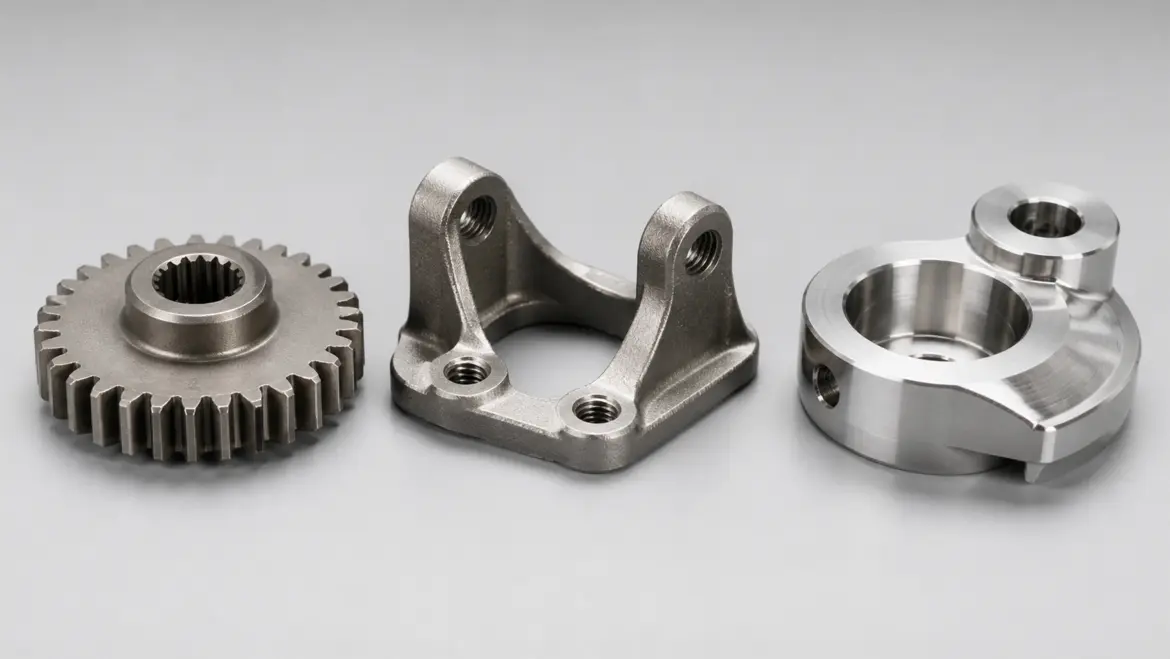
If you've ever held a dental bracket, a hearing aid shell, a watch case, or a small gear inside a power tool, there's a good chance it was made by MIM. The process can produce hundreds of thousands of identical near-net-shape parts in stainless steel, low-alloy steel, titanium, or tungsten carbide. "Near-net-shape" just means the part comes out of the process almost finished, with very little metal left to cut away.
This guide walks through how the MIM process works, what materials it uses, the real tolerances and limits, how MIM compares to CNC machining and casting, and a simple 6-point check to tell if your part is a good fit. We'll keep the language plain and the numbers specific.

What Is Metal Injection Molding in Simple Terms?
Metal injection molding, shortened to MIM, is a hybrid of two older ideas: plastic injection molding and powder metallurgy. You take very fine metal powder, mix it with a plastic and wax binder, and you get a feedstock that flows like a hot plastic. That feedstock can be injected into a mold to form a part with very fine features.
The part that comes out of the mold isn't a finished metal part yet. It still contains binder. It has to go through two more steps (debinding and sintering) to become solid metal. The result is a piece that is 96% to 99% as dense as a fully solid metal block, which is strong enough for most engineering applications.
Another name you'll see for MIM is metal powder injection molding, or simply powder injection molding (PIM) when it covers both metal and ceramic powders. The terms are used interchangeably across industry sources, including the Metal Powder Industries Federation (MPIF).
Key Takeaway
MIM is most valuable when you need a small, complex metal part in real production volume (10,000 pieces a year and up). Below that volume, tooling cost usually wipes out the savings. Above it, MIM often beats both CNC machining and investment casting on cost per part.
How Does Metal Injection Molding Work? The 4-Step Process
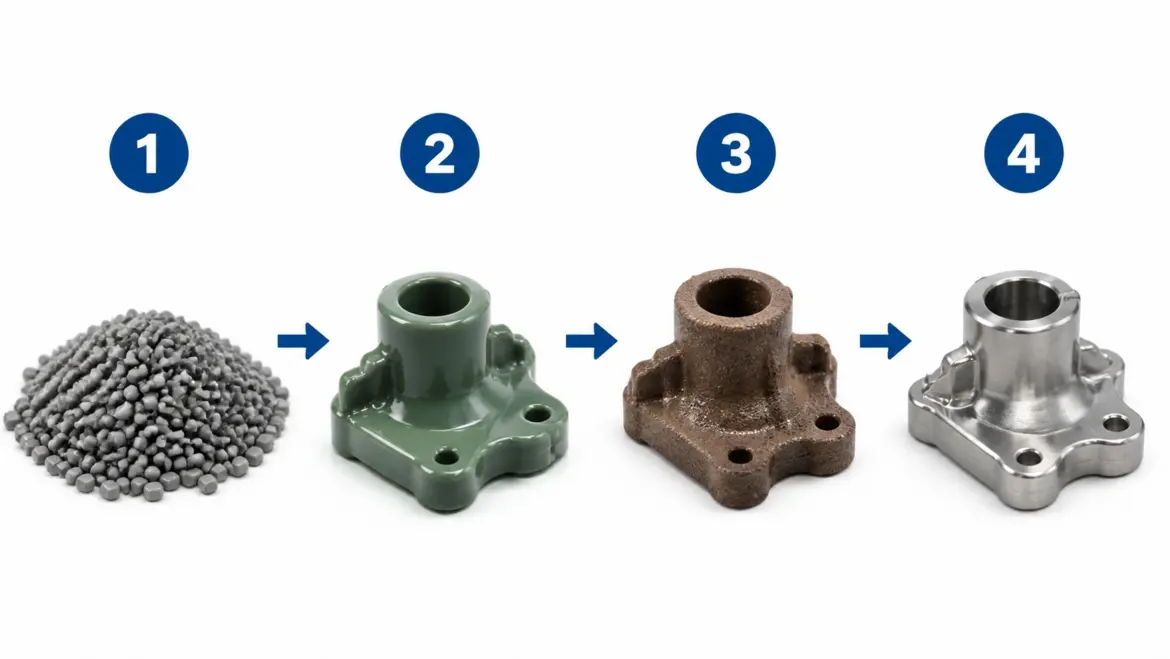
The MIM process has four core steps. Each step changes the part in a specific way. Skipping or rushing any of them shows up later as cracks, warping, or dimensions that drift out of spec.
- Compounding. Fine metal powder is blended with a plastic and wax binder, then pelletized into feedstock.
- Molding. The feedstock is heated and injected into a steel mold, producing an oversized "green part."
- Debinding. Most of the binder is removed using solvent, heat, or catalytic gas, leaving a porous "brown part."
- Sintering. The brown part is heated in a furnace until the metal powder fuses, shrinking the part 15-20% to final size.
Each step is explained in more detail below.
Step 1: Feedstock Compounding
The starting point is metal powder so fine it looks like talc, usually between 5 and 20 microns. That powder is mixed with a binder system (a blend of waxes, polymers, and lubricants) until it forms a uniform paste. Once cooled and pelletized, it's called MIM feedstock.
The mix ratio matters. Too much binder and the part will sag during debinding. Too little binder and the feedstock won't flow well enough to fill a thin-walled mold. Most production feedstocks are about 60% metal powder and 40% binder by volume.
Step 2: Injection Molding the Green Part
The feedstock is heated and shot into a steel mold on a machine that looks almost identical to a plastic injection molding machine. The hot feedstock fills every corner of the mold cavity and cools. What pops out is called a green part.
The green part is oversized on purpose. It will shrink in the next two steps, so the mold is built about 17-20% larger than the final design. This is the step where most of the geometry (thin walls, sharp corners, undercuts, holes) is locked in.
Step 3: Debinding the Brown Part
Most of the binder has to come out before sintering, or trapped binder will turn to gas and blow the part apart. MIM debinding uses one of three methods: a solvent bath that dissolves the wax, a catalytic gas that breaks down a special polymer binder, or a slow thermal cycle that burns the binder off in a furnace.
What you're left with is called a brown part. It still has the shape of the final part, but it's fragile and porous, almost like a chalk biscuit. You can crush it between your fingers.
Step 4: Sintering to Final Density
The brown part goes into a high-temperature furnace, usually under a controlled atmosphere of hydrogen or vacuum. The temperature climbs to about 85-90% of the metal's melting point. At that temperature, the powder particles fuse together at their points of contact, the pores close up, and the part shrinks evenly to its finished size.
After MIM sintering, the part typically reaches 96-99% of full theoretical density. That's strong enough to be used as-is for most parts, or it can move on to a secondary step like heat treatment, surface finishing, or light CNC machining on critical features.
What Materials Are Used in Metal Injection Molding?
MIM works with metals that can be made into fine powder and sintered cleanly. That's a smaller list than what you'd see in machining or casting, but it covers most engineering uses. Stainless steels dominate because they balance strength, corrosion resistance, and good sintering behavior.
At Meco, the most common MIM materials we run are MIM-316L stainless steel, MIM-17-4PH stainless steel, MIM-4605 low-alloy steel, MIM-FeNi50 soft magnetic alloy, plus brass, bronze, and tungsten carbide for wear parts. Here are the headline mechanical properties.
| Material | Tensile Strength | Yield Strength | Elongation | Typical Use |
|---|---|---|---|---|
| MIM-316L Stainless | > 450 MPa | > 190 MPa | > 40% | Medical, food, marine, corrosive environments |
| MIM-17-4PH (H900) | > 1100 MPa | > 1000 MPa | ~ 6% | Firearms, aerospace, high-strength fasteners |
| MIM-4605 Low Alloy | ~ 440 MPa (as sintered) | ~ 205 MPa | ~ 15% | Automotive, power tools, general machinery |
| MIM-FeNi50 | Soft magnetic, low coercivity | n/a | Ductile | Sensor cores, magnetic actuators |
| Tungsten Carbide | Extreme hardness (HRA 88+) | n/a | Brittle | Cutting inserts, wear plates |
These properties come from our internal qualification data and align with the chemistry and property ranges defined in ISO 22068, the international standard for sintered metal injection molded materials, and ASTM B883 in North America. For a side-by-side look at related metal-powder processes, see our powder metallurgy capability page.
Aluminum and copper are technically possible in MIM but rare. Aluminum is hard to sinter cleanly because the oxide layer on the powder fights the bonding step. Copper needs a tightly controlled atmosphere. Most production MIM stays in the stainless and low-alloy steel families.
What Are the Advantages of Metal Injection Molding?
MIM exists because traditional methods hit a wall when parts get small and complex. Here is where MIM earns its place.
Complex shapes in one shot. Internal threads, undercuts, gear teeth, fine surface text, and thin walls can all be molded directly. That removes the need for multiple machining setups and the fixtures they require.
Strong, dense parts. A sintered MIM part reaches 96-99% of full density. That's stronger than a typical sand or gravity casting and close to a wrought part for most uses.
Low material waste. Because the part comes out near-net-shape, you skip most of the chip-cutting that CNC turning and milling would require. Material yield is often above 95%.
Repeatable at high volume. Once the tool is built, cycle time per part is measured in seconds. That makes MIM very attractive for runs above 10,000 to 50,000 parts per year.
Material flexibility. You can hit a wide range of properties (corrosion resistance, hardness, magnetic behavior, biocompatibility) by changing the powder, without changing the tooling.
Tight tolerances without secondary work. Most MIM parts hold ±0.3% to ±0.5% of nominal dimension straight from the furnace. That's good enough for many features without any machining.
What Are the Disadvantages and Limits of MIM?
MIM isn't free. There are real reasons it isn't used for every metal part.
Tooling is expensive. Based on Meco's quoting data, a production MIM mold typically costs $15,000 to $80,000 USD, depending on cavity count and complexity. That cost has to be amortized across the production run. Below a few thousand parts, the math usually doesn't work.
Part size is limited. Most MIM parts weigh under 100 grams. According to industry sources like OptiMIM, parts over about 160 grams become very difficult to debind without defects. The thicker the wall, the longer the binder has to travel out, and the higher the risk of cracking.
Wall thickness has both a floor and a ceiling. Walls below about 0.5 mm are hard to fill. Walls above about 10 mm are hard to debind. The sweet spot is 1-6 mm.
Long lead time on first parts. Tooling, sampling, debinding cycles, and sintering all take time. First parts typically take 8-12 weeks. That's slower than CNC machining or metal 3D printing for prototypes.
Material list is narrower. Stainless and low-alloy steels dominate. If you need a specific aluminum alloy or a copper bus bar, MIM probably isn't your process.
MIM Tolerances, Standards, and Part Size Limits
This is the section engineers care about most, so we'll be specific.
Typical as-sintered MIM tolerances are ±0.3% to ±0.5% of the nominal dimension. On a 20 mm feature, that works out to roughly ±0.06 to ±0.10 mm. Tighter tolerances are possible but usually require a secondary CNC operation on the critical feature.
The governing international standard is ISO 22068:2012, Sintered Metal Injection Molded Materials, which defines chemistry, mechanical properties, and density requirements. In North America, ASTM B883 covers the same ground for MIM material specifications. Most reputable MIM suppliers will quote to one or both.
MIM Size and Tolerance Rules of Thumb
Weight: Best under 60 grams. Possible up to 100-160 grams. Wall thickness: 0.5 to 6 mm is the sweet spot. Linear tolerance: ±0.3-0.5% of dimension as-sintered. Surface finish: 0.8-1.6 µm Ra straight from the furnace. Density: 96-99% of theoretical for most production alloys.
MIM vs Investment Casting vs CNC Machining vs Powder Metallurgy
One of the most common questions we get is: how do I know if MIM is the right process? The honest answer is that it depends on volume, geometry, weight, and material. Here's how MIM stacks up against the three processes it competes with most often.
| Factor | MIM | Investment Casting | CNC Machining | Powder Metallurgy (Press & Sinter) |
|---|---|---|---|---|
| Best part size | Under 100 g | Grams to tens of kg | Any size | Small to medium |
| Geometric complexity | Very high | High | High (more setups) | Low to medium |
| Tolerance (typical) | ±0.3-0.5% | ±0.5-1.0% | ±0.01 mm achievable | ±0.1-0.2 mm |
| Density | 96-99% | ~100% | 100% | 85-92% |
| Tooling cost | Medium-high | Medium | None to low | Medium |
| Cost per part at high volume | Low | Medium | High | Lowest |
| Break-even volume | ~10,000+ | ~500+ | 1 piece | ~25,000+ |
| Lead time to first parts | 8-12 weeks | 6-10 weeks | 1-3 weeks | 8-12 weeks |
In our experience, the cleanest decision rule is this: if your part is small, complex, and you'll make a lot of them, MIM almost always wins on cost. If your part is large or simple, look at investment casting or machining instead. If you only need a few hundred pieces, machining is usually cheaper than building MIM tooling. For comparison context on machining costs, see our guide on CNC machine costs.
What Changed in MIM in 2025 and 2026?
MIM isn't a static process. Three shifts have reshaped how OEM sourcing teams are thinking about it in 2025 and 2026.
1. The market is still growing fast. The global MIM parts market was valued at roughly USD 4.6 billion in 2025 and is forecast to reach USD 5.2 billion in 2026, according to Global Market Insights. Most of that growth is in medical, EV components, and consumer electronics hinges.
2. Binder jetting is becoming a real alternative for prototype-to-low-volume work. Binder jet metal 3D printing uses similar metal powders and a similar sintering step, but skips the mold entirely. For runs under 1,000 parts, it's now often cheaper than MIM. For runs above 10,000, MIM still wins on piece price.
3. EV and medical demand is pulling MIM toward titanium and tighter spec control. We're seeing more requests for MIM titanium (Ti-6Al-4V) on medical implants and lightweighting brackets, and more PPAP-level documentation requirements across the board, not just on automotive programs.
What Industries and Parts Use Metal Injection Molding?
MIM shows up in almost any product that needs a small, strong, complex metal piece in big numbers. The biggest end markets are medical, automotive, consumer electronics, and firearms.
Medical and dental: Orthodontic brackets, surgical instrument tips, endoscope components, dental implants, biopsy forceps. MIM-316L is the workhorse here because it resists corrosion from sterilization and biological fluids.
Automotive: Turbocharger vanes, fuel injector parts, transmission components, seatbelt locks, sensor housings. MIM-17-4PH and MIM-4605 are common choices.
Consumer electronics: Hinges for laptops and folding phones, watch cases, hearing aid shells, connector shells. The ability to mold a thin, complex shape in stainless steel is hard to beat.
Firearms: Triggers, hammers, safety levers, sights. MIM-17-4PH in its H900 condition is widely used for its hardness and dimensional stability.
Aerospace and defense: Latches, fittings, small turbine components, fuze parts. The aerospace use is real but limited compared to investment casting or machining, and it focuses on smaller secondary components rather than primary structure.
Industrial and power tools: Small gears, ratchet mechanisms, cutting heads, wear inserts. Tungsten carbide MIM is used where extreme hardness is needed in a complex shape.
Is MIM Right for Your Part? A 6-Point Fit Check
We use this simple 6-point check with new customers to decide if MIM is worth quoting. Score your part below. Four or more "Yes" answers means MIM is probably your process. Three or fewer means another method will likely serve you better.
| # | Question | Yes (favors MIM) | No (favors another process) |
|---|---|---|---|
| 1 | Does the part weigh under 100 grams? | Under 100 g | Use casting or machining |
| 2 | Is the geometry complex (undercuts, fine threads, gear teeth)? | Yes | Use machining or stamping |
| 3 | Are wall thicknesses between 0.5 and 6 mm? | In range | Use casting or machining |
| 4 | Will annual volume exceed 10,000 parts? | Yes | Use machining or binder jetting |
| 5 | Is the material stainless steel, low-alloy steel, or carbide? | Yes | Reconsider material or process |
| 6 | Can critical tolerances live at ±0.3-0.5%? | Yes | Plan a secondary CNC step |
If you're not sure where your part lands, send us the CAD file. Our engineers will run a free DFM (design for manufacturability) review and tell you honestly whether MIM, casting, or machining is the better fit. That's part of how Meco's R&D engineering team supports every quote.
How Much Does Metal Injection Molding Cost?
MIM cost has two big components: tooling (one time) and piece price (every part).
Based on Meco's quoting data, a typical production MIM mold runs from about $15,000 for a simple single-cavity tool to $80,000 or more for a complex multi-cavity tool. Piece price for a small stainless part in production usually lands between $0.50 and $5.00 per piece, depending on weight, material, and finish requirements.
Here's a real example from a Meco program. A North American customer was CNC-machining a small MIM-17-4PH retention bracket for a power-tool assembly at roughly $6.40 per part, with annual volume of 40,000 units. We tooled the same part for MIM at $32,000 and brought piece price down to about $0.95. The program broke even in the fifth month of production, and total annual cost dropped by more than $200,000. (Customer details kept private. Numbers reflect a typical small-stainless MIM conversion we run several times a year.)
The math is straightforward. If your CNC version costs $X per part and your MIM version costs $Y per part with a $Z mold, MIM breaks even at Z / (X - Y) parts. After that, every part is savings. This is why MIM dominates consumer products and medical devices but is rare in low-volume aerospace work.
We always recommend asking for both a piece-price quote and a break-even analysis on any MIM job. Any serious MIM supplier should be able to give you, in writing, the volume at which their process beats your current alternative. For broader context on outsourced production economics, see our guide on what contract manufacturing involves.
How Meco Approaches Metal Injection Molding
Three things we do differently on MIM programs, based on 30+ years of running them across automotive, medical, electronics, and industrial customers.
1. We quote the right process, not just the one we run. Because Meco runs MIM, investment casting, powder metallurgy, and CNC machining in-house, we can tell you when MIM isn't your best option. About one in three parts a customer brings to us for MIM ends up quoted as investment casting or machining instead. That honesty matters when you're choosing a long-term partner.
2. DFM review is included on every quote, not just first-time customers. Our engineers flag wall-thickness issues, gating problems, and shrinkage risks before tooling is cut, not after first articles fail. This is built into our standard R&D engineering workflow.
3. Every MIM lot gets CMM verification on critical features before it ships. Our IATF 16949:2016 quality system requires it, and it's why our MIM quality rate runs above 99.99%. Material certificates, first article inspection reports, and PPAP-level documentation are standard, not extras.
Meco has been making metal parts for over 30 years, with production facilities totaling 36,000 m² across Thailand and China and U.S. engineering support. For customers who need a true single-source partner from concept through global delivery, our whole product manufacturing solution combines MIM with assembly, packaging, and warehousing in the U.S., Canada, Japan, and Thailand. To get a quote or a DFM review on a MIM part, visit our metal injection molding services page or contact us directly. Quotes come back in under 24 hours.
Frequently Asked Questions About Metal Injection Molding
What is metal injection molding in simple terms?
Metal injection molding (MIM) is a way to make small, complex metal parts. Fine metal powder is mixed with a plastic binder, injected into a mold like a plastic part, then debinded and sintered until the powder fuses into solid metal. MIM is most often used for parts under 100 grams in volumes above 10,000 per year, in stainless steels and low-alloy steels.
How does metal injection molding work step by step?
MIM has four main steps. First, fine metal powder is mixed with a wax and polymer binder to create a feedstock. Second, that feedstock is injected into a steel mold to form an oversized green part. Third, the binder is removed using solvent, gas, or heat, leaving a porous brown part. Fourth, the part is sintered in a high-temperature furnace, where the powder fuses and the part shrinks 15-20% to its final size and density.
What materials can be used in metal injection molding?
The most common MIM materials are stainless steels (MIM-316L and MIM-17-4PH), low-alloy steels (MIM-4605), soft magnetic alloys (MIM-FeNi50), tungsten carbide, brass, and bronze. Stainless steels dominate because they balance strength, corrosion resistance, and good sintering behavior. Aluminum and copper are technically possible but rare in production MIM. Material specifications typically follow ISO 22068 or ASTM B883.
What is the maximum size for a MIM part?
Most MIM parts weigh under 100 grams, with the sweet spot between 5 and 60 grams. Parts above roughly 160 grams become very difficult to debind without internal cracking. Wall thickness matters more than overall size: the practical range is 0.5 to 6 mm. Thicker walls hold trapped binder and risk defects. Larger or thicker parts are usually better suited to investment casting or CNC machining.
What tolerances can MIM hold?
As-sintered MIM parts typically hold ±0.3% to ±0.5% of the nominal dimension. On a 20 mm feature, that works out to roughly ±0.06 to ±0.10 mm. Tighter tolerances are possible but usually require a secondary CNC step on the critical feature, such as a bore or mating surface. Surface finish straight from the furnace is around 0.8 to 1.6 µm Ra, comparable to a machined finish.
What is the difference between MIM and investment casting?
MIM uses powdered metal injected into a mold and sintered, while investment casting pours molten metal into a ceramic shell built around a wax pattern. MIM is better for very small (under 100 g), highly complex parts in high volumes, with tighter tolerances and smoother surface finish. Investment casting handles a much wider size range (grams to tens of kilograms) and a broader material list. For runs below a few thousand parts, investment casting usually wins on tooling cost.
Is MIM cheaper than CNC machining?
At high volumes, yes. MIM has a big upfront tooling cost (typically $15,000 to $80,000), but the piece price for small complex parts can be a fraction of the equivalent CNC machined cost. The break-even point is usually between 5,000 and 25,000 parts, depending on geometry. Below that, CNC machining is usually cheaper because there's no tooling to amortize. Above it, MIM scales much more economically.
What industries use metal injection molding?
The biggest end markets for MIM are medical and dental (surgical instruments, implants, orthodontic brackets), automotive (turbocharger vanes, fuel system parts, transmission components), consumer electronics (hinges, watch cases, connectors), and firearms (triggers, sights, safety levers). MIM also has a smaller role in aerospace, defense, and industrial tooling. The global MIM parts market was valued at roughly USD 4.6 billion in 2025.
Is MIM the same as powder metallurgy?
MIM is a branch of powder metallurgy, but they aren't the same. Traditional powder metallurgy (press-and-sinter PM) compacts metal powder in a die under high pressure, then sinters it. MIM mixes powder with a binder and injects it into a mold, which allows for more complex shapes and thinner walls. PM parts typically reach 85-92% density with simpler geometry. MIM parts reach 96-99% density with intricate features.
How long does MIM tooling take and what is the lead time for first parts?
A typical MIM tool takes 4 to 8 weeks to build, depending on complexity and cavity count. Once the tool is ready, sampling, debinding cycles, and sintering add another 3 to 4 weeks before approved first articles are in hand. Plan on 8 to 12 weeks from kickoff to first qualified parts. Once production starts, follow-on orders typically ship in 4 to 6 weeks. For faster prototypes, CNC machining or metal 3D printing is usually a better fit.
Get MIM Parts Built Right, From Prototype to Millions
Sourcing a small, complex metal part shouldn't mean juggling separate suppliers for tooling, molding, sintering, and finishing. Meco runs metal injection molding, powder metallurgy, investment casting, CNC machining, and surface finishing in-house, so we can quote you the process that actually fits your part, not just the one we happen to run.
With 30+ years of turnkey manufacturing experience and IATF 16949:2016 certified quality, Meco is built for programs where precision, traceability, and on-time delivery aren't negotiable.
- 40+ In-House Processes: MIM, powder metallurgy, investment casting, CNC machining, surface finishing, and mechanical assembly under one roof.
- IATF 16949:2016 Certified: Automotive-grade quality applied across every industry. 99.99% quality rate. 99.8% on-time delivery.
- Honest DFM Feedback with Every Quote: If MIM isn't the right call, we'll tell you. Quotes back in under 24 hours.
- Prototype to Mass Production: 10 pieces to 10 million+. No minimum order quantities.
- Global Logistics: Warehousing in the U.S. (Ohio & Florida), Canada, Japan (Tokyo & Osaka), and Thailand. JIT and VMI delivery programs available.
Send us your drawings and our engineering team will give you a MIM piece-price quote, a break-even analysis, and an honest read on whether MIM, casting, or machining will deliver the lowest landed cost for your program.
Request a Quote Today