Metal Stamping Services for Precision Stamped Parts
We turn flat sheet metal into finished stamped parts, fast and at low unit cost. From 10 samples to 10 million production parts in aluminum, steel, stainless, brass, bronze, and copper.

What Are Metal Stamping Services?
Metal stamping services turn flat sheet metal into finished parts using a press and a shaped steel tool called a die. The press drives the sheet into the die to cut, punch, bend, draw, or emboss it in one stroke. Once the die exists, the press repeats that stroke millions of times, which is why stamping is the lowest cost way to make metal parts in volume.
The trade is simple. You pay once for the die, then every part after that is cheap. Most cars, appliances, and electronics are built from metal stamped parts for exactly this reason.
According to Precedence Research, the global sheet metal market was worth USD 354.04 billion in 2025 and is growing at a 4.93% CAGR. Meco runs progressive die stamping, compound dies, and gang dies alongside in-house CNC machining, surface finishing, and mechanical assembly, so a stamped part can leave finished and assembled on one purchase order. Stamping sits inside our wider fabrication and welding capability.
Metals
6 Types
Aluminum, carbon steel, stainless, brass, bronze, copper.
Thickness
Up to 6 mm
Thin foil gauges up to structural brackets.
Order Size
10 to 10M+
No minimum order quantity.
Quality
IATF 16949:2016
The standard automotive OEMs require.
Every Stamping Method Under One Roof
Different parts need different dies. These are the four stamping methods we run, matched to part shape, metal, and volume.
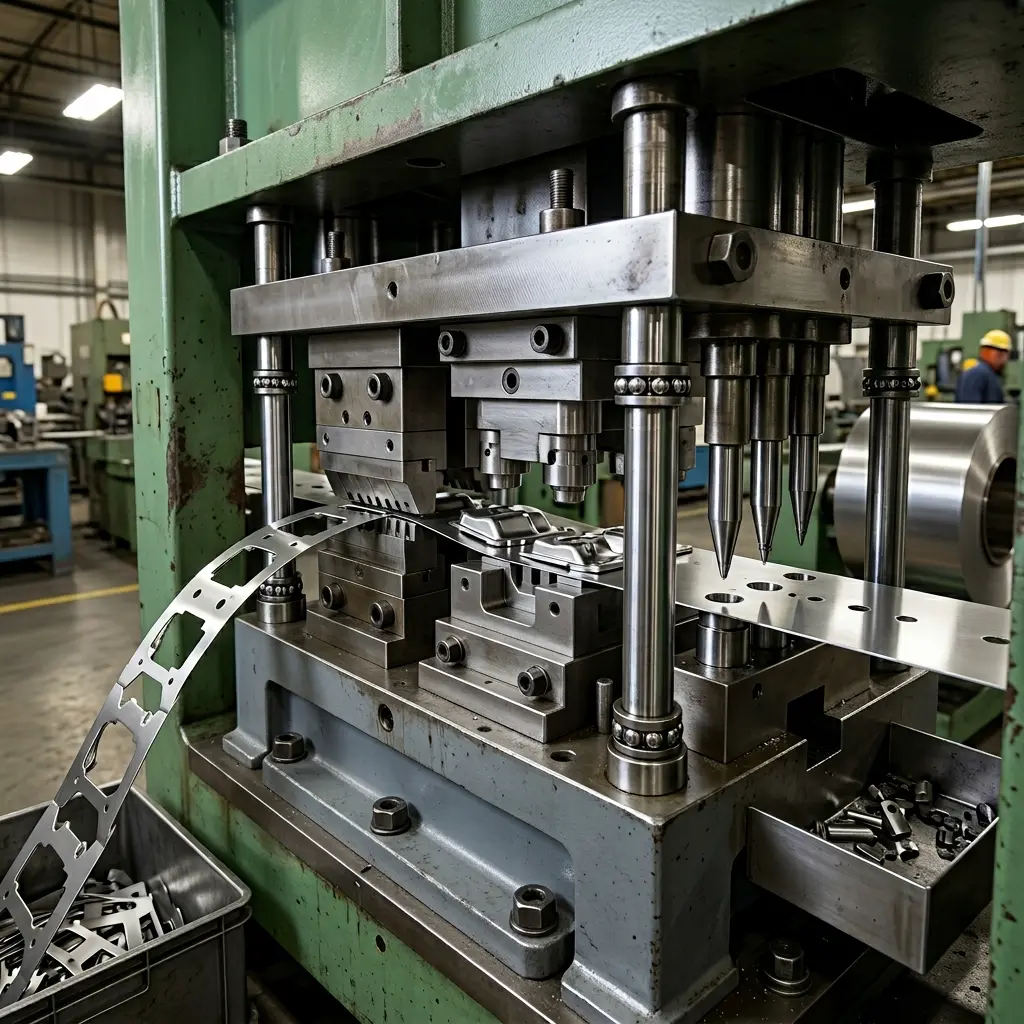
Progressive Die Stamping
A coil strip feeds through a line of stations inside one die. Each station cuts, punches, or forms a different feature, and a finished part drops out at the end. It is the fastest and cheapest route to large volumes. We design and build these tools ourselves in 3 to 6 weeks.
Explore progressive stamping →
Bending and Forming
This is where a flat blank becomes a 3D part. We use it for L brackets, channels, enclosures, and structural panels. For lower volumes we run the same geometry on CNC bending instead, which skips tooling entirely.
Explore CNC bending →
Compound and Gang Dies
A compound die blanks the outline and pierces the holes in one stroke, which keeps the part exceptionally flat. A gang die groups several operations when a full progressive tool cannot be justified. Both suit terminals, washers, clips, and shims.
Compare die types →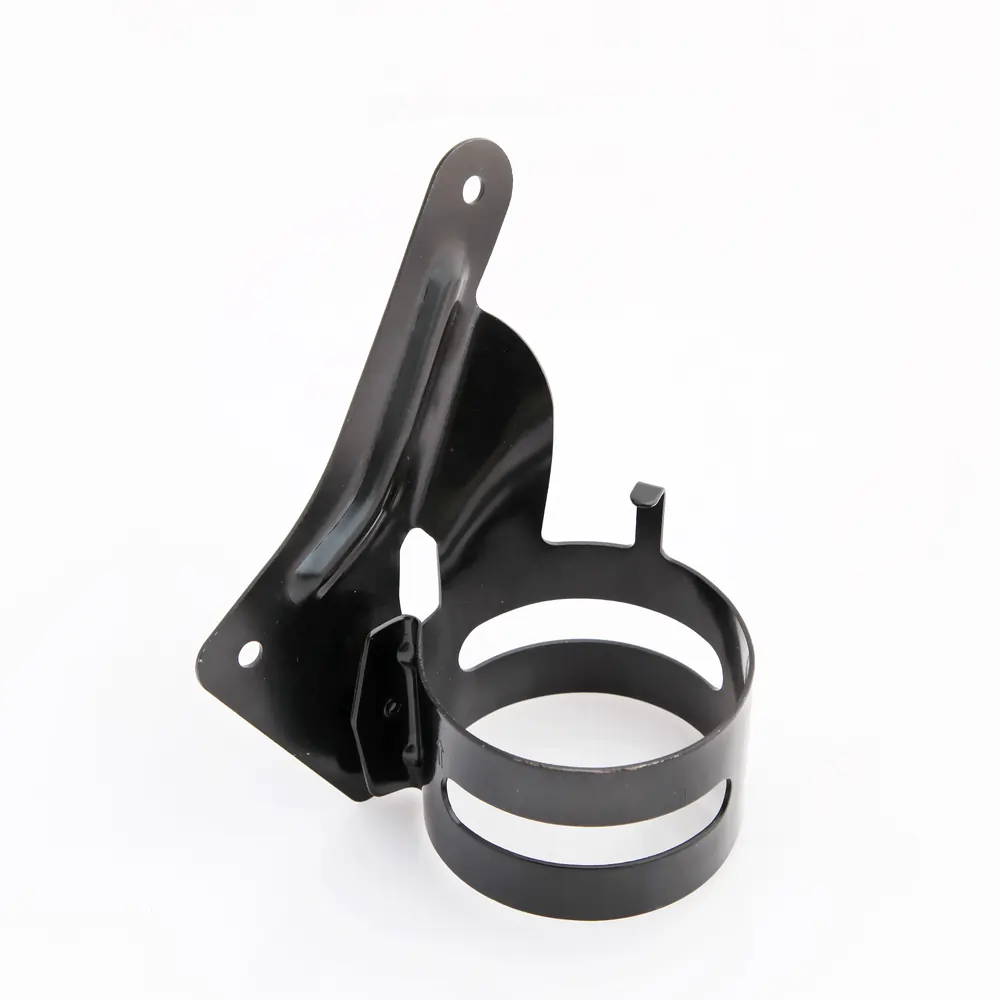
Coining and Embossing
Coining is the same principle used to strike currency. High pressure squeezes the blank to force flatness and sharp detail. Embossing raises logos, part numbers, or stiffening ribs without adding a component. Both pair well with plating and coating.
See finishing options →Swipe to see all four methods
Which Stamping Method Fits Your Part?
Choose on three inputs: annual volume, how much tooling you can amortise, and the tightest tolerance the part actually needs. If you are still choosing a supplier, read how to find a manufacturer for your product.
| Method | Best Quantity | Tool Cost | Typical Tolerance | Best For |
|---|---|---|---|---|
| Progressive Die | 100,000+ parts | Highest | 0.05 mm | Lowest unit cost at scale |
| Compound Die | 50,000 to 1M parts | Medium | 0.05 mm | Parts needing high flatness |
| Gang Die | 10,000 to 500,000 parts | Medium | 0.1 mm | Cutting tooling spend |
| Single Stage Die | 1,000 to 50,000 parts | Low | 0.15 mm | Simple parts, quick turnaround |
| Laser Cutting | 1 to 10,000 parts | None | 0.1 mm | Prototypes, no tooling wait |
| CNC Bending | 1 to 50,000 parts | None | 0.1 mm | Small batches, design still moving |
Swipe the table sideways to see every column
When Stamping Is Not the Right Choice
Three cases where we will quote you a different process instead, because stamping will cost you more or miss the print.
You Need Tighter Than 0.05 mm
Stamping tolerance comes from die clearance and material springback, so it has a floor. If a bore, a bearing seat, or a mating face has to hold tighter, or two features must stay concentric, use CNC machining, which holds 0.01 mm. We often stamp the blank and machine the one critical feature.
The Part Is Thicker Than 6 mm
Stamping works on sheet and strip. Solid, thick walled, or complex 3D bodies such as housings, gear blanks, and structural bosses belong in die casting or forging, where the grain structure also comes out stronger.
You Only Need a Few Hundred Parts
A die has to be paid for before the first part exists. Below roughly 10,000 pieces the tooling rarely amortises. Laser cutting plus bending gives you the same geometry with no tool, and lets you keep changing the design.
Swipe for all three alternatives
How Accurate Are Metal Stamped Parts?
Meco quotes stamped part tolerances against DIN 6930-2 and GB/T 13914, the two general tolerance standards for stamped steel parts. Fine class is the tightest, coarse the loosest. Ask for fine only where the feature needs it, because it drives tool cost.
| Nominal Size (mm) | Fine | Medium | Coarse |
|---|---|---|---|
| Up to 6 | 0.05 to 0.4 | 0.10 to 0.4 | 0.20 to 0.8 |
| 6 to 30 | 0.08 to 0.4 | 0.15 to 0.6 | 0.30 to 1.0 |
| 30 to 120 | 0.10 to 0.5 | 0.20 to 0.8 | 0.40 to 1.5 |
| 120 to 400 | 0.15 to 0.7 | 0.30 to 1.2 | 0.60 to 2.0 |
| 400 to 1000 | 0.20 to 1.0 | 0.40 to 1.6 | 0.80 to 2.5 |
Within a class, the tighter figure applies to thinner stock. Thicker material shifts you toward the upper bound because of edge rollover and die wear.
| Nominal Size (mm) | Fine | Medium | Coarse |
|---|---|---|---|
| Up to 6 | 0.1 to 0.8 | 0.2 to 0.8 | 0.4 to 1.6 |
| 6 to 30 | 0.2 to 0.8 | 0.3 to 1.0 | 0.6 to 2.0 |
| 30 to 120 | 0.3 to 1.0 | 0.5 to 1.5 | 1.0 to 2.5 |
| 120 to 400 | 0.4 to 1.5 | 0.6 to 2.0 | 1.2 to 3.0 |
Formed dimensions open up because the material springs back after the punch retracts. Springback grows with higher yield strength, so stainless and high strength steel move more than mild steel.
| Bend Leg Length (mm) | Fine | Medium | Coarse |
|---|---|---|---|
| Up to 10 | 1° | 1° 30′ | 3° |
| 10 to 25 | 30′ | 50′ | 2° |
| 25 to 63 | 30′ | 50′ | 2° |
| 63 to 160 | 20′ | 25′ | 1° |
| Over 160 | 15′ | 20′ | 45′ |
Short legs hold angle worst because there is less length to measure over. Where you need fine class we add coining at the bend and raise inspection frequency. Material certificates to EN 10204 3.1 are available on request.
6 Design Rules That Cut Stamping Cost
Our engineers check every drawing against these six before quoting. Applying them at design stage is where most of the 15 to 30% DFM saving comes from.
Keep Bend Radius at or Above Material Thickness
An inside radius smaller than the stock thickness stretches the outer fibre past its limit and cracks it. Start at 1x thickness for mild steel and 1.5 to 2x for aluminum and stainless, then tighten only if a test part allows.
Keep Holes Away From Bend Lines
A hole inside the bend deformation zone pulls into an oval. Leave at least 2.5x material thickness plus the bend radius between the hole edge and the bend line, or move the hole to a second operation after forming.
Respect Minimum Edge Distance
Punching too near an edge tears the remaining web instead of shearing it cleanly. Keep at least 2x material thickness of solid metal between any hole and the part edge, and the same between adjacent holes.
Use Standard Punch Sizes
A non standard hole means a non standard punch, a longer tool build, and a spare part you have to wait for later. Sticking to common clearance sizes for M3 to M6 lets us use stock punches and shortens the tool by days.
Apply Fine Tolerance Only Where It Works
Blanket fine class across every dimension can multiply tool and inspection cost several times over. Identify the two or three features that control fit and function, hold those tight, and let the rest sit at medium class.
Send the Drawing Before You Freeze It
Our engineers review the CAD before any steel is cut. A larger hole, a different bend sequence, or a more common grade routinely takes 15 to 30% out of the part price, but only while the design can still move.
Swipe through all six rules
What Drives the Price of Metal Stamped Parts?
Stamping cost splits into a one time tooling charge and a per part charge. Volume decides which one dominates. For a wider view of metal part pricing, see our complete metal part cost guide.
Number of Die Stations
Every extra operation is another station in the tool. Station count is the biggest single driver of tooling price, ahead of part size.
Material and Strip Layout
Scrap between blanks is metal you pay for and never ship. Nesting the layout tighter often saves more than switching grade.
Tolerance Class
Moving a feature from medium to fine class means better die steel, closer clearance, and more frequent in process checks.
Secondary Operations
Deburring, heat treatment, plating, and hardware insertion each add a step. Doing them in house removes freight and handoffs.
Annual Volume
Tooling is amortised across the run. The same die is expensive at 5,000 parts and irrelevant at 500,000.
Packaging and Delivery Point
Bulk, tray, or reel packing changes handling cost. Shipping from the closest of our five warehouse regions changes landed cost.
A Note on Die Prices You See Quoted Online
Published stamping die prices vary enormously because they describe different parts. Across the industry, simple single stage dies sit in the low thousands, while multi station progressive dies for complex automotive parts reach six figures. Those figures are an industry guide, not a Meco price list.
We do not quote tooling from a table. Send the drawing and you get an itemised tooling and piece price, with the DFM notes that produced it, inside 24 hours. Tooling ownership and amortisation terms are confirmed in writing on that quote.
Why Buyers Choose Meco for Stamping
One supplier, our own factories in two countries, and the quality system automotive OEMs audit against.
Our Own Tool Room
Many stamping shops subcontract their dies. We design, machine, and try out progressive, compound, and gang tools in house in 3 to 6 weeks, so an engineering change goes to our own toolmakers rather than into a third party queue.
Two Countries, Both Ours
20,000 m² in Thailand and 16,000 m² in China, owned and operated, not brokered. Dual region production is real supply continuity rather than a second sales office. Read how a contract manufacturer differs from an OEM.
DFM Before Steel Is Cut
Every quote carries a design review. Bend radii, edge distances, strip layout, and tolerance class all get checked, and the resulting changes typically remove 15 to 30% from the part price. Quote back inside 24 hours.
Finished, Not Just Stamped
Finishing, heat treatment, welding, hardware insertion, and assembly all run under the same roof and the same IATF 16949:2016 system. One PO, one accountable supplier. Your design stays yours, with NDAs signed as standard.
Swipe for all four
Industries We Supply Metal Stamped Parts To
From EV battery trays to EMI shielding cans, stamping programs sized and documented to your industry.
Swipe the tabs to see all ten industries
Automotive Stamping
Body and chassis brackets, EV battery tray components, exhaust and underbody heat shields, seat frame members, and HVAC housings. Programs run under APQP with PPAP submission, SPC on control characteristics, and full lot traceability, which is what a tier one supplier audit expects.
Aerospace Stamping
Interior and systems brackets, avionics enclosures, structural clips, and cabin trim panels. Every lot ships with material certificates traced to the mill, first article inspection reports, and non destructive testing where the drawing calls for it. Meco is not AS9100 certified, so we support non flight critical stamped hardware rather than primary structure.
Home Appliances
Cavity and cabinet panels, chassis frames, refrigerator side and rear panels, range hood housings, and HVAC duct components. High volume stamping followed by powder coat or galvanized finish, with brackets and hardware fitted before the parts leave.
Consumer Electronics
EMI shield cans and fingers, server rack and chassis panels, PCB mounting brackets, battery contacts, and thin wall enclosures. We press in threaded standoffs, then anodize or powder coat before the parts move to PCB assembly. See how the finished unit comes together in our box build assembly guide.
Telecommunications
Antenna mounting brackets, weather sealed outdoor enclosures, base station housings, waveguide brackets, and connector shells. Finished in e-coat or powder coat over galvanized or stainless stock so the hardware survives years of UV, salt, and freeze cycling. Joining is handled by our in house welding processes.
Heavy Equipment
Operator cab panels, guarding and shrouds, control box housings, conveyor and mounting brackets in heavy gauge steel. Frequently welded into larger fabrications and combined with cold forged fasteners, then supplied as a finished sheet metal assembly.
Medical Equipment
Equipment enclosures, diagnostic cart and housing panels, bed and trolley frames, and cleanable storage cabinetry. Stamped in 304 or 316L stainless, then passivated and polished so surfaces tolerate repeat sterilisation. Meco is not ISO 13485 certified, so we supply equipment level hardware rather than implantable or sterile barrier devices.
Industrial Hardware
Spring clips, retaining and shim washers, electrical terminals, mounting brackets, valve plates, and pump components. This is classic high speed progressive work in strip, packed in bulk or on reel. Background reading in our industrial manufacturing guide.
Lighting Manufacturing
Lamp reflectors, fixture bodies and cans, LED retainers, driver housings, and decorative trim plates. Mostly stamped aluminum, finished in anodize or powder coat, with the surface class agreed up front because reflectors show every mark. Compare finishes in our surface finish chart.
Commercial Furniture
Drawer slide components, chair base and column brackets, modular wall and panel connectors, locker hinges, and trim. Stamped in steel or aluminum and finished in PVD, powder coat, or brushed stainless for office, hospitality, and education contracts.
Metals We Stamp
Six base metals, the grades we hold or source routinely, and the finishes we apply in house afterwards. Full options are listed on our surface finishing page.
| Metal | Common Grades | Finish Options | Typical Use |
|---|---|---|---|
| Aluminum | 1050, 3003, 5052, 6061 | Anodize, powder coat, e-coat, PVD | Lightweight brackets, reflectors, heat sinks |
| Carbon Steel | 1008, 1010, 1045, cold rolled | Zinc plate, hot dip galvanize, powder coat | Structural brackets, panels, guards |
| Stainless Steel | 304, 304L, 316, 316L, 430 | Polish, passivate, brush, powder coat | Medical and food contact hardware |
| Brass | C260, C360, C464 | Chrome, nickel, PVD, lacquer | Decorative trim, plumbing, terminals |
| Bronze | C510 phosphor bronze, C932 | Nickel, electroless nickel, PVD | Spring contacts, bushings, wear parts |
| Copper | C110, C145, C194 | Tin plate, nickel plate, lacquer, PVD | Busbars, lead frames, electrical contacts |
Swipe the table to see every column
Metal Stamping FAQ
How much does a stamping die cost?
It depends almost entirely on how many stations the die needs. Across the industry, simple single stage dies sit in the low thousands and complex multi station progressive dies for automotive parts run into six figures. Those are guide figures, not a Meco price list. The important number is cost per part: a die amortised over 500,000 pieces adds a fraction of a cent each. Send a drawing and we return itemised tooling and piece pricing in 24 hours.
What is metal stamping?
Metal stamping uses a press and a hardened steel die to cut, punch, bend, draw, or emboss sheet metal into a finished part in one or more strokes. The die carries the geometry, so every part is identical. It is the lowest cost route to metal parts in volume once the tooling is paid for. Our industrial manufacturing guide sets it alongside casting, forging, and machining.
What are metal stamped parts used for?
Almost any thin walled metal component made in quantity. Common examples are automotive brackets and heat shields, EMI shield cans and PCB brackets in electronics, appliance panels and chassis, spring clips, washers, electrical terminals, lamp reflectors, and furniture hinges. If a part starts life as flat sheet and you need thousands of them, it is probably a stamping.
What is the difference between progressive and compound dies?
Progressive dies carry the strip through a series of stations, each adding one operation, until a finished part separates at the last station. Compound dies perform two or more operations, typically blanking and piercing, in a single stroke on a single station, which produces exceptionally flat parts. Progressive tooling costs more up front but wins clearly above roughly 100,000 pieces a year.
How accurate are stamped parts?
Flat features reach 0.05 mm at DIN 6930-2 fine class on small nominal sizes, widening as the part gets bigger. Formed and bent dimensions run looser, typically 0.1 to 0.5 mm, because the material springs back after the punch retracts. Where a single feature needs to be tighter than stamping allows, we stamp the blank and finish that feature with CNC machining, which holds 0.01 mm.
What metals can be stamped?
We stamp aluminum, carbon steel, stainless steel, brass, bronze, and copper, up to about 6 mm thick. Harder and higher strength grades need larger bend radii and wear the die faster, which shows up in tooling life rather than in the first sample. Above 6 mm the part usually belongs in forging or casting instead.
When should I use stamping instead of laser cutting or CNC machining?
Use stamping above roughly 10,000 parts a year, where the low piece price repays the die. Use laser cutting plus bending for prototypes and runs under that, or while the design is still changing. Use CNC machining when tolerances go tighter than 0.05 mm or the part is thicker than sheet. Many programs use all three across their life.
How fast can you make stamped parts?
Quotes come back in under 24 hours. Untooled prototype parts ship in 1 to 2 weeks via laser cutting and bending. Stamping tooling takes 3 to 6 weeks to design, cut, and try out, plus roughly a week for first article approval. Once the tool is signed off, production typically ships 2 to 4 weeks from purchase order.
Is there a minimum order quantity for metal stamping?
Meco has no minimum order quantity. In practice, small quantities are made without tooling using laser cutting or CNC bending, from as few as 10 pieces, while true progressive die stamping starts to make economic sense above about 10,000. Read more on on demand manufacturing for low volume options.
Can you finish and assemble the stamped parts too?
Yes, and it is the main reason buyers consolidate here. Surface finishing, heat treatment, welding, hardware insertion, and full mechanical assembly all run in the same plants under one quality system. You get a finished, inspected assembly on one purchase order instead of managing four suppliers and the freight between them.
What certifications does Meco hold?
Meco is IATF 16949:2016 certified, which is the automotive quality management standard and incorporates every ISO 9001:2015 requirement plus stricter process controls. We supply EN 10204 3.1 material certificates, PPAP and FAI documentation, CMM reports, and REACH and RoHS declarations on request. We are not certified to AS9100, ISO 13485, or ITAR, and we say so up front rather than at the audit.
Who protects my design if I share it?
Your design stays yours. Meco provides IP protection and signs NDAs as standard before any drawing review begins, which matters most for brand owners sending a full product rather than a single part. Tooling ownership and amortisation terms are set out in writing on the quote, so there is nothing to discover later.
How to Start a Stamping Project
Upload 3D files in STEP or IGES plus a 2D drawing, and tell us the metal, thickness, finish, tolerance class, and annual volume. Use our quote form. You get a response inside 24 hours.
Our engineers check bend radii, edge distances, hole spacing, strip layout, and tolerance class, and come back with the changes that reduce cost. This step is where the 15 to 30% saving usually comes from, and it only works before the design is frozen.
We design, machine, and try out the die in house over 3 to 6 weeks, run first off parts, and inspect them on CMM. You review the first article report and approve before any production runs.
Parts run on automatic presses under SPC, then go through finishing and assembly as required. We ship from whichever of our Thailand, China, US, Canada, or Japan locations is closest to you.
Get DFM Feedback on Your DesignLearn More About Stamping and Manufacturing
Three guides that go deeper into the decisions this page touches on.

How Much Does It Cost to Get a Metal Part Made?
What actually drives price across stamping, casting, forging, and machining, with the tooling and volume maths laid out.
Read the guide →
What Is Mechanical Assembly?
How stamped parts become finished products: riveting, threaded inserts, welding, and torque controlled fastening.
Read the guide →How to Find a Manufacturer for Your Product
How to shortlist a stamping partner, what to ask about tooling and quality, and the warning signs worth walking away from.
Read the guide →Swipe for all three guides
