
The Die Casting Process: A Complete Step-by-Step Guide
The die casting process is a manufacturing method that pushes molten metal into a reusable steel mold at high pressure, then cools and ejects the part.
It's used to produce strong, complex metal parts at high speed and low cost per piece. Most die-cast parts are made from aluminum, zinc, or magnesium, and the same die can run for hundreds of thousands of cycles before it wears out.
For engineers and sourcing teams, die casting is the go-to method when you need thousands or millions of identical metal parts with tight dimensions and smooth surfaces.
Think engine brackets, gearbox housings, laptop frames, light fixtures, and door handles. The process is fast, repeatable, and built for scale but it's not the right choice for every project.
This guide walks you through the full die casting process step by step. You'll see the 6 production stages, the main types of die casting, the metals that work best, real tolerance numbers from the North American Die Casting Association (NADCA), and a clear comparison with sand casting and CNC machining. By the end, you'll know exactly when die casting is the right call and when it isn't.

What Is Die Casting?
Die casting is a metal forming process where molten metal is forced into a steel mold (called a "die") under pressure. The mold has been custom designed to shape a part or product of your design. Once the metal cools and hardens, the mold opens and the finished part is pushed out by ejector pins. The die is then reused for the next cycle and the next, often tens of thousands of times.
Die casting works best with non-ferrous metals that is, metals that don't contain iron. Aluminum, zinc, magnesium, and copper alloys are the big four.
These metals melt at lower temperatures than steel, which means the die lasts longer and the process runs faster. For a deeper background on the basics, see our companion guide on what die casting is.
Key Takeaway: Die Casting in One Sentence
Die casting is a high-speed manufacturing process that injects molten metal into a reusable steel mold to produce thousands or millions of identical, near-net-shape parts with smooth surfaces and tight tolerances — typically from aluminum, zinc, or magnesium alloys.
What Are the 6 Steps of the Die Casting Process?
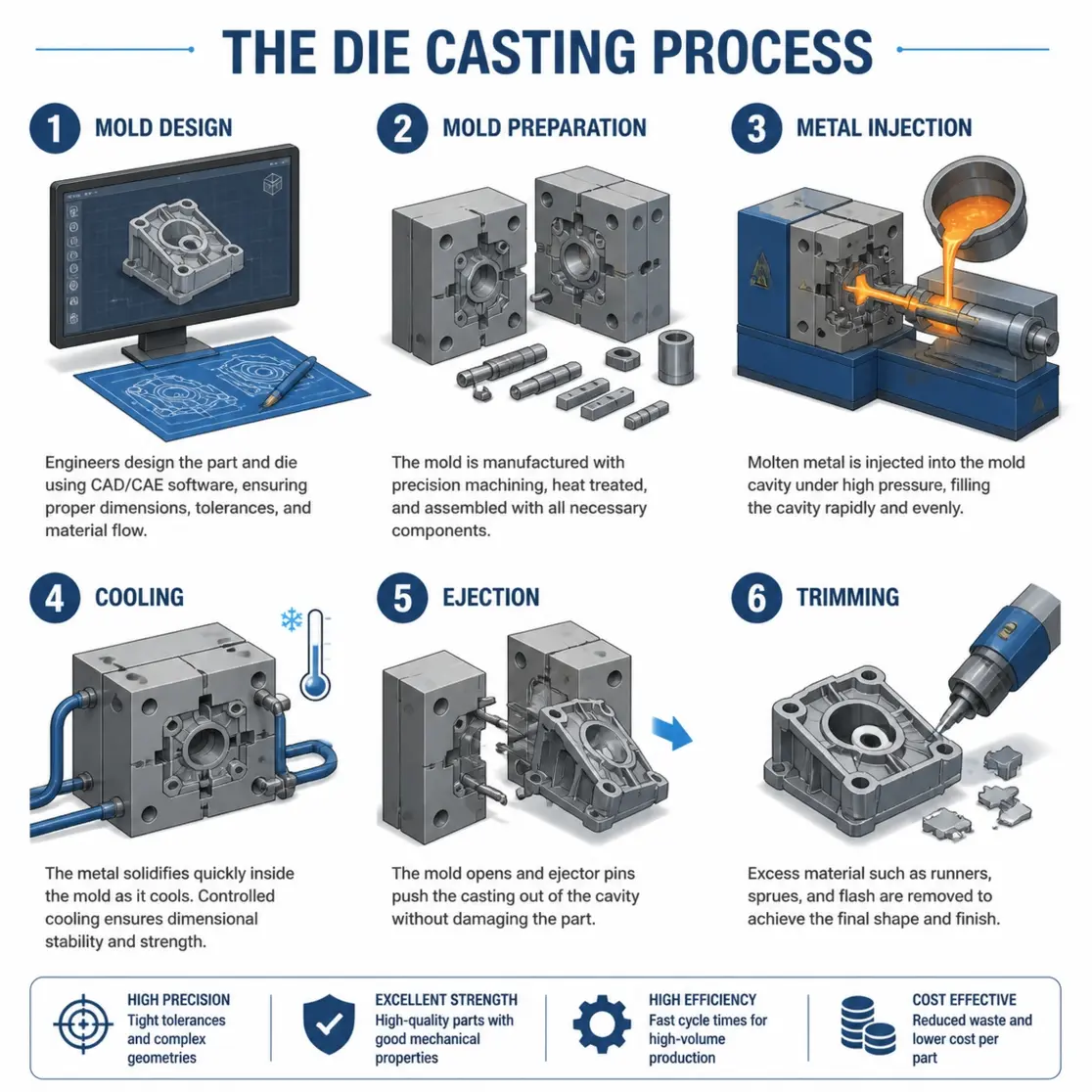
The die casting process has six main steps: die design and build, die preparation and lubrication, metal melting and injection, cooling and solidification, ejection, and trimming and finishing. Each step takes seconds to minutes, and the full cycle for a typical aluminum part runs about 30 to 90 seconds.
- Die Design and Build — Engineers design the steel mold and machine it to spec.
- Die Preparation and Lubrication — The mold is cleaned, heated, and sprayed with release agent.
- Metal Melting and Injection — Molten metal is forced into the die under pressure.
- Cooling and Solidification — The metal hardens inside the mold.
- Ejection — The die opens and ejector pins push the part out.
- Trimming and Finishing — Excess metal is removed and the part is finished.
Step 1: Die Design and Build
Everything starts with the die itself. Engineers design the mold in CAD software, simulate metal flow with CFD (computational fluid dynamics - software that predicts how liquid metal will move through the mold), and then machine the die from hardened tool steel.
A typical die has two halves: a fixed half that stays attached to the injection system, and a moving half that opens to release the finished part. Inside, you'll find the cavity (the negative shape of your part), runners (channels for the metal to flow through), gates (the entry points into the cavity), and ejector pins (the rods that push the part out).
Die build is the most expensive part of the project. A single aluminum production die can cost anywhere from $15,000 to $150,000 depending on size and complexity. That's why die casting only makes sense for medium to high volumes you need enough parts to spread the tooling cost across making it cost $$ per part vs $$$$$.
Step 2: Die Preparation and Lubrication
Before each cycle, the die is cleaned and sprayed with a release agent (a lubricant that stops the metal from sticking). The die is also pre-heated. A cold die would shock the molten metal and cause defects, so the steel is brought up to a working temperature usually 150°C to 300°C (300°F to 570°F) depending on the alloy.
The two halves then close together and a clamping force locks them shut. Clamping force depends on part size small zinc parts may need 25 tons, while large aluminum structural castings can require 800 tons or more. Meco's machines handle 25 to 168 tons for zinc and 180 to 800 tons for aluminum.
Step 3: Metal Melting and Injection
The chosen alloy is melted in a furnace at a temperature well above its melting point. Aluminum melts around 660°C (1,220°F), zinc around 420°C (790°F), and magnesium around 650°C (1,200°F). The molten metal is then injected into the die.
Injection is where pressure does its work. In high pressure die casting, the metal enters the cavity at 10,000 to 26,000 PSI (about 700 to 1,800 bar). That kind of force pushes liquid metal into thin walls and tiny features in milliseconds. According to Fictiv's HPDC technical reference, fill times for typical parts run between 10 and 100 milliseconds faster than you can blink.
Step 4: Cooling and Solidification
Once the cavity is full, pressure is held while the part cools and solidifies. Cooling is controlled with water channels built into the die. Too fast and the metal can shrink unevenly, causing warpage. Too slow and you waste cycle time.
This step usually takes 2 to 30 seconds for most parts. Thicker walls take longer; thin walls cool almost instantly.
Step 5: Ejection
After cooling, the moving half of the die pulls away and ejector pins push the part out. The casting still has the runners, gates, and any flash (thin webs of extra metal that squeezed between the die halves) attached to it.
On automated lines, a robot arm grabs the part as it ejects and drops it onto a conveyor. Manual cells have an operator do the same job by hand.
Step 6: Trimming and Finishing
The final step removes the runners, gates, and flash. This is done by a trim press (basically a punch that cuts the extras away) or by manual deburring. The leftover metal goes back into the furnace and gets reused die casting wastes very little material.
From here, parts can move into secondary operations: CNC machining for tight-tolerance features, surface finishing like anodizing or powder coating, or assembly into a larger product. Meco runs all of these in-house, so a part can go from raw aluminum ingot to surface-finished, assembled, packaged, and shipped without ever leaving our facility.
Pro Tip: DFM Catches 80% of Problems Before They Happen
In our experience, the single biggest cost driver in a die casting project isn't the metal or the labor — it's a die that needs rework after the first sample. Catching wall thickness issues, draft angle problems, and undercuts during a Design for Manufacturability (DFM) review can save weeks of tooling rework and tens of thousands of dollars. Always request a DFM review before you cut steel.
Types of Die Casting: Hot Chamber, Cold Chamber, and Pressure Variants
There isn't just one die casting process — there are several. The two big families are split by how the metal gets melted (hot chamber vs. cold chamber), and within those, you can vary the injection pressure (high pressure, low pressure, gravity, vacuum). Here's how they break down.
Hot Chamber Die Casting
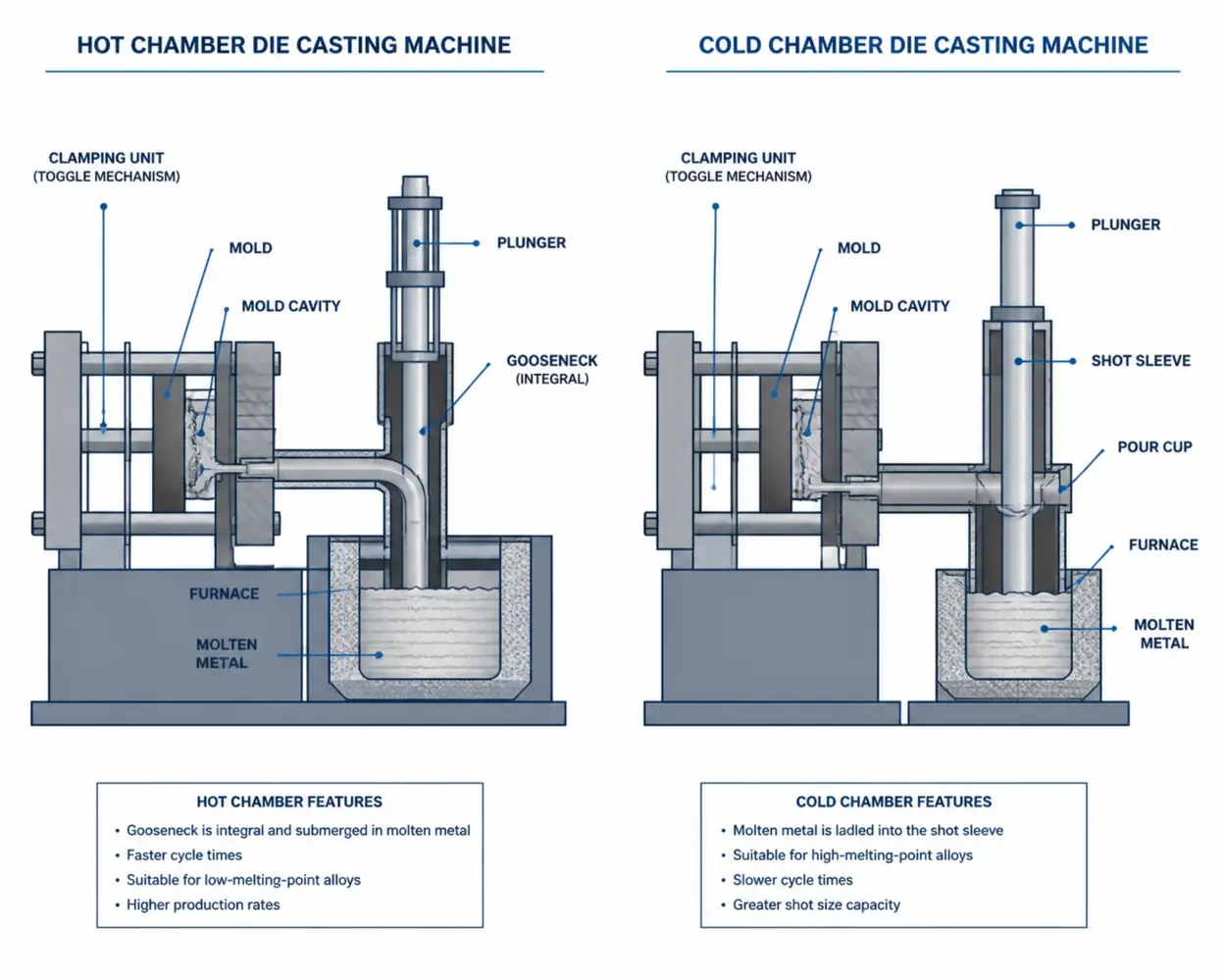
In hot chamber die casting, the furnace is built right into the casting machine. A plunger pushes molten metal through a "gooseneck" — a curved tube that sits in the molten pool and into the die. Because the metal stays inside the machine, cycles are fast: about 15 to 20 minutes per setup, with shot-to-shot times under a few seconds.
The catch? The hot chamber can't handle very high temperatures without damaging the gooseneck. So this method is reserved for low-melting-point alloys: zinc (Zamak 2, 3, 5, 27), magnesium (some grades), tin, and lead. If you're making small zinc parts in big volumes, think locks, gears, decorative hardware, hot chamber is usually the answer.
Cold Chamber Die Casting
Cold chamber die casting separates the furnace from the machine. Metal is melted in a standalone furnace, ladled (scooped) into a separate injection sleeve, and then a hydraulic piston rams it into the die. The cycle is slower because each shot needs a fresh ladle of metal, but the machine can handle alloys that would destroy a hot chamber gooseneck.
This is the method for aluminum, brass, copper, and high-melting-point magnesium alloys. Most aluminum die castings, including the vast majority of automotive structural parts, come from cold chamber machines.
High Pressure Die Casting (HPDC)
HPDC is what most people picture when they hear "die casting." It uses very high injection pressure (10,000–26,000 PSI) to fill the die in milliseconds. The result is thin walls, sharp details, smooth surfaces, and very fast cycle times. Both hot and cold chamber machines can be set up for HPDC.
The downside: that violent fill can trap air, which leads to porosity (tiny gas bubbles) inside the part. Vacuum-assist and clever gating reduce the risk, but it's still a real concern for parts that need to be welded or pressure-tested later.
Low Pressure Die Casting (LPDC)
LPDC takes the opposite approach. Instead of slamming metal into the mold, it gently pushes it upward from a sealed furnace below the die using pressurized air (about 7 to 100 PSI). The fill is slow and smooth, which means much less air entrapment and much denser parts.
LPDC is the standard for safety-critical aluminum parts like wheels and suspension components. It's slower than HPDC but produces stronger, more leak-tight parts. Meco offers low pressure casting for exactly these kinds of demanding applications.
Gravity Die Casting (Permanent Mold)
No pressure at all, just gravity. Molten metal is poured into the die from above and allowed to flow into the cavity under its own weight. It's slower and less detailed than HPDC, but the parts are very dense and have excellent mechanical properties.
This method is great for medium-volume aluminum parts where strength matters more than thin walls or fine features. See Meco's gravity casting capabilities for typical specs and materials.
Vacuum Die Casting
Vacuum die casting is an upgrade to HPDC. The air is sucked out of the die cavity before the metal is injected, which dramatically reduces porosity. The trade-off is added equipment cost and slightly longer cycle times — but for parts that need to be heat-treated, welded, or pressure-tested, the quality boost is worth it.
| Type | Pressure Range | Best For | Typical Metals | Trade-off |
|---|---|---|---|---|
| Hot Chamber HPDC | 10,000–26,000 PSI | High-volume small parts | Zinc, magnesium, lead | Can't handle high-temp alloys |
| Cold Chamber HPDC | 10,000–26,000 PSI | Aluminum & higher-temp alloys | Aluminum, brass, copper, magnesium | Slower cycle than hot chamber |
| Low Pressure (LPDC) | 7–100 PSI | Wheels, suspension, safety parts | Aluminum (A356) | Slower cycle, larger footprint |
| Gravity Casting | Gravity only | Medium-volume strong parts | Aluminum (A356, ZL101) | Lower detail than HPDC |
| Vacuum Die Casting | HPDC + vacuum | Weldable, heat-treatable parts | Aluminum, magnesium | Higher tooling and equipment cost |
What Materials Are Used in Die Casting?
The vast majority of die-cast parts are made from one of four metal families: aluminum, zinc, magnesium, or copper alloys. Each has its own strengths, weight, and price point.
Steel and iron can technically be cast but not die-cast. Their melting points are too high (above 1,400°C) for steel dies to survive repeated cycles. If you need a ferrous part, look at investment casting or sand casting instead.
| Material | Common Alloys | Key Properties | Typical Applications |
|---|---|---|---|
| Aluminum | ADC12, A360, A380, AlSi12, AlSi10Mg | Lightweight, corrosion-resistant, good strength, thermally conductive | Automotive housings, gearbox cases, heat sinks, brackets, EV battery enclosures |
| Zinc | Zamak 2, 3, 5, 27 | High precision, fine detail, low melting point, dense | Locks, decorative hardware, small gears, electrical connectors |
| Magnesium | AZ91D, AM50, AS41 | Ultra-lightweight (33% lighter than aluminum), good strength-to-weight | Laptop frames, camera bodies, automotive structural parts |
| Copper / Brass | Brass alloys | Conductive, corrosion-resistant, antimicrobial | Plumbing fittings, electrical components |
Aluminum is by far the most common. According to Grand View Research, aluminum accounted for the largest share of the global die casting market in 2024, and the segment is projected to keep growing through 2030 thanks to electric vehicle demand for lightweight structural castings. Meco specializes in aluminum, zinc, and magnesium die casting per ASTM B85.
Die Casting Tolerances and Precision
Die casting is one of the most accurate casting processes available, but it's not a substitute for CNC machining when you need micron-level precision. Tolerances depend on the alloy, part size, and whether you specify NADCA's "Standard" or "Precision" tolerance grade.
The North American Die Casting Association (NADCA) publishes the industry-standard tolerance tables. Here's the simplified version for linear dimensions:
| Tolerance Grade | First Inch (Basic) | Each Additional Inch | When to Use |
|---|---|---|---|
| NADCA Standard | ±0.010" (±0.25 mm) | ±0.001" (±0.025 mm) | Most general applications |
| NADCA Precision | ±0.002" (±0.05 mm) | ±0.001" (±0.025 mm) | Tight-fit features, mating surfaces |
Draft angles are also part of the spec. As a rule of thumb, inside walls need 1–2° of draft, outside walls 0.5–1°, and cored holes about 2° per side. Without draft, the part won't release cleanly from the die. For features that need tighter tolerances than die casting can deliver, the standard move is to post-machine those features with CNC machining — often to ±0.01 mm or better.
Quick Reference: Tolerance Reality Check
If your drawing calls for tolerances tighter than ±0.05 mm on any feature, expect that feature to need post-cast CNC machining. That's not a flaw of die casting, it's just how the physics of shrinkage and cooling work. Smart designers spec "as-cast" tolerances on most features and reserve tight tolerances for bores, threads, and mating surfaces.
Die Casting vs. Sand Casting vs. CNC Machining: Which Should You Choose?
Die casting isn't always the right answer. Here's a side-by-side look at how it stacks up against the two most common alternatives.
| Factor | Die Casting | Sand Casting | CNC Machining |
|---|---|---|---|
| Tooling Cost | High ($15K–$150K+) | Low ($500–$5K) | None (programming only) |
| Cost Per Part (at volume) | Very low | Medium | High |
| Minimum Economical Volume | ~1,000+ parts | ~10+ parts | 1+ parts |
| Surface Finish | Excellent (as-cast) | Rough (needs machining) | Excellent |
| Tolerance | ±0.05 mm (NADCA Precision) | ±1.5 mm | ±0.01 mm |
| Best For | High-volume Al/Zn/Mg parts | Large, low-volume iron/steel parts | Prototypes, ferrous metals, precision |
The honest answer? If you need fewer than ~1,000 metal parts, CNC machining is usually cheaper. Between 1,000 and 10,000 parts, the math gets interesting — it depends on geometry, alloy, and finishing requirements. Above 10,000 parts of an aluminum, zinc, or magnesium design, die casting almost always wins on total cost. For background on the alternatives, see our guides on what sand casting is and what gravity casting is.
Advantages and Disadvantages of Die Casting
Die casting is powerful, but it comes with real trade-offs. Here's the unvarnished version.
Advantages
- Fast cycle times. A small zinc part can be cast every 2–3 seconds. Aluminum parts run in 30–90 seconds. That's how high-volume runs become economical.
- Excellent dimensional accuracy. NADCA Precision tolerances of ±0.05 mm beat almost every other casting process.
- Smooth as-cast surfaces. Ra 1–2 μm is typical, which often means no machining needed on cosmetic surfaces.
- Complex geometries. Thin walls (as low as 0.5 mm for zinc), tight ribs, undercuts with slides, and integral features all work.
- Low cost per part at volume. Once tooling is paid off, parts can cost under $1 each.
- High material yield. Runners and flash are remelted, so material waste is minimal.
- Long die life. A well-built aluminum die lasts 100,000+ cycles. Zinc dies can run over a million.
Disadvantages
- High upfront tooling cost. $15,000 to $150,000+ for a production die. Not viable for prototypes or short runs.
- Limited to non-ferrous metals. No steel, no cast iron. If you need a ferrous part, look elsewhere.
- Porosity risk. The high-speed fill can trap air. This limits welding and pressure-tight applications unless vacuum assist is used.
- Part size limits. Most die-cast parts weigh under 30 kg. Larger castings exist but get expensive fast.
- Long lead time for new tooling. Designing, building, and validating a new die typically takes 6–12 weeks.
Common Applications and Industries
Die-cast parts are everywhere. Look around any vehicle, appliance, or electronic device and you'll find them.
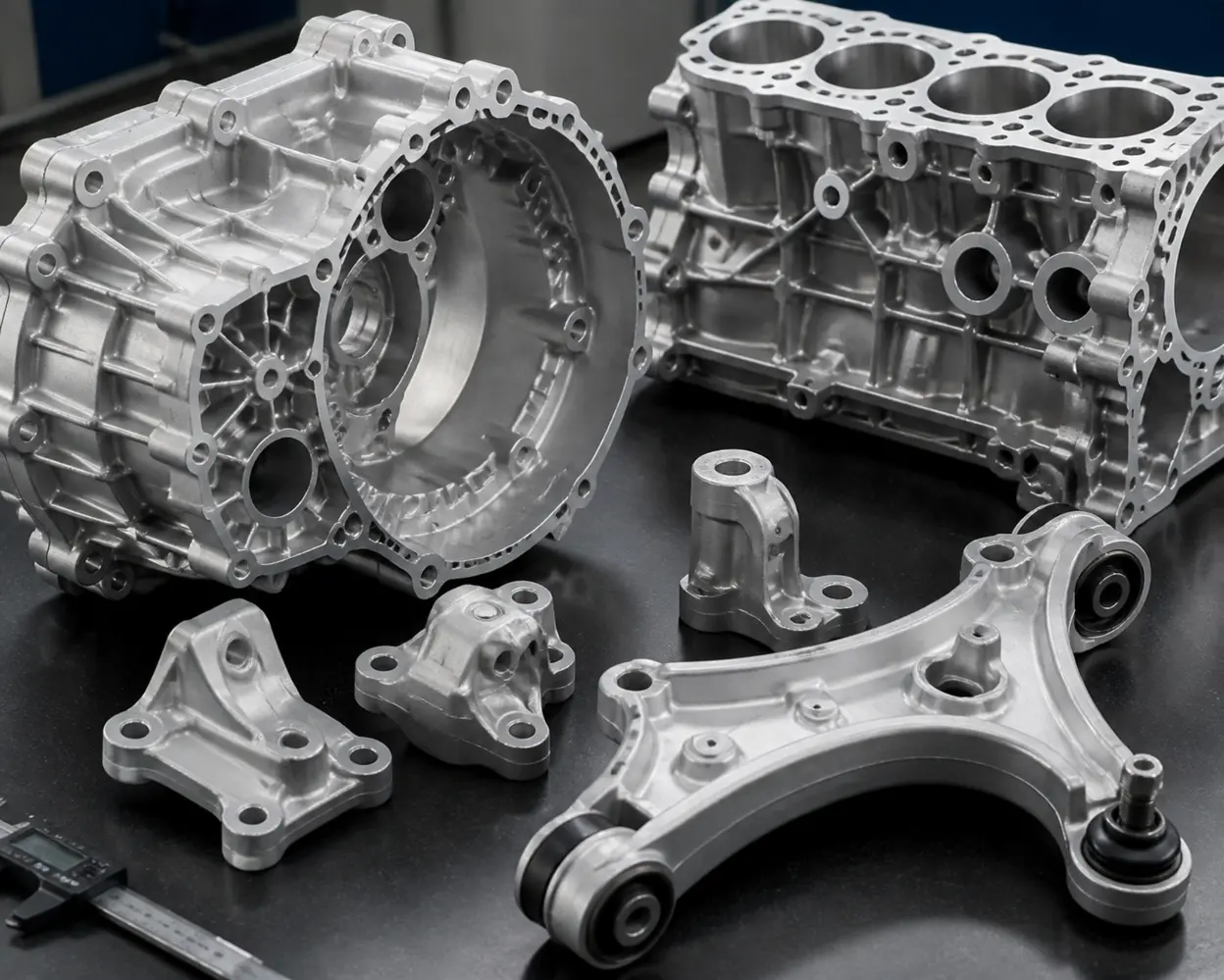
- Automotive: Engine blocks, gearbox housings, transmission cases, EV battery trays, brackets, oil pans. Die casting in the automotive industry has exploded with electric vehicles — Tesla's "Gigacasting" approach replaced 70+ stamped parts with a single rear underbody casting.
- Consumer electronics: Laptop chassis, smartphone frames, camera bodies, set-top box housings.
- Aerospace: Brackets, housings, instrument bezels (non-critical structural parts).
- Home appliances: Washing machine motor housings, fan brackets, range hood components.
- Lighting: Streetlight housings, LED heat sinks, decorative fixtures.
- Industrial: Pump bodies, valve housings, gear cases, hydraulic blocks.
- Telecommunications: 5G base station housings, network equipment chassis, RF shielding.
How Much Does Die Casting Cost?
Die casting cost breaks into two buckets: tooling (one-time) and per-part (recurring).
Tooling for a production die typically runs $15,000 to $150,000. Small simple zinc dies sit at the low end. Large multi-cavity aluminum dies with slides and complex cooling sit at the high end. Prototype dies built from softer aluminum tool steel can come in cheaper ($5,000–$15,000) but won't survive a full production run.
Per-part cost at volume usually lands between $0.50 and $5.00 for typical aluminum or zinc parts under 1 kg. The exact number depends on alloy price, part weight, cycle time, secondary operations, and finishing. Larger parts and tighter tolerances push the number up.
The real economic question isn't "what does die casting cost?" — it's "at what volume does die casting beat the alternatives?" For most aluminum parts, the break-even versus CNC machining sits somewhere between 1,000 and 5,000 pieces. Below that, CNC. Above that, die casting.
Choosing a Die Casting Partner
The die casting process itself is mature and well understood — but the quality of your finished parts comes down to your partner. A good die caster catches design issues during quoting, builds a die that survives a full production run, and runs a quality system that catches problems before they ship.
Here's what to look for:
- Quality certification. IATF 16949:2016 is the gold standard. It's built on top of ISO 9001:2015 and adds automotive-grade controls for APQP, PPAP, SPC, and FAIR. A supplier with IATF certification applies that rigor to every program, not just automotive.
- In-house finishing and machining. If your part needs CNC features, surface treatments, or assembly, having all of that under one roof eliminates handoff delays and quality gaps.
- DFM support. Your partner should review your design before quoting and flag issues — wall thickness, draft angles, ejector pin locations, gating strategy.
- Tonnage range. Make sure their machines fit your part size. Tiny parts need tiny machines; large structural castings need 800-ton clamping force or more.
- Alloy depth. A good die caster handles multiple alloys across aluminum, zinc, and magnesium families.
Meco's die casting services cover zinc (25–168 tons, 1g to 1,500g parts) and aluminum (180–800 tons, 1g to 5,000g parts) per ASTM B85 and NADCA tolerance standards. We're IATF 16949:2016 certified and integrate die casting with in-house CNC machining, surface finishing, and assembly — so your part can go from concept to packaged finished goods through one accountable partner. Learn more about our end-to-end approach in our turnkey manufacturing overview.
Deciding between metal and plastic for your part? Our guide to die casting vs injection molding compares cost, strength, tolerances, and lead times side by side.
Frequently Asked Questions About the Die Casting Process
What is the die casting process in simple terms?
Die casting is a manufacturing process that pushes molten metal into a reusable steel mold (called a die) at high pressure, lets it cool, and then ejects the finished part. The same die is used over and over to produce thousands or millions of identical metal parts. It's most commonly used with aluminum, zinc, and magnesium alloys to make complex parts with smooth surfaces and tight tolerances.
What are the 6 steps of die casting?
The six steps of die casting are: (1) die design and build, (2) die preparation and lubrication, (3) metal melting and injection, (4) cooling and solidification, (5) ejection, and (6) trimming and finishing. A typical aluminum part cycles through all six steps in about 30 to 90 seconds. Zinc parts can cycle in as little as 2 to 3 seconds.
What is the difference between hot chamber and cold chamber die casting?
Hot chamber die casting has the furnace built into the casting machine, with a plunger that pushes molten metal directly into the die through a gooseneck. It's fast but only works with low-melting-point alloys like zinc and some magnesium. Cold chamber die casting uses a separate furnace and ladles each shot into the machine. It's slower but handles higher-melting-point alloys like aluminum, brass, and most magnesium grades.
What metals can be die cast?
Die casting works with non-ferrous metals — those that don't contain iron. The main families are aluminum (ADC12, A380, AlSi10Mg), zinc (Zamak 2, 3, 5, 27), magnesium (AZ91D, AM50, AS41), and copper-based alloys including brass. Steel and cast iron cannot be die cast because their melting points are too high for the steel dies to survive repeated cycles.
What tolerances can die casting achieve?
NADCA Standard tolerances allow ±0.010" (±0.25 mm) for the first inch and ±0.001" (±0.025 mm) for each additional inch. NADCA Precision tolerances tighten the first inch to ±0.002" (±0.05 mm). For features that need tighter than ±0.05 mm — such as bearing bores, mating surfaces, and tapped holes — post-cast CNC machining is typically used to bring tolerances to ±0.01 mm or better.
How is die casting different from sand casting?
Die casting uses a reusable steel mold and injects metal at high pressure, producing thousands of identical parts with smooth surfaces and tight tolerances. Sand casting uses a single-use sand mold and pours metal under gravity, producing larger, rougher parts at much lower tooling cost. Die casting wins on speed, precision, and per-part cost at high volume. Sand casting wins on low volumes, large part sizes, and ferrous metals like steel and iron.
What are the main advantages and disadvantages of die casting?
The main advantages are fast cycle times, excellent dimensional accuracy, smooth as-cast surfaces, the ability to produce complex thin-walled geometries, and very low per-part cost at high volume. The main disadvantages are high upfront tooling cost ($15,000 to $150,000+), the limitation to non-ferrous metals, the risk of internal porosity from the high-speed fill, part size limits (typically under 30 kg), and tooling lead times of 6 to 12 weeks.
How much does die casting cost per part?
At production volume, typical aluminum or zinc die-cast parts under 1 kg cost between $0.50 and $5.00 per part. Cost depends on alloy price, part weight, cycle time, secondary operations like CNC machining, and finishing. Tooling is a separate one-time cost of $15,000 to $150,000 or more depending on die size and complexity. Die casting usually beats CNC machining on total cost above 1,000 to 5,000 parts, depending on geometry.
What industries use die casting the most?
The automotive industry is by far the largest user of die casting, especially for engine, transmission, and EV battery components. Other major users include consumer electronics (laptop and smartphone frames), home appliances (motor housings, brackets), aerospace (non-critical brackets and housings), lighting (LED heat sinks, fixtures), industrial equipment (pump and valve bodies), and telecommunications (5G base station housings).
Get Your Die Casting Project Built Right the First Time
Coordinating separate vendors for die casting, machining, finishing, and assembly creates delays, quality gaps, and avoidable cost. Meco runs the full die casting workflow under one roof — from die design and DFM review through finished, packaged parts delivered to your warehouse.
With 30+ years of turnkey manufacturing experience and IATF 16949:2016 certified facilities, Meco is built for OEM die casting programs where precision, traceability, and on-time delivery matter.
- Full Alloy Range: Aluminum (ADC12, A360, A380, AlSi10Mg), zinc (Zamak 2, 3, 5, 27), and magnesium (AZ91D, AM50, AS41) per ASTM B85.
- Tonnage Capacity: Zinc 25–168T (1g–1,500g parts), aluminum 180–800T (1g–5,000g parts).
- NADCA Tolerances: Standard and Precision tolerance grades, with optional post-cast CNC machining to ±0.01 mm.
- 40+ In-House Processes: Die casting integrated with CNC machining, surface finishing, heat treatment, and mechanical assembly.
- IATF 16949:2016 Certified: 99.99% quality rate. 99.8% on-time delivery. DFM feedback with every quote.
Send us your CAD files and our engineering team will return a quote with DFM feedback within 24 hours.
Request a Quote Today