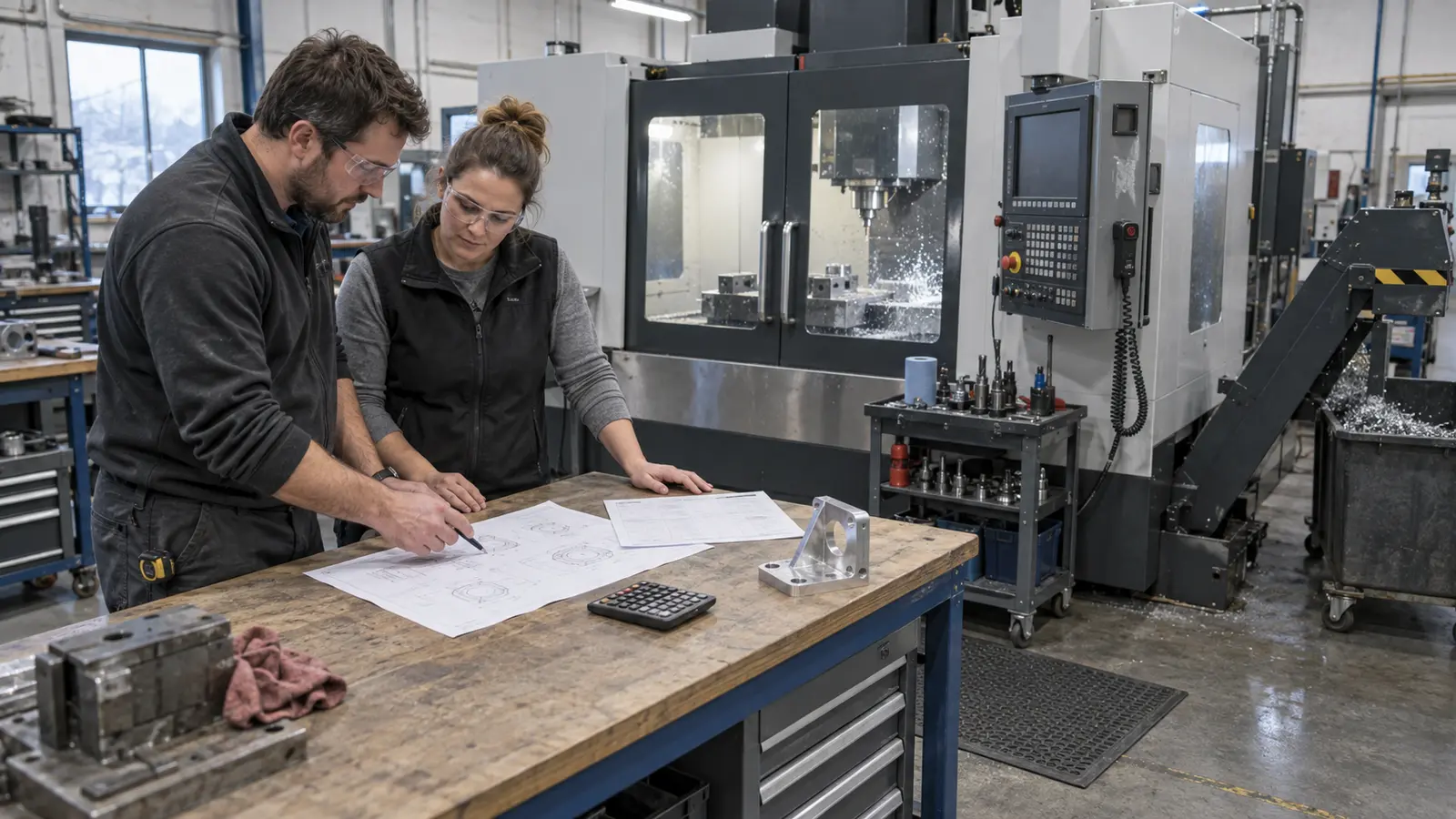
CNC machining cost is the sum of material, machine time, setup, finishing, inspection and logistics. A simple part in a repeat batch may cost tens of dollars, while a complex tight-tolerance prototype can cost hundreds.
The most useful number is not the hourly machine rate. It is the total landed cost per conforming part at the required quantity, quality level and delivery date.
All ranges below are planning benchmarks, not quotations. A production quote requires the CAD model, drawing, material, tolerance, finish and volume.
You have a released CAD model and the geometry works. The next question is what the part will cost to machine. The answer depends on more than the metal removed from the billet.
A CNC quote combines fixed costs, such as CAM programming and fixture preparation, with variable costs, such as stock, cycle time, finishing and inspection. Order quantity decides how those fixed costs are distributed.
This guide focuses on the cost of buying machined parts. For the ownership cost of the equipment itself, see the CNC machine cost guide. For a comparison across casting, forging, stamping and machining, use the metal part cost guide.
Key takeaways
- Hourly rate matters, but setup, quantity and inspection often change the per-part result more.
- Standard materials, practical tolerances and fewer setups usually lower cost.
- A higher-axis machine can cost more per hour but still reduce total cost by removing extra fixturing.
- Offshore comparisons should use landed cost, not shop rate alone.
- The fastest route to an accurate number is a complete quote package with CAD, drawing, material, finish and annual volume.
What Does CNC Machining Cost in 2026?
CNC machining is commonly priced through an hourly machine rate and a per-part quote. The hourly rate explains machine capacity; the per-part price combines all job-specific inputs and is normally the better number for budgeting.
A basic 3-axis job generally carries a lower hourly rate than 4-axis, 5-axis or turn-mill work. However, the lower rate is not automatically cheaper. If a 3-axis route needs several setups while a 5-axis route completes the part in one controlled operation, the more capable machine may reduce labour, fixture cost and variation.
| Machine type | North America planning range | Asia planning range | Typical fit |
|---|---|---|---|
| 3-axis CNC mill | $30 to $75 per hour | $15 to $40 per hour | Prismatic parts, pockets and drilled features |
| 4-axis CNC mill | $75 to $130 per hour | $30 to $60 per hour | Indexed features around one rotary axis |
| 5-axis CNC mill | $100 to $200+ per hour | $40 to $80 per hour | Compound angles and complex surfaces |
| CNC turning centre | $50 to $110 per hour | $20 to $50 per hour | Shafts, bushings and other rotational parts |
| Turn-mill centre | $120 to $200+ per hour | $50 to $90 per hour | Rotational parts with milled features |
Use ranges as a screening tool
Published rate ranges help compare process routes, but they cannot replace a drawing-based quote. Two parts of similar size can have very different costs because of tolerance, tool access, inspection and setup count.
Six Factors That Drive CNC Machining Cost
The six main drivers are machine selection, material, geometry and tolerance, setup, finishing, and quantity. Each one changes either the fixed cost of starting the job or the variable cost of producing every part.
1. Machine type and axis configuration
A 3-axis CNC machine is efficient for prismatic parts, holes, pockets and accessible surfaces. Parts with features around several faces may need indexed 4-axis machining or simultaneous 5-axis machining.
Choose the process by total operations, not by hourly rate in isolation. Fewer setups can shorten the route and protect positional accuracy between features.
2. Material and machinability
Material affects the stock price, cutting speed, tool life, coolant strategy and scrap risk. Aluminum 6061 is often economical because it is widely available and machines quickly. Stainless steel and titanium usually need slower cutting conditions and more tool control.
| Material | Machinability | Main cost effect | Relative planning level |
|---|---|---|---|
| Aluminum 6061 | Excellent | Fast cutting and generally low tool wear | Baseline |
| Carbon steel | Good | Lower stock price but slower cutting than aluminum | Moderate |
| Stainless steel 304 or 316 | Moderate to difficult | Lower speeds, higher cutting force and more tool wear | Higher |
| Brass C360 | Excellent | Fast machining but higher stock cost | Low to moderate |
| Titanium Grade 5 | Difficult | Heat control, slower feeds and high tool wear | High |
| PEEK | Moderate | High material cost and thermal control requirements | High, material-driven |
3. Geometry, tolerance and setup count
Deep pockets, small internal radii, thin walls, long-reach tools and inaccessible features extend cycle time. A tight tolerance applied to one functional feature may be reasonable; applying it to the entire drawing can add inspection and process-control cost without improving performance.
Meco's custom CNC machining capability supports work from prototypes through production, but the economical route still begins with identifying which dimensions are function-critical.
4. Programming, fixtures and first-piece approval
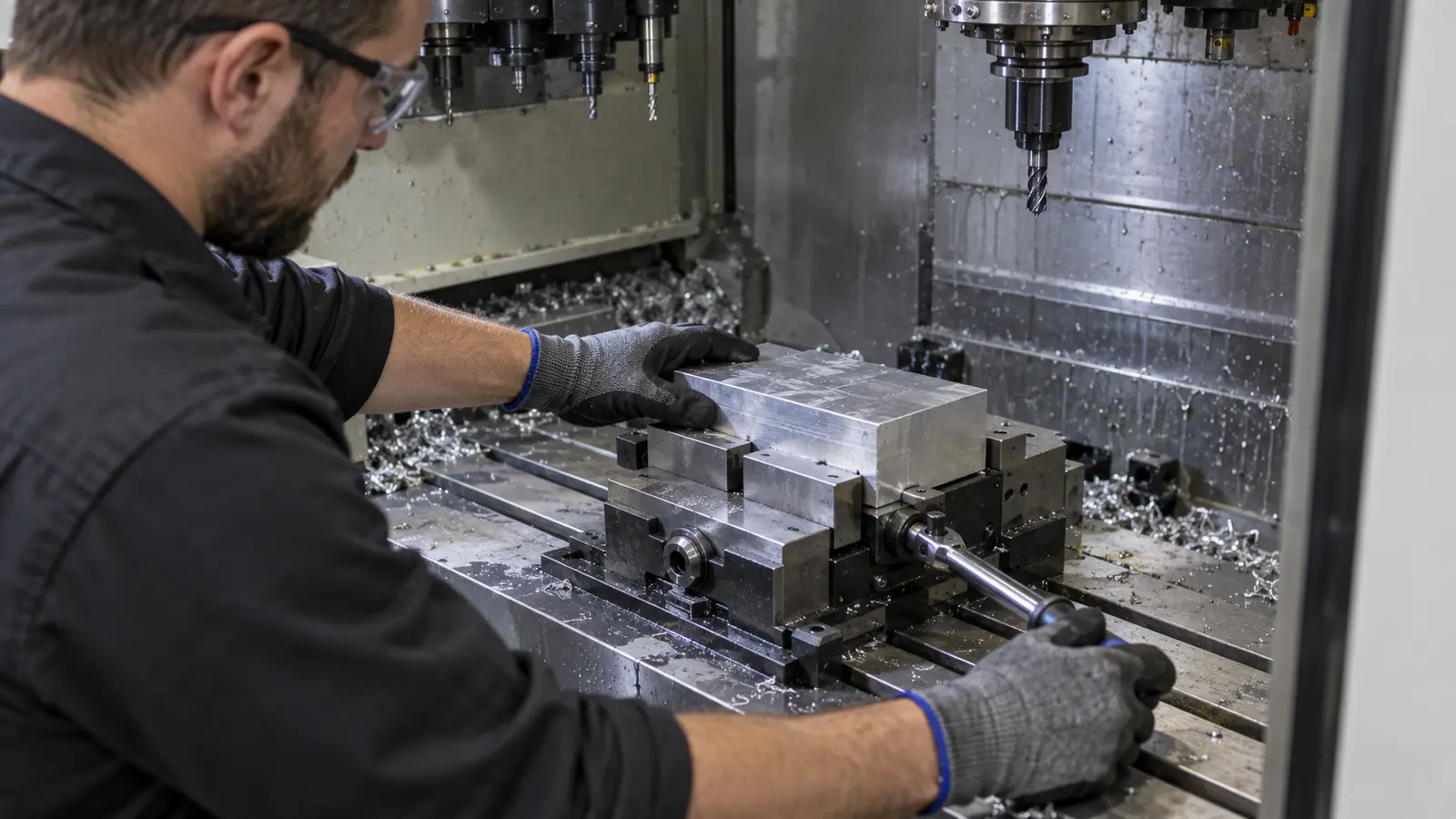
Before production starts, the shop creates CAM toolpaths, selects tools, prepares workholding, sets datums and verifies the first part. These steps are largely fixed for the batch, so they have a large per-part effect at low quantity and a smaller effect as volume increases.
5. Finishing and inspection
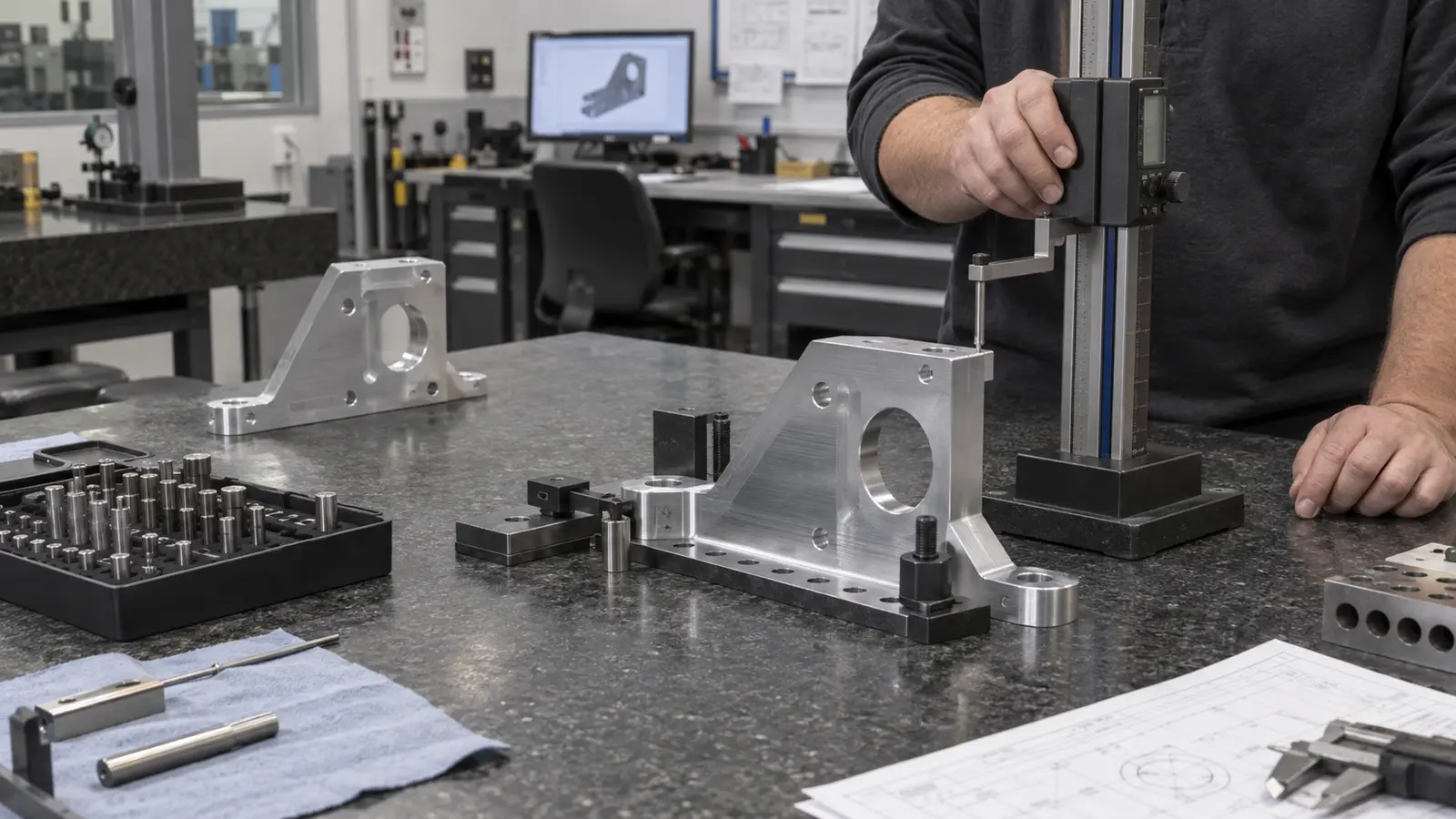
Anodizing, plating, powder coating, heat treatment, deburring and cleaning are separate operations. Inspection cost depends on the number of critical dimensions, sampling plan, gauge method and required records such as FAI, PPAP or material certificates. Review surface finishing options early because masking, cosmetic requirements and coating thickness can change the machining plan.
6. Quantity, packaging and logistics
Quantity spreads the setup cost and may improve material purchasing and cycle consistency. It also changes packaging, inventory and freight. A useful quote separates repeatable unit cost from one-time engineering or tooling charges.
How to Calculate CNC Machining Cost
A practical model is material plus machine time plus allocated setup plus finishing plus inspection. Freight, duties, packaging and commercial margin must then be added to compare the true landed cost.
Planning formula
Total part cost = material + machine time + setup divided by batch size + finishing + inspection + logistics.
Consider a 6061 aluminum bracket measuring about 120 × 80 × 30 mm. It has a machined pocket, two threaded holes, a ±0.05 mm drawing tolerance and a clear anodized finish.
| Cost component | Illustrative value | Basis |
|---|---|---|
| Raw material per part | $3.50 | 6061 aluminum billet including expected waste |
| Machining time | 18 minutes | 3-axis cycle including normal tool changes |
| Machine rate | $65 per hour | Illustrative North American planning rate |
| Machining per part | $19.50 | 18 minutes multiplied by $65 per hour |
| Setup and programming | $220 one time | CAM, fixturing and first-piece verification |
| Finishing and deburring | $8.50 per part | Illustrative clear anodize and edge break |
| Inspection | $3.00 per part | Standard dimensional check |
| Quantity | Setup per part | Other variable cost | Illustrative total per part |
|---|---|---|---|
| 1 | $220.00 | $34.50 | $254.50 |
| 10 | $22.00 | $34.50 | $56.50 |
| 100 | $2.20 | $31.70 | $33.90 |
| 500 | $0.44 | $28.80 | $29.24 |
The sharpest change occurs between one part and ten because the same setup is divided across more units. The curve then flattens. A larger order can still reduce cost through material purchasing, stable tooling and repeat processing, but savings are project-specific.
Regional Rates and Landed Cost
Regional machine rates are only the starting point. Freight, duties, lead time, communication, inspection and the cost of resolving a nonconforming batch can narrow or reverse the apparent price gap.
| Cost factor | North America | China or Thailand | Europe |
|---|---|---|---|
| Machine rate | Usually higher | Usually lower | Usually mid to high |
| Freight | Shorter domestic routes | International air or ocean freight | International freight to North America |
| Duties and tariffs | Limited for domestic supply | Depends on origin, HTS code and material | Depends on origin and trade treatment |
| Communication | Same or nearby time zones | Time-zone planning required | Moderate time-zone difference |
| Best comparison | Unit price plus local logistics | Full landed cost plus quality control | Full landed cost plus lead time |
Meco combines production in China and Thailand with North American support. That structure allows sourcing teams to compare route, capacity and country of origin within one manufacturing programme instead of treating geography as a standalone price decision.
How to Reduce CNC Machining Cost
The strongest cost reductions usually come from design and process choices made before the purchase order. The goal is to remove unnecessary operations while protecting the features that control fit, sealing, motion and service life.
Use tight tolerances selectively
Identify the dimensions that drive function and relax noncritical features to an appropriate general tolerance. This reduces slow finishing passes and unnecessary inspection.
Reduce setups and special tools
Orient features so they can be reached in fewer operations. Use standard hole sizes, thread forms, stock thicknesses and corner radii where the design allows them.
Choose material for function and machinability
Do not specify a premium alloy by habit. Compare strength, corrosion, temperature and finishing needs against machinability and availability. Meco's materials resource can help frame that discussion.
Match quantity to demand
Increasing the batch reduces allocated setup cost, but it can add inventory and obsolescence risk. Compare the unit-price saving with carrying cost and forecast confidence.
Combine machining, finishing and assembly
Separate suppliers create freight, queues, incoming inspection and responsibility gaps. A partner that can machine, finish, inspect and assemble can simplify the route and give one team control of the final specification.
Want a cost-focused DFM review? Send the CAD model, drawing and target volume. Meco will review process choice, tolerances, workholding and finishing before quoting.
Get DFM Feedback on Your DesignWhen CNC Is Not the Lowest-Cost Process
CNC machining is strongest for low to medium volume, precise features and designs that may still change. At higher volume, near-net-shape processes can reduce material removal and cycle time.
For plastic parts with stable geometry and sufficient volume, injection molding may justify its tooling investment. For complex metal shapes, die casting, investment casting or forging followed by machining of critical surfaces may lower total cost.
For prototypes, metal 3D printing or plastic 3D printing may avoid fixtures and support fast design changes. The right comparison is the full process route, including tooling, secondary machining, inspection and expected lifetime volume.
How to Get an Accurate CNC Quote
A complete technical package gives the supplier enough information to choose the process and price the risk. Missing tolerances, finishes or documentation requirements force assumptions that can make a quote either unreliable or unnecessarily conservative.
- 3D CAD in STEP or IGES format
- 2D drawing with critical tolerances and datums
- Material grade and any certification requirement
- Surface finish and cosmetic requirements
- Prototype quantity, production batch and annual volume
- Inspection, FAI, PPAP and traceability requirements
- Required delivery date and shipping destination
A useful supplier response should identify assumptions, one-time charges, the expected process route and any features that create cost or manufacturing risk. For broader supplier selection criteria, see how to choose a CNC machining partner.
Total Cost of Ownership
The lowest unit price is not always the lowest procurement cost. Rework, supplier handoffs, long replenishment time, excess safety stock and incomplete documentation can outweigh a small difference in machine rate.
Compare quotations on the same basis: conforming part, required documentation, delivered location and agreed lead time. If machining, finishing and assembly are split across suppliers, include each shipment, inspection and coordination step. Meco's whole-product manufacturing model is designed for programmes where one accountable partner is more valuable than a series of disconnected purchase orders.
Price the Complete Process
Meco can review the part, select a practical machining route and quote machining, finishing, inspection and assembly as one programme.
- Response. Quote review within 24 hours.
- Engineering. DFM feedback with every quote.
- Processes. 40+ in-house manufacturing capabilities.
- Quality. IATF 16949:2016 with FAI, PPAP and CMM reporting available.
- Scale. Prototype through mass production.
Browse all 40+ processes, check the materials we run, or go straight to a quote.
Request a Quote