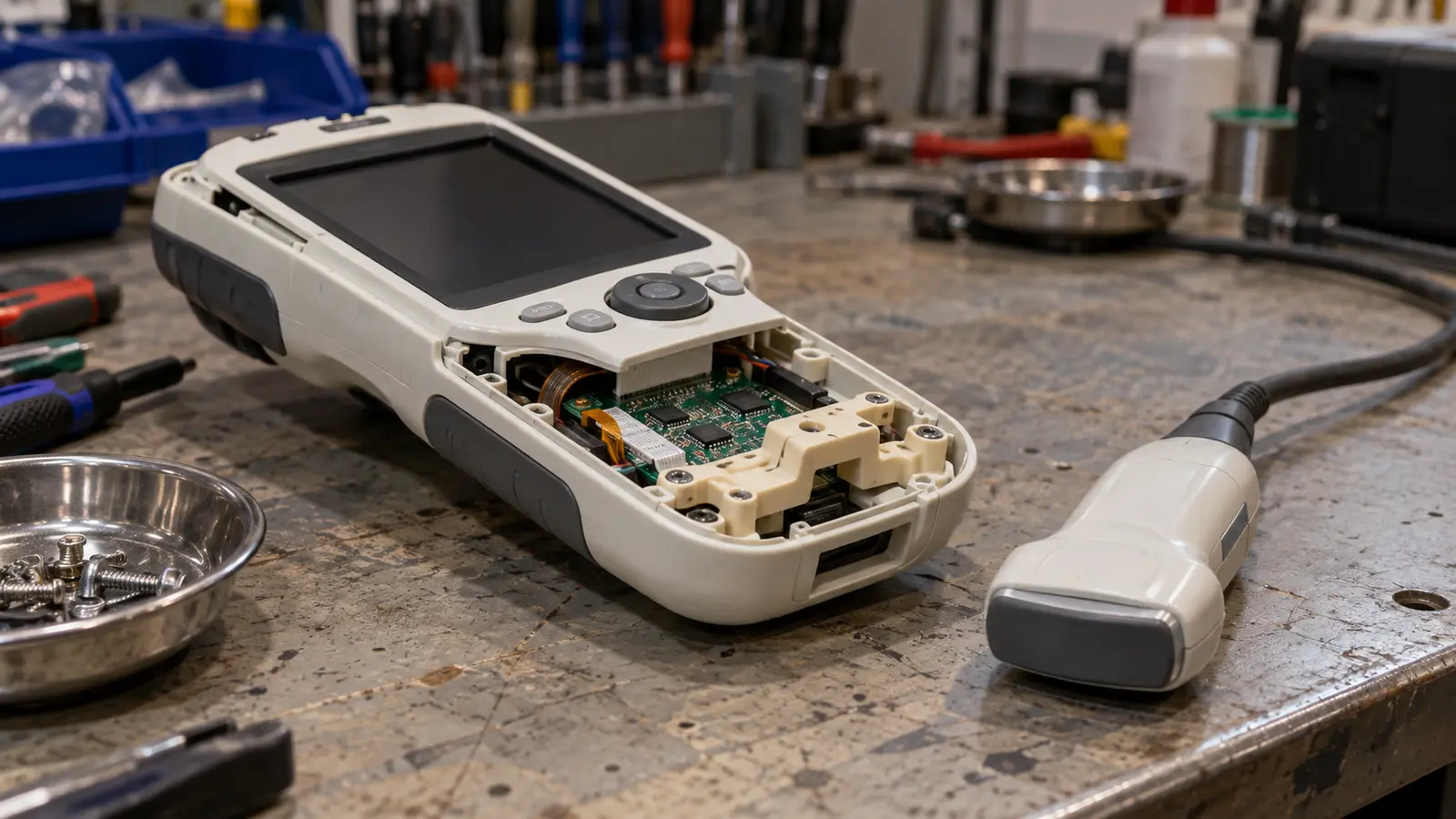
Medical plastics machining uses CNC tools to make polymer parts for medical devices. Choose the exact material grade, then agree the tolerances, cleaning process and traceability records for its intended use.
PEEK, UHMWPE, POM, PTFE, PEI and Nylon offer different strengths. A material test report helps with selection, but it does not establish the biological safety of the finished device.
Engineering polymers help device designers reduce weight, manage wear and insulate electrical parts. They appear in diagnostic housings, surgical tools and some qualified implants. The best choice depends on the job each part must do.
This guide covers materials, CNC processes and biological evaluation. It keeps the focus on the drawing, the chosen grade and the records needed to release a part. For the wider process and sourcing context, see our medical CNC machining guide.
Key takeaways
- Select a grade, not just a polymer name. Additives, stock form and sterilization can change performance.
- Agree critical dimensions early. Heat, moisture and clamping affect plastic parts during cutting and inspection.
- Evaluate the finished device. Patient contact, residues and cleaning matter as well as the raw material.
- Compare machining with molding. Use volume, design stability and total program cost to choose the route.
- Define the quality package. Meco's IATF 16949:2016 system supports FAI, PPAP, CMM inspection and material traceability; agree the scope for your order.
Why use engineering plastics in medical equipment?
Engineering plastics can reduce weight, resist chemicals and provide electrical insulation. Their value comes from matching each property to a specific device function.
A plastic does not need to replace metal in every part of a device. A metal frame may provide strength while a polymer cover protects electronics. A low-friction insert may reduce wear where two moving parts meet.
- Lower weight. Many polymers are less dense than metals. The saving depends on the part shape and the thickness needed to carry the load.
- Imaging behavior. Some polymers allow X-rays to pass through more readily than metals. Fillers and device design still affect the image.
- Chemical resistance. Select a grade that tolerates the actual cleaners and sterilization route. Repeated steam cycles can change dimensions or properties.
- Electrical insulation. Polymer housings and connectors help separate conductive parts. The complete design still needs the relevant electrical safety checks.
These benefits support a wide range of medical equipment manufacturing projects. Implant use is a separate qualification question. A polymer used in one approved device is not automatically suitable for a different contact site or service life.
Which plastics should you consider for a medical component?
Start with the load, contact conditions and cleaning method, then compare exact grades. PEEK, UHMWPE, POM, PTFE, PEI and Nylon each solve different design problems.
The table keeps the six material families from the original guide. The examples describe possible uses, not approval of every grade for those uses. Ask the stock supplier for data covering the specific material you plan to machine.
| Material | Useful properties | Qualification checks | Application examples |
|---|---|---|---|
| PEEK | Strength, heat resistance and radiolucency in suitable grades | Grade data, sterilization evidence and biological evaluation; ASTM F2026 for relevant implant material | Surgical guides; qualified spinal cages and dental components |
| UHMWPE | Wear resistance and low friction; difficult to hold rigidly | Grade, processing history and sterilization effects; ASTM F648 where specified for implants | Qualified hip, knee and shoulder bearing components |
| POM or acetal | Stiffness, low moisture uptake and good dimensional stability | Exact homopolymer or copolymer grade; cleaning compatibility and contact requirements | Inhaler and insulin pen mechanisms; valves and connectors |
| PTFE | Low friction and broad chemical resistance; creep under load | Fillers, creep allowance and applicable biological data | Seals, gaskets, bushings and fluid-path parts |
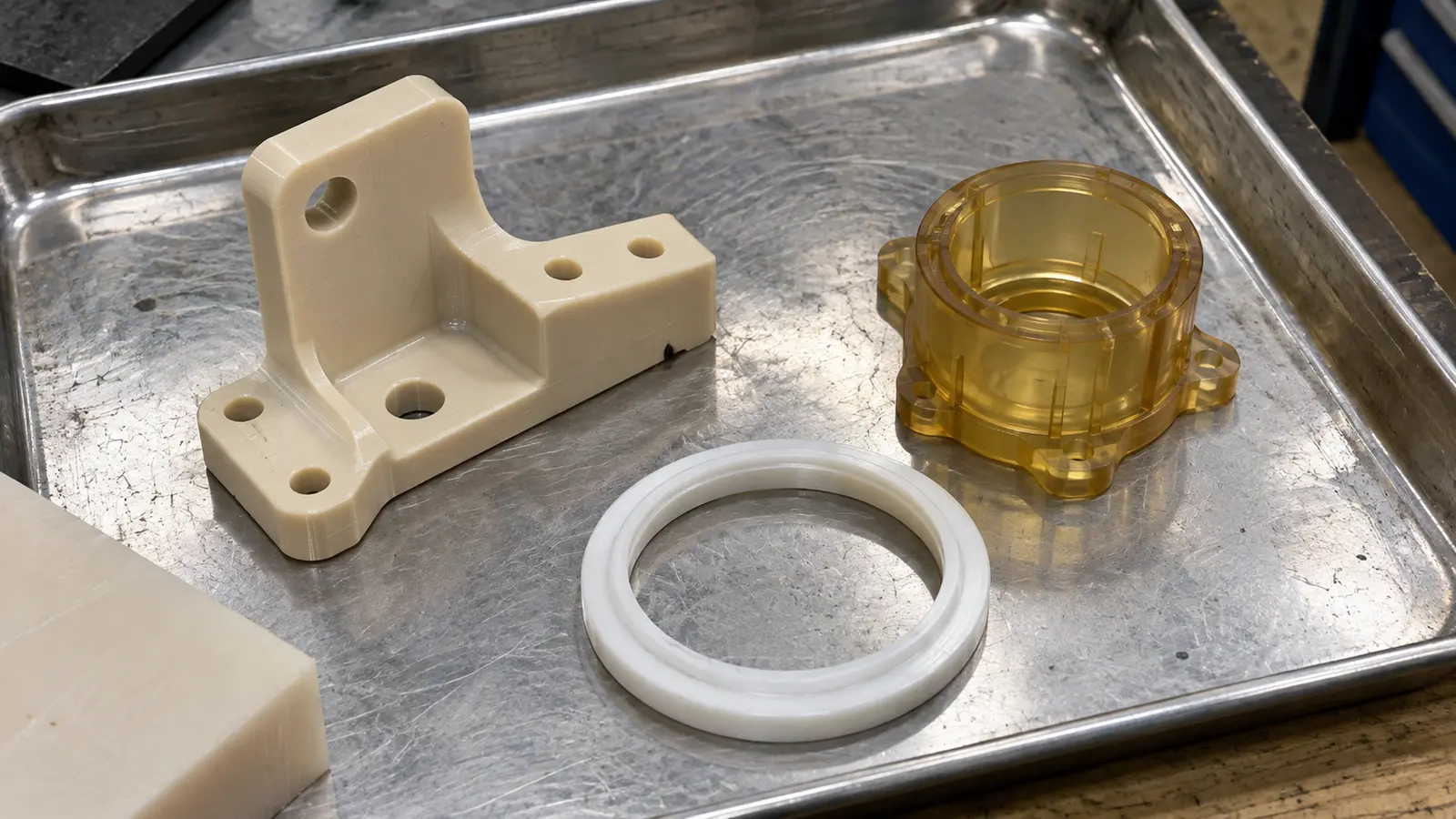
| PEI or Ultem | Stiffness, heat resistance and amber appearance in unfilled grades | Medical-grade data and evidence for the planned sterilization cycles | Instrument housings, light handles and tray components |
| Nylon or PA | Fatigue resistance and useful wear properties; moisture sensitivity | PA type, moisture conditioning and intended contact use | Gears, guide bushings, cable ties and non-contact housings |
PEEK means polyetheretherketone; UHMWPE is ultra-high-molecular-weight polyethylene. POM is polyoxymethylene, PTFE is polytetrafluoroethylene, PEI is polyetherimide and PA is polyamide. Delrin and Ultem are trade names, so the drawing should also state the supplier grade.
Curbell's medical plastics guidance compares material choices and sterilization considerations. Use it to form a shortlist, then obtain the grade-specific evidence. Check strength and temperature limits in the actual data sheet.
Start with the contact plan
Record who or what the part touches, for how long, and under which conditions. Short contact can still need evaluation. Define cleaning and sterilization before choosing a grade, rather than treating contact beyond 24 hours as the only trigger.
Which CNC processes work for medical plastics?
Milling suits blocks and housings; turning suits round parts. Drilling, threading and small-feature cutting need a process matched to the polymer's heat and stiffness.
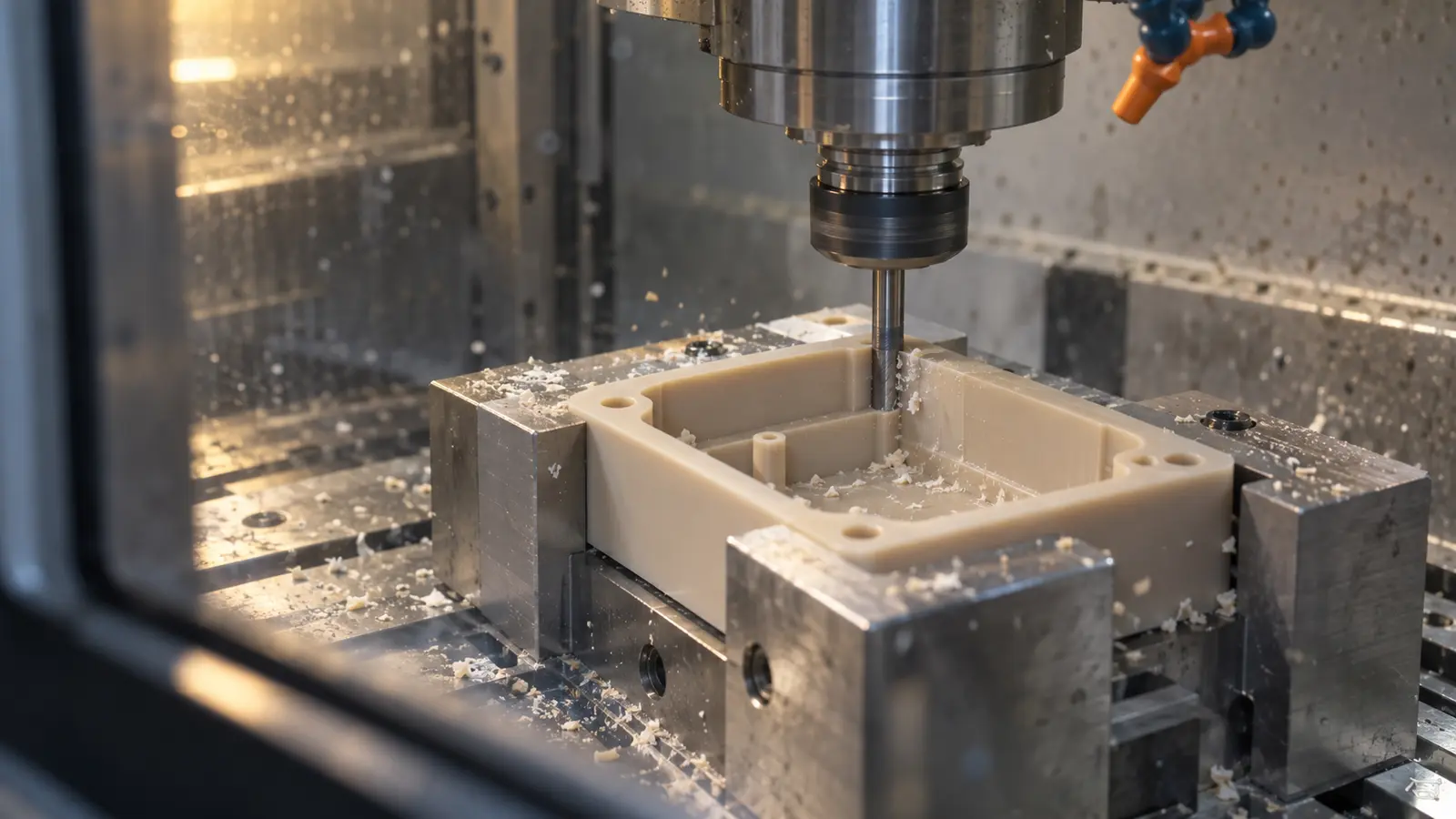
Plastic chips must leave the cut before heat builds up. Tool sharpness, chip clearance and support matter. A clamp that holds steel well may bend a polymer part, leaving it out of shape once the fixture is released.
Three-axis and five-axis milling
Three-axis milling suits flat guides, manifold blocks and many housings. Five-axis CNC machining can reach angled faces and reduce repeated setups. Tool access, fixture clearance and the chosen datum scheme determine which features can share a setup.
A curved guide with holes and a mounting face is a useful design example. Keep related features in one setup where possible. Confirm their true-position requirement through a trial and inspection plan, rather than assuming an axis count guarantees accuracy.
Turning round components
CNC turning suits valve seats, threaded connectors and cylindrical bodies. Thin tubes and flexible stock need support close to the cut. Swiss-type turning is one possible industry approach; the equipment and process for a Meco order must be confirmed during review.
Drilling and threading
Drilling must clear chips without rubbing or melting the hole wall. Peck cycles can help in some cases. Hole depth, tool geometry and the material grade determine whether they are useful.
Choose cut threads, formed threads or inserts to suit the load and resin. Forming taps displace material and can stress a thin wall. Neither thread forming nor cutting is the best route for every thermoplastic.
Small features and micro-machining
Endoscopic parts, fluid channels and hearing-aid housings may need very small features. These need careful checks of tool reach, burrs and inspection access. Review the geometry before committing to a tool, spindle speed or tolerance.
The Mitsubishi Chemical Group machining toolkit explains polymer cutting, support and stress relief. Its guidance reinforces a practical point: use a process chosen for the material, then prove the result on the part.
How should you specify tolerances and surface finish?
Put tight limits on features that control fit, sealing or alignment. Agree how the part will be conditioned and measured before accepting those limits.
Plastics expand with heat and can move as stress is released. Nylon also changes with moisture. A part measured straight from the machine may differ from the same part after storage or cleaning.
The targets below preserve the original guide's design examples. They are discussion points, not standard tolerance classes or guaranteed Meco capability for all polymers. Meco must confirm each requirement against the grade, geometry and agreed inspection method.
| Feature | Original general target | Original tighter target | What to review |
|---|---|---|---|
| Linear dimension | ±0.05 mm | ±0.025 mm | Feature size, stock stress and inspection temperature |
| True position | 0.08 mm | 0.04 mm | Datums, fixture release and measurement method |
| Surface roughness Ra | 1.6 μm | 0.4 μm | Tool access, grade and function of the surface |
| Wall thickness | 1.5 mm | 1.0 mm | Wall height, clamping, stiffness and distortion |
| Hole diameter | ±0.05 mm | ±0.02 mm | Depth, reaming trials and inspection access |
Ra describes average surface roughness. Specify it by functional zone, not as one finish for the whole part. A sealing face, sliding bearing and outer cover may need different finishes.
A low Ra value alone does not prove that a part is clean or limits bacterial adhesion. Cleaning performance also depends on shape, residues and the validated process. Discuss these needs during design-for-manufacturability review, or DFM.
How do biocompatibility and traceability work together?
Biological evaluation assesses the device in its intended use. Traceability connects its parts to the selected materials and the controlled production history.
Start with the FDA's biocompatibility assessment basics. The part's role and contact conditions guide the evidence needed. A resin report may support the evaluation, but cutting fluids, handling and cleaning can affect the finished surface.
ISO 10993 and the current US context
ISO 10993-1:2025 is the sixth edition of the biological safety framework. It links evaluation to risk management. The plan considers contact and exposure, then identifies evidence gaps rather than assigning the same tests to every part.
As of this update, FDA partially recognizes the 2025 edition. Its recognition record lists exclusions and implementation notes. Declarations to the recognized 2018 edition remain accepted through July 1, 2029, under the stated transition.
Keep the FDA's 2023 ISO 10993-1 guidance in view when planning a US submission. Check the current recognition record before choosing the edition and test plan. A newer ISO publication does not remove the regulator's conditions.
Material tests and implant specifications
USP Class VI data may be requested for a selected grade. It describes biological reactivity under the reported test conditions. It does not prove that the finished device will never release harmful substances or replace its biological evaluation.
For implant PEEK, ASTM F2026-23 defines material requirements. Check the material certificate against the specification and purchase order. Meeting a material standard does not itself approve an implant or establish Meco's qualification to manufacture it.
From stock lot to finished component
Keep the resin or stock supplier's Certificate of Analysis, or CoA, with the grade and lot identity. Link the issued stock to the production lot and inspection record. If the stock converter and resin producer differ, preserve both links.
Agree the required depth of traceability with Meco before ordering. Full material traceability, first article inspection and production records support that chain. Serial numbers, record fields and retention periods belong in the quality agreement; do not assume every job has the same package.
When should you machine instead of injection mold?
Machine when the design is changing or demand does not justify a mold. Consider molding once stable geometry and repeat volume can repay the tooling cost.
The original guide used 5,000 units per year as a rough dividing point. Keep it as a screening prompt, not a cost rule. A simple part may favor molding earlier; a complex part may remain economical to machine at a higher volume.
| Factor | CNC machining | Injection molding |
|---|---|---|
| Best starting point | Prototypes, bridge production and smaller repeat lots | Stable designs with enough repeat demand |
| Upfront work | Programming, workholding and inspection planning | Mold design, tooling, trials and qualification |
| Design changes | Often a program or fixture change | May need a mold modification or replacement |
| Tolerance drivers | Grade, cutting, support and conditioning | Grade, shrinkage, mold and process control |
| Material use | Stock is cut away; nesting affects waste | Near-net shapes; runners and rejects still matter |
| Release planning | Part and process evidence for the machined route | New evidence for the molded route and finished device |
Use the injection molding process guide to understand the alternative. Meco’s injection molding services can support the next stage. A hybrid plan can use machined parts while tooling is developed. Do not assume the machined part's test results transfer unchanged to a molded version.
A Meco process handoff check
Meco offers both machining and molding, so review the change as one program. Confirm the stock grade, molded resin, shrinkage allowance and critical dimensions together. The shared supplier helps coordination; the new process still needs its own agreed release checks.
Choosing your production route? Send your drawing, grade, contact conditions and volume. Meco can review the process options and the quality records needed.
Get DFM Feedback on Your DesignHow can you design medical plastics for machining?
Design for stable walls, clear tool access and measurable features. Keep tight limits where they serve a function, then review material movement before release.
- Keep wall changes gradual. The original 1.5 mm wall target is a starting point. Tall or flexible walls may need more support. A 1.0 mm wall needs a specific fixture and cutting review.
- Limit tight tolerances. The original ±0.025 mm example belongs on features that control fit or alignment. A wider ±0.05 mm limit may suit other features if the design allows it.
- Allow for heat and moisture. Use the exact grade's expansion data. Record inspection conditions and the expected service range. Avoid checking a warm part against a room-temperature drawing without accounting for the difference.
- Review deep pockets. The original depth-to-width screening ratio of 4:1 flags tool reach and chatter risk. It is not a universal limit. Review access and consider roughing before a separate finish pass.
- Review stock stress. Stress-relieved stock or intermediate annealing may help asymmetric parts stay stable. Follow the stock supplier's instructions and check whether the added heat cycle affects qualification.
Also make the important features easy to inspect. A narrow internal channel may be easy to draw but hard to measure or clean. Add a datum scheme, surface callouts and cleaning requirements before requesting a production quote.
What quality records should the order include?
Define the records before production starts. The inspection and traceability package should match the drawing, customer requirements and device program.
Meco operates an IATF 16949:2016-certified quality system. That is a confirmed credential, not a substitute for medical-device requirements. Supplier approval and regulatory responsibilities remain with the parties defined in the program's quality agreement.
Agree the inspection and control package
- First article inspection, or FAI. Define which drawing requirements will be checked, the methods used and the report format.
- Material records. Confirm grade, stock source, CoA and lot links. State whether serial identification is needed.
- Measurement results. Coordinate measuring machine, or CMM, reports can support accessible dimensions. Agree a suitable method for roughness and features a CMM cannot reach.
- Process controls. Identify critical-to-quality features, or CTQs, and the controls used to hold them.
- Production approval. Request a Production Part Approval Process, or PPAP, package where relevant. Agree its level and contents; it is not a medical approval.
- Risk and capability records. Agree whether a Process Failure Mode and Effects Analysis, or PFMEA, and Statistical Process Control, or SPC, are needed. Set the process capability index, Cpk, target in the plan rather than promising a blanket value.
- Other evidence. Specify cleaning, packing, change control and any required REACH or RoHS statements. Confirm availability and applicability for the chosen material.
Get the sample report format before placing the order. A list of acronyms is less useful than a report that links a real measurement to a drawing revision. Confirm how a material or process change will be reviewed before it is introduced.
What should you check in a machining partner?
Check whether the supplier can make, inspect and document your specific part. Ask for evidence that matches the material and geometry rather than relying on a general capability claim.
- Polymer experience. Request relevant sample work and discuss clamping, burr control, conditioning and inspection. Ask how the proposed process will be proven.
- Process coverage. A medical assembly may also need metal parts, molded housings and finishing. Meco combines these with mechanical assembly, reducing separate supplier handoffs.
- Volume changes. Discuss the move from samples to pilot lots and repeat orders. Meco has no minimum order quantity; agree the economics and quality scope at each stage.
- Delivery planning. Meco has production in Thailand and China, Canadian headquarters and warehousing support in North America and other markets. Confirm where your program will run and how stock will be released.
For multi-part programs, our medical device assembly guide connects component manufacture with assembly planning. Bring the drawing, target volume and quality needs to the same discussion so the quote covers the full handoff.
Discuss Your Medical Plastics Project
Send your CAD files, material grade, volume and quality requirements. Meco will review the machining route, DFM needs and documentation scope.
- Processes: milling, turning and complementary molding
- Materials: grade selection against intended use
- Quality: IATF 16949:2016, FAI, PPAP and CMM
- Integration: parts, finishing and assembly
- Ownership: your design and tooling stay yours
References
Sources used for material, machining and biological evaluation guidance. Checked 7 October, 2026.
- Life Sciences and Medical Equipment. Curbell Plastics.
- Guide to machining plastic parts. Mitsubishi Chemical Group.
- Basics of Biocompatibility. FDA.
- ISO 10993-1:2025 sixth edition. ISO.
- Recognition record for ISO 10993-1:2025. FDA.
- Use of International Standard ISO 10993-1 guidance September 2023. FDA.
- ASTM F2026-23 implant PEEK material specification. ASTM International.
Application examples and AI-generated images are illustrative. They do not show a Meco facility, customer project, approved device or clinical result.
