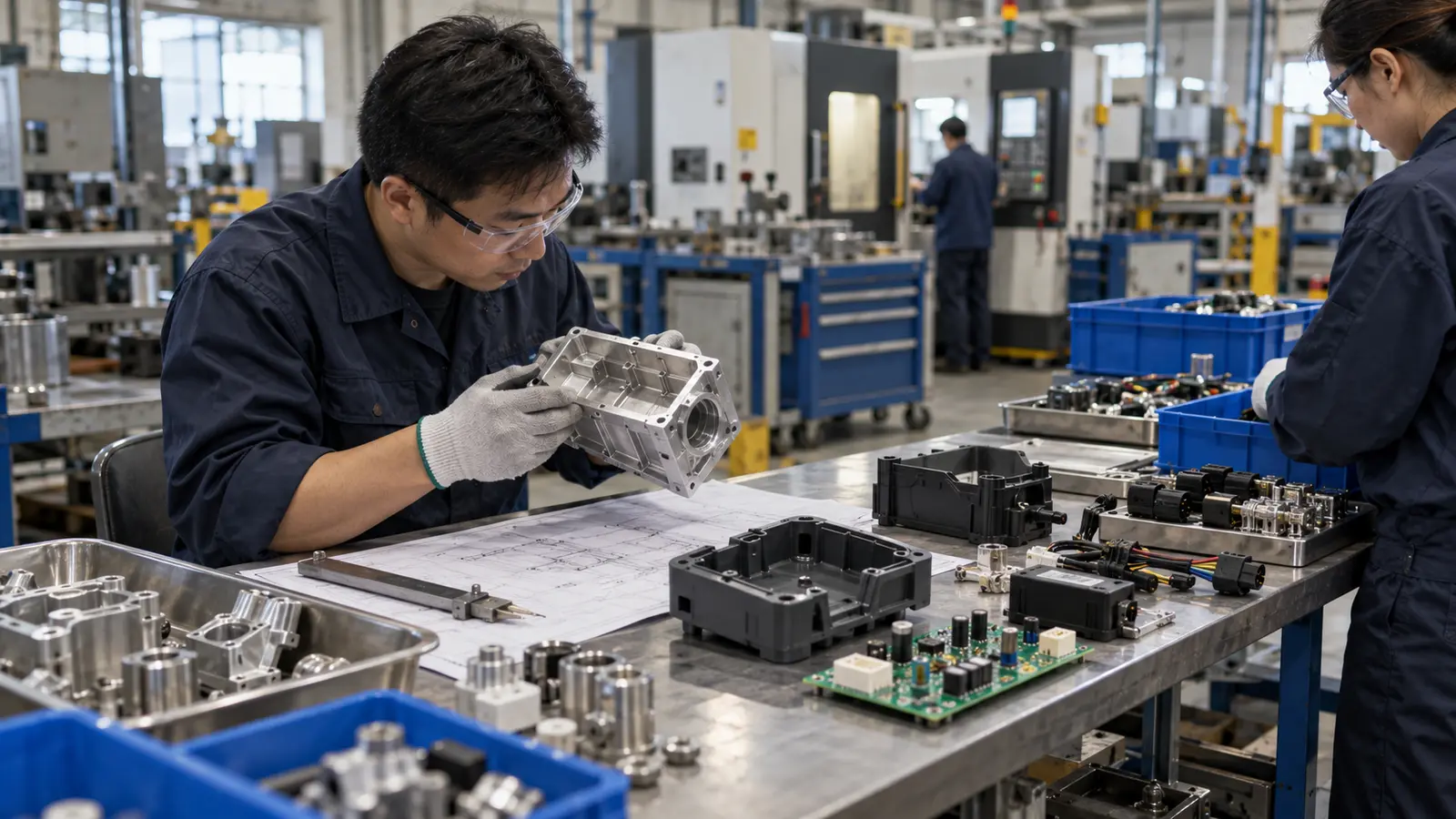
A contract manufacturer builds a product to the customer's design and specifications, while an OEM can refer to a component maker, a branded manufacturer, or a factory using its own product platform. The label matters less than the commercial terms behind it.
The practical questions are who owns the design, who owns the tooling, and what you can take with you if production moves. For custom products, those answers determine IP control, switching flexibility, upfront investment, and supply chain risk.
You're bringing a product to market. You have a design, perhaps a working prototype, and now you need someone to manufacture it. The search quickly becomes confusing because terms such as OEM, contract manufacturer, ODM, and turnkey partner are often used differently by different suppliers.
That ambiguity can become a commercial problem if both sides assume different rules for design ownership, tooling, or exit rights. The safest approach is to define the relationship by what each party owns and does, not by the label on the quote.
Key takeaways
- Contract manufacturing: you bring the product design and the manufacturer builds to your specifications.
- OEM: the term can describe several different business relationships, so ownership must be confirmed in writing.
- ODM: the supplier designs and manufactures a product that the buyer typically rebrands.
- Tooling matters: design ownership and tooling ownership should both be explicit before production begins.
- Most products use a mix: standard OEM components can sit inside a custom contract-manufactured product.
Why does “OEM” mean different things?
OEM is not one universally consistent commercial model. In practice, the term is used in at least three ways, and the meaning changes who owns the design and how much freedom the buyer has.
In the strict traditional sense, an original equipment manufacturer makes a component or product that is sold within another company's finished product. In automotive and aerospace, however, “OEM” often means the branded vehicle or equipment manufacturer itself.
In some sourcing contexts, OEM is also used for a factory that builds a buyer's branded product on an existing supplier platform. In that arrangement, some product elements may belong to the buyer while the underlying architecture remains with the supplier.
| OEM may mean | Who owns the design | Typical context |
|---|---|---|
| Component maker whose part goes into another company's product | The component maker owns its component IP | Electronics and industrial components |
| Brand company that specifies and sells the finished product | The brand owns the product IP | Automotive and aerospace supply chains |
| Factory building a branded product on an existing platform | Mixed and contract-dependent | Private label and sourcing programs |
The three-question test
On the first supplier call, ask three questions: Who owns the design files? Who owns the tooling and can I collect it? If I move production, what leaves with me?
Those answers reveal the real relationship more reliably than the words OEM or contract manufacturer.
What is a contract manufacturer?
A contract manufacturer produces goods on behalf of another company using the customer's requirements, drawings, or product specifications. The customer controls the product design, while the manufacturer provides production capability and the agreed manufacturing services.
Modern contract manufacturing can include engineering support, sourcing, quality inspection, surface finishing, mechanical assembly, packaging, and warehousing. A capable partner can therefore act as an extension of the customer's operations rather than as a single-process job shop.
For a deeper explanation of the model, see what a contract manufacturer is and what occurs during contract manufacturing.
What are the main contract manufacturer vs OEM differences?
The biggest differences are design ownership, tooling ownership, commercial structure, flexibility, engineering responsibility, and switching risk. These are the terms that affect cost and control after the project moves beyond the quote stage.
1. Design ownership and IP control
With contract manufacturing, the customer brings the design and the manufacturer builds it. With an OEM component, the supplier usually owns the component design and sells that engineering as part of the product.
The risks are different. A buyer giving a contract manufacturer complete files needs strong confidentiality and IP protections. A buyer relying on a proprietary OEM component needs to consider dependence on technology they do not own.
2. Tooling ownership
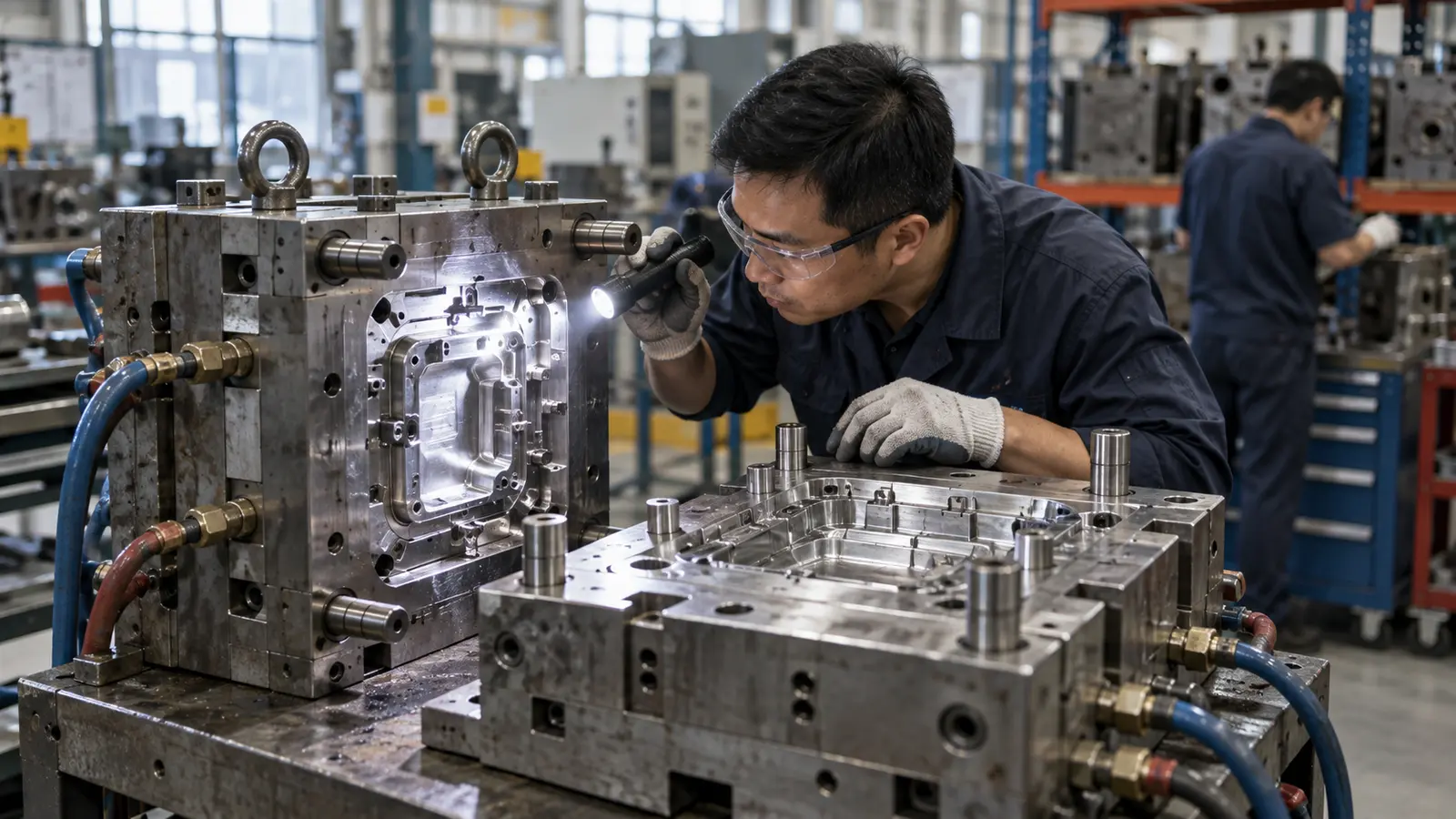
Tooling ownership should be agreed separately from product IP. If the customer pays for dedicated tooling, the contract should state who owns it, who physically holds it, and what happens if the customer moves production.
This matters most for processes such as injection molding and die casting, where dedicated tooling can represent significant upfront cost and lead time. Meco's policy is straightforward: your design and your tooling stay yours, and customers may move them to another supplier at their own expense and arrangement.
3. Scope of involvement
An OEM component supplier may focus on one standard subsystem. A contract manufacturer can cover one custom part or a much wider production scope, including materials, tooling, fabrication, machining, finishing, assembly, and delivery.
When one partner manages the full build, the model becomes whole product manufacturing or turnkey manufacturing.
4. Commercial relationship and cash flow
OEM components commonly use catalogue pricing, volume tiers, and supplier-controlled product roadmaps. Contract manufacturing is project-specific, with tooling, process planning, validation, and production pricing built around the customer's own design.
That changes the cash-flow profile. Custom manufacturing can require more upfront engineering and tooling investment, while a standard OEM component often reduces development spend but keeps a supplier margin in every unit purchased.
5. Flexibility and scalability
A contract manufacturing program can be planned around prototypes, pilot quantities, and later production ramps. Meco supports production from 10 pieces to 10 million+ with no minimum order quantity.
OEM components can still scale very well, but buyers work within the supplier's own minimums, product availability, lead times, and lifecycle decisions.
6. Where the engineering effort sits
With a standard OEM component, much of the product engineering is already complete and spread across many customers. With contract manufacturing, the customer provides the product requirements and may also use the manufacturer's R&D engineering and DFM support to improve manufacturability before production.
The trade-off is control versus development effort. Standard components can shorten development time. Custom manufacturing gives the buyer more differentiation and control over the final product.
| Factor | OEM component relationship | Contract manufacturer |
|---|---|---|
| Who designs the product | Supplier designs its component or platform | Customer owns the product design |
| IP ownership | Supplier-owned or mixed | Customer-owned product IP |
| Tooling | Often supplier-owned | Customer ownership can be specified for dedicated tooling |
| Upfront investment | Usually lower for standard parts | Higher when custom tooling and validation are required |
| Time to market | Often faster for existing parts | Depends on custom engineering, tooling, and validation |
| Volume flexibility | Supplier terms and MOQs apply | Can be planned from prototype through mass production |
| Differentiation | Lower when competitors can buy the same part | Higher for proprietary custom designs |
| Switching supplier | Harder for proprietary supplier designs | Easier when the customer owns files and tooling |
Where does ODM fit?
An ODM, or Original Design Manufacturer, designs and manufactures a product that another company can rebrand and sell. It requires less product engineering from the buyer, but it also provides less product differentiation and less ownership of the underlying design.
One useful way to think about the models is by how much engineering the buyer brings. With an ODM, the supplier brings most of the product design. With an OEM component, the buyer integrates supplier-designed subsystems. With contract manufacturing, the buyer brings the custom product design and buys manufacturing capability.
| Factor | ODM | OEM component | Contract manufacturer |
|---|---|---|---|
| Who creates the design | Supplier | Supplier for its component | Customer |
| Buyer engineering input | Low | Moderate integration work | High |
| Speed to market | Usually fastest | Fast for proven components | Longer when custom tooling is needed |
| Differentiation | Lowest | Moderate | Highest |
| Typical use | Private label finished goods | Standard subsystems and components | Custom hardware and assemblies |
Can one product use OEM, ODM, and contract manufacturing together?
Yes. Most finished hardware products use more than one sourcing model at the same time. Standard components can come from OEM suppliers, custom product-defining parts can be contract manufactured, and a generic accessory may come from an ODM catalogue.
For example, industrial equipment may use standard power supplies, connectors, and sensors, while its die cast housing, machined brackets, molded covers, and final assembly are custom. The useful question is not which model wins overall, but which parts of the product genuinely create differentiation.
Not sure what should be custom? Send your drawings, BOM, and target volume. Meco can review the build and flag which parts justify custom production before you commit to tooling.
Talk to an EngineerWhen should you choose an OEM partner?
Choose an OEM supplier when you need a proven standard component or subsystem that is not the core differentiator of your product. You benefit from engineering that is already validated and available without funding a custom design from zero.
Power supplies, standard sensors, connectors, motors, and other established subsystems are common examples. The main supply-chain risk is dependence on the supplier's availability, pricing, and product lifecycle.
For critical components, consider second-source options early so a discontinuation or supply interruption does not stop the entire product.
When should you choose a contract manufacturer?
Choose a contract manufacturer when your product is custom and you need a partner to build to your design, quality requirements, and production plan. This is especially valuable when one product combines several manufacturing processes.
A product may include die cast housings, CNC-machined inserts, injection molded covers, and PCB assembly. Managing those through one manufacturing structure reduces the number of supplier handoffs and creates one point of accountability.
The same logic applies to procurement and logistics. An integrated partner can combine manufacturing with supply chain management and warehousing instead of requiring the buyer to coordinate every vendor separately.
What contract questions should you ask before production?
Clarify ownership, change control, subcontracting, and exit terms before tooling or production begins. These clauses are easier to agree when the relationship is starting than when the buyer needs to move quickly.
- Tooling ownership and possession. Who owns dedicated tools, who stores them, and how can they be collected?
- IP assignment. Who owns the original design, and who owns any product-specific improvements created during production?
- Exit terms. What happens to work in progress, files, inspection records, tooling, and approved supplier information?
- Subcontracting disclosure. Which operations are done outside the quoted facility, and by whom?
- Change control. Can materials, processes, or sub-suppliers be changed without written approval?
Meco can sign an NDA before drawings or files are shared. Your design and tooling remain yours, and Meco does not produce your product for anyone else.
This article is general information, not legal advice. Manufacturing agreements should be reviewed by qualified legal counsel for the relevant jurisdiction.
Why are OEM and contract manufacturing models becoming more integrated?
Manufacturing partners increasingly combine engineering, production, sourcing, assembly, and logistics under one management structure. This hybrid or turnkey model reduces the coordination burden for products that would otherwise move between several specialist suppliers.
Modern contract manufacturers can provide DFM, prototyping, tooling, production, finishing, assembly, packaging, and delivery. Meco's prototype-to-production guide explains how that transition can be managed across one program.
Deloitte's 2026 manufacturing outlook highlights continued supply-chain complexity and a focus on resilience and agility. For buyers, that makes supplier structure and visibility important alongside piece price.
How do you evaluate the right manufacturing partner?
Evaluate the partner on process depth, quality systems, engineering support, scale, transparency, and logistics, not just the quoted unit price. A low price can become expensive if the supplier cannot control quality, ramp production, or support a design change.
Process coverage and depth
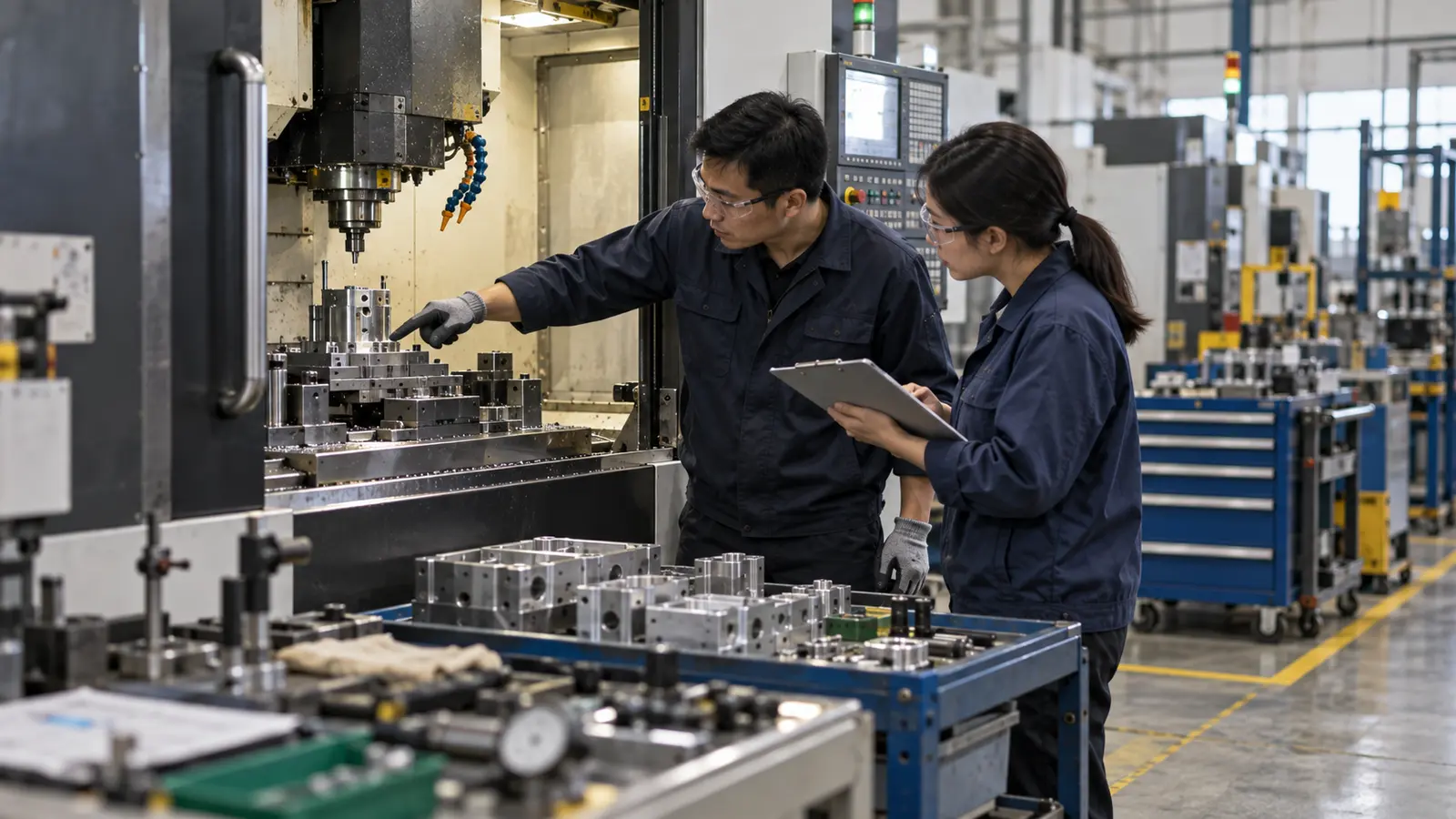
Confirm that the supplier can run the processes your product actually needs. If several processes are claimed as in-house, ask what equipment is used, what inspection follows each step, and which operations are still subcontracted.
Meco's capabilities page provides the current process overview.
Quality system and certification
Verify the certifications that matter to your program. Meco's formal quality certification is IATF 16949:2016. Buyers should also ask how the supplier uses APQP, PPAP, SPC, FAI, CMM inspection, traceability, and documented change control.
Communication and DFM support
The quoting process can reveal how the supplier thinks. Useful DFM feedback should identify manufacturing risks, tolerance conflicts, material alternatives, or process choices before tooling and production decisions are locked in.
Meco provides DFM feedback with every quote and targets quote response in under 24 hours.
Scalability
Ask how the supplier handles a program that begins with a pilot quantity and later expands. Capacity matters, but so do sourcing readiness, quality planning, workforce flexibility, packaging, and logistics.
Geographic support
Factory location affects communication, shipping, risk, and inventory planning. Meco combines production in Thailand and China with North American support and warehousing locations across North America and Asia.
Red flags to watch for
Be cautious when a supplier cannot provide certification evidence, avoids tooling ownership questions, hides subcontracting, or promises a schedule without discussing process constraints. Transparent answers before the order are a better indicator than a polished capability list.
What is the bottom line?
The contract manufacturer vs OEM decision is mainly about ownership, control, and where engineering responsibility sits. Standard OEM components can shorten development time, while contract manufacturing is better suited to proprietary products that need custom production and clear ownership.
Most real products use both. Decide which components are standard, which parts define your product, and which supplier relationship gives you the right balance of cost, control, and supply-chain resilience.
Before signing, ask the three questions again: who owns the design, who owns the tooling, and what can move with you if production changes.
Build With Clear Ownership
If you own a custom product design, Meco can review the manufacturing route, tooling needs, and production plan before the program moves forward.
- NDA first. Available before drawings or files are shared.
- Your IP. Your design and tooling stay yours.
- Process coverage. 40+ manufacturing processes under one management structure.
- Quality. IATF 16949:2016 certified.
- Scale. 10 pieces to 10 million+ with no minimum order quantity.
Browse whole product manufacturing or review all manufacturing capabilities.
Request a QuoteReferences and sources
External industry context checked for this September 2026 refresh.
- Deloitte Research Center for Energy & Industrials. 2026 Manufacturing Industry Outlook. Deloitte Insights, 13 November 2025.
This article is general information, not legal or customs advice. Have manufacturing agreements reviewed by qualified legal counsel. For tariff, classification, or customs questions, confirm current requirements with a licensed customs broker.
