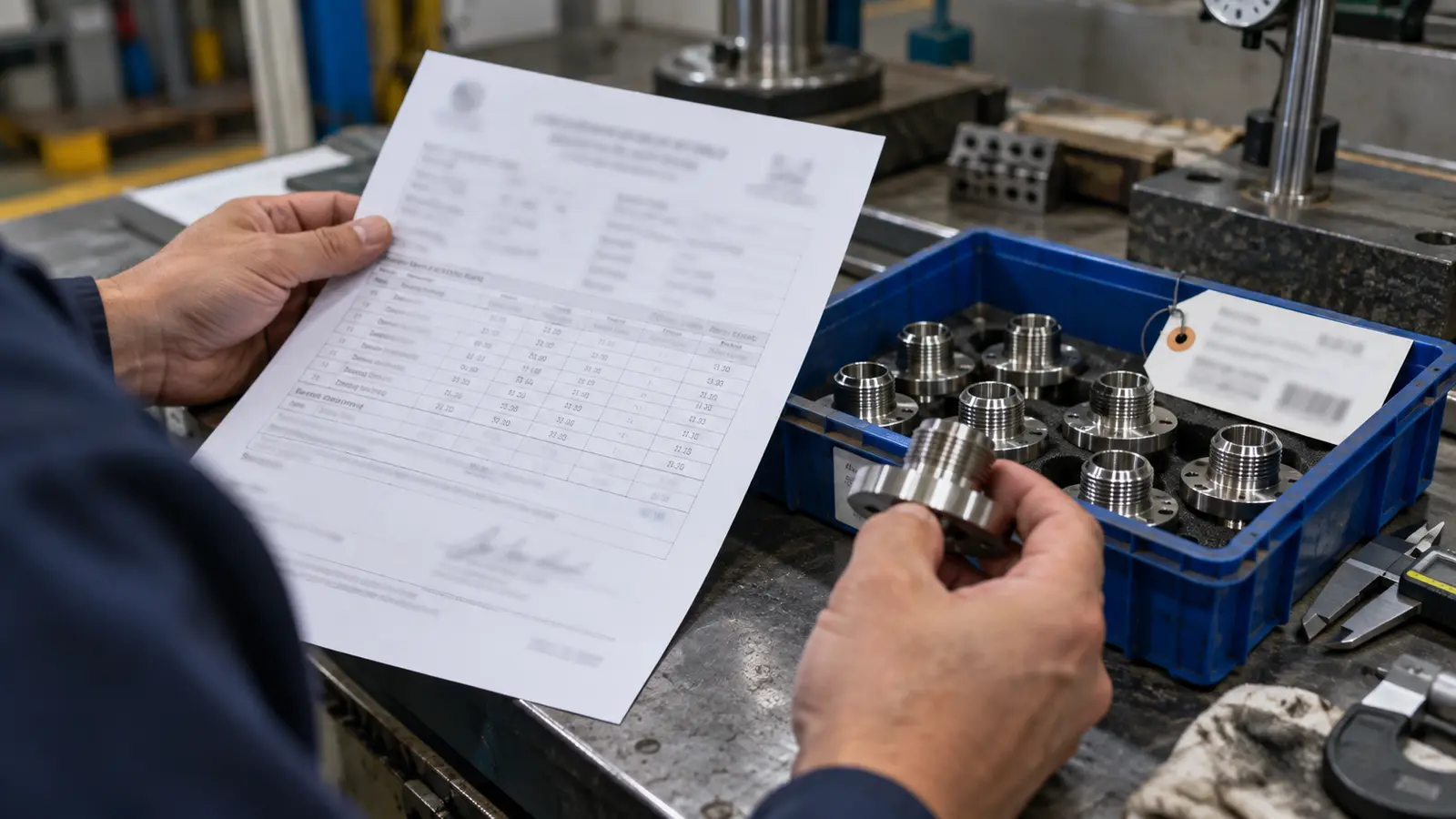
An EN 10204 Type 3.1 certificate states that supplied metal meets the order and reports results of specific inspection. The manufacturer’s authorized inspection representative, independent of the manufacturing department, validates it.
Before accepting one, match the product standard, test results and heat or lot record to the material supplied.
A certificate can be genuine and still fail the requirements on your drawing. This guide explains what Type 3.1 establishes, where it differs from other types, and how to check a certificate before production.
Key takeaways
- Type 3.1 includes specific inspection results and a validation by an authorized representative independent of manufacturing.
- Type 3.2 adds validation by the buyer’s representative or an inspector designated by official regulations.
- Match the specified grade and product standard, then trace the reported heat or lot to the supplied material.
- Request the certificate type and all required tests in the purchase order.
What does EN 10204 Type 3.1 mean?
EN 10204 defines inspection documents for metallic products. Type 3.1 reports specific inspection results for products supplied and declares compliance with the order.
The standard distinguishes specific inspection, which uses products to be supplied or test units of which they form part, from non-specific inspection, which need not relate to those products. The standard also allows a manufacturer to transfer relevant test results from an incoming material certificate, provided traceability is maintained. See the EN 10204:2004 text.
Mill test certificate (MTC) and mill test report (MTR) are common trade names, but neither label alone proves compliance with Type 3.1. Check the declared document type, specific results and validation.
What counts as specific inspection?
Specific inspection does not mean every finished part must be destroyed for a test. The standard permits inspection of the products to be supplied or of test units from which those products form part. The applicable product specification defines sampling and the tests to perform.
For example, a mill may report chemistry for a heat and mechanical test results for a defined test unit. A machine shop then needs records showing which incoming heat became which finished parts. If that chain breaks when stock is cut or mixed, a valid mill certificate alone cannot identify the material in a particular finished component.
How do the four certificate types compare?
Types 2.1 and 2.2 do not require results from specific inspection. Types 3.1 and 3.2 do, and they differ in who validates the document.
| Type | Document | Test results | Validation |
|---|---|---|---|
| 2.1 | Statement of compliance | No test results required | Manufacturer |
| 2.2 | Test report | Non-specific inspection results | Manufacturer |
| 3.1 | Inspection certificate | Specific inspection results | Manufacturer’s authorized inspection representative, independent of manufacturing |
| 3.2 | Inspection certificate | Specific inspection results | Manufacturer’s independent inspection representative plus buyer’s representative or an inspector designated by official regulations |
Type 3.2 requires the second validation to be planned with the supplier. Do not assume that a previously issued 3.1 can simply be relabeled after delivery.
When should a buyer ask for 3.2?
Start with the drawing, contract and applicable equipment rules. If they explicitly call for Type 3.2, arrange the second validator before inspection takes place. Do not select a document type only from a generic industry list, since the governing product specification may require additional tests or a different inspection arrangement.
Type 2.2 may be acceptable for a low-risk purchase where batch-specific results are not required. Type 3.1 gives a buyer specific inspection results under the manufacturer’s independent inspection function. Type 3.2 adds the additional validation defined in the standard. The extra document category does not repair incorrect chemistry, weak traceability or a mismatch with the order.
Who validates a Type 3.1 certificate?
The manufacturer’s authorized inspection representative validates Type 3.1 and must be independent of the manufacturing department.
EN 10204 does not itself require ISO 9001 certification or a third-party signature for Type 3.1. For pressure equipment, separate material documentation obligations may apply under Directive 2014/68/EU, Annex I, point 4.3. Confirm those requirements for the equipment category and material route instead of treating every 3.1 certificate as PED approval.
Meco holds IATF 16949:2016 certification. This quality system supports inspection and traceability, but it does not replace the requirements of the material standard or the purchase order.
Is an ISO 9001 certificate required?
EN 10204 does not name ISO 9001 as a condition for issuing Type 3.1. Its document definition focuses on conformity to the order, specific inspection results and validation by the manufacturer’s authorized representative who is independent of manufacturing.
Do not confuse that document definition with rules that apply to a particular finished product. Pressure equipment under the European directive has its own material-documentation provisions. Buyers should give the supplier the relevant equipment and material requirements, then check the complete compliance route with the responsible engineering or conformity team.
How should you check a 3.1 certificate?
Match the certificate to the order, the applicable product standard, the results and the physical material. Resolve discrepancies before machining or assembly.
- Identify the material. Match product form, grade, standard and revision to the drawing and purchase order.
- Review reported results. Compare required chemical, mechanical and any additional test values with the limits in the specified standard.
- Trace the batch. Match the heat or lot number to labels, markings and production records.
- Check condition. Confirm dimensions, delivery condition and heat treatment where required.
- Check validation. Confirm the document says Type 3.1 and identifies the authorized inspection representative.
- Resolve missing evidence. Ask for the original mill record or further testing if a transferred result cannot be traced to the parts.
The exact test fields depend on the product standard and the order. A 3.1 document does not automatically include every possible test, such as hardness or non-destructive examination.
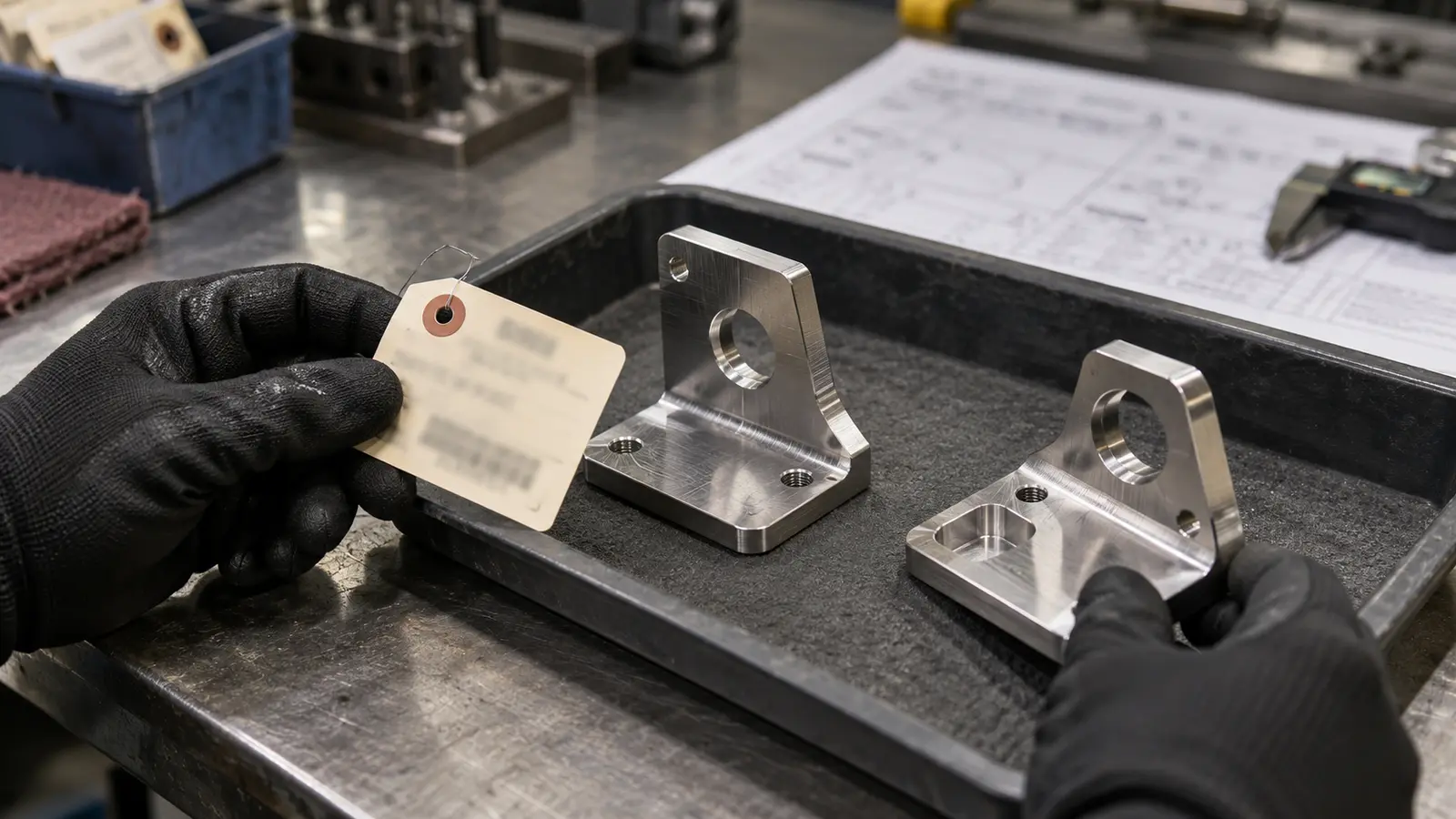
What information should you expect to find?
A useful certificate identifies the issuer and material, the order or delivery, the heat or lot, the relevant specification, the actual test results and the validator. It may also report product dimensions, quantity, condition and supplemental test results. The exact layout is not fixed by EN 10204.
Review both the measured value and its unit. A value that looks plausible can still be compared against the wrong limit or against a specification for another product form. The same grade designation may appear in standards for plate, bar and cast material with different tests or acceptance rules.
What if a distributor supplies the certificate?
A distributor may pass on the original manufacturer’s certificate, but the connection to the material delivered must remain clear. Match the manufacturer, heat and product description to the distributor’s labels and delivery records. Ask for the original underlying document when a summary omits the source or rewrites the results without a traceable reference.
Can ASTM 316L replace EN 1.4404?
Do not assume two similar grade names satisfy the same specification. Compare the applicable product standards and measured results before accepting a substitution.
For example, an order for EN 10088-2 grade 1.4404 cannot be cleared solely because the supplier presents an ASTM A240 316L certificate. The alloy names are closely related, but product form, limits and delivery conditions must match the actual order.
As one simple illustration, the British Stainless Steel Association explains why low-carbon 316L differs from standard 316 in weld-related corrosion behavior. A grade name is a starting point for review, not a substitute for checking the specified standard.
A hypothetical receiving check
If a drawing calls for EN 1.4404 but the certificate names only ASTM A240 316L, pause acceptance. Compare the measured chemistry and properties with the EN specification, confirm the product form, and obtain written approval for any substitution. This is an example, not a Meco customer case.
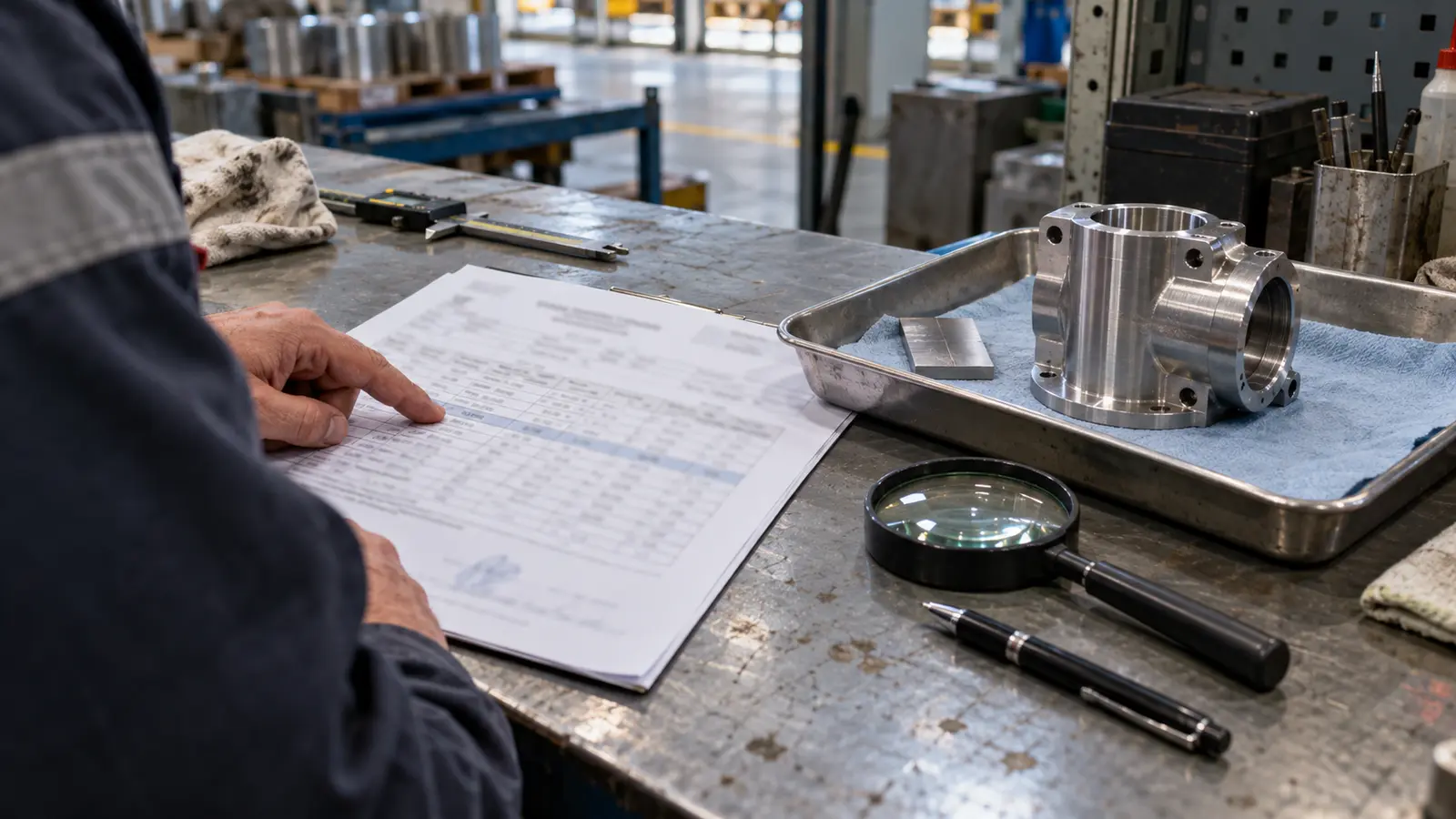
Why can a genuine certificate still fail the order?
The certificate answers the specification printed on it. If the drawing names a different specification, its test results may be accurate but insufficient to show conformity. Even where some chemical limits overlap, other requirements such as mechanical properties, condition, testing method or product form may differ.
Read the precise grade and standard on both documents. If the supplier proposes an equivalent material, have the design owner assess and approve it before use. Do not silently edit a certificate to add a grade that the issuer did not validate.
Low-carbon grades also illustrate why one letter matters. The L denotes a lower maximum carbon content than the standard 316 grade in the comparison described by the British Stainless Steel Association. That matters when the part will be welded, but a low-carbon label by itself does not establish all the other properties required by an EN product standard.
Unsure what to request? Send the drawing and material standard. Meco can review the documentation requirement with your quote.
Ask an EngineerDoes EN 10204 cover castings and aluminum?
Yes. EN 10204 applies to metallic products, not only steel. It can also be applied to non-metallic products by agreement.
For a casting, specify which tests and test units are relevant to the pour or lot. For a machined aluminum part, connect the stock certificate to the finished component through the material and job records. The evidence needed changes with the product standard and process.
Meco’s investment casting, die casting and CNC machining work can each involve different material records. For polymers, buyers often request a resin certificate of analysis instead; agree on the exact document before ordering.
How does traceability change across processes?
For machined parts, the incoming stock heat may be recorded when material is cut, assigned to a job and followed through machining and inspection. For castings, a cast or melt number and the relevant test unit may form the starting point. Some components include purchased inserts or more than one material, so a finished assembly can require several material records.
The inspection document applies to the defined material or product and its specified test results. It does not by itself certify every downstream machining dimension, weld or assembled function. If a buyer needs those records, list them separately, such as a first article inspection report, dimensional report or other project-specific documentation.
What should the purchase order say?
State the certificate type, exact product standard and required tests on the purchase order. Specify when the certificate must arrive and how the material will be identified.
Example purchase order wording
“Supply EN 10204:2004 Type 3.1 inspection certificate for material to [exact grade and product standard]. Include results for all tests specified by that standard and this order, the heat or lot identification, and a traceable link to the supplied parts. Submit documentation before shipment.”
Adapt this wording to the part and confirm any project-specific inspection or pressure-equipment requirements.
If a certificate and part do not match, hold the affected lot, request source records, and agree the disposition before use. Positive material identification can help check alloy identity but may not verify every element or mechanical property required by the standard.
What should happen when a document fails review?
First identify the discrepancy: wrong document type, missing heat link, missing result, wrong standard or a reported value outside a limit. Ask the supplier for the source record and an explanation. A corrected clerical reference is different from a material that genuinely fails a specified test.
Keep the affected material identified while the issue is reviewed. If additional testing is proposed, agree the method, sampling and decision authority in writing. A handheld alloy check can support identification, but it is not a substitute for a required tensile test or a complete review of all specified chemistry.
For repeat orders, record the certificate requirement in the approved drawing or purchasing specification. This helps a supplier plan the correct tests at material purchase, rather than discovering after shipment that a requested result was never collected.
How can purchasing and engineering avoid a mismatch?
Purchasing should send the supplier the exact drawing revision and material specification, then state when the inspection certificate is due. Engineering should review any proposed substitution, especially when a supplier uses a regional grade name that sounds equivalent. Quality should define how incoming documents and physical lot identification will be checked.
These three reviews can occur before material is bought. If the team waits until the final parts arrive, some missing tests may no longer be possible on the original test unit. A supplier may need to source a different heat, perform a newly agreed test or remake the parts. Early agreement reduces that rework without asking for a more expensive certificate than the project requires.
A simple approval record can include the material standard, grade, product form, inspection type, test list, source heat, marking method and person who accepts any deviation. Keep this record with the order. It gives the next buyer or inspector a clear answer when a repeat delivery arrives months later with a new heat number.
Should the certificate follow the finished assembly?
That depends on the contract and the product. If an assembly contains several metal components, one certificate for its largest housing does not cover the fasteners, shaft and bracket. Decide which components need material evidence and how their individual lot records will be indexed under the assembly number.
For a finished machined part, a clear record may link the material heat to the incoming bar or casting, the shop traveler, the machining lot and the final part identifier. When several heats feed one production order, the supplier needs a way to show which finished pieces came from each heat. Without that map, attaching several genuine mill certificates to the shipment still leaves the individual part untraceable.
How can Meco support material traceability?
Meco can coordinate material documentation with casting, machining and assembly, so the certificate can be connected to the finished part.
With more than 30 years in turnkey manufacturing and IATF 16949:2016 certification, our engineering team can review the drawing, the material standard and the requested inspection documents. Ask for a 3.1 certificate during quoting so its availability and scope are confirmed for the process and material.
Our whole-product manufacturing capability connects multiple operations under one project. For related decisions, see our guide to CNC machining tolerances and the metal part cost guide.
Send the full drawing callout rather than only the phrase “material certificate.” Include the standard, grade, product form, required tests and whether the document must be supplied before shipment. This lets engineering and purchasing check the material route and documentation scope at the same time.
Where a project combines casting, machining and final assembly, define how each material record maps to the final part number. One supplier coordinating those operations can make that handoff easier to review, while the supporting records still need to be checked for each lot.
Specify the Right Certificate
Send us the drawing and material standard. We can confirm the documentation request while reviewing your manufacturing quote.
- Quality. IATF 16949:2016 certification
- Process. Casting, machining and assembly
- Review. DFM feedback with every quote
Explore Meco capabilities and our supply chain management support.
Discuss Your ProjectReferences and sources
- CEN. EN 10204:2004, Metallic products, Types of inspection documents.
- European Union. Directive 2014/68/EU, Annex I, point 4.3.
- British Stainless Steel Association. Comparison of 304/316 and low-carbon grades.
