Aerospace CNC machining is computer controlled cutting used to make flight hardware to tolerances that casting and forging cannot hold on their own. Meco machines to ±0.01 mm as standard, down to 0.005 mm on key features, and verifies results on a CMM accurate to ±0.002 mm.
Most aerospace parts use 3-axis to 5-axis machining in aluminum, titanium or stainless steel. Low volume machined parts typically land between $50 and $300 each, falling to $15 to $50 above about 1,000 units, with lead times of 1 to 3 weeks.
One point to be clear about: Meco is IATF 16949:2016 certified and is not AS9100 registered. If your program requires an AS9100 certificate on the supplier, say so before you send a drawing.
Aerospace parts fail in ways that other parts do not. A bracket that is 0.05 mm out of position on a consumer product is a rattle. On an airframe it is a load path that no one modelled.
That is why CNC machining sits at the centre of aerospace manufacturing. It starts from solid stock and removes only what the drawing says to remove. Nothing shrinks, nothing shifts, and the result can be measured against the model feature by feature.
Machining is also the process that finishes everything else. Castings get machined. Forgings get machined. Printed parts get machined. The interfaces that matter almost always see a cutter before they see an assembly line.
This guide covers what aerospace CNC machining actually produces, which materials are used and why, the tolerances and inspection records you should expect, and what the parts cost. The figures come from Meco production data, not from industry averages.
It also answers the certification question directly, because that is the first thing a serious aerospace buyer asks and the first thing most supplier pages avoid.
Key takeaways
- Tolerance. ±0.01 mm is the standard machined tolerance, with 0.005 mm achievable on selected key features rather than across a whole part.
- Inspection. CMM measurement verified to ±0.002 mm, with FAI reports, PPAP, SPC and full lot and serial traceability available on request.
- Materials. Aluminum and titanium dominate aerospace machining. Meco runs ten metal families in house, including titanium, but does not machine nickel superalloys such as Inconel.
- Certification. Meco holds IATF 16949:2016, which contains every ISO 9001:2015 requirement. Meco is not AS9100 certified and is not ITAR registered.
- Cost. Expect $50 to $300 per part below roughly 1,000 units, and $15 to $50 above it. 5-axis machine time runs $75 to $200 per hour, 3-axis runs $30 to $75.
- Lead time. Machined parts ship in 1 to 3 weeks, against 6 to 14 weeks for die casting and 6 to 12 weeks for hot forging, because there is no tool to build first.
- Volume. Machining wins from 1 to about 1,000 parts. Past that, tooled processes usually cost less per part even after the tool is paid for.
What is CNC machining in the aerospace industry
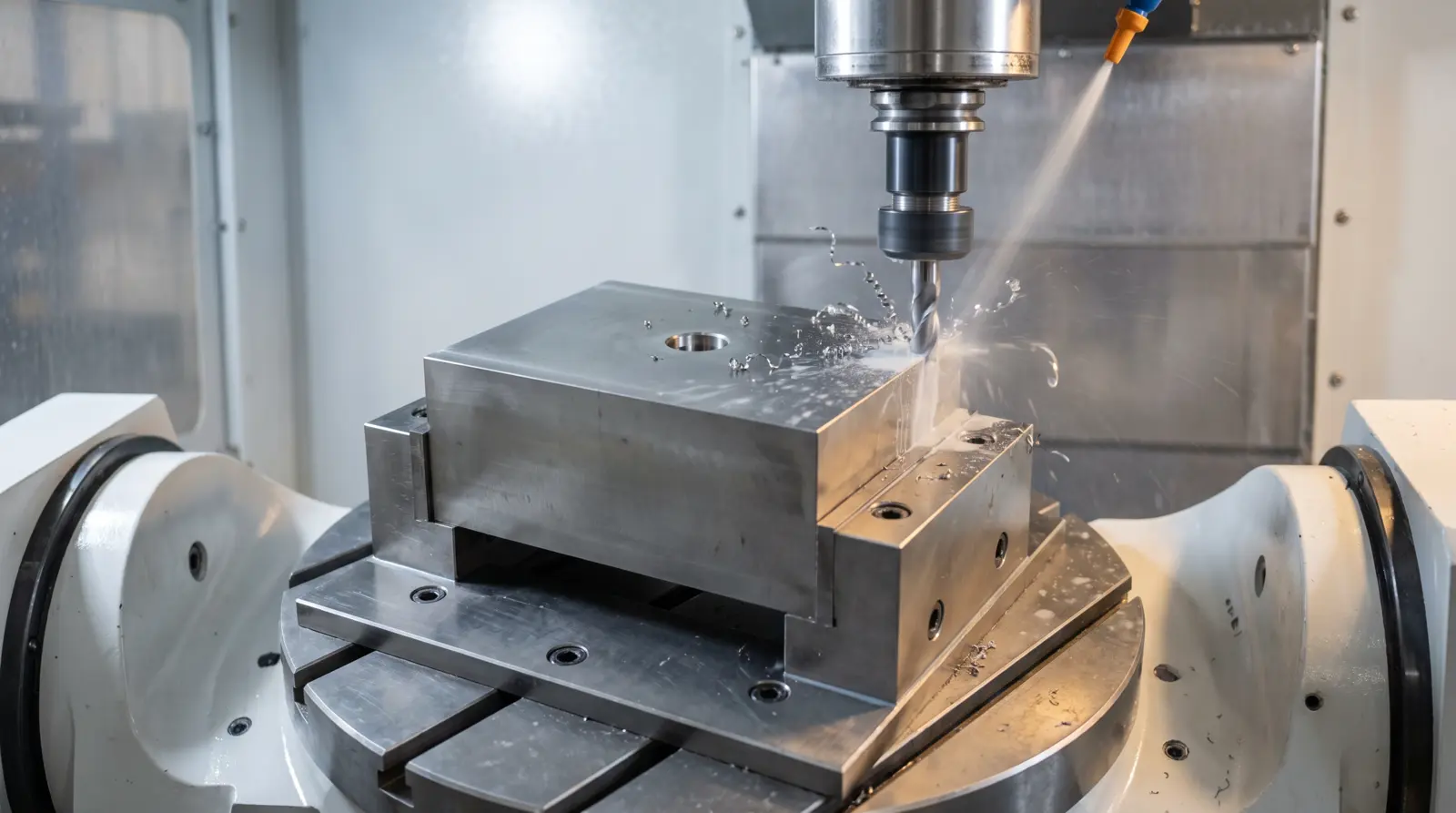
Aerospace CNC machining is subtractive manufacturing of flight hardware, where a programmed cutter removes material from solid stock until the part matches the CAD model. The defining feature is not the cutting. It is that the same program, the same fixture and the same inspection routine produce the same part on unit 500 as on unit one.
The machine follows a toolpath generated from your 3D model. Milling cuts flat faces, pockets and contours. Turning produces round features. Drilling and tapping create the holes and threads that hold the assembly together.
Axis count decides what is possible in one setup. A 3-axis machine cuts in X, Y and Z, which suits plates, covers and simple brackets. A 5-axis machine tilts and rotates the part, so a housing with angled bosses on four faces can be cut complete rather than moved between fixtures.
That matters more in aerospace than in most sectors. Every re-fixture introduces a new alignment error. A part machined complete in one setup carries one datum, not four.
Why precision and traceability matter in aerospace
Aerospace tolerances are tight because the parts are loaded, cycled and inspected for decades, and because nobody can service them in flight. A fastener hole that is slightly oversized does not fail on day one. It fails after 20,000 pressurisation cycles.
Three things drive the requirement. Fit, because assemblies are stacked and errors add up. Load, because a surface that is not flat concentrates stress at an edge. Weight, because designers pocket parts down to the minimum safe wall and then have no margin left for a machining error.
Traceability is the second half of the job and often the harder half. A machined aerospace part has to come with proof: which heat lot the bar stock came from, which machine cut it, who inspected it, and what the CMM actually read.
Meco supports this with material certificates, EN 10204 3.1 certification, traveler tracking, barcode and PDA logging, and full lot and serial trace. Non-destructive testing is available by ultrasonic, dye penetrant and X-ray where the drawing calls for it.
Why the paperwork is the deliverable
On a commercial part, the part is the deliverable and the report is admin. On an aerospace part it is closer to the reverse. A perfect part with an incomplete first article inspection record cannot be installed, and a supplier who treats documentation as an afterthought will be found out at the first audit.
Aerospace components produced by CNC machining
Most machined aerospace parts are small, structural and invisible: brackets, housings, fittings, mounts and linkages. They are rarely the parts in the brochure, and they are almost always the parts that hold the brochure parts on.
Structural brackets and fittings
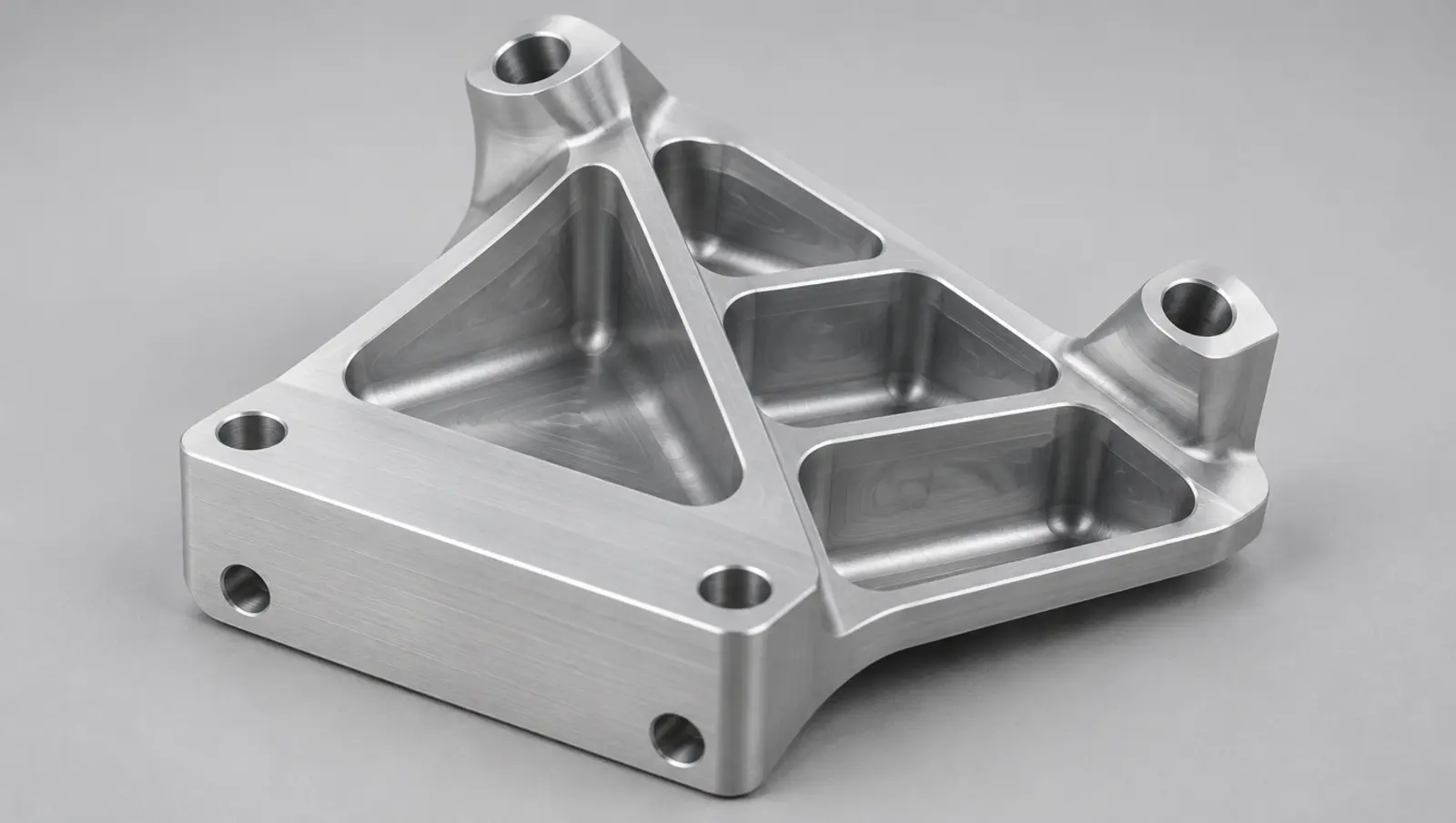
These look simple and are not. Aerospace brackets are pocketed hard to shave grams, which leaves thin webs that flex under cutting pressure. Holding ±0.01 mm on a 2 mm wall takes light cuts, good fixturing and a machinist who knows when to slow down.
Avionics and sensor housings
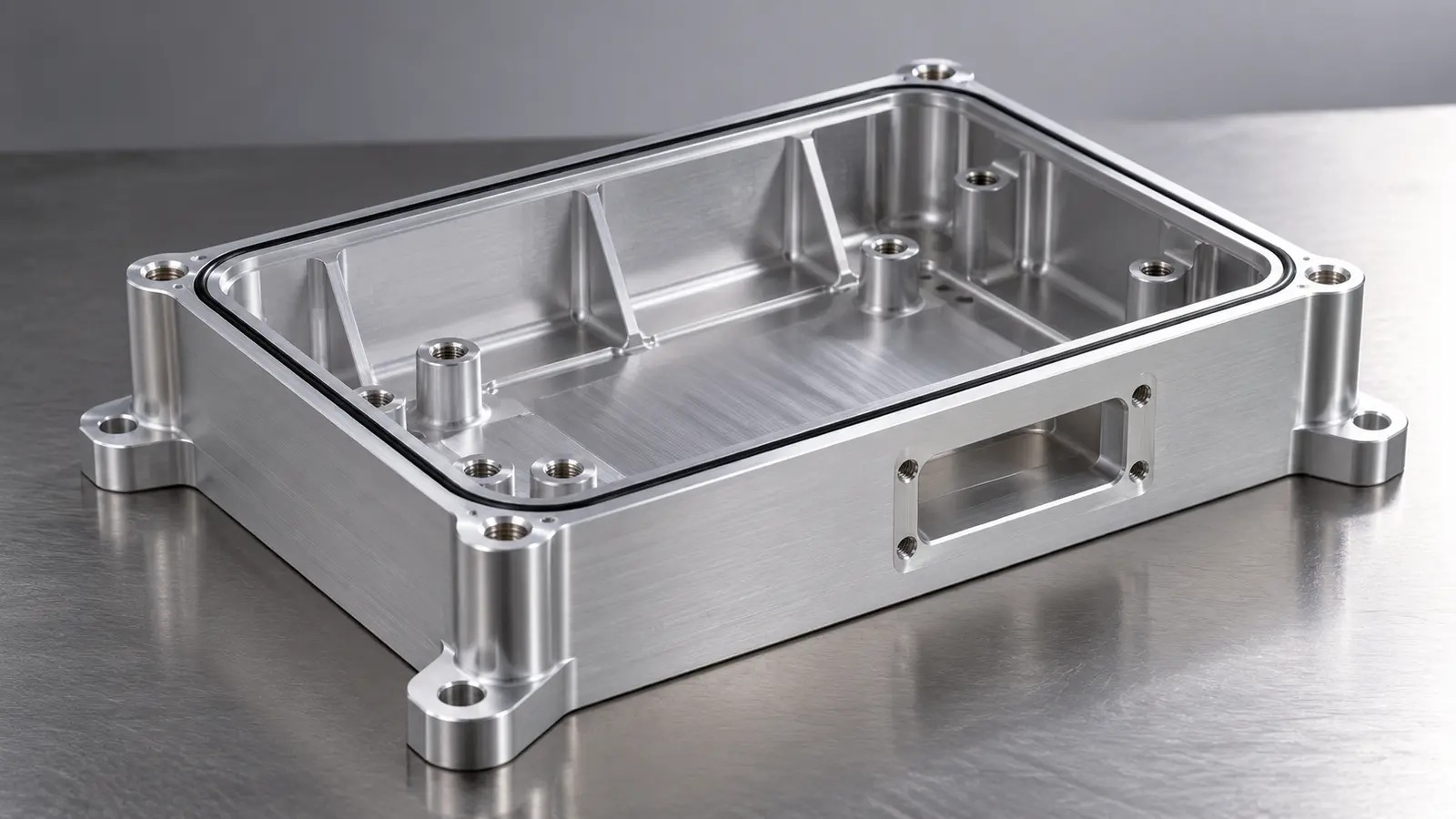
Housings combine a sealing face, a connector cutout and a set of mounting bosses that all have to relate to one datum. This is the classic case for 5-axis work, because moving the part between three fixtures stacks three separate errors into one seal groove.
Engine and propulsion hardware
Mounts, casings and interface rings run hot and carry load at the same time. The machining challenge is dimensional stability: the part has to hold its shape after stock removal relieves the residual stress in the billet, which is why heavy aerospace parts are often rough machined, stress relieved, then finish machined.
Flight control and linkage components
Clevises, levers and rod ends translate pilot input into surface movement. Clearance and concentricity drive the spec here, because slop in a linkage becomes lag in the control response.
| Component type | Typical material | Primary process | Why this route |
|---|---|---|---|
| Structural brackets and mounts | Aluminum, titanium | 5-axis CNC machining | Complex pockets on several faces, cut complete in one setup |
| Avionics and sensor housings | Aluminum, magnesium | CNC milling and drilling | Flat sealing faces and hole patterns on one datum |
| Round fittings, bushings, spacers | Stainless steel, titanium | CNC turning | Concentricity and surface finish on rotating features |
| Threaded interfaces and access panels | Aluminum, titanium | CNC tapping | Repeatable thread class on high-cycle fastener points |
| High-fatigue structural hardware | Steel, aluminum | Hot forging then machining | Grain flow follows the part shape, then machining sets the dimensions |
| Thin-wall and complex enclosures | Stainless steel, aluminum | Investment casting then machining | Near net shape cuts stock removal on awkward geometry |
| Panels, trays and sheet enclosures | Aluminum, steel | Laser cutting and CNC bending | Flat stock, low tooling cost, fast iteration |
| Welded frames and sub-assemblies | Aluminum, stainless steel | TIG welding then machining | Weld first, then machine the interfaces back into position |
| Design validation prototypes | Metal and engineering polymers | Metal 3D printing | Geometry proof in 3 to 7 days before committing to a tool |
| Post-process performance | All metals | Heat treatment and surface finishing | Sets final hardness, fatigue life and corrosion protection |
Materials used in aerospace CNC machining
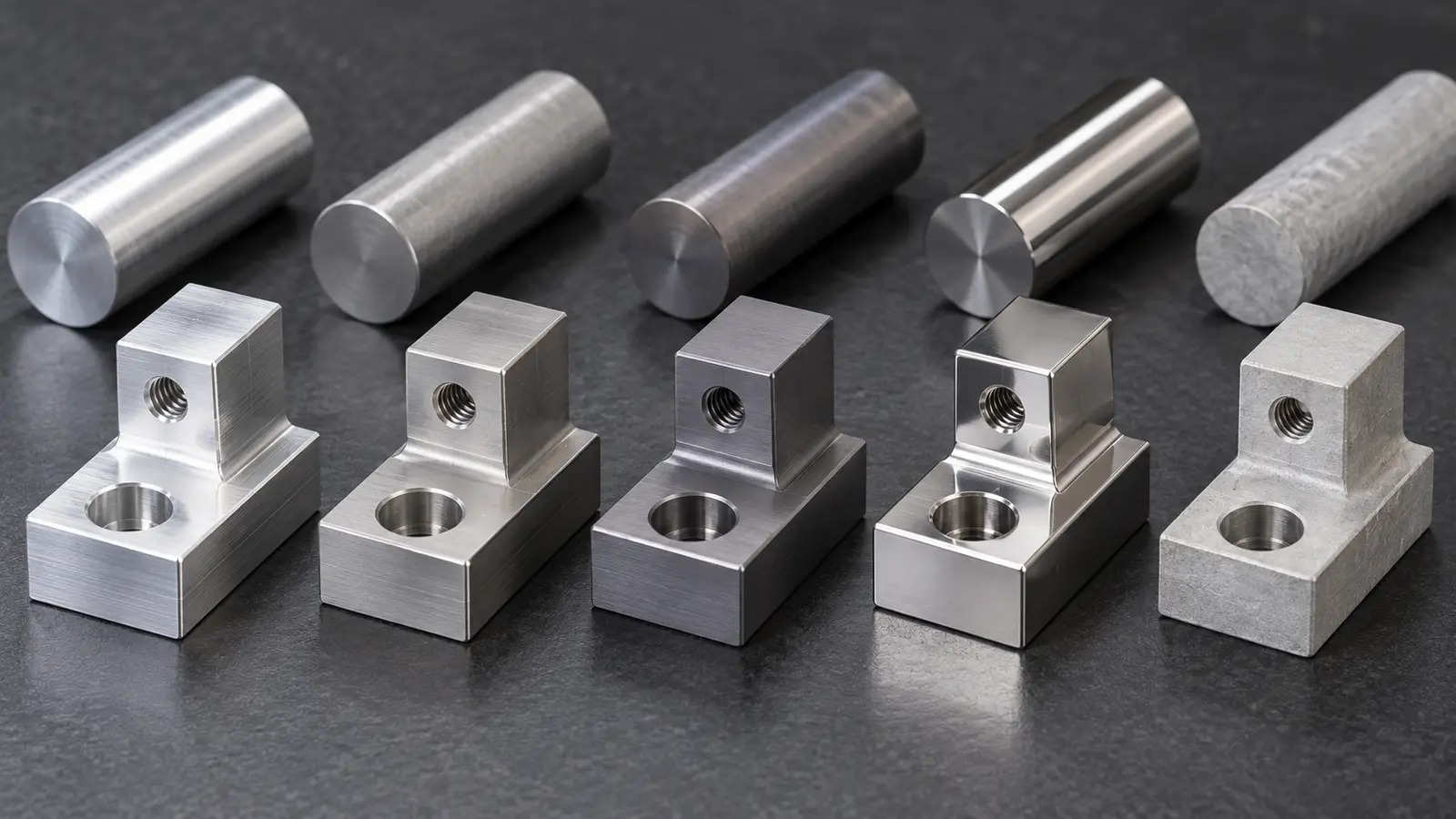
Aluminum and titanium account for most machined aerospace metal, with stainless steel used where strength and corrosion resistance matter more than weight. Material choice is a strength to weight decision first and a cost decision second.
Aluminum machines fast, which keeps the per-part price low. Titanium is roughly as strong as steel at about half the weight, but it cuts slowly and eats tooling, so the same geometry can cost several times more.
Meco runs ten metal families in house: aluminum, carbon steel, alloy steel, stainless steel, brass, bronze, copper, zinc, magnesium and titanium. Fifteen or more aluminum grades are active. Grade selection is worth doing properly at quote stage, because it moves both cost and lead time.
| Material family | Grades used in aerospace | Why it is chosen | Machined in house at Meco |
|---|---|---|---|
| Aluminum alloys | 6061, 7075, 2024 | Best strength to weight for the money, cuts fast, anodises well | Yes, 15+ grades active |
| Titanium alloys | Ti-6Al-4V is the industry workhorse | Steel-level strength at about half the weight, corrosion resistant, holds up hot | Yes, titanium is one of the ten families |
| Stainless steel | 316, 17-4 PH, 420 | High strength and fatigue life where weight is not the constraint | Yes |
| Magnesium alloys | AZ91D and similar cast grades | Lightest structural metal in common use, good vibration damping | Yes, mainly as cast then machined |
| Nickel superalloys | Inconel 625 and 718 | Keeps strength in hot section and exhaust environments | No. Not one of Meco's ten in-house metal families |
| High-performance polymers | PEEK, PA, POM | Insulating, light, low friction for non-structural hardware | Yes, PEEK is one of the eight core resins |
Tolerances, inspection and quality standards
Meco's standard machined tolerance is ±0.01 mm, tightening to 0.005 mm on selected key features, verified on a CMM accurate to ±0.002 mm. Those are three different numbers and they are often confused, so it is worth separating them.
The standard tolerance is what the process holds across the part. The key feature tolerance applies to a small number of critical dimensions, not to every dimension on the drawing. The CMM figure is measurement accuracy, which has to be several times tighter than the tolerance being checked or the measurement means nothing.
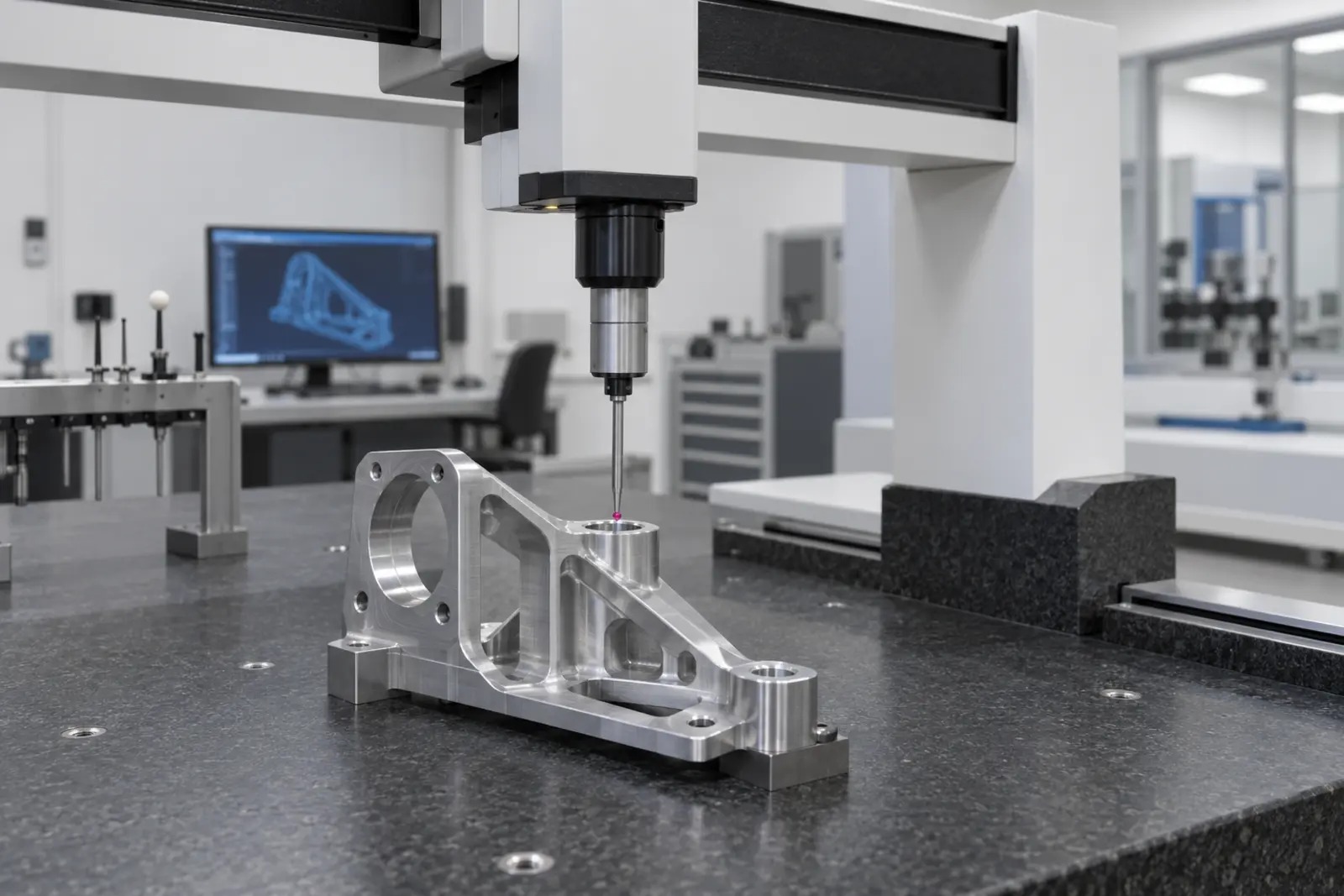
Where a drawing carries no individual tolerance, general tolerances under ISO 2768 apply. Choosing the right class matters, and over-specifying tolerances is one of the most common ways an aerospace part ends up costing twice what it needed to.
Surface finish carries its own callouts. Machined aerospace surfaces commonly sit around Ra 0.4 μm on sealing and bearing faces, and looser elsewhere. The surface finish chart sets out how those values map to process.
On the documentation side, Meco runs APQP, PPAP, SPC, PFMEA, FAIR and gauge R&R, with CTQ reporting, certificates of analysis, REACH and RoHS compliance and conflict minerals reporting available.
The AS9100 question, answered straight
Meco is certified to IATF 16949:2016. Meco is not certified to AS9100, is not certified to ISO 13485, and is not ITAR registered. We would rather you know that in paragraph one than find out during supplier onboarding.
What IATF 16949:2016 gives you is the automotive sector's top-tier quality management standard, which is built on and contains every ISO 9001:2015 requirement. It governs process control, risk reduction, traceability and continuous improvement, and Meco applies it across every industry and process.
What it does not give you is an AS9100 certificate. If your program requires one on the supplier, or requires an ITAR-registered source, Meco is not the right fit for that part and we will tell you at quote stage rather than at PPAP.
Where Meco does fit is the large volume of aerospace-adjacent work that needs aerospace-grade process discipline without an AS9100 flow-down: ground support equipment, tooling and fixtures, test rigs, interiors and non-flight-critical hardware, and prototype and qualification builds ahead of a certified production source.
Not sure your part fits? Send a STEP or IGES file with your target volume and tolerance callouts. You get a cost breakdown plus DFM notes back within 24 hours, and a straight answer on whether the certification route works.
Get DFM Feedback on Your DesignCNC machining vs casting, forging and 3D printing
Machining wins on accuracy and lead time. Casting and forging win on cost per part once volume passes roughly 1,000 units. In practice most aerospace parts use two processes, not one.
Against casting, machining gives tighter tolerances and no porosity risk inside the material. Die casting holds NADCA standard tolerances near ±0.010 in and needs 6 to 14 weeks including the tool, but drops to $1 to $10 per part at volume.
Against forging, the comparison is not really a contest. Forging aligns the grain structure with the part shape, which is why highly loaded aerospace hardware is forged. Then it gets machined, because forging alone will not hold a bearing bore.
Against additive, printing buys geometry that cannot be cut and prototypes in 3 to 7 days. Printed parts almost always need machining afterwards to bring mating faces, bores and threads into tolerance.
| Process | Typical tolerance | Ideal volume | Lead time | Best aerospace use |
|---|---|---|---|---|
| CNC machining | ±0.01 mm, ISO 2768 | 1 to 10,000 | 1 to 3 weeks | Brackets, housings, all finished interfaces |
| Investment casting | Near net shape per ICI | 500 to 50,000 | 6 to 12 weeks | Complex thin-wall shapes, then machined |
| Die casting | NADCA standard ±0.010 in | 5,000 to 1,000,000+ | 6 to 14 weeks | High volume aluminum enclosures |
| Hot forging | ASTM B247 / BS EN 10243 | 1,000 to 500,000+ | 6 to 12 weeks | Fatigue-critical structural hardware |
| Metal 3D printing | Post-machining required | 1 to 100 | 3 to 7 days for prototypes | Geometry validation before tooling |
What aerospace CNC machined parts actually cost
A low volume machined aerospace part typically costs $50 to $300, dropping to $15 to $50 above roughly 1,000 units. Machining carries almost no tooling cost, usually $0 to $1,000 for fixtures, which is why it beats every tooled process at low volume.
Machine time is the main driver. A 3-axis mill runs $30 to $75 per hour in North America, turning runs $50 to $110, and 5-axis runs $75 to $200 or more. Programming and setup is a one-time $50 to $1,000 per job, and secondary finishing adds $3 to $50 or more per part.
Worked example: a 5-axis avionics bracket, 25 pieces
Take a pocketed 6061 aluminum bracket that needs machining on four faces to one datum. Cut it in three setups on a 3-axis machine and you carry three alignment stack-ups. Cut it complete on 5-axis and you carry one.
| Cost line | Basis | Per part |
|---|---|---|
| Programming and setup | $400 for the job, spread over 25 pieces | $16 |
| 5-axis machine time | 0.6 hr per part at $75 to $200 per hour | $45 to $120 |
| Fixturing | $0 to $1,000, soft jaws in this case | Under $10 |
| Anodising | Secondary finishing, $3 to $50+ per part | $3 to $50 |
| Indicative total | Sits inside the published low volume band | $64 to $196 |
Two things fall out of that arithmetic. Setup dominates at 25 pieces and almost disappears at 500, which is why the same part lands in the $15 to $50 band at volume. And machine time, not material, is what an aggressive tolerance actually buys you.
For a full breakdown across processes, see the metal part cost guide, which covers tooling amortisation and break-even volume in detail.
Choosing an aerospace machining partner
Ask four questions: what tolerance you hold as standard, how you prove it, what happens when a part is out of spec, and whether your certifications actually match my program. Vague answers to any of these are the signal.
Ask for a real number on tolerance, not the phrase "tight tolerances". Ask what the CMM is accurate to, because a supplier measuring a ±0.01 mm feature with a ±0.01 mm instrument is guessing.
Ask about the second operation. Most aerospace parts need heat treatment or finishing after machining, and every handoff between vendors adds a week and a chance to lose traceability. Meco runs CNC machining, forging, casting, heat treatment, finishing and assembly under one roof, across 40+ processes.
Finally, ask about the path from first article to production. Qualification parts and production parts should come from the same process, not from a prototype shop and then a different factory. Moving from prototype to production is where most programs lose time.
Get your aerospace part quoted
Send the model and the volume, and you get real numbers back rather than a callback request. If the certification route does not work for your program, we will say so upfront.
- 24-hour quotes. Cost breakdown, not a single figure.
- DFM feedback with every quote. Typically 15 to 30 percent off part cost.
- IATF 16949:2016 certified. FAI, PPAP and CMM reports available.
- No minimum order. 1 prototype to 10 million pieces.
- 40+ processes under one roof. No vendor handoffs between operations.
Browse all 40+ processes, see our aerospace parts manufacturing work, or go straight to a quote.
Request a QuoteReferences and sources
Standards references verified against the issuing bodies on 11 September 2026.
- International Automotive Task Force. IATF 16949:2016. IATF Global Oversight.
- International Organization for Standardization. ISO 2768-1:1989, General tolerances, Part 1. ISO.
- North American Die Casting Association. Product Specification Standards for Die Castings. NADCA.
Cost figures are representative ranges based on Meco production data and are not quotations. Actual pricing depends on geometry, material, tolerance, finish and volume. This article is general information, not engineering or contractual advice.
