
We've watched customers throw away tens of thousands of dollars in tooling and scrapped parts because they specified the wrong material on round one. A drone startup last year shipped us a job in stainless steel that should have been aluminum. The part was three times heavier than it needed to be, took five times longer to machine, and they had to redesign the airframe to carry the extra weight.
This guide exists so you don't make that mistake. We'll break down every CNC machining material worth knowing in 2026, including what it costs, how fast it cuts, and what jobs it's actually good for.
No marketing speak. No vague "best for premium applications" filler. Just the real-world tradeoffs we use on our own shop floor every day.

What "Best Material" Actually Means in CNC Machining
"Best" isn't one answer. It's a balance between four things: how easy a material is to cut, how strong the finished part needs to be, how much the raw stock costs, and how the part will be used. A material that's perfect for a drone bracket is wrong for a surgical tool.
Machinists rank "easy to cut" using a number called a machinability rating. It's a percentage compared to a baseline material. Throughout this guide, we use the AISI B1112 free-cutting steel scale, where B1112 is set at 100%. The higher the number, the faster a CNC machine can cut it without wearing down tools or scrapping parts.
A note on machinability ratings
Different industries use different baselines. The aluminum industry sometimes scores 6061 at 360% on a 1112-steel scale, while the brass industry uses C360 = 100% as its own internal benchmark. We've standardised every number in this guide to the AISI B1112 steel = 100% scale so you can compare apples to apples. Source: Copper Development Association.
Here's the quick-pick view if you're in a hurry:
| If You Need… | Start With | Cost Tier |
|---|---|---|
| A light, cheap prototype | Aluminum 6061 | $ |
| Maximum strength, low weight | Aluminum 7075 or Titanium Grade 5 | $$$ to $$$$$ |
| Corrosion resistance | Stainless steel 316 or Titanium | $$$ to $$$$ |
| High-volume, fast-machining parts | Brass C360 | $$ |
| Electrical conductivity | Copper C110 | $$$ |
| Lightweight gears or bushings | Delrin (POM) | $ |
| High-heat plastic parts | PEEK | $$$$ |
The 5 Questions That Decide Your CNC Material
Before you pick a grade or compare prices, answer these five questions. We use this same checklist when our engineers review every customer drawing. It cuts hours off the back-and-forth.
1. What does the part need to do?
Is it a load-bearing bracket? A bushing that slides? A heat sink? An enclosure that just needs to look good? The part's job sets the floor for strength, stiffness, and wear resistance.
2. Where will it live?
Indoors, outdoors, saltwater, engine bay, sterilised lab? Operating environment decides corrosion resistance, heat tolerance, and whether you need a special finish. A part headed for a marine application can't be made from regular steel. It'll rust within months.
3. How many do you need?
Ten prototypes? Ten thousand production parts? For low volumes, CNC machining wins on every material. For very high volumes, you might switch to casting or stamping, but the prototype is still machined first. If pricing is a concern at scale, read our guide on how much CNC machining costs.
4. What's your budget per part?
Material cost is only part of the equation. A "cheap" material that machines slowly can be more expensive than a "pricey" one that cuts fast. Brass C360 is a perfect example. The raw stock costs more than aluminum, but the per-part labour can drop by half.
5. What finish do you want?
Polished, anodised, painted, raw? Some finishes only work with certain materials. You can anodise aluminum and titanium, but not stainless steel. Plan finishing into your material choice from day one.
Best Metals for CNC Machining
Metals make up roughly 80% of what runs through a CNC shop. Here's the short list of every machinable metal worth knowing, what it costs, and what it's actually good at.
Aluminum: The Default Choice
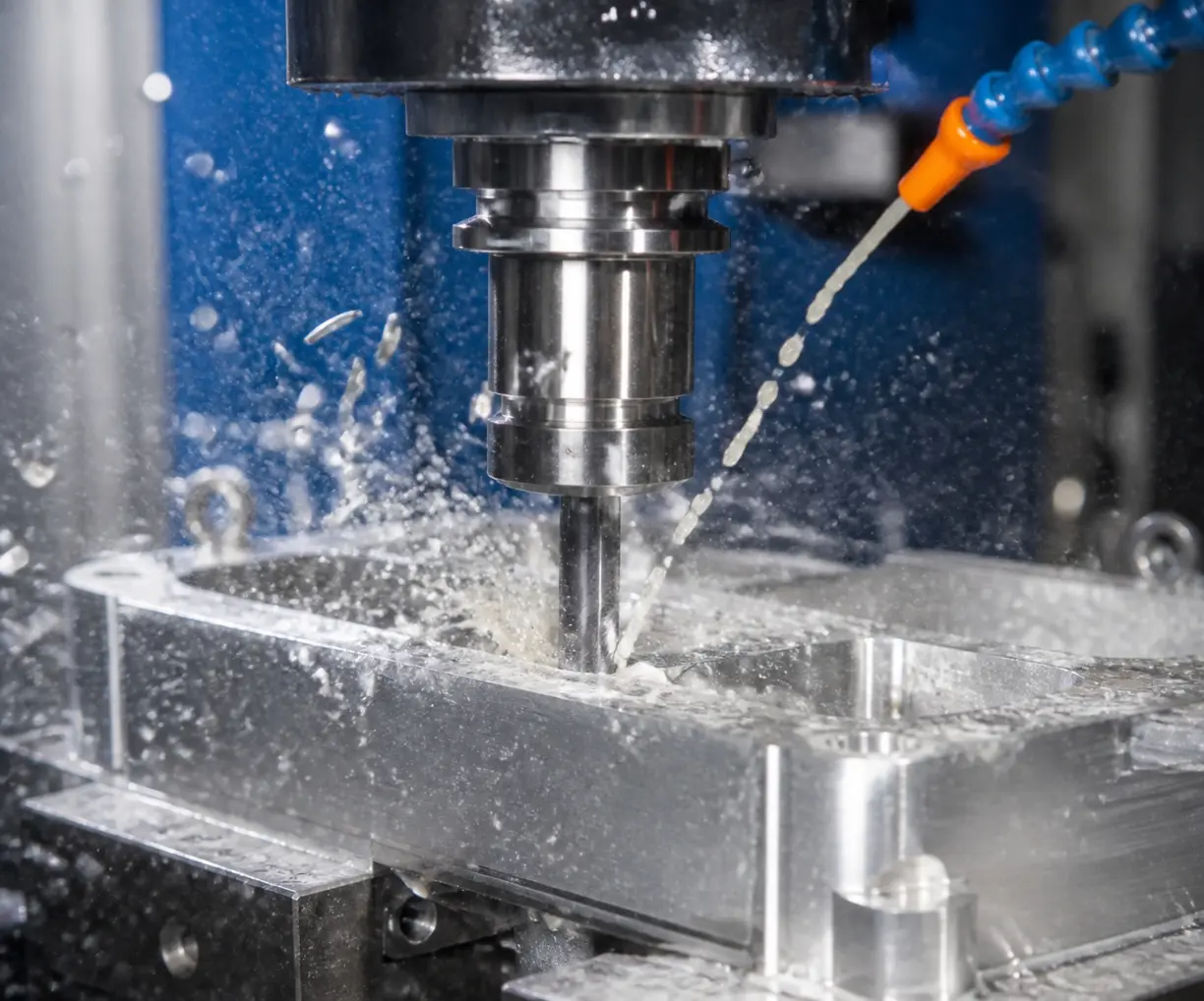
If you're not sure where to start, start here. Aluminum is the most common metal we machine, full stop. It's light, corrosion-resistant, easy to cut, and friendly on tool life.
Aluminum 6061 is the workhorse. It's the best aluminum for CNC machining when you want a balance of strength, cost, and machinability. You'll find it in housings, brackets, fixtures, drone frames, and prototypes. It also welds well and takes anodising beautifully.
Aluminum 7075 is the high-strength cousin. It's used in aerospace structures, performance bike parts, and military gear. Strength rivals some steels at a third of the weight. Downside: it costs more and isn't as weldable as 6061.
Aluminum 5052 shines when you need formability and seawater resistance. It's the alloy of choice for marine fittings and pressure vessels.
Engineer's tip: When 6061 is gummy, switch to 7075
6061 is famous for being "gummy." The chips don't break cleanly, which slows everything down on small precision parts. If you're chasing tight tolerances on a small lot, 7075 chips like a dream and finishes cleaner. You'll pay more for the bar stock, but the finished part may actually cost less.
Stainless Steel: When You Need It to Last
Stainless steel handles harsh environments without rusting. It's the right call for food, medical, marine, and chemical applications. The trade-off is that it's harder to cut than aluminum and wears tools faster.
304 is the default grade. Machinability rating around 45% (on the B1112 scale). Good corrosion resistance, weldable, affordable. Used in food equipment, kitchen hardware, and general industrial parts.
316 handles saltwater and chemicals better than 304 thanks to added molybdenum. Machinability drops to around 36%. It's the standard for marine fittings and surgical instruments. Pay 20 to 30% more than 304 and expect slower cycle times.
303 adds sulfur for better stainless steel CNC machining speed (machinability around 78%). Use it for high-volume parts like fasteners and bushings where you can sacrifice a little corrosion resistance.
17-4 PH is the heavy hitter. It can be heat-treated to very high strength while staying corrosion-resistant. You'll see it in turbine blades, valve bodies, and aerospace fittings.
Mild & Alloy Steel: The Workhorses
Steel is the cheapest way to get serious strength. The catch is it rusts unless you plate, paint, or galvanise it. That's why we usually pair steel parts with a surface finish like zinc plating or powder coat.
1018 mild steel is general-purpose, weldable, and easy to machine (around 78% machinability). Great for jigs, shafts, and machinery parts.
1045 is a step up in strength and is often used for shafts and gears that need to take real load.
4140 alloy steel is the toughness upgrade. It machines well (around 65%), heat-treats well, and handles fatigue. You'll find it in axles, drivetrain parts, and tooling.
4340 climbs higher in strength and is the go-to for aircraft landing gear and heavy industrial parts. After machining, most steel parts go through heat treatment to lock in the final mechanical properties.
Brass: The Most Machinable Metal on the Bench
Brass C360 has a machinability rating of around 300% on the B1112 scale, making it the easiest metal to CNC machine. Period. It cuts like butter, holds tight tolerances, and produces a beautiful golden finish without any secondary work.
Brass machining is the right answer for plumbing fittings, electrical connectors, decorative hardware, and any high-volume part where cycle time matters. The downside is that brass is heavy and not strong enough for structural work.
If you want maximum throughput on a turning centre, this is the material. A skilled programmer can run brass C360 about three times faster than aluminum 6061 on the same machine.
Copper: When Conductivity Wins
Copper conducts heat and electricity better than almost any other commercial metal. C110 (electrolytic tough pitch copper) is the workhorse, with about 101% IACS electrical conductivity. You'll see it in bus bars, heat exchangers, electrical contacts, and high-power electronics.
The trade-off: copper is gummy and tricky to machine (rating around 20%). Sharp tools, high speeds, and good coolant are non-negotiable. Cost factor versus mild steel is roughly 3x.
Titanium: Premium Performance, Premium Price
Titanium has the best strength-to-weight ratio of any common machinable metal. It's also corrosion-resistant, biocompatible, and able to handle high heat. That's why titanium CNC machining is standard in aerospace, defence, and medical implants.
Grade 2 is commercially pure titanium. Softer, more formable, used in chemical and marine work.
Grade 5 (Ti-6Al-4V) is the famous aerospace alloy. Strong, light, and biocompatible. Used in jet engine components, surgical implants, and high-performance brackets. Machinability rating is roughly 22%.
Why is titanium hard to machine? Three reasons: it's strong even when hot, it doesn't conduct heat well (so the cutting edge gets cooked), and it work-hardens fast. Expect cutting speeds about one-fifth of what you'd run on steel. Plan for it in the quote.
Best Plastics for CNC Machining
Plastic isn't just for prototypes anymore. Engineering plastics deliver real performance (wear resistance, chemical resistance, electrical insulation) at a fraction of the weight of metal. Here are the CNC plastic materials worth knowing, in the order you should think about them.
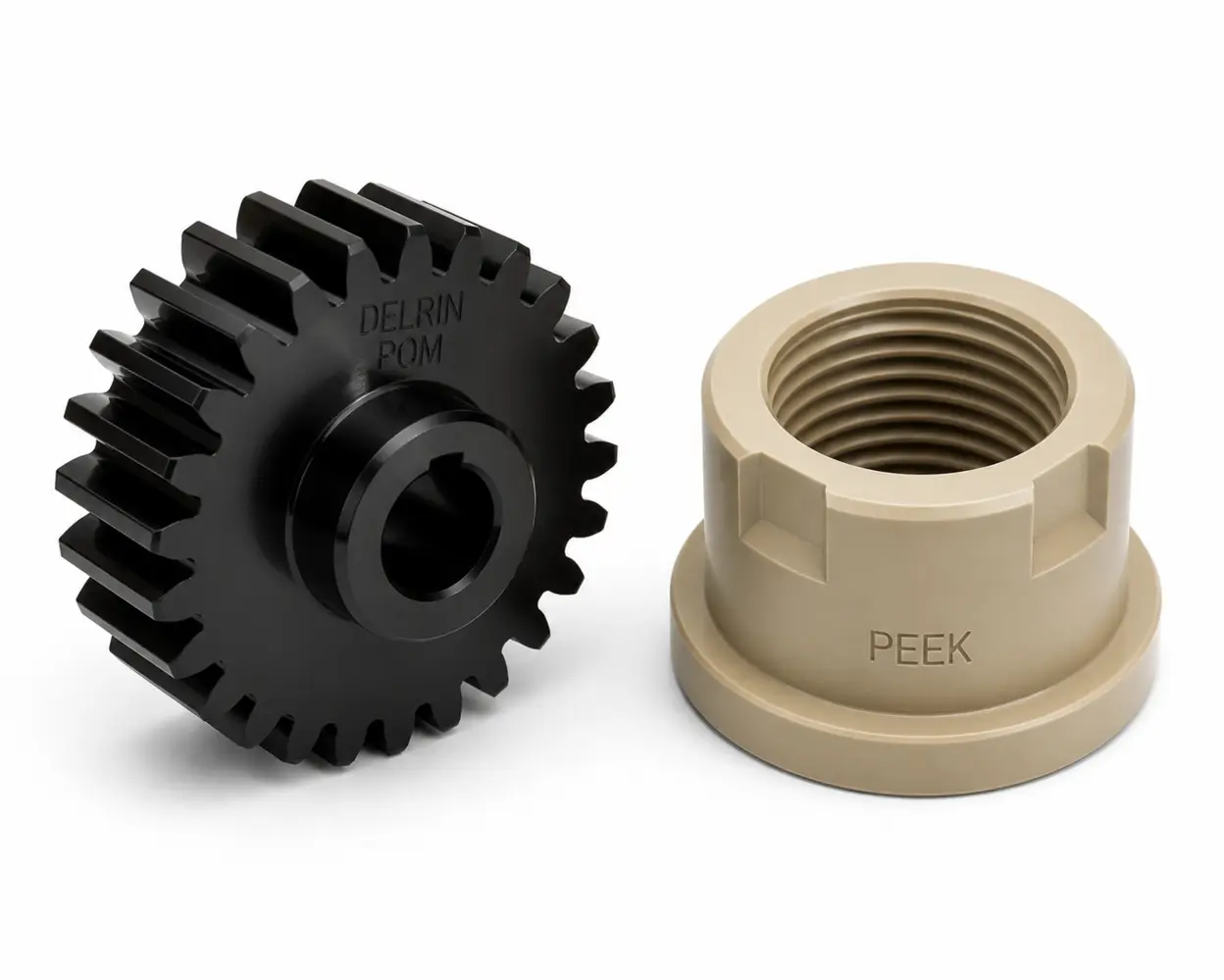
Delrin (POM): The Most Underrated Material in CNC Machining
Here's a take you won't read on most other manufacturer blogs: Delrin is the most underused material in modern CNC shops. Most designers default to aluminum out of habit. For a huge category of parts (gears, bushings, snap-fits, low-load brackets, slides), Delrin is cheaper, lighter, faster to machine, and self-lubricating.
Delrin POM CNC machining produces some of the cleanest, most precise plastic parts you'll ever see. It's stiff, low-friction, dimensionally stable, and barely absorbs water. The chips break clean. The surface comes off the cutter looking finished. You can hold tolerances close to what you'd get on metal.
We had a customer in 2025 who came to us with a small mechanical assembly originally specified in 6061. After our DFM review, we recommended swapping four of the eight components to Delrin. Same fit, same function, 40% lower part cost, and 60% less weight. The only reason they hadn't done it themselves was that nobody on their team had thought to question the original "default to aluminum" call.
Use Delrin for gears, bushings, cams, sliding parts, snap-fits, and small mechanical components where you don't need ultimate strength or high-temperature performance.
Nylon (PA6, PA66): Tough and Wear-Resistant
Nylon is tougher than Delrin and handles impact better. The catch is it absorbs moisture, which causes dimensional changes over time. A nylon part that fits perfectly in a dry climate may swell out of spec in a humid environment. Use it for impact-loaded parts, cable guides, bearings, and rugged housings where a small amount of dimensional drift is acceptable.
Glass-filled nylon (30% glass fibre is common) bumps stiffness and dimensional stability significantly, at the cost of being slightly harder on tooling.
PEEK: When Plastic Needs to Behave Like Metal
PEEK CNC machining is what you reach for when you need a plastic that can handle 250°C operating temperatures, harsh chemicals, and high mechanical stress. It's biocompatible, so it's also a favourite for medical implants and surgical instruments. PEEK is also a common replacement for metal in weight-critical aerospace applications.
The catch is cost. PEEK bar stock is roughly 50 to 100 times more expensive than aluminum on a per-pound basis. A small medical-grade PEEK part can hit $80 to $200 just in raw material. Use it where its properties earn their keep, and don't use it for anything a cheaper engineering plastic can handle.
One more note: PEEK comes in unfilled, glass-filled, and carbon-filled grades. The filled grades add stiffness and wear resistance but reduce machinability and cost more.
PTFE (Teflon): Slippery, Chemical-Proof, Heat-Tolerant
PTFE has the lowest coefficient of friction of any solid known to engineering, and shrugs off almost every chemical. Use it for seals, gaskets, electrical insulators, valve liners, and chemical-handling parts. It can run continuously at temperatures up to 260°C, which is higher than almost any other common plastic.
The trade-offs: PTFE is soft (don't expect it to hold heavy loads), creeps under sustained pressure, and is harder to machine to tight tolerances than Delrin because it deflects under cutting force. Plan on slightly looser tolerances for PTFE than you'd target on POM or PEEK.
ABS, Polycarbonate & PMMA: The Prototyping Trio
These three are the everyday plastics. ABS is cheap and impact-resistant, perfect for enclosure prototypes that will eventually be injection moulded. Polycarbonate is tougher, clearer, and handles higher temperatures. PMMA (acrylic) is optically clear and used for light pipes, display covers, and lenses where you need transparency at a low cost.
One word of caution: PMMA chips and cracks easily when machined. It needs sharp tools, light cuts, and an experienced operator to come off the spindle without micro-fractures.
The Master Comparison Table
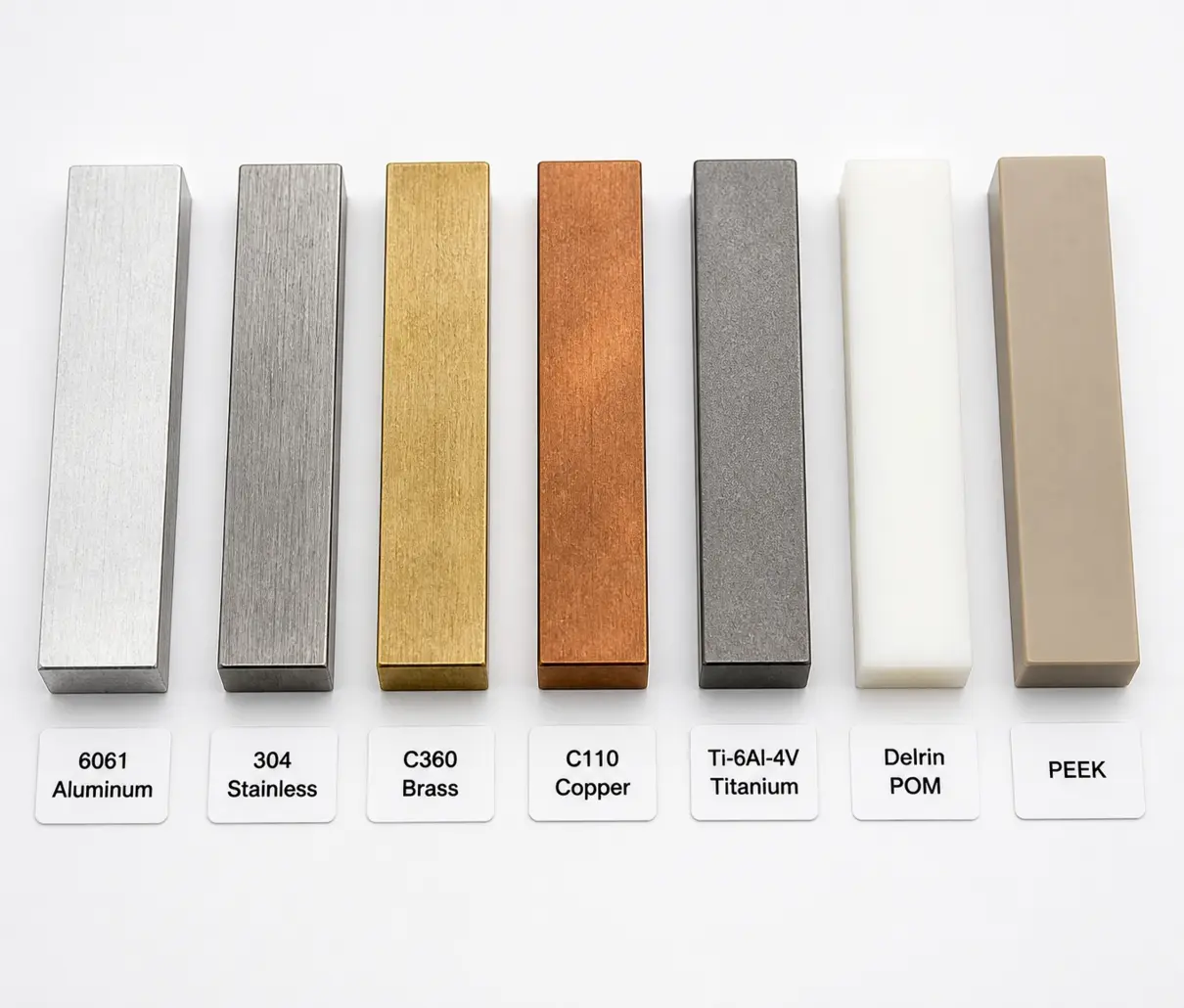
One table with everything in one place. Use it as a quick reference before you spec your next part. Source data is pulled from MatWeb, the Copper Development Association, and our own shop floor records. All machinability ratings use the AISI B1112 = 100% baseline.
| Material | Machinability (B1112=100) | Strength | Cost Tier | Best For |
|---|---|---|---|---|
| Aluminum 6061 | ~190% | Medium | $ | General purpose, prototypes, housings |
| Aluminum 7075 | ~190% | High | $$$ | Aerospace, performance parts |
| Stainless 304 | ~45% | High | $$$ | Food, medical, general industrial |
| Stainless 316 | ~36% | High | $$$$ | Marine, chemical, surgical |
| Stainless 303 | ~78% | High | $$$ | High-volume fasteners, bushings |
| Mild Steel 1018 | ~78% | Medium | $$ | Jigs, shafts, machinery |
| Alloy Steel 4140 | ~65% | High | $$$ | Drivetrain, tooling |
| Brass C360 | ~300% | Medium | $$ | Fittings, connectors, high-volume |
| Copper C110 | ~20% | Low-Medium | $$$ | Bus bars, heat sinks |
| Titanium Grade 5 | ~22% | Very High | $$$$$ | Aerospace, medical implants |
| Delrin (POM) | Excellent | Medium | $ | Gears, bushings, precision plastics |
| Nylon (PA66) | Very Good | High | $$ | Wear parts, housings |
| PEEK | Good | High | $$$$$ | Medical, aerospace, high-heat |
| PTFE (Teflon) | Fair | Low | $$ | Seals, insulators, chemical parts |
Don't Forget the Hidden Cost: Secondary Operations
Here's a trap we see customers fall into all the time. They pick a material based purely on the price of the bar stock, and they forget that material choice cascades into every operation downstream. By the time a part is finished, the "cheap" material is often the most expensive one.
A few real-world examples we deal with weekly:
- Anodising aluminum 6061 adds roughly $2 to $5 per part for Type II clear, and more for hard anodise (Type III). If your design calls for hard anodise, plan that into the quote from day one.
- Zinc plating mild steel adds another $1 to $4 per part, plus a few days of lead time. Skip it, and an outdoor part will start rusting in weeks.
- Heat treating 4140 to get it to its rated strength adds $3 to $10 per part. The "cheap" alloy steel is only cheap if you don't actually need its rated mechanical properties.
- Polishing stainless 316 to a mirror finish for a medical application can double the per-part cost.
The lesson is simple. When you're comparing two materials, compare the total finished cost, not just the raw stock price. Our quoting team factors all of this in automatically. If you want a deeper dive, our surface finishing services page walks through every coating we offer with material compatibility notes.
Materials We'd Talk You Out Of
Every guide tells you what to use. Almost none tell you what to avoid. Here are the most common material specs we push back on during DFM review, and what we usually recommend instead.
Bad calls we see every month
- Cast iron for prototype parts. It's hard on tools, dusty to machine, and the porosity makes tight tolerances unreliable. Use 1045 steel or ductile iron instead.
- PTFE for structural parts. It looks like a tough plastic on the spec sheet, but it creeps under load and won't hold a thread. Use Delrin or glass-filled nylon if you need stiffness with chemical resistance.
- Raw mild steel for any outdoor part. It will rust. Either spec a stainless grade or plan for zinc plating, e-coat, or powder coat as part of the quote.
- 316 stainless when 304 would do. A surprising number of customers default to 316 because it "sounds better." If your part isn't seeing saltwater or aggressive chemicals, 304 is 20 to 30% cheaper and machines significantly faster.
- Titanium for parts that don't need it. Titanium is expensive, slow to machine, and overkill for 90% of applications. Unless you have a hard requirement for strength-to-weight, biocompatibility, or extreme corrosion, use aluminum 7075 instead.
- PEEK for prototypes. It's biocompatible and high-temp, but at $200 per pound, you're burning budget. Prototype in Delrin or nylon, then switch to PEEK for production if you actually need its properties.
Matching Materials to Your Industry
Every industry has its favourites. The right answer for an aerospace bracket is the wrong answer for a kitchen appliance. Here's how it usually breaks down on our shop floor.
| Industry | Most-Used Materials | Why |
|---|---|---|
| Automotive | Aluminum 6061, 4140 steel, brass | Mix of light weight and high strength |
| Aerospace | Aluminum 7075, Titanium Grade 5, 17-4 PH stainless | Strength-to-weight is king |
| Medical | Stainless 316, Titanium, PEEK, Delrin | Biocompatibility and sterilisation |
| Consumer Electronics | Aluminum 6061, copper, ABS, polycarbonate | Cost, conductivity, cosmetics |
| Heavy Equipment | 4140 steel, 304 stainless, cast iron | Strength and durability over weight |
| Food & Beverage | Stainless 304/316, Delrin, PTFE | Hygiene and washdown resistance |
Our team has spent 30+ years building parts across all of these industries. We've watched the same patterns hold up time and time again. Start with these defaults, then tweak only when you have a specific reason.
How Meco Helps You Pick the Right Material
Honestly, this is the part most articles get wrong. They list materials and stop there. But picking the material is only the first decision. You also need the right partner to actually cut it.
Some shops are fantastic at aluminum and don't touch titanium. Some can run brass C360 all day and struggle with thin-wall stainless. The wrong shop on the right material still gets you a bad part.
When to bring in a turnkey partner
If your part will move from prototype to production, or needs more than one process (machining plus finishing plus assembly), a single accountable partner saves weeks of coordination. Meco runs custom CNC machining alongside 40+ other processes under one roof, with IATF 16949:2016 certified quality and a guaranteed quote in under 24 hours.
We've machined every material in this guide for OEM customers across 10+ industries. When you send us a drawing, our engineering team reviews it for material suitability, tolerance feasibility, and cost. You get DFM feedback with every quote, not after you've already paid for tooling.
If you're still narrowing down your options, read our companion guide on how to choose a CNC machining partner, or check the CNC machine cost breakdown for the equipment side of the equation.
Frequently Asked Questions About CNC Machining Materials
What is the best material for CNC machining?
For most projects, aluminum 6061 is the best starting point. It's affordable, lightweight, corrosion-resistant, and easy to machine, which keeps cycle times short and tool wear low. When the part needs more strength, switch to 7075 aluminum or stainless steel. For specialty needs like high heat or biocompatibility, look at titanium or PEEK.
What is the easiest metal to CNC machine?
Brass C360 is the easiest metal to CNC machine, with a machinability rating around 300% on the AISI B1112 baseline. It cuts fast, holds tight tolerances, and produces a clean finish straight off the tool. Aluminum 6061 is a close second and is the default choice when weight or cost is more important than cycle time.
Is brass easier to machine than aluminum?
Yes, brass C360 is easier to machine than aluminum 6061 on a per-cycle basis. Brass chips break cleaner, the cutter runs faster, and the surface finish needs less secondary work. The trade-off is that brass costs more per pound and is roughly three times heavier than aluminum, so the choice depends on whether speed or weight matters more for your part.
What is the best plastic for CNC machining?
Delrin (POM) is the best plastic for CNC machining when you want precision and a clean surface finish. It's stiff, low-friction, dimensionally stable, and machines almost as cleanly as metal. For high-temperature or biocompatible applications, PEEK is the premium choice. For low-cost prototype housings, ABS and polycarbonate are the standard picks.
What's the difference between 6061 and 7075 aluminum?
Aluminum 6061 is cheaper, more weldable, and great for general-purpose parts. Aluminum 7075 is significantly stronger (close to mild steel strength) but costs more and isn't easily welded. Use 6061 for housings, brackets, and prototypes. Switch to 7075 when you need maximum strength-to-weight, like in aerospace structures or performance components.
Can stainless steel be CNC machined?
Yes, stainless steel is routinely CNC machined, but it's slower and harder on tools than aluminum or brass. Grade 304 is the most common and machines reasonably well at about 45% machinability rating. Grade 316 is harder to cut but resists saltwater and chemicals far better. Free-machining 303 is the right pick for high-volume parts where speed matters more than corrosion resistance.
Why is titanium hard to machine?
Titanium is hard to machine for three reasons. It stays strong even at high temperatures, so cutters can't soften it easily. It has poor thermal conductivity, so heat builds up at the cutting edge and shortens tool life. And it work-hardens fast, meaning the surface gets harder the more you cut it. Expect cutting speeds of roughly one-fifth of what you'd run on steel.
What is the cheapest material for CNC machining?
Aluminum 6061 is usually the cheapest material for CNC machining when you combine raw stock cost and machining time. ABS and Delrin are cheaper per pound but only suit certain applications. Mild steel 1018 is inexpensive as raw material but needs a surface finish to prevent rust, which adds cost downstream.
What does a machinability rating actually tell you?
A machinability rating is a percentage comparing how easy a material is to cut against a baseline (usually AISI B1112 free-cutting steel at 100%). A higher number means faster cutting speeds, longer tool life, and lower per-part cost. Brass C360 rates around 300%. Aluminum 6061 rates around 190%. Titanium Grade 5 drops to about 22%. The rating is a strong starting clue, but real-world cost also depends on part geometry and finish requirements.
How do I choose the right CNC material for my part?
Answer five questions in order: what does the part need to do, where will it operate, how many do you need, what's your per-part budget, and what surface finish do you want. The answers will narrow your options to two or three candidates. From there, compare machinability ratings, cost tiers, and finish compatibility to make the final call. When in doubt, send the drawing to a manufacturing partner for DFM feedback before you commit.
Not Sure Which Material Fits Your Part? Let Meco's Engineers Recommend One.
Picking the right material is half the battle. The other half is finding a shop that can actually cut it to spec, on time, at the right price.
With 30+ years of turnkey manufacturing experience and IATF 16949:2016 certified quality, Meco machines every material in this guide, from aluminum 6061 prototypes to titanium aerospace brackets.
- 40+ In-House Processes: Custom CNC machining, turning, milling, 3/4/5-axis, surface finishing, heat treatment, and full assembly under one roof.
- IATF 16949:2016 Certified: Automotive-grade quality applied across every industry. 99.99% quality rate. 99.8% on-time delivery.
- DFM Feedback With Every Quote: Our engineers review your drawing for material, tolerance, and cost before you commit. Quotes back in under 24 hours.
- Prototype to Mass Production: From 10 pieces to 10 million+. No minimum order quantities.
- Global Logistics: Warehousing in the U.S. (Ohio and Florida), Canada, Japan, and Thailand. JIT and VMI programs available.
Send us your CAD file and we'll tell you which material makes the most sense, and what it'll cost.
Request a Quote Today