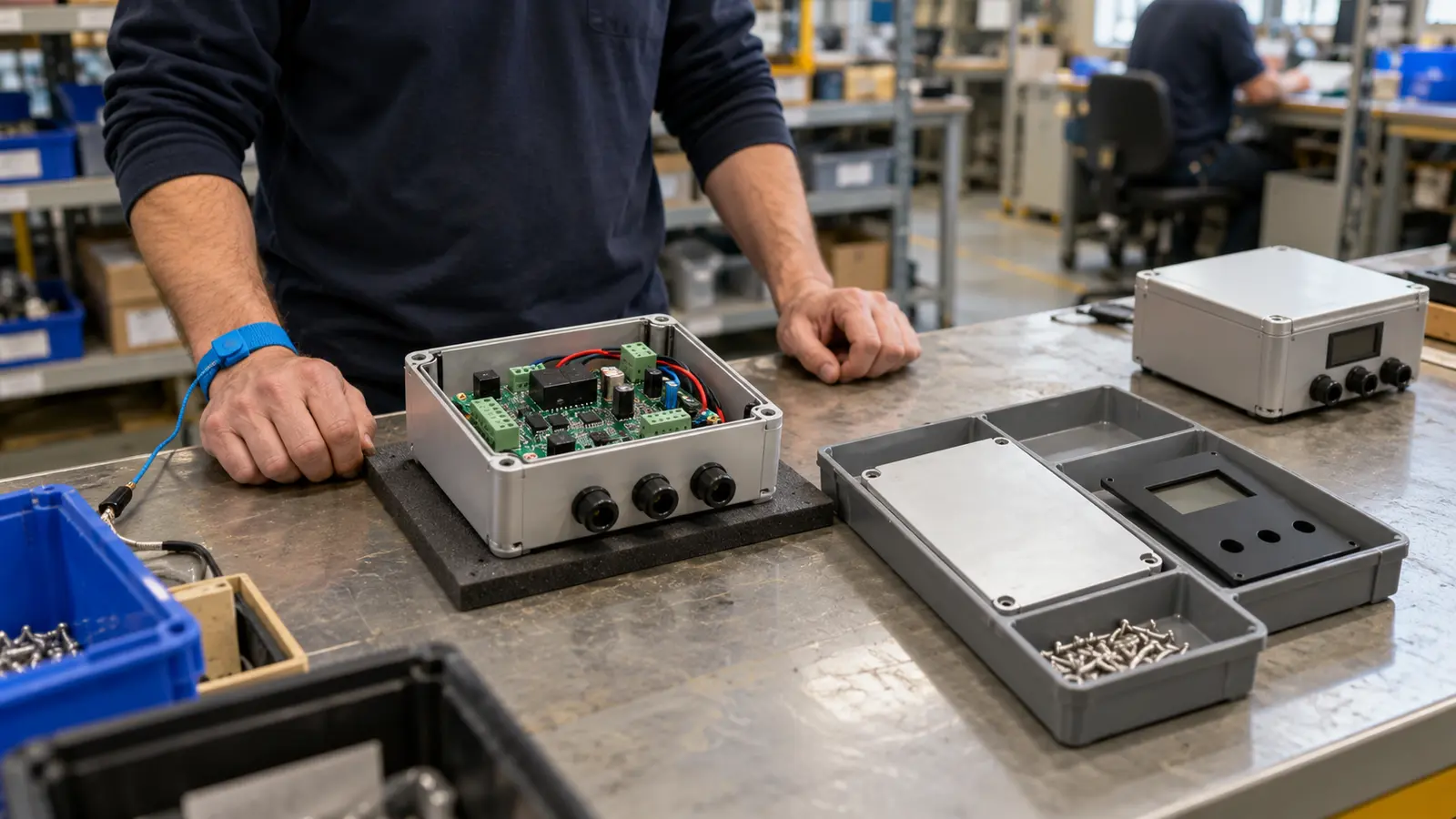
Turnkey manufacturing means one supplier manages the agreed product build, from design review and sourcing through production, assembly and delivery, under one contract.
It suits products that need several processes coordinated on one schedule. Confirm the scope, approval gates, ownership terms and total cost before committing.
Key takeaways
- One contract, clear scope. Define the finished product and who owns each stage.
- Six stages, planned approvals. Link design, sourcing, tooling, production, assembly and delivery.
- Compare the full cost. Include tooling, unit price, tests, packaging and supplier handoffs.
- Check the partner. Verify process coverage, quality records and ownership terms.
- Protect your design. Meco signs an NDA before files are shared and keeps your design and tooling yours.
What Is Turnkey Manufacturing?
Turnkey manufacturing means one supplier manages the agreed build from design review and sourcing through production, assembly and delivery. You use one contract instead of coordinating a separate supplier for each stage.
You will also see the term written as turn-key manufacturing, with a hyphen. Both spellings describe the same model: the buyer "turns the key" on a finished, ready-to-sell product instead of managing the build themselves.
Five or six vendors create several possible points of failure. A handoff may be missed, quality standards may differ, or shipping may slip. The buyer has to resolve those gaps.
A turnkey contract puts the agreed specification and finished build with one partner. One contact answers for the whole product, rather than just one step. That makes responsibility clearer, though the contract and controls still matter.
According to HTF Market Intelligence’s November 2025 report, the global turnkey manufacturing solutions market was valued at $88.2 billion in 2024. The report forecasts $166.4 billion by 2033 and lists an 8.10% compound annual growth rate. Those are the publisher’s estimates, offering context for demand for a single manufacturing partner.
Turnkey describes the agreed manufacturing scope, while OEM and ODM describe different product and design relationships. An original equipment manufacturer (OEM) relationship can use a customer’s design; an original design manufacturer (ODM) may supply its own design. The contract manufacturer, OEM and ODM comparison explains those distinctions, so do not treat turnkey and OEM as mutually exclusive models.
Turnkey Manufacturing Definition and Meaning
Turnkey centers on single-source accountability for the agreed finished product. The contract defines who owns each stage and what must be approved.
The turnkey manufacturing definition centers on one idea: a single supplier owns every step needed to turn a design file into a finished product. That supplier manages sourcing, tooling, production, quality control, and shipping under one contract and one quality system.
In plain terms, turnkey means the supplier manages the agreed build, rather than leaving you to coordinate a separate assembler, packaging vendor and freight forwarder. You still own the product requirements and approvals. Agree the scope so both sides know what "finished" includes.
The turnkey manufacturing meaning traces back to construction and real estate, where a "turnkey" building was handed over ready to occupy. Manufacturing borrowed the term for the same reason: the product arrives ready to sell, not ready for the next vendor in line.
Build-to-print is another model buyers compare with turnkey. A build-to-print supplier follows the drawing for the stated part or scope. The brief may not include design input.
Turnkey adds a broader build scope. The supplier reviews the design, sources materials and parts, and manages the agreed result through delivery. A drawing is still essential, but the job does not stop at making the part.
The Six-Stage Turnkey Manufacturing Process
The usual sequence is design review, sourcing, tooling and samples, production, assembly and quality checks, then packing and delivery. Approval gates keep each stage tied to the agreed specification.
The process usually follows these six stages, from design review to delivery. Suppliers may use different names for the stages. Keep the approvals and handoffs clear so a missed step does not delay the build.
- Design and engineering review: the supplier checks your CAD files for manufacturability and flags design changes that cut cost or improve strength. This step often catches wall-thickness, draft-angle, or tolerance issues before they turn into scrapped tooling.
- Material and vendor sourcing: the supplier selects alloys, resins, and any bought-in components, then locks in supply. Locking sourcing early protects the production schedule from material shortages that can otherwise stall a build for weeks.
- Tooling and prototyping: molds, dies, or fixtures are built and a first sample is produced for approval. This sample, sometimes called a T1 or first-off part, is measured against the drawing before any volume production starts.
- Production and machining: approved tooling runs at the agreed volume, whether that is ten pieces or ten million. Process controls established during tooling qualification carry through the full production run to keep part-to-part variation low.
- Assembly and quality control: parts are joined into a finished product and inspected against the agreed specification. Inspection records, including dimensional reports and material certifications, travel with the shipment for traceability.
- Packaging and global delivery: the finished product is packaged, labeled, and shipped to the customer or their distribution network. Packaging specifications are usually agreed during the quoting stage so the product arrives ready for retail or industrial use without repacking.
How Meco Runs This Process
Meco maps this six-stage framework onto a five-step quote-to-production sequence that starts the moment a customer submits a design file. Each step has a defined owner and a defined output, so nothing stalls waiting on a handoff.
- Request a Quote
- Quote plus DFM Feedback
- Tooling Kickoff
- Sample Verification
- Production Launch
A customer sends a STEP or IGES design file with material, volume, finish and testing requirements, and Meco responds in under 24 hours. The quote includes design for manufacturing (DFM) feedback. Changes to wall thickness, draft or tolerances can reduce cost, but the saving depends on the design.
Tooling kickoff sets the initial T0 and follow-up T1 trial plan. A first-off sample is inspected and documented before production launches against the agreed schedule and packaging plan. First article inspection (FAI) records check the drawing requirements, including critical dimensions, before volume production approval.
Plan the full quote-to-production schedule
An 8 to 16 week program is an illustrative planning window, not a standard delivery promise. Simple CNC parts can move sooner because no mold is needed. A program with hard steel molds or casting dies needs tooling, samples and approval time before the first run.
Ask for dates for design approval, tool completion, first samples, corrections and production release. Meco’s process-specific tooling references below are more useful than one deadline applied to every product. Confirm bought-in parts, testing and shipping as well.
Early design choices affect the cost and schedule of the first run. Turnkey Product Development: From Idea to Production explains that path. It also shows how each prototype test can guide the later tooling decision.
What's Included in a Turnkey Manufacturing Program
Scope normally covers the steps needed to turn your design into a shipped product. Confirm the processes, bought-in parts, tests and packaging before comparing quotes.
A program covers the agreed steps from design file to shipment. That may include design review, material choice, tooling, production, assembly, testing, packing and freight. The process mix changes when the product includes electronics, molded plastic or machined metal parts.
- Engineering and design-for-manufacturability review before tooling starts, catching cost and strength issues while changes are still cheap to make.
- Material sourcing across metals and engineering plastics; see the full materials reference for grades and tolerances by process.
- Tooling for casting, machining, forging, stamping, extrusion, or molding; see the full capabilities overview for process coverage. Programs built primarily around injection molding follow a slightly different qualification path than metal tooling, which Turnkey Injection Molding covers in detail.
- Production at the committed volume, with no minimum order quantity in Meco's case, whether the program calls for ten prototype units or a multi-million-unit annual run.
- Mechanical or electromechanical assembly into a finished product, including fastening, bonding, and wire harnessing, plus functional testing where the product includes electronics.
- Inspection, testing, and documentation against the agreed specification, typically including dimensional reports, material certifications, and functional test records.
- Packaging, labeling, and delivery to the customer's chosen destination, configured for retail shelf-ready packaging or bulk industrial shipment as needed.
These programs serve automotive parts, medical device housings, industrial equipment and consumer electronics enclosures. A product may need two or three processes to reach its final form. One turnkey scope can replace the separate contracts you would otherwise manage for that build.
Match the scope to the required processes. CNC machining can suit tight metal features, while die casting can suit repeated aluminum or zinc parts. Both may feed into one assembly.
A CNC-led program can move through tooling sooner. There may be no mold or die to build, only fixtures and cutting programs. Turnkey CNC Machining follows that route.
The table compares three processes from Meco’s tolerance and volume references. Use it to screen options, then confirm the drawing requirements.
| Process | Typical Tolerance | Ideal Volume |
|---|---|---|
| CNC machining | Selected features to ±0.01 mm; specify the ISO 2768 class separately | 1 to 10,000 |
| Die casting | NADCA-based reference: ±0.010 in; confirm the feature and applicable class | 5,000 to 1,000,000+ |
| Injection molding | ±0.05 mm standard | 500 to 1,000,000+ |
Evaluating a Turnkey Manufacturing Partner
Choose a partner whose process coverage, quality records and ownership terms fit the product. Check the evidence behind the turnkey claim before committing to tooling.
Not every supplier that calls itself turnkey offers the same depth of service. Check these fundamentals before committing tooling budget:
- Quality system: ask which certification applies to the production site and how its inspection records support your specification.
- Process coverage: identify the operations run in-house and those subcontracted.
- Ownership: put design, tooling ownership and release terms in writing.
- Quote scope: ask for DFM feedback, approval milestones and the response time.
Keep design and tooling ownership clear
We sign an NDA before you share any drawings or files. Your design and tooling stay yours. We do not produce your product for anyone else.
You may move your design and tooling to another supplier without Meco-imposed conditions. You handle the expense and arrangements of that transfer. Record the build scope and approval stages before work starts.
Check which processes the supplier runs itself. A CNC-only shop may outsource molding, casting or assembly. You still need to know who controls those handoffs.
A wider in-house process list can simplify the build when it covers what your product needs. Process count alone is not enough. Check that one partner owns the agreed result across the full scope.
Check the quality records before production starts. A certified system should support consistent inspection, material records and traceability for each shipment. Ask to see the planned records, rather than relying only on a certificate.
IATF 16949 is relevant to automotive supply chains, while ISO 9001 covers quality management more broadly. Check the certificate scope and production site. Meco’s stated certification is IATF 16949:2016.
Response time is a useful first signal, but it does not prove delivery performance. Ask how the supplier handles a design change, a rejected sample or a production problem. Meco responds to quote requests in under 24 hours; compare the proposed scope and supporting records as well as the speed of that reply.
Turnkey Manufacturing vs. Sourcing Parts From Separate Suppliers
Turnkey puts one partner in charge of the agreed build. With separate suppliers, you coordinate the interfaces, approvals and schedules across the vendors.
The core difference between turnkey manufacturing and sourcing from separate suppliers is accountability. Turnkey puts one company on the hook for the whole build. Separate sourcing spreads that responsibility across every vendor you hire, which means you absorb the coordination risk yourself.
Turnkey is a fuller scope within contract manufacturing. The contract manufacturing overview explains the broader model. A contract manufacturer may own only machining or molding, leaving you to manage the other steps.
The same distinction applies to assembly. In a consignment program, you supply the components.
In a turnkey program, the supplier sources the agreed parts. Meco’s contract assembly services explain both options.
| Factor | Turnkey Manufacturing | Separate Suppliers |
|---|---|---|
| Point of contact | One supplier for the whole build | A different contact for each process |
| Tooling ownership | Customer owns the tooling they pay for | Varies by vendor, often unclear |
| Quality accountability | One partner owns the agreed quality and inspection plan | Each vendor answers only for its own step |
| Design changes | DFM feedback folded into the quote | Change requests routed through multiple vendors |
| Minimum order quantity | No MOQ in Meco's model | Set independently by each vendor |
| IP protection | NDA available before files are shared; define protection across the program | A separate NDA needed with every vendor |
The choice rarely comes down to price alone. If separate vendors appear 5% cheaper, compare that hypothetical saving with project management time, shipping between vendors and rework at final assembly. A shared tolerance plan can make turnkey valuable when several processes must fit together, but the full cost comparison still decides.
Bring the whole build together. Send your design, volume and required finish. Meco can review the process mix and provide DFM feedback for a coordinated production plan.
Talk to an EngineerWhat Does Turnkey Manufacturing Cost?
Tooling is often the largest upfront cost, followed by the cost of each production step. Compare a complete program quote rather than only the tool or unit price.
Turnkey manufacturing cost depends mainly on tooling type, since tooling is usually the largest upfront expense before per-part pricing kicks in. The table below shows typical tooling cost and lead time ranges by process.
| Process | Tooling Type | Typical Cost Range | Lead Time |
|---|---|---|---|
| Sand casting | Sand patterns | $500 to $5,000 | 4 to 8 weeks |
| Investment casting | Wax tooling | $3,000 to $15,000 | 6 to 12 weeks |
| Gravity casting | Gravity dies | $10,000 to $30,000 | 4 to 10 weeks |
| Injection molding | Aluminum test mold | $2,000 to $8,000 | 2 to 3 weeks |
| Injection molding | Soft steel mold | $8,000 to $25,000 | 4 to 8 weeks |
| Injection molding | Hard steel mold | $20,000 to $80,000+ | 4 to 8 weeks |
| Die casting | Die-casting dies | $20,000 to $150,000+ | 6 to 14 weeks |
Tooling is only the first line item on a turnkey quote. Per-part pricing also depends on material, volume, surface finish and secondary operations such as anodizing, plating or heat treatment. Labor and material prices can change, so confirm the quote’s validity period.
As an illustrative budget, a mid-size enclosure with a soft steel injection mold and a machined aluminum bracket might allow $15,000 to $30,000 for combined tooling. That is a planning assumption, not a Meco quote. Compare the combined program’s actual unit price with the same scope bought separately; volume does not guarantee a discount.
Meco’s 2026 metal part pricing guide breaks down machining and other metal part costs. For a full-product budget, add assembly, tests, packaging and delivery. Spread tooling over the expected lifetime quantity and compare the total with separate sourcing.
Turnkey Manufacturing for Electronics and Multi-Process Products
An electronic product needs a shared plan for its housing, board, wiring and tests. A turnkey partner can own that interface plan across the build.
An enclosure with an electronic control board is a clear use case for turnkey. The build may need a machined or molded housing, a printed circuit board (PCB) design and assembly, wiring and final box build. Separate suppliers may use different processes and quality plans.
A turnkey partner can coordinate the mechanical and electronic work under one agreed quality plan. Confirm who owns each operation and the final tests. The value lies in controlling the interfaces, not simply putting every supplier on one purchase order.
Check the fit between the housing, board and connectors early. A connector opening off by half a millimeter may prevent fit or create a failure in use. Compare the mechanical and electronic drawings before tooling.
Turnkey Electronics Manufacturing explains how board assembly and box build fit this model. It also shows where electronics tests belong in the six-stage process.
When Turnkey Manufacturing Beats Piecemeal Sourcing
Turnkey often fits products that need several processes on one schedule. A simple part made through one trusted supplier may need less coordination.
Turnkey manufacturing tends to make sense when a product needs more than one process, when the team lacks in-house sourcing capacity, or when time to market matters more than negotiating each vendor separately.
- The product combines multiple processes, such as a machined housing with a molded gasket and an assembled electronic module, where a single quality system keeps the tolerance stack under control across every interface.
- The team wants one point of accountability for quality rather than managing several vendor relationships, each with its own inspection standard and its own explanation when something goes wrong.
- Volume needs to scale without renegotiating a new supplier at each stage, since a turnkey partner can typically run 10 pieces to 10 million or more under one contract without a change in point of contact.
- IP protection matters and the team wants a single NDA covering the full build rather than a separate agreement with every vendor who touches the design file.
A single simple process may fit a trusted local vendor well. With two or more processes, compare the cost of coordinating separate suppliers. The added work may exceed the unit-price saving, but check it for your program.
Turnkey is not the right fit for every product. A simple bracket made from one material in modest volume may need little coordination. One supplier for one process can be enough.
The model earns its cost when a small team would otherwise manage several vendors. Process count, product complexity and sensitive design information all affect that choice. Meco’s turnkey manufacturing services cover CNC machining, die casting, injection molding, forging and assembly under an IATF 16949:2016 quality system.
Build Your Product with One Partner
Meco can coordinate the design review, tooling, production and assembly for your multi-process product. Send the requirements to discuss the scope and next step.
- Coverage. 40+ in-house processes
- Quality. IATF 16949:2016 certified
- Scale. No minimum order quantity
- Feedback. DFM notes with every quote
References and sources
Market forecast checked 7 October, 2026. Tooling, tolerance and volume references follow Meco’s published capability data and need project-specific confirmation.
- Turnkey Manufacturing Solutions Market, 18 November 2025. HTF Market Intelligence.
Costs and schedules are planning references, not project quotes or delivery promises. Photos are AI-generated illustrations, not Meco facility or customer-project photographs.
