Aluminum Extrusion Alloys and Tempers
Learn about the grades we run as routine production, from soft 1050 up to high strength 7075.
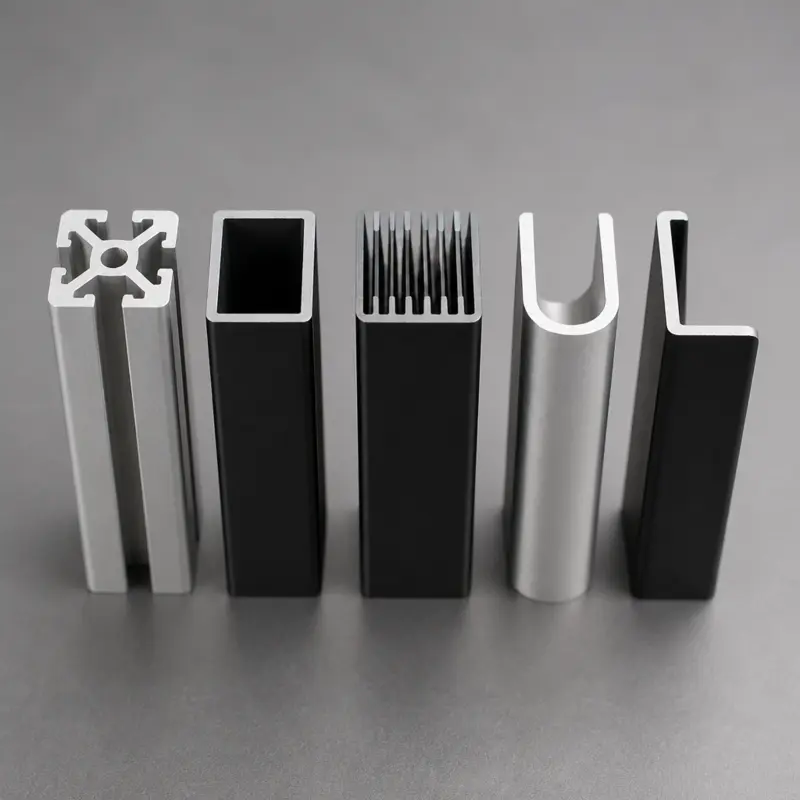
Which Aluminum Alloys Can Be Extruded
While most wrought aluminum alloys can be extruded, material choice heavily impacts production costs.
The selected alloy dictates press speed, tool wear, and scrap rates. Because of this, two visually identical profiles can vary drastically in lead time and total cost.
Review our core extrusion alloys below by grade and temper, or visit custom aluminum extrusions to learn more about our process.
Alloys
8 Grades
1050, 3003, 5052, 6063, 6005, 6061, 6082 and 7075.
Tempers
T1 Through T651
T1, T4, T42, T451, T5, T6, T62 and T651, alloy depending.
Die Lead Time
4 to 6 Weeks
Then 500 to 1,000,000+ pieces off the same die, with no MOQ.
Tolerance Basis
ANSI H35.2
Or EN 755-9. Machined features held to ±0.01 mm afterwards.
Swipe for all four
Extrusion Alloys, Ranked by How Easily They Flow
Extrudability moves die cost, press speed and piece price further than the metal price does. These are the grades we press, softest first.
| Alloy | Tempers We Run | Extrudability (6063 = 100) | EN 755-9 Group | Anodizing Response | Typical Profiles |
|---|---|---|---|---|---|
| 1050 | Non heat treatable, no T temper | Around 200 | Group 1, easy | Excellent, brightest clear finish | Busbar, trim, reflectors, thermal strip |
| 3003 | Non heat treatable, no T temper | Around 180 | Group 1, easy | Fair, even grey | Tube, ducting, heat exchanger sections |
| 6063 | T1, T4, T5, T6 | 100, the baseline | Group 1, easy | Excellent, the anodizing benchmark | Window and door frames, heat sinks, rail |
| 6005 | T5, T6 | Slightly below 6063 | Group 1, easy | Good | Structural profiles, railings, ladders |
| 6061 | T4, T6, T651 | Around 70 | Group 2, harder | Good, less uniform than 6063 | Machined structural parts, brackets, tube |
| 6082 | T6, T651 | Below 6061 | Group 2, harder | Good | Load bearing sections, beams, plate rail |
| 5052 | Non heat treatable, no T temper | Around 60 | Group 2, harder | Good, marine grade | Marine sections, fencing, hydraulic tube |
| 7075 | T6, T651 | Around 13 | Group 2, difficult | Poor, needs coating | High strength structural, sports frames |
Scroll inside the table to see all rows and columns
Extrudability ratings heavily dictate production costs. Published standards rate 6063 as excellent for extrusion, while 7075 is classified as difficult. Note that cast alloys like ADC12, A360, A380 and A356 cannot be extruded; view these under our casting materials. If your part requires milling rather than pressing, explore our CNC machining materials.
Temper Does Half the Work, and Costs Half the Argument
The same alloy can arrive soft enough to bend or hard enough to carry load. The letter and number after the dash decide which, and whether the profile needs a furnace after the press.
| Temper | What Happens to the Metal | Effect on the Profile | Specify It When |
|---|---|---|---|
| T1 | Cooled from the press, then aged at room temperature | Low strength, high formability | The profile will be bent or formed after extrusion |
| T4 | Solution treated, then aged at room temperature | Mid strength, keeps useful formability | The profile still has to be bent or stretched after extrusion |
| T42 | Solution treated and naturally aged as a separate step | T4 properties from a re-treated section | A stocked or reheated profile has to meet T4 minimums |
| T451 | T4, then stress relieved by stretching | T4 strength with less residual stress | Long sections have to stay straight before machining |
| T5 | Quenched straight off the press, then aged in a furnace | Good strength, best dimensional stability | Thin wall architectural and enclosure profiles, the 6063 default |
| T6 | Solution treated off press, quenched, then aged | Highest strength for the 6xxx series | The section is structural or carries a hardness spec |
| T62 | Solution treated and artificially aged as a separate step | T6 properties from a re-treated section | The profile is heat treated after forming or welding |
| T651 | T6, then stress relieved by stretching | T6 strength with less locked in stress | Heavy machining follows and flatness has to hold |
Scroll inside the table to see all rows and columns
Published Minimums by Alloy and Temper, per ASTM B221 and EN 755-2
| Alloy and Temper | Tensile, MPa min | Yield, MPa min | Elongation, percent | What It Buys You |
|---|---|---|---|---|
| 6063-T5 | 150 | 110 | 8 | Thin walls that stay straight |
| 6063-T6 | 205 | 170 | 8 | More strength, same clean anodize |
| 6005-T5 | 260 | 240 | 8 | 6061 strength at Group 1 extrudability |
| 6061-T4 | 180 | 110 | 16 | Strength that survives bending and forming |
| 6061-T6 | 260 | 240 | 8 | Strength plus good machining and welding |
| 6082-T6 | 290 | 250 | 8 | The strongest routine 6xxx choice |
| 7075-T6 | 540 | 480 | 7 | Maximum strength per unit weight |
Scroll inside the table to see all rows and columns
Two key cost-saving alternatives are worth noting. Choosing 6005-T5 delivers the same 260 MPa minimum tensile as 6061-T6, but it flows closer to 6063, which lowers the production cost of complex hollow profiles. If your thick-walled component requires uniform internal hardness, view our integrated metal heat treatment services.
How to Choose an Extrusion Alloy and Temper
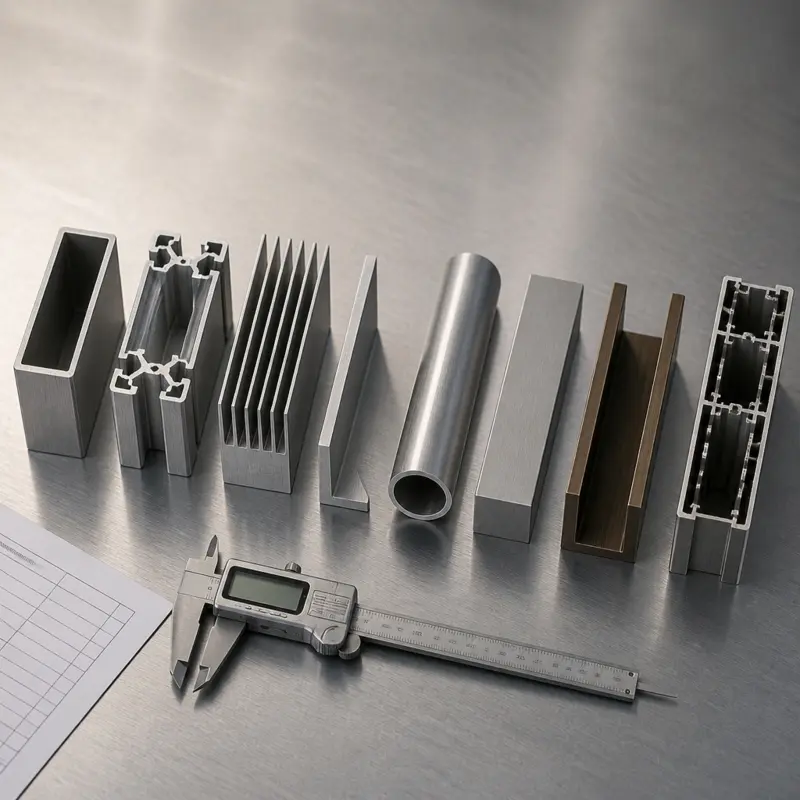
Work inward from the wall thickness, not outward from the alloy. Extrusion rewards thin, balanced sections, and the thinner the wall the more the alloy has to flow.
| If Your Priority Is | Look At | Watch Out For |
|---|---|---|
| Thin walls and fine detail | 6063, T5 | Strength ceiling, check deflection early |
| Best anodized appearance | 6063, clear or coloured | Ask about film thickness and finish class up front |
| Structural load, complex hollow | 6005 in T5 or T6 | Availability, confirm the billet at quote |
| Heavy machining after extrusion | 6061-T6, or T651 on long sections | Residual stress pulling the part out of flat |
| Highest routine strength | 6082-T6 | Faster quench needed, so slower press |
| Maximum strength per weight | 7075-T6, or T651 for straightness | Low extrudability, higher die and piece cost |
| Marine or chemical exposure | 5052, or 6063 anodized | Non heat treatable, so no T temper strength |
| Electrical or thermal transfer | 1050 and 6063 | Soft, so support it mechanically |
Swipe the table sideways to see every column
What the Profile Will Actually Hold
Extrusion tolerance is a standard, not a single number. It scales with the dimension, the wall and whether the feature crosses a hollow, so design against the class rather than a figure.
| Route | Alloys | Tolerance Basis | Ideal Volume | Lead Time |
|---|---|---|---|---|
| Standard extrusion | 1050, 3003, 6063, 6005 | ANSI H35.2 standard, or EN 755-9 | 500 to 1,000,000+ | Dies 4 to 6 weeks |
| Harder alloy extrusion | 6061, 6082, 5052, 7075 | ANSI H35.2 standard, wider on aggressive features | 500 to 1,000,000+ | Dies 4 to 6 weeks, slower press |
| Precision extrusion | 6063, 6005 preferred | Tighter than standard on nominated dimensions only | 2,000 and up | Dies 4 to 6 weeks |
| Extrusion plus machining | All of the above | ±0.01 mm, ISO 2768, verified on CMM to ±0.002 mm | 1 to 10,000 | 1 to 3 weeks after profile |
| Extrusion plus finishing | 6063, 6061, 6005 | Anodize, powder coat or mechanical finish to spec | Any | Adds 1 to 2 weeks |
Scroll inside the table to see all rows and columns
Two things drive the number on the quote. The first is that a die amortises across the run. The second is extrudability. Send the cross section and you get an itemised tooling and piece price with the DFM notes behind it inside 24 hours. Tolerance classes follow the Aluminum Association tables published as ANSI H35.2. For the full process detail, see custom aluminum extrusions.
Records That Ship With the Profile
An alloy and temper callout on a purchase order is only as good as the certificate behind it. These are the documents we can attach to the billet lot that became your sections.
Billet and Mill Certificates
Material certificates to EN 10204 3.1, plus certificates of analysis naming alloy, temper and heat number.
Lot Traceability
A record from billet through press, ageing oven, machining and finishing, so any section can be traced back to its cast lot.
Dimensional Verification
First article inspection and CMM reports against the section drawing, with gauge repeatability data on request.
Compliance Reporting
REACH and RoHS documentation at material and finished part level, plus conflict minerals reporting and PPAP packages.
Swipe for all four
Aluminum Extrusion Alloys FAQ
What are the best aluminum alloys for extrusion?
The 6xxx series, and 6063 above all. It sets the extrudability baseline of 100 that every other alloy is indexed against, anodizes cleanly and still reaches 205 MPa tensile in T6. Meco also presses 6005, 6061 and 6082 in 6xxx, plus 1050, 3003, 5052 and 7075 where the application demands it.
What is the difference between 6061 and 6063 for extrusion?
6061 carries more magnesium and silicon, so it is stronger at 260 MPa minimum in T6 against 205 MPa for 6063-T6, and it machines better. 6063 extrudes far more easily, at an index of 100 against roughly 70 for 6061, so it fills thinner walls and finer detail and gives a more even anodized surface. Pick 6061 for machined structural parts and 6063 for frames, trim and heat sinks.
Can 7075 be extruded?
Yes, but it is one of the hardest alloys to press. Its relative extrudability sits around 13 against 6063 at 100, so the press runs slowly, the die wears faster and the piece price rises. It also needs solution treatment and ageing away from the press. Specify 7075-T6 when the strength to weight ratio genuinely requires it, and T651 when a long section has to be stress relieved by stretching before machining.
What does T5 mean on an aluminum extrusion?
T5 means the profile was quenched as it came off the press, then artificially aged in a furnace. Because there is no separate solution treatment, T5 gives slightly less strength than T6 but noticeably better dimensional stability and less distortion. That is why 6063-T5 is the standard temper for thin wall architectural and enclosure profiles.
Which extrusion alloy anodizes best?
6063 gives the cleanest and most uniform anodized film of the structural grades, and 1050 is brighter still where strength does not matter. 6005 anodizes well too, just short of 6063. 6061 anodizes well but can read less even across a large flat face. 7075 anodizes poorly and is usually powder coated instead.
What tolerances can aluminum extrusions hold?
Profiles are held to the Aluminum Association tables published as ANSI H35.2, or to EN 755-9 for European drawings. Both scale the tolerance with the dimension, the wall thickness and whether the feature crosses a hollow, so there is no single number. Where one feature has to be tighter than any extrusion class allows, we machine it afterwards to ±0.01 mm and verify on CMM to ±0.002 mm.
How long does an extrusion die take, and what volume justifies one?
Extrusion dies run 4 to 6 weeks. Once cut, the same die can produce anywhere from 500 to over 1,000,000 pieces, and Meco applies no minimum order quantity. Because tooling amortises across the run, the same profile prices very differently at low and high volume, so send your annual quantity with the drawing rather than a single order size.
Do extruded profiles come with material certificates?
Yes. Mill certificates to EN 10204 3.1, certificates of analysis naming alloy and temper, REACH and RoHS documentation, conflict minerals reporting, PPAP packages, first article inspection and CMM reports are all available on request, with traceability from billet lot to finished section under an IATF 16949:2016 certified quality system.
What to Send for an Alloy and Temper Call
A DXF or STEP of the profile shape, with wall thicknesses, cut length, annual quantity and the finish you want on it.
Our engineers check wall balance, tongue ratio, corner radii and metal flow, then confirm the alloy and temper will fill the section as drawn. Section changes made before the design freezes typically remove 15 to 30 percent from the part price.
An itemised die and per piece price, the alloy and temper we recommend, the tolerance class we will hold on it, and the notes explaining why.
Where to Read Further on Aluminum
Three guides that pick up where this reference stops, on finishing, machining and what a part costs.

Anodized Aluminum vs Aluminum
What the anodic film actually changes, how to identify it, and which coatings it is compatible with.
Read the guide →
Best Materials for CNC Machining
Which grades cut cleanly and which fight the tool, with machinability ratings and cost per grade.
Read the guide →
What It Costs to Get a Metal Part Made
Where the money goes across tooling, material, cycle time and finishing, with real published ranges.
Read the guide →Swipe for all three guides
