
Anodized aluminum is raw aluminum that has undergone an electrochemical process to grow a controlled aluminum oxide layer on its surface, increasing hardness by 3 to 4 times (from roughly 60 to 100 HV to 200 to 500 HV), improving corrosion resistance, and enabling permanent coloring. Raw mill-finish aluminum has only a naturally occurring oxide film of 2 to 3 nanometers, which is too thin to provide meaningful protection in demanding environments.
For engineers and sourcing managers evaluating surface treatments, the distinction between anodized and non-anodized aluminum determines part longevity, coating compatibility, dimensional tolerances, electrical behavior, and total cost of ownership. Yet the practical questions that follow, such as how to confirm whether an existing part is anodized, whether powder coat adheres over an anodized surface, and whether paint bonds to powder-coated metal, are rarely addressed in the same place.
This guide covers all of it. You will find a complete property comparison with specifications sourced to MIL-A-8625 and ISO 7599, five practical methods to identify whether aluminum has been anodized, a full coating-over-coating compatibility breakdown, and guidance on which aluminum alloys produce the best anodizing results. If you are also comparing aluminum against other engineering metals such as brass or titanium for your next project, our aluminum vs brass vs titanium comparison covers hardness, density, machinability, and cost side by side. Whether you are specifying a new part for CNC machining or deciding how to refinish an existing aluminum component, this is the reference that answers every question in one read.
What Is Anodizing and How Does It Work?
Anodizing is an electrochemical process that converts the surface of aluminum into a hard, porous aluminum oxide (Al₂O₃) layer. Unlike paint or powder coat, the anodic layer is not applied on top of the metal. It grows from the aluminum itself, making it metallurgically bonded and impossible to peel or flake.
The process works by immersing the aluminum part (the anode) in an acid electrolyte bath, most commonly sulfuric acid, and passing direct current through the solution. Oxygen ions are released at the anode surface and react with the aluminum to form aluminum oxide. By controlling voltage, current density, temperature, and immersion time, the thickness, hardness, and porosity of the resulting oxide layer can be precisely tuned.
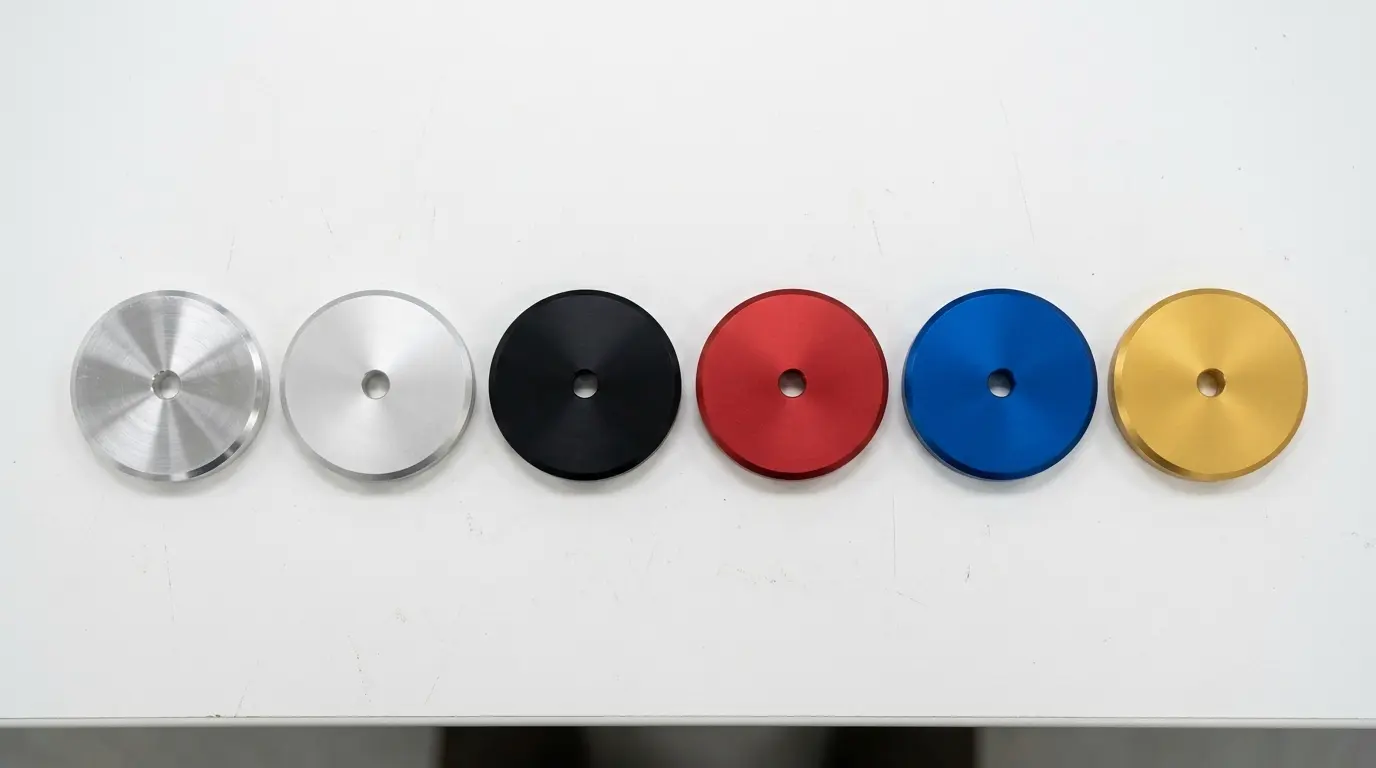
After the oxide layer is grown, it contains millions of microscopic pores arranged in a honeycomb structure. These pores can absorb dyes for permanent coloring before being sealed, typically in hot deionized water or nickel acetate solution, to close the pore structure, lock in the dye, and maximize corrosion resistance. A clear anodized aluminum finish skips the dye step entirely, producing a silvery, semi-matte appearance that is noticeably more uniform than raw mill finish aluminum. The sealed anodic layer becomes an integral part of the aluminum substrate and cannot chip, peel, or delaminate because it is the surface.
Anodizing Types: Type I, Type II, and Type III Compared
The MIL-A-8625 military specification defines three primary anodizing types, each producing different thickness, hardness, and performance characteristics. Understanding these types is essential for specifying the right treatment on engineering drawings and purchase orders.
| Property | Type I (Chromic Acid) | Type II (Sulfuric Acid) | Type III (Hardcoat) |
|---|---|---|---|
| Electrolyte | Chromic acid | Sulfuric acid | Sulfuric acid (low temp, high current) |
| Typical Thickness | 1.3 to 7.6 µm (0.00005" to 0.0003") | 5 to 25 µm (0.0002" to 0.001") | 25 to 150 µm (0.001" to 0.006") |
| Surface Hardness | Approximately 200 HV | 200 to 350 HV | 400 to 600 HV |
| Color Dyeing | Limited (thin layer) | Excellent, wide color range | Limited (dark gray/black natural color) |
| Corrosion Resistance | Good (thin but dense) | Very Good | Excellent |
| Wear/Scratch Resistance | Low | Moderate | Excellent, comparable to hard chrome |
| Typical Applications | Aerospace (fatigue-sensitive parts) | Architectural, consumer electronics, general industrial | Hydraulic cylinders, pistons, sliding surfaces, military/defense |
| Relative Cost | Higher (environmental controls) | Lowest | Highest |
| Governing Spec | MIL-A-8625 Type I / IB | MIL-A-8625 Type II | MIL-A-8625 Type III |
Type II anodizing is the most widely specified for commercial and industrial parts. It balances cost, corrosion performance, and aesthetic flexibility. Type III, also known as hard anodized aluminum, is reserved for applications where extreme wear resistance or high surface hardness is required. Its 400 to 600 HV hardness approaches that of hardened tool steel. Meco's surface finishing services include both Type II and Type III anodizing as part of integrated post-machining and post-casting workflows.
Anodized Aluminum vs Raw Aluminum: Complete Property Comparison
The following table compares anodized aluminum (Type II, the most common specification) against raw mill-finish aluminum across every property that matters for engineering and sourcing decisions. This is the core reference for anyone evaluating whether anodized aluminum is better than regular aluminum for a specific application.
| Property | Raw (Mill-Finish) Aluminum | Anodized Aluminum (Type II) | Engineering Significance |
|---|---|---|---|
| Surface Hardness | 60 to 100 HV (alloy-dependent) | 200 to 350 HV (Type II); 400 to 600 HV (Type III) | 3 to 6 times harder surface resists scratches, dents, and abrasion |
| Natural Oxide Thickness | 2 to 3 nm (forms instantly in air) | 5 to 25 µm (Type II); up to 150 µm (Type III) | Roughly 1,000 to 10,000 times thicker protective layer |
| Corrosion Resistance | Moderate (natural oxide provides limited protection) | Excellent (sealed oxide resists salt spray, chemicals, moisture) | Anodized parts pass 336+ hours of salt spray testing per ASTM B117 |
| Electrical Conductivity | High (approximately 37.7 MS/m for 6061-T6) | Insulating (oxide resistivity: 10¹¹ to 10¹³ Ω·cm) | Anodized surfaces act as electrical insulators, critical for grounding and EMI design |
| Thermal Conductivity | High (approximately 167 W/m·K for 6061) | Reduced at surface (Al₂O₃ is approximately 30 W/m·K) | Oxide layer acts as a thermal barrier, consider for heat sink designs |
| Weight Change | Baseline | Negligible (oxide is roughly 1.5 times denser than aluminum but the layer is thin) | No measurable weight impact for most applications |
| Dimensional Change | None | Approximately 50% growth outward, 50% penetration inward from original surface | A 25 µm Type II layer adds roughly 12.5 µm to external dimensions per side |
| Color Options | Silver metallic only | Clear, black, red, blue, gold, bronze, green, and virtually unlimited with dye | Color is permanent (dye absorbed into pore structure), unlike paint which sits on top |
| Surface Appearance | Bright metallic luster (can be uneven) | Uniform matte or semi-gloss finish | Anodizing masks minor surface imperfections and provides consistent cosmetic quality |
| UV Resistance | Poor (oxidizes unevenly over time) | Excellent (sealed oxide is UV-stable; dyed colors resist fading) | Critical for outdoor and architectural applications |
| Paintability and Adhesion | Requires pretreatment (etch primer or conversion coating) for paint adhesion | Porous oxide provides excellent mechanical bond for paints, powder coat, and adhesives | Anodized surfaces are one of the best substrates for subsequent organic coatings |
| Food Safety | Can leach aluminum into acidic foods | Non-reactive (sealed oxide prevents leaching) | Anodized aluminum cookware is the industry standard for commercial food preparation |
| Repairability | Can be refinished, polished, or re-treated | Damaged anodize cannot be locally repaired; must be stripped and re-anodized | Plan for full part re-processing if the oxide layer is breached |
| Cost Premium | Baseline | +15 to 30% for Type II; +40 to 60% for Type III (varies by part size and batch) | Offset by reduced maintenance, longer service life, and lower replacement frequency |
Dimensional Change: What Engineers Need to Know
Anodizing grows the oxide layer partially into the aluminum substrate and partially outward from the original surface. The standard rule of thumb is a roughly 50/50 split. For a 25 µm (0.001") Type II anodize layer, expect approximately 12.5 µm (0.0005") of dimensional growth per side on external features and 12.5 µm of bore reduction per side on internal features. For tight-tolerance parts machined to ±0.01 mm, this dimensional change must be compensated in the pre-anodize machining dimensions. Meco's CNC machining and surface finishing workflows are integrated specifically to manage this. Machining dimensions are adjusted to account for oxide growth before parts enter the anodizing line.
Which Aluminum Alloys Anodize Best?
Not all aluminum alloys produce the same anodizing results. The alloying elements, particularly copper, silicon, and zinc, directly affect oxide layer uniformity, color consistency, and achievable hardness. Choosing the wrong alloy for an anodized application is one of the most common specification errors in aluminum part design.
| Alloy Series | Key Alloying Element | Anodizing Quality | Notes |
|---|---|---|---|
| 5xxx (e.g., 5052, 5005) | Magnesium | Excellent, best for clear anodize | 5005 is the top recommendation for architectural sheet; 5052 is excellent for industrial parts |
| 6xxx (e.g., 6061, 6063, 6082) | Magnesium + Silicon | Very Good | 6063 is the top choice for aluminum extrusions; 6061 produces excellent hardcoat results |
| 7xxx (e.g., 7075) | Zinc | Good (with precautions) | High copper content can cause yellowish or uneven color; excellent for hardcoat but color matching is difficult |
| 2xxx (e.g., 2024) | Copper | Poor for decorative; acceptable for hardcoat | High copper produces soft, thin, yellowish oxide. Not recommended for color anodizing |
| Cast alloys (e.g., A356, ADC12, A380) | Silicon (high percentage) | Poor to Fair | High silicon creates dark, mottled finish. Die cast parts are generally better suited for powder coating or painting than anodizing |
The Aluminum Anodizers Council recommends 5005 for sheet and 6063 for extrusions when clear, uniform decorative anodizing is the priority. For hardcoat (Type III) where appearance is secondary to wear performance, 6061 and 6082 deliver the best combination of hardness and layer integrity.
How to Tell If Aluminum Is Anodized: 5 Reliable Test Methods
Identifying whether an aluminum part has been anodized is essential when determining coating compatibility, planning rework, or verifying supplier compliance. The anodic oxide layer is transparent to translucent, so clear anodized aluminum can look very similar to raw mill-finish aluminum to the untrained eye. The following five methods, arranged from simplest to most definitive, will confirm the presence of an anodize layer.
Method 1: Visual and Tactile Inspection
Anodized aluminum has a distinctly uniform matte or semi-gloss surface that absorbs light rather than reflecting it sharply. Raw aluminum has a brighter, more reflective metallic luster that often appears slightly uneven. Run your fingertip across the surface: anodized aluminum feels smoother and more "dry" compared to the slightly slick or greasy feel of raw aluminum. If the part has any color (black, red, blue, gold), it is almost certainly anodized, because dye molecules are absorbed into the porous oxide layer during processing.
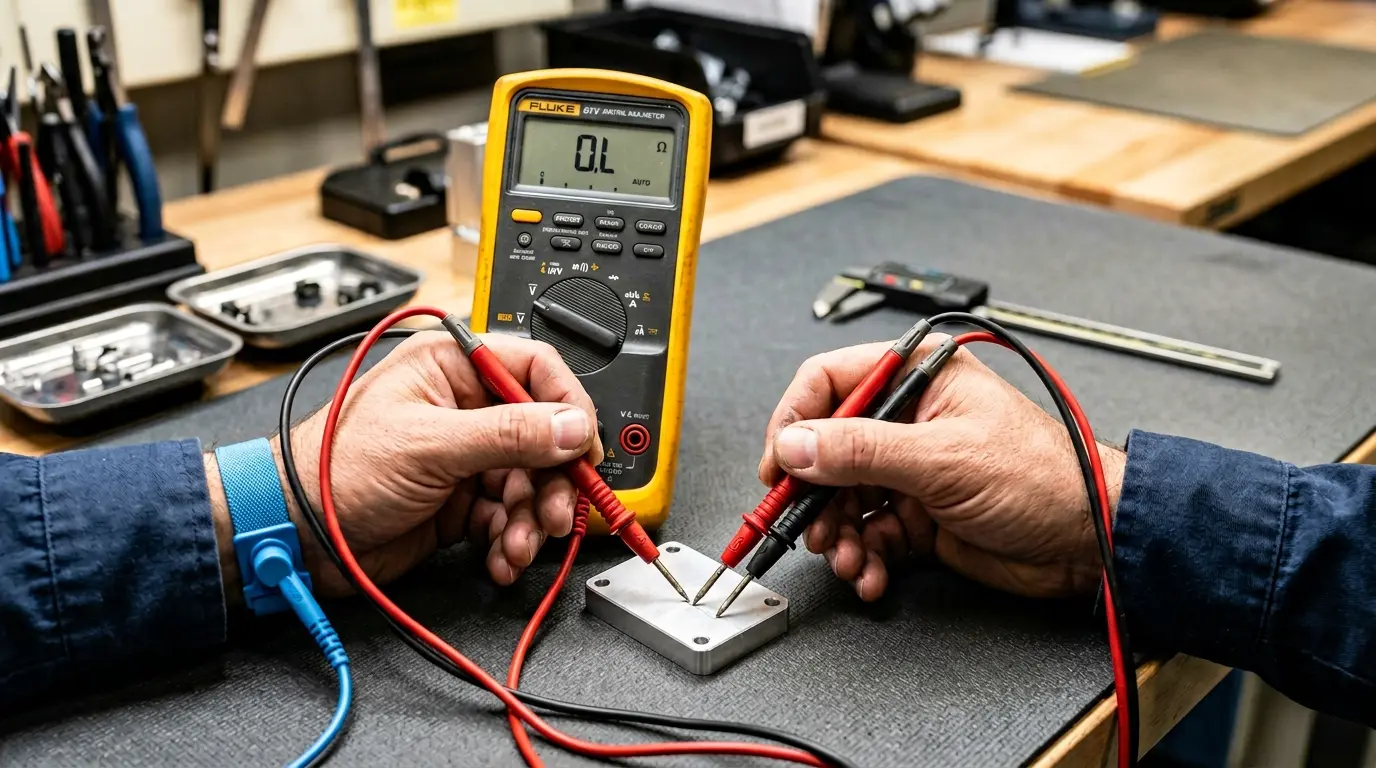
Method 2: Multimeter Conductivity Test (Most Practical)
This is the fastest and most reliable field test. Set a digital multimeter to continuity or resistance mode. Touch both probes gently to the aluminum surface without scratching through the coating. Raw aluminum is highly conductive, so the multimeter will show near-zero resistance and beep in continuity mode. Anodized aluminum is an electrical insulator with a resistivity of 10¹¹ to 10¹³ Ω·cm, so the multimeter will show open-circuit (OL) and will not beep. If the probes are pressed hard enough to scratch through the oxide layer, you will get a reading, so use light contact pressure.
Method 3: Scratch and Hardness Test
Drag a piece of hardened steel (such as a file or scribe) lightly across an inconspicuous area of the surface. Raw aluminum at 60 to 100 HV scratches easily and leaves a bright metallic mark. Anodized aluminum at 200 to 600 HV (depending on type) resists the scratch and shows little to no marking. This method is destructive, so use it only in non-cosmetic zones.
Method 4: Eddy Current Thickness Measurement
An eddy current coating thickness gauge (such as the PosiTector 6000 or Fischer Dualscope) placed on the surface will measure the oxide layer thickness directly per ASTM B244. Raw aluminum reads zero or near-zero. Type II anodize typically reads 5 to 25 µm. Type III reads 25 to 150 µm. This is the standard QA method in production environments and provides a numerical result.
Method 5: Chemical Spot Test
Apply a small drop of dilute sodium hydroxide (NaOH, roughly 10% solution) to the surface. On raw aluminum, the drop will bubble and dissolve the metal within seconds, leaving a dark spot. On anodized aluminum, the oxide layer resists the chemical attack for significantly longer (minutes rather than seconds). Rinse thoroughly after testing. This method is destructive and should only be used in a controlled lab environment with proper PPE.
Quick Decision: Which Test Should You Use?
For a quick shop-floor check, the multimeter conductivity test (Method 2) is the best balance of speed, reliability, and non-destructiveness. For incoming inspection or PPAP verification, use eddy current thickness measurement (Method 4) to confirm both the presence and the thickness of the anodize layer against the drawing specification.
Can You Powder Coat Over Anodized Aluminum?
Yes. Anodized aluminum is actually one of the preferred substrates for powder coating adhesion. The porous oxide layer provides excellent mechanical bonding for the powder particles, and major powder manufacturers list anodizing as a recommended pretreatment for aluminum.
However, adhesion success depends on several factors. The anodize must be clean, because contaminants such as oils, fingerprints, or inorganic dyes on the anodized surface can create adhesion-weak zones. According to Products Finishing, the recommended quality check is AAMA 2604/2605 wet adhesion testing: cross-hatch the coated surface, immerse it in boiling deionized water for 20 minutes, and then perform a tape pull test. If the powder coat survives this test without lifting, the adhesion is reliable for production.
There are cases where powder coat over anodize fails. Some sulfuric acid (Type II) processes with heavy sealing or inorganic dye penetration can reduce pore availability and interfere with adhesion. If you are specifying powder coat over anodize, communicate this requirement to both the anodizer and the powder coater so the anodize seal and surface preparation can be optimized for the two-step process.
Process Steps: Powder Coating Over Anodized Aluminum
- Clean the anodized surface to remove all oils, dust, and handling residues using a solvent wipe or alkaline cleaner. Do not use aggressive chemicals that could attack the oxide layer.
- Light abrasion (optional but recommended) with a Scotch-Brite pad or fine media blast at 120 to 180 grit improves mechanical tooth without removing the anodize. For a complete guide to blasting media selection, grit-to-Ra values, and surface preparation standards, see our dedicated article on sand blasted finishes.
- Apply powder coat via electrostatic spray and cure per the powder manufacturer's specification (typically 180 to 200°C / 356 to 392°F for 10 to 20 minutes).
- Adhesion test via cross-hatch tape pull per ASTM D3359, or wet adhesion per AAMA 2604/2605 for architectural applications.
Meco's integrated surface finishing services manage both anodizing and powder coating in-house, eliminating the coordination gap between separate finishing vendors that is the most common cause of adhesion failures.
Can You Paint Over Powder-Coated Metal?
Yes, but surface preparation is critical. Powder coat is a thermoset polymer, and once cured it forms a hard, cross-linked surface that is chemically inert and physically smooth. Paint will not adhere to a smooth, clean powder-coated surface without mechanical abrasion to create a "tooth" for bonding.
How to Paint Over Powder-Coated Metal Successfully
- Clean the surface by removing dirt, grease, and contaminants with a degreaser or TSP (trisodium phosphate) wash. Rinse thoroughly and allow to dry completely.
- Sand the powder coat with 180 to 320 grit sandpaper or a Scotch-Brite pad to scuff the entire surface. The goal is to dull the gloss and create micro-scratches that give the paint a mechanical key. Powder coat is harder than standard paint, so expect more effort than sanding over a painted surface.
- Apply an adhesion-promoting primer such as a 2K (two-component) epoxy primer or a bonding primer rated for thermoset surfaces. This is the most important step. Skipping primer over powder coat is the leading cause of paint delamination.
- Apply the topcoat once the primer has cured per the manufacturer's instructions. Apply the liquid topcoat (urethane, acrylic, or alkyd) in thin, even coats.
- Verify adhesion after full cure by performing a cross-hatch tape pull test per ASTM D3359.
Can You Powder Coat Over Existing Powder Coat?
Yes, with limitations. A second layer of powder coat can be applied over an existing cured powder coat if the original layer is clean, intact, and lightly abraded. The key risk is over-cure: the first layer is exposed to a second cure cycle, which can cause it to become brittle, discolor, or outgas (creating pinholes in the new layer). For best results, keep the total cumulative cure time within the powder manufacturer's recommended limits and verify adhesion with a tape pull test after the second cure.
Coating Compatibility Quick Reference
The table below summarizes every common aluminum coating-over-coating scenario, distilled into a single reference for engineering and sourcing teams.
| Scenario | Compatible? | Key Requirement |
|---|---|---|
| Powder coat over anodized aluminum | Yes | Clean surface; light abrasion recommended; adhesion test per AAMA 2604/2605 |
| Liquid paint over anodized aluminum | Yes | Porous oxide provides good adhesion; use etch primer for best results |
| Powder coat over raw aluminum | Yes | Requires chemical pretreatment (chromate or non-chromate conversion coating) or mechanical abrasion |
| Liquid paint over powder-coated metal | Yes (with prep) | Scuff sand 180 to 320 grit + 2K epoxy primer required |
| Powder coat over powder coat | Yes (with caution) | Risk of over-cure; cumulative cure time must stay within spec; adhesion test required |
| Anodize over powder coat | No | Powder coat must be fully stripped before anodizing because oxide can only grow from bare aluminum |
| Anodize over anodize | No (without stripping) | Existing anodize must be chemically stripped before re-anodizing |
When to Specify Anodizing vs. Other Surface Finishes
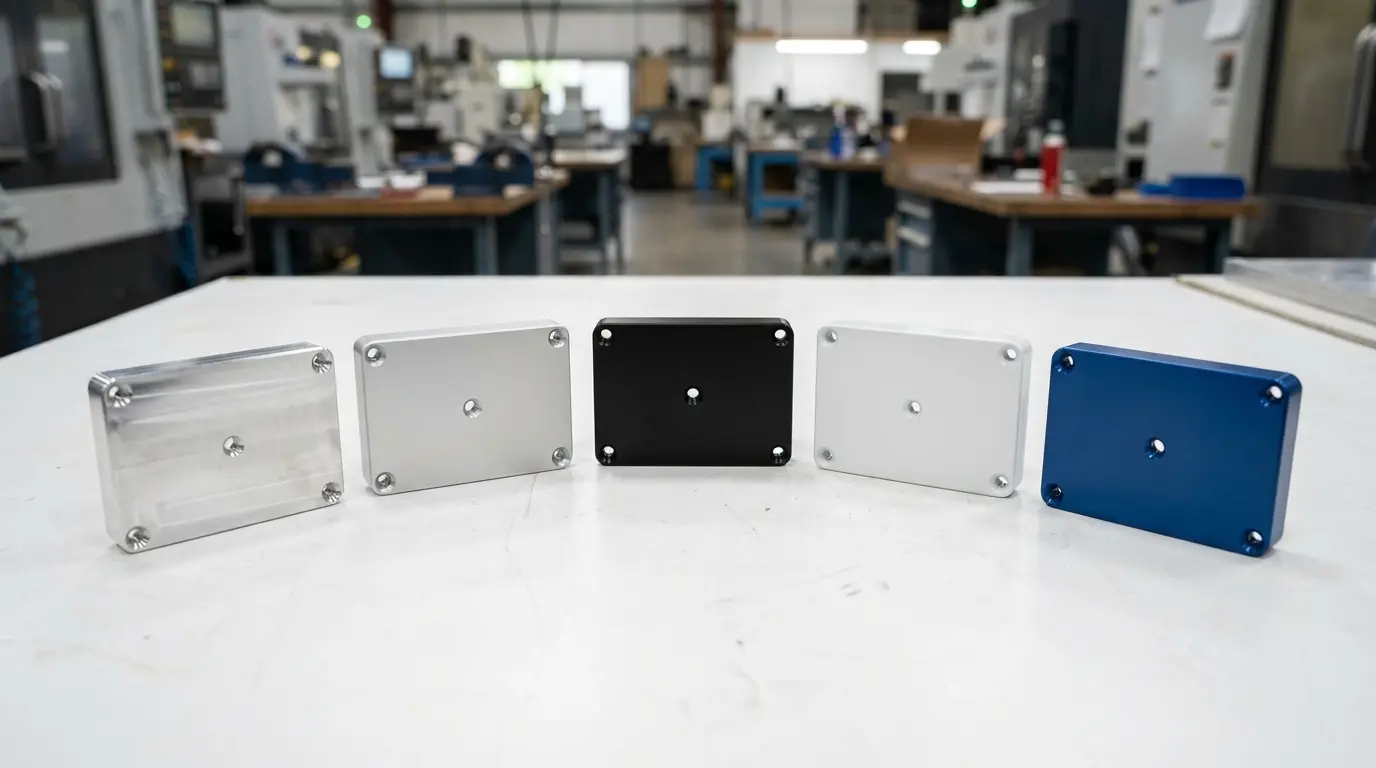
Anodizing is not always the right choice. The decision depends on the base alloy, the operating environment, the cosmetic requirements, and the total cost of ownership. The following decision framework helps engineers and sourcing managers match the finish to the application.
Choose anodizing when: the base material is wrought aluminum (5xxx or 6xxx series), corrosion resistance and surface hardness are priorities, the part must resist scratching or abrasion in service, permanent color is required without risk of chipping or peeling, the part functions as an electrical insulator by design, or the application involves outdoor or architectural exposure to UV.
Choose powder coating when: the base material is cast aluminum with high silicon alloys like ADC12 or A380 that anodize poorly, a thick protective layer (50 to 150 µm) is needed, the part requires a wide range of custom RAL or Pantone colors with glossy, textured, or metallic finishes, or when cost per square meter is the primary driver. For a detailed cost breakdown, see Meco's powder coating cost guide.
Choose painting when: small touch-up areas or custom graphics are required, the part is too large for powder coating ovens, or the application demands a specific liquid coating chemistry such as marine-grade polyurethane or high-temperature ceramic coatings.
Anodized Aluminum Applications by Industry
Anodized aluminum is specified across virtually every manufacturing sector. The specific anodizing type and thickness depend on the performance demands of each application.
Aerospace: Type I (chromic acid) and Type III (hardcoat) anodize are standard for aircraft structural components, landing gear, and avionics housings where fatigue life, corrosion resistance, and wear performance are non-negotiable. Aerospace parts manufacturers use anodizing alongside NDT and full material traceability to meet program requirements.
Automotive: Type II anodizing is used for interior trim, decorative bezels, and lightweight structural brackets. Type III appears on performance components such as pistons, valve bodies, and EV battery enclosure hardware where hardness and thermal management matter.
Consumer Electronics: Type II anodizing dominates this sector. It provides the matte-finish, dye-colored housings seen on smartphones, laptops, tablet enclosures, and audio equipment. The sealed oxide layer resists fingerprints, scratches, and everyday wear.
Medical Equipment: Type III hard anodized aluminum provides a non-reactive, sterilization-compatible surface for surgical instruments, diagnostic device housings, and patient-handling equipment frames.
Industrial and Heavy Equipment: Type III anodize on hydraulic cylinder bores, pneumatic valve bodies, and sliding wear surfaces replaces hard chrome plating in many applications, offering comparable hardness with lower environmental impact and no hexavalent chromium.
Frequently Asked Questions About Anodized Aluminum vs Raw Aluminum
What is the difference between anodized aluminum and regular aluminum?
Anodized aluminum has been electrochemically treated to grow a thick, hard aluminum oxide (Al₂O₃) layer on its surface, typically 5 to 25 µm for Type II and up to 150 µm for Type III (hardcoat). Regular raw aluminum has only a natural oxide film of 2 to 3 nanometers. This engineered oxide layer makes anodized aluminum 3 to 6 times harder (200 to 600 HV vs. 60 to 100 HV), significantly more corrosion resistant, electrically insulating, and capable of absorbing permanent dye colors. The anodic layer is metallurgically bonded to the aluminum and cannot peel or chip like paint.
How can you tell if aluminum is anodized?
The fastest and most reliable field test is the multimeter conductivity test. Set a digital multimeter to continuity mode and gently touch both probes to the surface. Raw aluminum is conductive and will beep. Anodized aluminum is an electrical insulator and will show open-circuit (OL). Other methods include visual inspection (anodized surfaces are matte and uniform versus the bright metallic luster of raw aluminum), scratch testing with hardened steel (anodized aluminum resists scratching), eddy current thickness measurement per ASTM B244, and chemical spot testing with dilute sodium hydroxide.
Can you powder coat over anodized aluminum?
Yes. Anodized aluminum is actually one of the preferred substrates for powder coating because its porous oxide layer provides excellent mechanical bonding. Major powder manufacturers list anodizing as a recommended pretreatment for aluminum. The surface must be clean and free of oils or inorganic dyes that could block adhesion. For quality verification, use AAMA 2604/2605 wet adhesion testing: cross-hatch the surface, immerse in boiling deionized water for 20 minutes, and perform a tape pull test. If adhesion fails consistently, the anodize chemistry may be incompatible with the specific powder system.
Can you paint over powder-coated metal?
Yes, but proper surface preparation is essential. Powder coat is a hard, smooth thermoset polymer that paint will not adhere to without mechanical abrasion. The correct process is: clean the surface with a degreaser, scuff sand with 180 to 320 grit sandpaper to create a mechanical key, apply a 2K epoxy or bonding primer rated for thermoset surfaces, then apply the liquid topcoat. Skipping the sanding and primer steps is the leading cause of paint peeling over powder coat. Always verify adhesion with a cross-hatch tape pull test per ASTM D3359 after full cure.
Does anodizing change the dimensions of aluminum parts?
Yes. The anodic oxide layer grows approximately 50% outward from the original surface and 50% inward, penetrating into the aluminum substrate. For a 25 µm Type II anodize, expect roughly 12.5 µm of dimensional growth per side on external features and 12.5 µm of bore reduction per side on internal features. For parts machined to tight tolerances of ±0.01 mm or tighter, the pre-anodize machining dimensions must be adjusted to compensate for this growth. Always coordinate with your machining and anodizing teams to ensure final post-anodize dimensions meet drawing requirements.
Which aluminum alloys anodize the best?
The 5xxx series (especially 5005 and 5052) and 6xxx series (especially 6063 and 6061) produce the best anodizing results with uniform color, consistent oxide thickness, and excellent hardness. The Aluminum Anodizers Council recommends 5005 for sheet and 6063 for extrusions when decorative clear anodizing is the goal. High-copper alloys like 2024 in the 2xxx series and high-silicon cast alloys such as A380 and ADC12 anodize poorly, producing yellowish, uneven, or mottled results. For these alloys, powder coating or painting is typically a better surface finish choice.
Is anodized aluminum safe for cooking and food contact?
Yes. The sealed anodic oxide layer is non-reactive and prevents aluminum from leaching into food, even when exposed to acidic ingredients like tomatoes, citrus, or vinegar. This is why hard anodized aluminum is the standard material for commercial cookware including pots, pans, and baking sheets. Raw aluminum, by contrast, can react with acidic or alkaline foods, causing discoloration and transferring trace amounts of aluminum into the food.
How long does anodized aluminum last?
Anodized aluminum typically lasts 20 to 30 years in outdoor architectural applications and indefinitely in controlled indoor environments. Type III hardcoat anodizing can exceed 30 years of service on industrial wear surfaces. The primary risk factor is exposure to highly alkaline or acidic environments (pH below 4 or above 9), which can dissolve the oxide layer over time. Under normal conditions, the sealed oxide does not degrade under UV exposure and does not peel or flake.
Is anodized aluminum electrically conductive?
No. The anodic oxide layer is an excellent electrical insulator, with resistivity measured at 10¹¹ to 10¹³ Ω·cm. This is a critical design consideration because anodized aluminum parts cannot be used for electrical grounding or as current-carrying conductors unless the anodize is locally removed (masked during anodizing or mechanically removed afterward) at contact points. This insulating property is also why the multimeter conductivity test is the most reliable way to identify anodized versus raw aluminum.
Get Your Aluminum Parts Anodized, Machined, and Delivered from One Partner
Coordinating separate vendors for CNC machining, anodizing, powder coating, and assembly creates lead time risk and coating adhesion failures at every handoff point. Meco eliminates that complexity by managing the full aluminum part workflow, from raw material through machining, surface finishing, assembly, and global delivery, under one IATF 16949:2016 certified quality system.
With 30+ years of turnkey manufacturing experience and 40+ in-house processes, Meco is built for aluminum programs where tolerances, finish quality, and on-time delivery are non-negotiable.
- Integrated Surface Finishing: Type II and Type III anodizing, powder coating, painting, chrome plating, nickel plating, PVD, e-coating, and galvanizing, all managed in-house with full process traceability.
- Precision CNC Machining: Tolerances to ±0.01 mm with pre-anodize dimensional compensation built into the machining program.
- IATF 16949:2016 Certified: Automotive-grade quality applied across every industry. 99.99% quality rate. 99.8% on-time delivery.
- DFM Feedback with Every Quote: Including alloy-to-finish compatibility review and dimensional compensation guidance, delivered in under 24 hours.
- Prototype to Mass Production: From 10 pieces to 10 million+. No minimum order quantities.
Submit your drawings and let Meco's engineering team help you select the right alloy, anodize type, and coating strategy for your aluminum program.
Request a Quote Today