
Hot Chamber vs Cold Chamber Die Casting: The Complete 2026 Engineering Guide
The main difference between hot chamber and cold chamber die casting comes down to where the metal is melted. In a hot chamber die casting machine, the furnace is built into the machine and the metal stays molten between shots. In a cold chamber die casting machine, the metal is melted in a separate furnace and ladled in for each cycle. Hot chamber is faster and works with low-melting metals like zinc and magnesium. Cold chamber is slower but handles high-melting metals like aluminum, copper, and brass.
That's the short answer. But picking the right die casting machine type for your part is rarely that simple. Cycle time, porosity, tooling cost, die casting tonnage, and even the chemistry of the molten metal all play a role. Get the choice wrong and you'll pay for it in scrap rates, die wear, or quoting confusion.
This guide shows how each high pressure die casting process works, which metals fit which machine, a side-by-side specification table, a tonnage-by-material reference, and a simple four-question decision framework. If you're already evaluating suppliers, our die casting services page lists Meco's full alloy and tonnage range.

What Is Die Casting? A Quick Refresher
Die casting is a high pressure die casting process. Molten metal is forced into a reusable steel mold (the "die") at speeds of 30 to 100 meters per second and held under pressure until it solidifies. The result is a near-net-shape metal part, meaning the part comes out very close to its final shape with little machining needed. You get tight tolerances, smooth surfaces, and very little wasted material.
The process is fast, repeatable, and well suited to medium-to-high production volumes. Most consumer electronics housings, automotive transmission cases, and zinc hardware you've touched today were die cast. For a deeper introduction, see our full guide on what die casting is. If your part doesn't fit pressure die casting at all, lower-pressure processes like gravity casting or low pressure casting may be a better fit.
There are two main die casting machine types: hot chamber and cold chamber. They use different machine designs because different metals behave very differently when melted. Let's break each one down.
What Is Hot Chamber Die Casting?
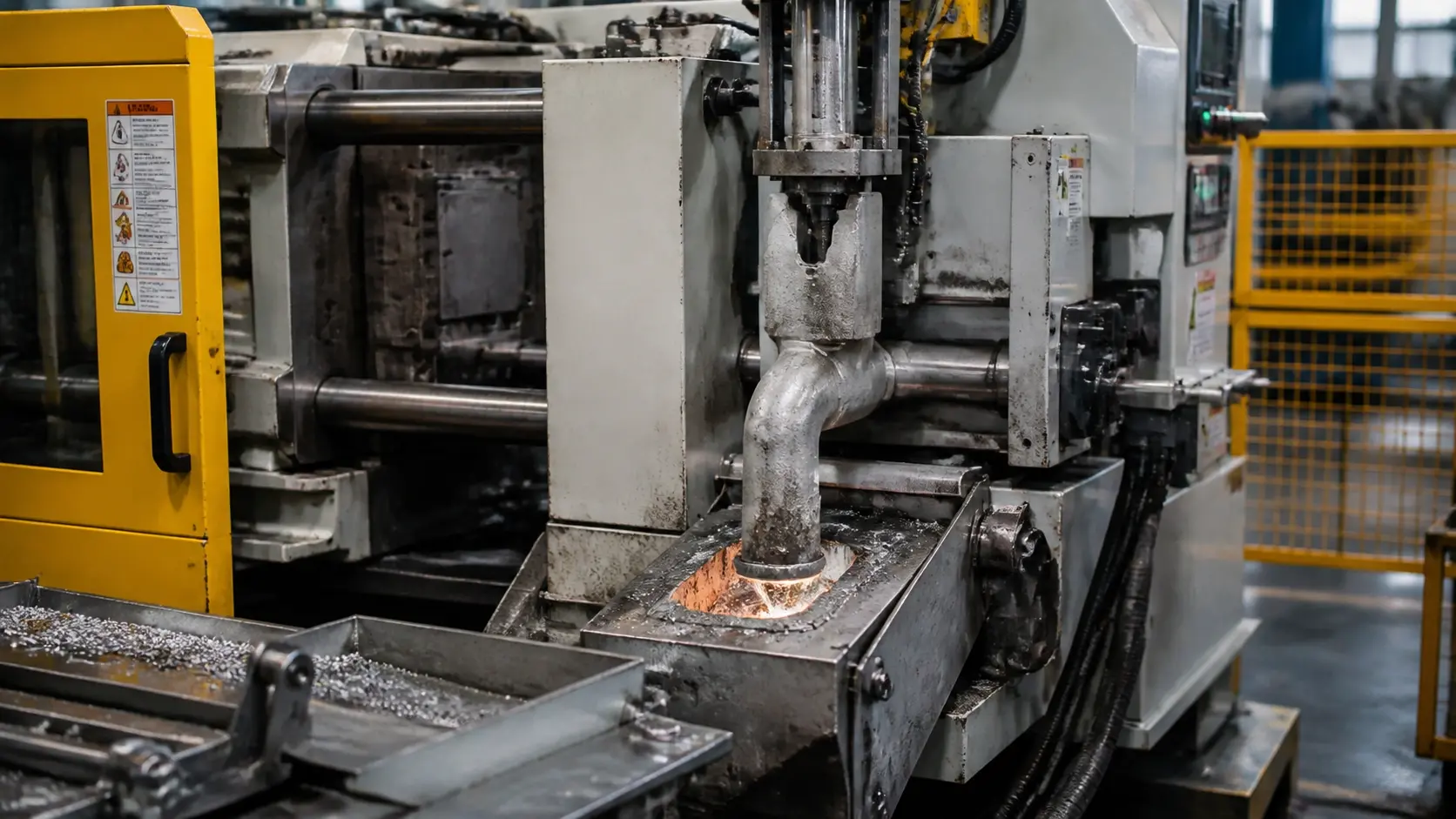
Hot chamber die casting is a process where the injection system of the die casting machine sits directly inside a pool of molten metal. The metal stays liquid between cycles, so the next shot is always ready to go. That's why hot chamber machines are sometimes called "gooseneck machines." The curved metal tube that delivers the melt looks like a goose's neck, which is where the term gooseneck die casting comes from.
Because the injection parts live inside the molten metal, this process only works with metals that won't attack the steel components. In plain English: the metal has to be "kind" to the machine. Zinc, magnesium, and lead alloys fit that bill. Aluminum doesn't, and we'll explain why later.
How the Hot Chamber Die Casting Process Works
Here's the cycle, step by step:
- The dies close. Two halves of a steel mold clamp together under high tonnage.
- The gooseneck fills. Molten metal flows from the built-in furnace into the gooseneck channel by gravity.
- The plunger fires. A hydraulic piston pushes down, forcing the molten metal up through the gooseneck and into the die cavity at pressures of 1,000 to 5,000 psi.
- The metal solidifies. Cooling channels in the die pull heat out fast, usually in under a second.
- The die opens and ejects. Ejector pins push the part out. The plunger retracts. The gooseneck refills.
- The cycle repeats. A typical hot chamber zinc cycle takes 3 to 15 seconds end to end.
The whole loop is automated. A well-tuned hot chamber zinc cell can produce 200 to 1,200 small parts per hour from a single cavity. Multi-cavity dies push that number higher.
Gooseneck Defined
A gooseneck is the curved injection channel that connects the furnace to the die in a hot chamber machine. Picture a steel U-tube that sits half-submerged in molten zinc. When the plunger pushes down, metal flows up the gooseneck and into the die. It's the heart of the hot chamber design, and the part that wears out fastest.
What Metals Work in Hot Chamber Machines?
Hot chamber die casting is reserved for low-melting-point alloys. Here's what fits:
- Zinc alloys (Zamak 2, 3, 5, and 27) are the workhorse of hot chamber casting. They melt at around 380–390 °C (716–734 °F). Standard chemistries are defined by ASTM B86, with related die casting alloy ingot specifications covered under ASTM B85.
- Magnesium alloys (AZ91D, AM50, AS41) can be hot chamber cast, but they need specialized machines with cover gas systems to prevent ignition.
- Lead and tin alloys are used for niche applications like battery terminals, fishing weights, and pewter goods.
If you see zinc or magnesium grades on a spec sheet, you're looking at hot chamber territory. Meco's hot chamber die casting machines run from 25 to 168 metric tons of clamping force, producing parts from 1 gram to about 1.5 kg.
What Is Cold Chamber Die Casting?
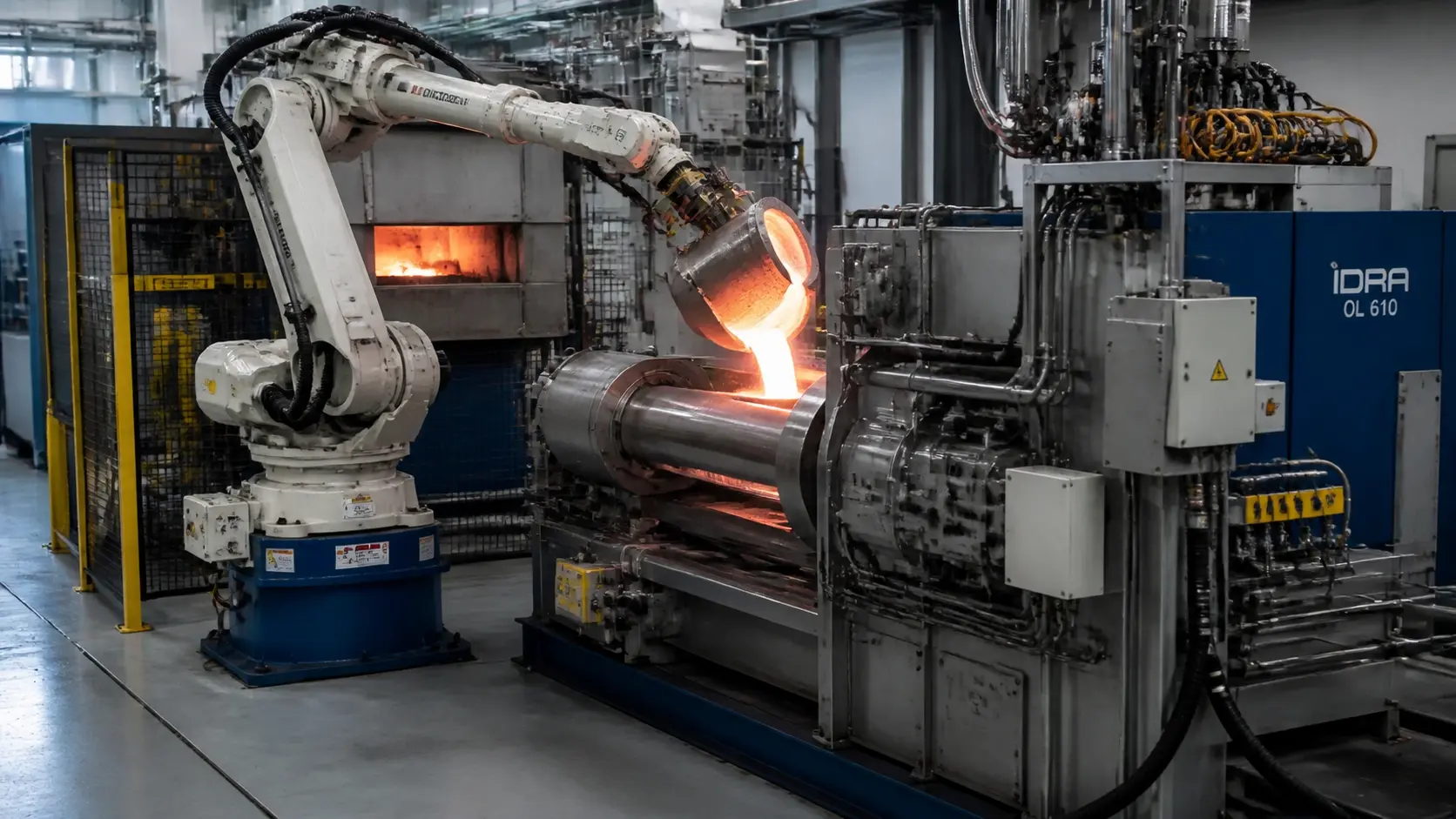
Cold chamber die casting separates the melting from the injection. Metal is melted in a standalone furnace, then a measured shot is poured (manually or by robot) into the machine's shot sleeve. From there, a plunger drives the metal into the die under very high pressure.
"Cold" is a relative term. The shot sleeve is far from cold. It's just cooler than the molten metal. Cold chamber die casting machines are built this way because aggressive metals like aluminum would chew through a submerged injection system in days.
How the Cold Chamber Die Casting Process Works
The cycle looks like this:
- The dies close under high die casting tonnage, often 200 to 4,500 tons.
- The shot sleeve is loaded. A robotic ladle scoops a precise volume of molten aluminum (or other alloy) from the holding furnace and pours it into a horizontal shot sleeve.
- The plunger fires. A hydraulic plunger pushes the metal into the die at pressures of 10,000 to 25,000 psi, much higher than hot chamber.
- The metal solidifies. Cooling lines pull heat from the die. Solidification takes 1 to 30 seconds depending on wall thickness and part size.
- The die opens. Ejector pins remove the casting. Excess metal (the biscuit, the leftover slug of metal from the shot sleeve) is trimmed off.
- The cycle resets. Total cycle time runs 30 seconds to 3 minutes, with large structural aluminum parts at the longer end.
Cold chamber lines are typically built around a ladle robot, a die-spray robot, and an extraction robot. That's a lot of capital, but it's what makes the process repeatable at scale.
Shot Sleeve Defined
A shot sleeve is the horizontal steel cylinder where molten metal is poured before the plunger fires it into the die. Think of it like the chamber of a syringe. In cold chamber die casting, the shot sleeve has to handle quick exposure to extreme heat without warping, so it's made from heat-treated tool steel and replaced as a wear part.
What Metals Work in Cold Chamber Machines?
Cold chamber covers everything the hot chamber can't:
- Aluminum alloys (ADC12, A380, A360, AlSi10Mg, AlSi12) are the dominant material and account for the largest share of the global die casting market.
- Copper and brass alloys are used for plumbing fittings, electrical connectors, and decorative hardware.
- Magnesium when the part is too large for hot chamber or requires higher pressure.
- Higher-melting zinc alloys (ZA-8, ZA-12, ZA-27). These aluminum-rich zinc alloys are too aggressive for hot chamber machines.
Meco's cold chamber die casting machines run from 180 to 800 tons, producing aluminum parts from 1 gram up to about 5 kg. That covers everything from small heat sinks to mid-size housings used in automotive parts manufacturing programs.
Hot Chamber vs Cold Chamber Die Casting: Side-by-Side Comparison
Here's the cleanest way to compare both processes. Use this table during design reviews or when scoping a new part.
| Specification | Hot Chamber Die Casting | Cold Chamber Die Casting |
|---|---|---|
| Furnace location | Built into the machine | Separate, external furnace |
| Compatible metals | Zinc, magnesium, lead, tin | Aluminum, copper, brass, high-Al zinc alloys |
| Typical melt temperature | 380–650 °C (716–1,200 °F) | 650–1,100 °C (1,200–2,000 °F) |
| Injection pressure | 1,000–5,000 psi (70–350 bar) | 10,000–25,000+ psi (700–1,700+ bar) |
| Cycle time | 3–15 seconds (small zinc parts) | 30 seconds to 3 minutes (aluminum) |
| Clamping force range | 25–500 tons | 200–4,500 tons |
| Typical part weight | 1 gram to 1.5 kg | 50 grams to 30 kg |
| Tooling cost | Lower | Higher (heavier dies, more thermal stress) |
| Machine cost | Lower (small Zn machines from ~$50K) | Higher (mid-size Al machines $500K to $3M+) |
| Surface finish | Excellent, minimal post-processing | Good, may need light machining or coating |
| Best for | Small, intricate, high-volume parts | Larger, structural, higher-strength parts |
| Tolerances (NADCA Standard) | ±0.010" basic / ±0.002" precision | ±0.010" basic / ±0.002" precision |
Pressure ranges, cycle times, and tolerance classes are referenced from the North American Die Casting Association (NADCA) machine and product specification standards, plus published technical data from machine manufacturer FRECH USA, a leading global builder of hot chamber die casting machines.
Die Casting Tonnage by Material
Tonnage refers to the clamping force a die casting machine applies to keep the die halves shut during injection. The right tonnage depends on projected part area, alloy, and injection pressure. Here's a typical range our engineering team uses as a starting point during quoting.
| Material | Process | Typical Tonnage Range | Typical Part Weight |
|---|---|---|---|
| Zinc (Zamak 2, 3, 5, 27) | Hot chamber | 25–168 tons | 1 g to 1.5 kg |
| Magnesium (AZ91D, AM50) | Hot chamber (small) or cold chamber (large) | 50–800 tons | 10 g to 3 kg |
| Aluminum (ADC12, A380, A360) | Cold chamber | 180–800 tons (Meco range); up to 4,500 tons industry-wide | 1 g to 5 kg (typical); up to 30 kg on large machines |
| Aluminum (structural, e.g. AlSi10Mg) | Cold chamber, often vacuum-assist | 800–4,500 tons | 2 kg to 30+ kg |
| Copper / Brass | Cold chamber | 250–1,200 tons | 50 g to 3 kg |
| High-Al Zinc (ZA-8, ZA-12, ZA-27) | Cold chamber | 180–800 tons | 100 g to 5 kg |
If the part you're quoting needs more tonnage than your supplier has available, that's a quick disqualifier. Confirm clamping force capacity early. For reference on the upper end of industry capability, machine builders like Bühler publish cold chamber lines up to and beyond 4,500 tons (Bühler's Carat series goes to 9,200 tons for the largest structural castings).
Why Can't You Hot Chamber Cast Aluminum?
This is one of the most common questions we get from product designers new to die casting. The short answer: aluminum eats hot chamber machines alive.
In a hot chamber setup, the gooseneck, plunger, and other injection parts are submerged in molten metal for hours at a time. Zinc and magnesium don't react aggressively with the steel components at their melting temperatures. They behave themselves.
Aluminum doesn't. When molten aluminum sits in contact with steel at 700 °C, it does two destructive things at once. First, it dissolves iron out of the steel. This is called iron pickup, and it ruins the chemistry of your castings. Second, aluminum forms brittle intermetallic compounds with iron (think of them like rust flakes, but harder and sharper) that flake off and erode the gooseneck. A hot chamber gooseneck running aluminum would be scrap in days, and the castings produced would be contaminated.
Cold chamber solves both problems by limiting the metal-to-steel contact to a few seconds per cycle. The shot sleeve and plunger see the molten aluminum just long enough to fire it into the die. They still wear out, but on a schedule that makes economic sense. This is also why the higher-aluminum zinc alloys (ZA-8, ZA-12, ZA-27) are cast on cold chamber machines even though zinc itself is a hot chamber metal.
Hot Chamber and Cold Chamber Die Casting: Pros and Cons
Hot chamber die casting wins on speed and cost per part for small zinc and magnesium components. Cold chamber unlocks aluminum, copper, brass, and larger structural parts. Here are both trade-offs at a glance.
Hot Chamber Die Casting Pros and Cons
| Advantages | Disadvantages |
|---|---|
| Fast cycle times (3 to 15 seconds for small parts) | Limited to low-melting alloys (no aluminum, copper, or brass) |
| Lower cost per part at volume | Smaller part size, typically capped at 1.5 kg per shot |
| Excellent surface finish, often plating-ready | Gooseneck is a consumable wear part |
| Tighter tolerances on small, intricate features | Not cost-effective below 5,000 to 10,000 parts per year |
| Lower tooling cost (less thermal stress on dies) | Lower injection pressure can limit thin-wall structural strength |
| Highly automatable (no ladling step) | Some alloys (e.g. ZA series) can't run on this machine type |
Cold Chamber Die Casting Pros and Cons
| Advantages | Disadvantages |
|---|---|
| Handles aluminum, copper, brass, and high-Al zinc alloys | Slower cycle times (30 seconds to 3 minutes) |
| Higher injection pressure produces denser, stronger parts | Higher machine cost ($500K to $3M+ for mid-size lines) |
| Larger parts possible (up to 30+ kg per shot) | Higher tooling cost due to thermal stress on dies |
| Longer die life with aggressive alloys like aluminum | Higher energy consumption per part |
| Better suited to structural automotive and EV components | More porosity risk from air trapped in the shot sleeve |
| Wider supplier base for high-melting alloy programs | More complex automation (ladle, spray, and extraction robots) |
If your part will be welded, machined into internal volumes, or pressure-tested, flag porosity targets early. Vacuum-assist and squeeze casting options exist for cold chamber lines, but they need to be specified at the quote stage. Most die cast parts also feed downstream into secondary operations like custom CNC machining, drilling, or thread tapping, so factor those steps into your total program cost.
How to Choose Between Hot and Cold Chamber Die Casting
Most engineers overthink this decision. In reality, the answer is usually obvious once you ask four simple questions. We call it the 4-T Test.
The 4-T Test: A Simple Decision Framework
Ask these four questions in order. The first "yes" gives you your answer.
- Temperature: Does the alloy melt above 700 °C? If yes, choose cold chamber. (This catches all aluminum, copper, and brass.)
- Tonnage: Does the part weigh more than 1.5 kg, or does projected area exceed available hot chamber clamping force? If yes, choose cold chamber.
- Tolerance: Does the part need very fine features under 0.5 mm? If yes, hot chamber leans slightly ahead because lower injection pressure handles intricate detail better.
- Throughput: Do you need more than 500,000 parts per year of a small component? If yes, hot chamber wins on piece price every time.
Real-World Examples by Industry
Here's how the choice plays out across the industries we serve every day:
- Automotive interior hardware (door handles, seat-belt buckles, locks): small, detailed, high-volume. Classic hot chamber zinc.
- Automotive structural (transmission cases, EV battery enclosures, chassis nodes): heavy, structural, aluminum. Always cold chamber.
- Consumer electronics: zinc hot chamber for small connectors and hinges; aluminum cold chamber for larger frames and audio housings.
- Home appliances: hot chamber zinc for knobs, hinges, and decorative trim; cold chamber aluminum for motor housings and heat-dissipating parts.
- Hardware and decorative goods (faucets, drawer pulls, awards): almost entirely hot chamber zinc, often plated.
If you're still on the fence, a good turnkey manufacturing partner will walk you through the trade-offs during your DFM review. Honestly, this is one of those calls where 15 minutes with an experienced die-casting engineer beats two days of internet research.
Frequently Asked Questions About Hot Chamber vs Cold Chamber Die Casting
What is the main difference between hot chamber and cold chamber die casting?
In hot chamber die casting, the furnace is built into the machine and the injection system sits inside the molten metal, so the next shot is always ready. In cold chamber die casting, the metal is melted in a separate furnace and ladled in for each shot. Hot chamber is faster and used for low-melting metals like zinc and magnesium. Cold chamber is slower but handles high-melting metals like aluminum, copper, and brass.
Why can't aluminum be cast using a hot chamber die casting machine?
Molten aluminum chemically attacks the steel parts of a hot chamber injection system. At around 700 °C, aluminum dissolves iron out of the gooseneck and plunger and forms brittle intermetallic compounds that erode the machine. Within days the gooseneck would be scrap and the castings would be contaminated. Cold chamber machines avoid this by keeping aluminum in contact with steel for only a few seconds per cycle.
Which is faster, hot chamber or cold chamber die casting?
Hot chamber die casting is significantly faster. Small zinc parts typically complete a full cycle in 3 to 15 seconds because the molten metal is always ready in the gooseneck. Cold chamber cycles run 30 seconds to 3 minutes because metal must be ladled in for each shot and larger aluminum parts need longer solidification time. For high-volume small components, hot chamber wins on throughput every time.
What is the typical die casting tonnage for hot vs cold chamber machines?
Hot chamber die casting machines typically run from 25 to 500 tons of clamping force, with most production cells in the 50 to 200 ton range for zinc. Cold chamber machines start around 180 tons and go up to 4,500 tons for structural aluminum casting. Meco operates hot chamber machines from 25 to 168 tons and cold chamber machines from 180 to 800 tons, covering most commercial part sizes from small hardware to mid-size automotive housings.
Which die casting process produces less porosity?
Hot chamber die casting generally produces parts with less porosity because the molten metal flow is smoother and there's no ladling step that traps air. Cold chamber die casting is more prone to porosity because air can be trapped in the shot sleeve during the pour. Cold chamber porosity can be controlled with vacuum-assist systems, squeeze casting, or careful gating design. For pressure-tight or weld-critical parts, always discuss porosity targets with your supplier upfront.
Which die casting process is better for large parts?
Cold chamber die casting is the only practical option for large parts. Hot chamber machines top out around 1.5 kg per shot because the gooseneck and built-in furnace can't handle larger volumes economically. Cold chamber machines routinely produce parts of 5 to 30 kg, and specialized structural machines can cast single parts over 100 kg. If your part weighs more than about 1.5 kg, cold chamber is the answer regardless of alloy.
Not Sure Which Die Casting Process Fits Your Part? Meco Can Help.
Choosing between hot chamber and cold chamber die casting affects cost, quality, lead time, and which finishing operations you'll need downstream. Get the call right at the quote stage and the program runs smoothly. Get it wrong and you'll pay for it in revisions, scrap, or supplier switches mid-program.
Meco runs both hot chamber and cold chamber die casting machines under one IATF 16949:2016 certified roof, with U.S. engineering support and a DFM review built into every quote.
- Both Processes In-House: Hot chamber (Zn 25–168T, 1g to 1,500g) and cold chamber (Al 180–800T, 1g to 5,000g). Full coverage of zinc, magnesium, aluminum, and high-aluminum zinc alloys.
- IATF 16949:2016 Certified: Automotive-grade quality system applied to every program. 99.99% quality rate. 99.8% on-time delivery.
- DFM Feedback with Every Quote: Our engineers review your part, recommend the right process, and flag tolerance or porosity risks before tooling starts. Quotes returned in under 24 hours.
- 40+ In-House Processes: Die casting plus CNC machining, surface finishing, heat treatment, and mechanical assembly under one roof. No fragmented supply chain.
- Prototype to 10M+ Parts: No minimum order quantities. Same engineering team from first sample through volume production.
Send us your CAD files and target alloy. We'll come back with a clear process recommendation, a tooling estimate, and a piece-price quote, usually within one business day.
Request a Quote Today