7075 vs. 6061 Aluminum: Yield Strength, Cost & CNC Guide

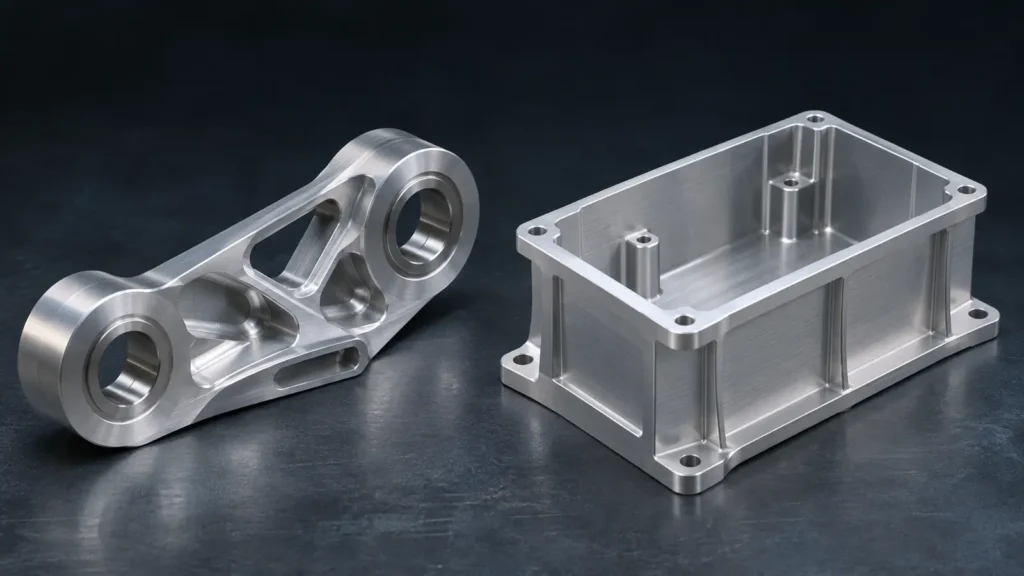
Machined aerospace bracket and equipment housing illustrating a 7075 vs 6061 aluminum design choice
Meco Whole Product Manufacturing Engineering Technical Guide

${articleTitle}

Source: ${window.location.href}  |  Generated: ${todayStr}
${clone.innerHTML}
`); frameDoc.close(); // Wait briefly for images and fonts inside the clean document before opening the PDF dialog const frameImages = Array.from(frameDoc.images); const imagePromises = frameImages.map(img => { if (img.complete) return Promise.resolve(); return new Promise(resolve => { img.onload = resolve; img.onerror = resolve; }); }); Promise.race([ Promise.all(imagePromises), new Promise(resolve => setTimeout(resolve, 1800)) ]).then(() => { if (btnSpan) btnSpan.textContent = originalText; printFrame.contentWindow.focus(); printFrame.contentWindow.print(); }); }); } });
Short answer

For 7075 vs 6061 aluminum, the practical choice is about loading and manufacturing, not just which metal is stronger. Representative T6 yield strengths are 503 MPa for 7075 and 276 MPa for 6061, while both have nearly the same density.

Choose 7075 when strength limits a light part. Start with 6061 when cost, welding, finish consistency and easy sourcing matter more. Verify the temper, stock form and required test evidence before purchase.

A drawing can call for a light aluminum bracket, but two alloys may lead to different purchase prices and production plans. The stronger option can be useful. It can also add cost without making the finished part lighter.

A buyer may compare a load-bearing aircraft fitting with an electronics enclosure. Both are machined aluminum. Only the first may need the extra yield strength of 7075. The enclosure may benefit more from easy finishing and assembly.

The important question is not which alloy wins every category. It is which property your part really uses. For a wider view of available grades and processes, see Meco's materials guide.

This comparison uses representative heat-treated T6 values, rather than treating every plate, bar and extrusion as identical. The exact product standard and thickness still control the purchase specification.

Key takeaways

  • Strength: 7075-T6 has substantially higher representative yield strength than 6061-T6.
  • Weight: Density is close. Swapping alloys without changing the design saves little mass.
  • Machining: Both can be CNC machined; access, tolerances and stock removal drive much of the cost.
  • Finish: Both can be anodized, but appearance and corrosion performance need grade-specific review.
  • Ordering: Specify alloy, temper, stock form, standard, finish and required material records.

7075 vs. 6061 aluminum: what changes most?

The main difference is strength, not a dramatic difference in weight.

6061 is an aluminum-magnesium-silicon alloy. It is used for frames, housings, machined plates and many structural parts. 7075 contains more zinc, with magnesium and copper, and is often selected for highly loaded components.

Both are heat-treatable. The T6 condition means the alloy has been solution heat treated and artificially aged to develop strength. Numbers in this table are representative values commonly quoted for the stated conditions, not universal acceptance limits.

Representative room-temperature comparison for commonly cited wrought T6 conditions. Actual minimum values depend on product form, thickness, orientation and standard; these are not Meco test results.
Property6061-T67075-T6What it means
Yield strength276 MPa (40 ksi)503 MPa (73 ksi)Resistance to permanent bending under load
Ultimate tensile strength310 MPa (45 ksi)572 MPa (83 ksi)Peak tensile load before fracture in a standard test
Density2.70 g/cm³2.81 g/cm³Similar mass for equal part volume
Typical Brinell hardnessAbout 95 HBAbout 150 HBA rough indication of resistance to indentation
Young's modulusAbout 69 GPaAbout 72 GPaSimilar elastic stiffness
General purchasing trendOften lower costOften higher costQuote actual stock, size and temper
Educational comparison of representative T6 yield strength and density for 6061 and 7075 aluminum
Representative T6 values show a large difference in yield strength but only a small difference in density.

These figures draw on the ASM wrought-alloy property tables available through the NIST materials database. For any real order, use the values in the applicable material specification and the mill certificate, not only this summary table.

Readers comparing several metal families can also use Meco's aluminum, brass and titanium comparison for a wider look at density and machining behavior.

Does the stronger 7075 alloy make a part lighter?

Only when the designer can remove material while still meeting all other loads and limits.

Yield strength describes the stress at which a metal starts to keep a permanent change in shape. It is not the same as stiffness. A bracket with a long unsupported arm can still flex even when it is made from a stronger alloy.

Strength is not stiffness

Think of a narrow aluminum beam between two mounting bolts. Under a small load, both alloys bend a little and return to shape. Their elastic stiffness is close because their Young's modulus values are similar.

7075 can allow a thinner section when permanent deformation is the controlling limit. It may not help much if the design is limited by deflection, vibration, joint stiffness or a minimum wall needed for machining.

The density difference is small

At equal volume, 7075 is slightly heavier than 6061, not lighter. It earns a weight benefit only if its extra strength allows a smaller cross-section. That redesign needs a proper load calculation.

For example, replacing a 6061 bracket with an identical 7075 bracket does not reduce its volume. It raises the strength reserve but changes little else about the geometry. Do not treat a direct alloy swap as a weight-saving program.

Strength values can also change with temperature, fatigue cycles, loading direction and the thickness of the purchased stock. Those limits may decide the alloy long before the nominal T6 yield number does.

Why do temper and stock form matter?

A material callout must describe more than an alloy number.

T6 names a heat-treatment condition. T651 adds controlled stretching for stress relief after heat treatment and is common for plate. The suffix tells the mill and buyer how the stock was made. It does not turn 6061 into 7075 or vice versa.

Thin sheet, thick plate, extruded shapes and bars can have different guaranteed property ranges. Even within one temper, direction and thickness matter. A comparison table is useful for choosing a family, but the mill specification settles what you receive.

For a fuller discussion of 6061-T6, T651 and T6511, use the 6061 aluminum properties guide. It covers those stock conditions without turning this two-alloy article into another temper glossary.

Plate versus extruded profiles

Plate is often chosen when deep pockets or large flat mounting areas will be cut away. Extrusions make sense when one section repeats along the part length. The most efficient starting form depends on volume and final geometry.

In production planning, a rectangular CNC billet and a near-net extrusion have different purchase and setup costs. The 6061 versus 6063 extrusion comparison explains another part of that choice when thin walls and anodized appearance are the primary needs.

For highly loaded parts, designers may also consider a forged blank before finish machining. A forging route is a separate manufacturing decision; selecting 7075 alone does not mean the part has forged grain flow.

How do 6061 and 7075 behave in CNC machining?

Both alloys are practical CNC materials, but chip formation and the part shape affect the process plan.

6061 cuts well in common milling and turning work. It can form longer, softer chips under some conditions, so sharp tools, chip control and coolant selection matter. 7075 is harder and often breaks chips more readily, but it can place more load on a tool.

The material difference does not set one universal cycle-time ratio. Toolpath length, removal volume, wall stability, workholding and inspection may outweigh the difference between the alloys. Meco's CNC machining materials guide compares many grades by machining use.

When is five-axis machining useful?

A part can need five-axis access when mounting faces, angled holes or deep side features cannot be reached efficiently from a single setup. Five-axis refers to machine motion and tool access, not to a strength grade.

A simple 7075 flat plate may only need three-axis milling. A complex 6061 housing can need five-axis CNC machining if several tool directions are required. Specify the finished geometry first, then choose a machine strategy.

Complex aluminum structural bracket with deep pockets angled access and precisely machined mounting bores
Part geometry, pocket depth and access to mounting faces often matter more to CNC setup than the alloy name alone.

Watch thin walls and heavy pocketing

A large pocket leaves a thin wall that can move under cutting forces or as residual stress is released from the stock. A restrained cutting plan and stable fixturing can help. The exact approach depends on the part and material condition.

For both alloys, call out datum surfaces that must remain accurate after finishing. A datum is a reference face used to locate and inspect the component. A surface that looks smooth is not automatically the right measurement reference.

Meco's custom CNC machining services cover the machining route, while the drawing should carry the actual part tolerance and inspection plan.

What makes a 7075 CNC part cost more?

Material price is one factor, but it is not the whole machining quote.

7075-T6 generally commands a higher raw-stock price than 6061-T6, but the gap changes with plate thickness, stock size, order quantity and market conditions. It is safer to request comparable supplier quotes than to publish a fixed multiplier.

A costly bracket may be expensive because it requires a large billet, deep pockets, multiple setups, close tolerances or careful finishing. Changing to cheaper stock does not remove those operations.

Cost factors depend on the drawing and a current quotation; no row is a universal alloy surcharge.
Cost driverWhat to checkWhy it matters
Raw stockAlloy, temper, size and certified lotHigher stock prices and poor nesting can raise material cost
Removed volumePockets, slots and starting billetMore material to cut can mean longer cycle time
SetupsNumber of orientations and datumsExtra operations add programming and inspection work
ToleranceOnly the dimensions that affect functionClose limits need more control and checking
FinishAnodize type, masking and appearanceProcess controls and sample approval add cost
Batch sizePrototype or repeat runSetup cost is spread differently over volume

Meco's approved reference benchmark puts North American five-axis machine rates at $75 to $200+ per hour. That is a budgeting range, not a quotation for either alloy and not proof that 7075 takes longer per part.

Two bracket cross-sections comparing oversized starting stock with a more efficient pocketed machining layout
Stock size, pocket volume and datum access can change machining time even when the finished part has the same function.

For a detailed discussion of machine time, setup and order size, read the CNC machining cost guide. It explains why a lower stock price does not always produce the lowest finished-part price.

Comparing two aluminum quotes? Share the part drawing, stock condition, expected quantity and critical features. Meco can review material choices and CNC process options before production.

Talk to an Engineer

Can both 6061 and 7075 be anodized?

Yes. Both can be anodized, but matching appearance and managing corrosion require different care.

Anodizing grows a protective oxide layer on aluminum. It is not paint, and it is not an automatic guarantee of salt-spray life or uniform color. The alloy chemistry, bath conditions and part geometry all affect the final result.

6061 usually offers a more predictable decorative anodized appearance than 7075. The zinc- and copper-containing 7075 family may show more variation in shade or finish. That does not mean 7075 cannot receive an engineered anodized coating.

The Aluminum Anodizers Council explains that anodize response changes with alloy composition. A finishing supplier should review the specified coating type, thickness, sealing and intended service exposure.

Meco also provides surface finishing services. If the finished part must match a visual sample, keep that requirement separate from a corrosion or wear acceptance test.

Neutral gray anodized aluminum finish coupons beside an uncoated machined sample under controlled workshop light
Anodizing is possible on both alloys, but finish appearance and corrosion requirements should be checked on actual samples.

Corrosion and welding are separate decisions

6061 generally offers better all-around corrosion behavior for many industrial settings. Bare 7075 can be more sensitive in certain environments, so coating and material temper may carry more weight in the design.

Conventional fusion welding of 6061 is common with an appropriate process, though the heat-affected zone can lose strength. Welding 7075 by conventional fusion methods is generally difficult because of cracking risk. A bolted or machined joint may be preferable when high strength is the reason for choosing 7075.

Neither comparison removes the need to check the actual operating environment. Salt, cleaners, temperature and contact with other metals can all change the finishing decision.

Which alloy should you choose for aerospace parts?

Select the alloy from the load case, the approved drawing and the required manufacturing records.

An aircraft-style fitting that carries high loads in a limited space may justify 7075. A cover, enclosure or fixture with moderate loads may favor 6061 for easier finishing, forming or lower total cost. The application name by itself is not an alloy specification.

Aerospace projects also require attention to orientation, fatigue, environmental exposure and inspection. For some cases, 7075 tempers other than T6 may be considered for stress-corrosion resistance, with a different strength balance. The engineering specification must decide.

Meco's aerospace parts manufacturing overview describes machining and quality documentation capabilities. It does not mean every illustrative aluminum sample or blog comparison is an aerospace-approved result.

Ask for the right material evidence

A supplier should identify the alloy and temper from purchase and mill records. The inspection package may include composition, mechanical properties, dimensional reports or a certificate, according to the purchase order. A hardness check alone does not establish every tensile property.

If material traceability matters, define the mill documentation and lot identification before purchasing the stock. Meco's EN 10204 3.1 certification guide explains the role of inspection documents when a contract requires them.

What should be on a 6061 or 7075 CNC drawing?

A usable drawing states the delivered material condition and what the finished part must achieve.

Write the alloy and temper together, then identify the stock form and a suitable procurement specification. Add the critical dimensions, datums, surface condition and any finishing constraints. Where a property value is critical, state the acceptance method.

  • Material: 6061 or 7075, exact temper and governing product standard.
  • Stock: Plate, bar or forging, plus relevant thickness or orientation.
  • Geometry: Fit dimensions, machining datums and features needing multi-side access.
  • Surface: Coating type, appearance sample, masking and assembly-contact areas.
  • Evidence: Mill certificate, dimensional inspection and any agreed functional tests.

A realistic sample check measures what the drawing controls. If a tight hole location matters, use the required datum reference. If the anodized appearance matters, approve actual samples under controlled light rather than relying only on a stock photograph.

For help setting function-based dimensions, see Meco's guide to CNC machining tolerances. Adding close limits where they are not needed can increase cost for either alloy.

For procurement teams comparing across alloy groups, the best CNC machining materials article provides a broader selection framework. Keep this page focused on the specific 7075 and 6061 choice.

7075 or 6061: which is the better choice?

Use 7075 when the design needs its higher strength, and use 6061 when that extra strength does not solve a real problem.

Choose 7075-T6 for a compact highly loaded machined component only after checking the actual load, stock properties and environmental limits. Choose 6061-T6 for general brackets, housings and welded or cosmetic parts when its strength is enough.

A good comparison ends with a drawing and a quote, not with a single winning alloy. Ask the supplier to price equivalent finished parts with the correct temper and finishing requirements. Then compare total cost against the performance requirement.

Review Your Aluminum Part

Share a drawing, target load, stock form and finish requirements. Meco can compare aluminum material and machining routes for your project.

  • Materials. 6061 or 7075 alloy and temper review.
  • Machining. Stock size, pockets, datums and setup planning.
  • Finishing. Anodize and assembly-surface requirements.
  • Quality. IATF 16949:2016 certified processes and inspection documentation.

Browse materials and alloys or review our CNC machining capabilities.

Talk to an Engineer

About the author

Meco Engineering Team

The Meco Engineering Team draws on over 30 years of turnkey manufacturing experience across CNC machining, forging, aluminum component production, finishing and mechanical assembly.

Our engineers work with sourcing managers and product designers to balance cost, tolerance and lead time from prototyping through production.

For aluminum part reviews, the team can help connect the material callout with the stock condition, part geometry and inspection requirements.

  • Specialisms. Aluminum material choices, CNC process planning and drawing reviews.
  • Equipment. CNC milling and turning capabilities; specific equipment should be confirmed for each quote.
  • Quality systems. FAI, PPAP, CMM inspection and material traceability as applicable.
  • Reviewed by. Meco process engineering and quality leads.

Meet the engineering team or talk to an engineer directly.

IATF 16949:2016 certified. 30+ years in turnkey manufacturing. 40+ in-house processes. Global production with North American support.

References and sources

  1. ASM Handbook, Properties of Wrought Aluminum and Aluminum Alloys. Published through the NIST materials data repository. Source property tables. Representative values depend on form and temper.
  2. Aluminum Anodizers Council, Specifying Anodized Finishes on Aluminum. Technical bulletin. Alloy chemistry affects finish response.

Values are reference information, not a substitute for current mill standards, test reports or engineering approval.