
Aluminum is softer than brass in most commonly used grades. Brass (C360) measures 100 to 120 HV on the Vickers hardness scale, while general-purpose aluminum (6061-T6) sits at 85 to 100 HV and pure aluminum (1100) drops to 25 to 35 HV. Titanium (Grade 5, Ti-6Al-4V) outperforms both at 300 to 370 HV, but at roughly 67% more weight than aluminum and several times the machining cost.
For engineers and sourcing managers selecting materials for CNC machining projects, the choice between aluminum, brass, and titanium comes down to five factors: how much the part can weigh, how hard the surface needs to be, how easily it machines, what environment it must survive, and what the budget allows. These three metals sit at very different points across all five dimensions.
This guide provides a complete side-by-side comparison with specific grades, hardness values, density figures, tensile strengths, machinability ratings, and cost context so you can match the right metal to the right application without guesswork.
Is Aluminum Softer Than Brass?
Yes. In most standard engineering grades, aluminum is softer than brass. Free-machining brass (C360/C36000) has a typical Vickers hardness of 100 to 120 HV, while the most widely used structural aluminum alloy (6061-T6) measures 85 to 100 HV. Pure aluminum grades like 1100 are significantly softer at just 25 to 35 HV.
However, there are important exceptions. Aerospace-grade aluminum 7075-T6 reaches 150 to 180 HV, which makes it harder than most standard brass alloys. Naval brass (C464) sits at 120 to 150 HV, placing it in the same range as high-strength aluminum. The answer to "is aluminum softer than brass" depends entirely on which specific alloy and temper you are comparing.
This matters for part design because hardness directly affects scratch resistance, wear life, and deformation under load. Brass components used in valve seats, bushings, and sliding-contact applications rely on their higher hardness for long-term dimensional stability. Aluminum parts that require surface hardness comparable to brass can achieve it through anodizing, which raises the surface to 200 to 600 HV depending on whether Type II or Type III hardcoat is specified. For a complete breakdown of anodizing types, identification tests, and how anodized aluminum compares to raw aluminum across every engineering property, see our companion guide on anodized aluminum vs raw aluminum.
Titanium Weight vs Aluminum Weight: Which Is Lighter?
Aluminum is significantly lighter than titanium. Aluminum has a density of approximately 2.70 g/cm³, while titanium (Ti-6Al-4V, Grade 5) has a density of approximately 4.50 g/cm³. That makes titanium roughly 67% heavier than aluminum for the same volume of material.
In practical terms, a 100 mm cube of aluminum weighs about 270 grams, while the same cube in titanium weighs about 450 grams. For parts where minimizing physical mass is the primary goal, aluminum is the clear winner. This is why aluminum dominates applications such as electronics enclosures, automotive body panels, drone frames, and general structural brackets where weight savings translate directly into performance or cost advantages.
Titanium's advantage emerges when you factor in strength. Because titanium is roughly 2 to 3 times stronger than most aluminum alloys at the tensile level, a titanium part can often be designed with thinner walls or less material to carry the same load. In those cases, the finished titanium part may weigh less than the aluminum equivalent even though the raw material is denser. This is the concept of strength-to-weight ratio, and it is the reason titanium remains competitive in aerospace manufacturing and high-performance applications despite its higher density and cost.
Complete Property Comparison: Aluminum vs Brass vs Titanium
The following table compares the most commonly specified grades of all three metals across every property that influences material selection for CNC-machined parts.
| Property | Aluminum (6061-T6) | Aluminum (7075-T6) | Brass (C360) | Titanium (Grade 5, Ti-6Al-4V) |
|---|---|---|---|---|
| Density (g/cm³) | 2.70 | 2.81 | 8.50 | 4.43 |
| Hardness (Vickers HV) | 85 to 100 | 150 to 180 | 100 to 120 | 300 to 370 |
| Tensile Strength (MPa) | 310 | 572 | 330 to 450 | 895 to 1,000 |
| Yield Strength (MPa) | 276 | 503 | 110 to 310 | 828 to 895 |
| Elongation (%) | 12 to 17 | 11 | 10 to 25 | 10 to 14 |
| Thermal Conductivity (W/m·K) | 167 | 130 | 115 | 6.7 |
| Electrical Conductivity (% IACS) | 43 | 33 | 26 | 1 |
| Melting Point (°C) | 582 to 652 | 477 to 635 | 885 to 900 | 1,604 to 1,660 |
| Corrosion Resistance | Good (excellent when anodized) | Fair (lower than 6061; prone in marine) | Good (excellent in marine/freshwater) | Excellent (outstanding in seawater, chlorides, body fluids) |
| Machinability Rating (relative) | High (fast cutting, low tool wear) | High | Very High (benchmark for free-machining metals) | Low (slow, high tool wear, heat buildup) |
| Relative Material Cost | Low | Moderate | Moderate to High | Very High (5 to 10 times aluminum) |
| Relative CNC Machining Cost | Low | Low to Moderate | Low | High (2 to 5 times aluminum) |
Sources: Material property data referenced from Thomas Publishing (6061 vs 7075), ASM MatWeb (Ti-6Al-4V), and Metal Supermarkets (Brass 360).
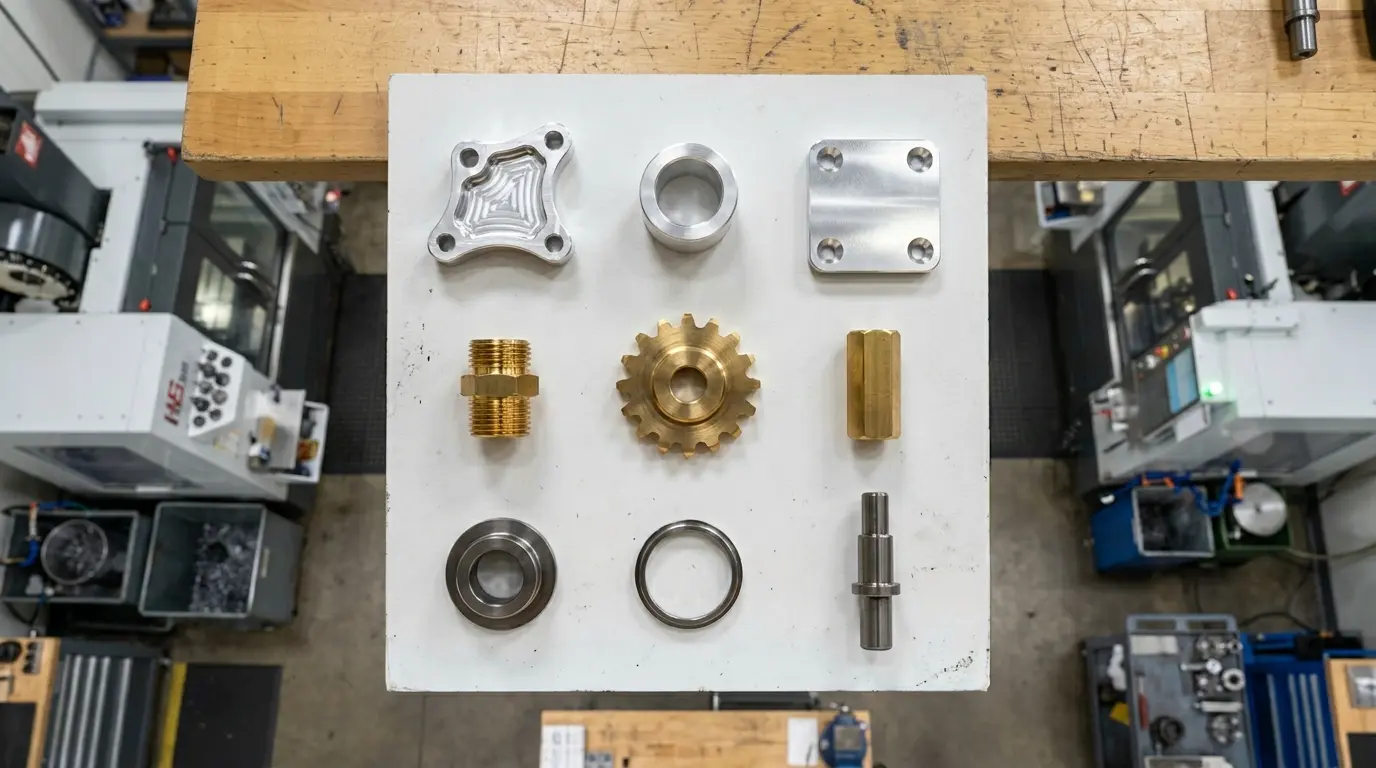
Hardness Comparison: How Aluminum, Brass, and Titanium Stack Up
Surface hardness determines how well a part resists scratching, indentation, and wear during service. The hardness of all three metals varies significantly by alloy grade and heat treatment condition.
| Material and Grade | Vickers Hardness (HV) | Brinell Hardness (HB) | Context |
|---|---|---|---|
| Aluminum 1100 (pure) | 25 to 35 | 23 to 32 | Very soft; easy to form, poor wear resistance |
| Aluminum 6061-T6 | 85 to 100 | 95 | Most common structural grade; moderate hardness |
| Aluminum 7075-T6 | 150 to 180 | 150 | Aerospace grade; harder than most brass alloys |
| Brass C360 (free-machining) | 100 to 120 | 100 | Benchmark for machinability; harder than 6061 aluminum |
| Brass C464 (naval) | 120 to 150 | 130 | High-strength brass for marine applications |
| Titanium Grade 2 (CP) | 145 to 190 | 160 | Commercially pure; good corrosion resistance, moderate strength |
| Titanium Grade 5 (Ti-6Al-4V) | 300 to 370 | 334 | Most widely used titanium alloy; very hard surface |
The key takeaway: standard aluminum (6061-T6) is softer than standard brass (C360), but high-strength aluminum (7075-T6) can exceed the hardness of common brass grades. Titanium Grade 5 is the hardest of the three by a wide margin and is the clear choice when surface hardness and wear resistance are primary design requirements.
What If You Need Aluminum With Brass-Level or Higher Hardness?
Anodizing transforms the surface hardness of aluminum without changing the base material. Type II anodizing raises surface hardness to 200 to 350 HV, which exceeds all standard brass grades. Type III hardcoat anodizing reaches 400 to 600 HV, approaching the surface hardness of hardened tool steel. For parts that need the lightweight properties of aluminum combined with high surface hardness, anodizing is the standard engineering solution. Our detailed guide on anodized aluminum vs raw aluminum covers the full property comparison, alloy compatibility, and coating-over-coating scenarios. Meco provides both Type II and Type III anodizing services integrated with CNC machining, so parts move directly from the machine to the anodizing line without a vendor handoff.
Weight Comparison: Density and Real-World Impact
Weight is often the deciding factor in material selection, especially in aerospace, automotive, consumer electronics, and portable equipment applications.
| Metal | Density (g/cm³) | Weight of 100mm Cube (g) | Weight Relative to Aluminum |
|---|---|---|---|
| Aluminum (6061) | 2.70 | 270 | 1.0x (baseline) |
| Titanium (Grade 5) | 4.43 | 443 | 1.64x heavier |
| Brass (C360) | 8.50 | 850 | 3.15x heavier |
Brass is by far the heaviest of the three, at more than three times the weight of aluminum per unit volume. This limits brass to applications where its superior machinability, corrosion performance in water systems, electrical conductivity, or aesthetic appearance justify the weight penalty. Titanium sits in the middle at 1.64 times the weight of aluminum, but its much higher strength means titanium parts can often be designed with thinner cross-sections to partially offset the density difference.
For applications where weight reduction is the primary goal, aluminum is the default material. Meco machines aluminum across all common alloy families (6061, 7075, 5052, 2024) for extruded profiles, CNC-machined components, and die cast parts.
Machinability: Which Metal Is Easiest to CNC Machine?
Machinability determines how fast a part can be produced, how much tool wear occurs, and ultimately how much the finished part costs. Brass, aluminum, and titanium sit at very different points on the machinability spectrum.
Brass: The Machinability Benchmark
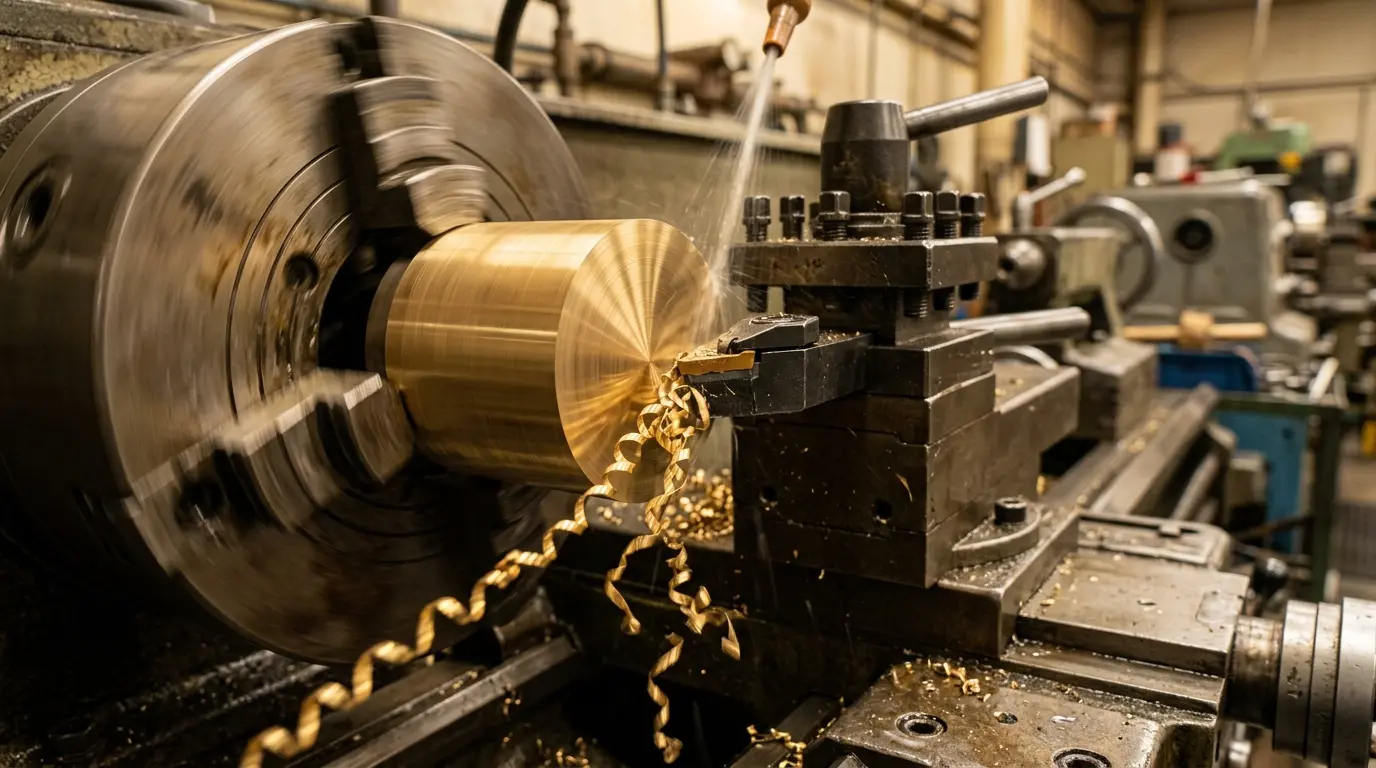
Free-machining brass (C360) is one of the easiest metals to machine and is often used as the baseline reference for machinability ratings. It produces short, well-broken chips, generates minimal tool wear, and delivers excellent surface finishes with standard carbide tooling. Cutting speeds can run high, cycle times are short, and dimensional accuracy is easy to maintain. This makes brass the preferred material for high-volume precision parts such as electrical connectors, fittings, valve bodies, and threaded components.
Aluminum: Fast, Light, and Cost-Effective
Aluminum machines very quickly, often faster than brass in terms of material removal rate due to its lower hardness. Cutting speeds for aluminum can reach several hundred meters per minute on modern CNC equipment. The primary machining challenge with aluminum is built-up edge (BUE), where the soft material welds to the cutting tool, causing poor surface finish and dimensional drift. This is controlled with sharp tooling geometry, proper coolant application, and appropriate feed rates. Despite this issue, aluminum remains one of the most cost-effective metals to CNC machine at volume. For a detailed breakdown of aluminum and brass machining costs, see Meco's guide on how much CNC machining costs.
Titanium: Difficult, Slow, and Expensive
Titanium is the most challenging of the three to machine. Its very low thermal conductivity (6.7 W/m·K versus 167 W/m·K for aluminum) means heat concentrates at the cutting edge rather than dissipating through the workpiece. This causes rapid tool wear, galling, and work hardening. According to ATI's Ti-6Al-4V data sheet, titanium tends to smear, gall, and weld to cutting tools during machining. Cutting speeds must be kept low, feeds must be carefully controlled, and rigid setups with strong clamping are essential. Expect titanium CNC machining costs to run 2 to 5 times higher than equivalent aluminum parts due to slower cycle times and higher tooling consumption.
When to Choose Each Metal: Application Decision Guide
The right material depends on the balance of performance requirements, environmental exposure, production volume, and cost constraints.
| Application Requirement | Best Choice | Reason |
|---|---|---|
| Maximum weight reduction | Aluminum | Lowest density at 2.70 g/cm³; lightest option by far |
| Maximum surface hardness and wear resistance | Titanium (or anodized aluminum) | Ti Grade 5 at 300 to 370 HV; Type III anodized aluminum at 400 to 600 HV |
| Best machinability and lowest CNC cost | Brass or Aluminum | Both machine easily; brass produces the best surface finish, aluminum has faster cycle times |
| Heat sinks and thermal management | Aluminum | Thermal conductivity of 167 W/m·K versus 115 for brass and 6.7 for titanium |
| Electrical conductivity | Brass or Aluminum | Both conduct electricity well; aluminum at 43% IACS, brass at 26% IACS |
| Seawater and chloride corrosion resistance | Titanium | Outstanding chloride resistance; far superior to both aluminum and brass in marine environments |
| Decorative or premium appearance | Brass (or anodized aluminum) | Brass provides a natural golden finish; anodized aluminum offers unlimited dye color options |
| Medical implants and biocompatibility | Titanium | Biocompatible and non-reactive with body fluids; standard for surgical implants |
| High-volume cost-sensitive production | Aluminum | Lowest combined material and machining cost at volume |
| Plumbing, valves, and fluid systems | Brass | Excellent corrosion resistance in freshwater systems; antimicrobial properties |
| High strength at elevated temperature | Titanium | Maintains strength to approximately 350°C; aluminum loses strength above 150°C |
Strength-to-Weight Ratio: The Real Performance Metric
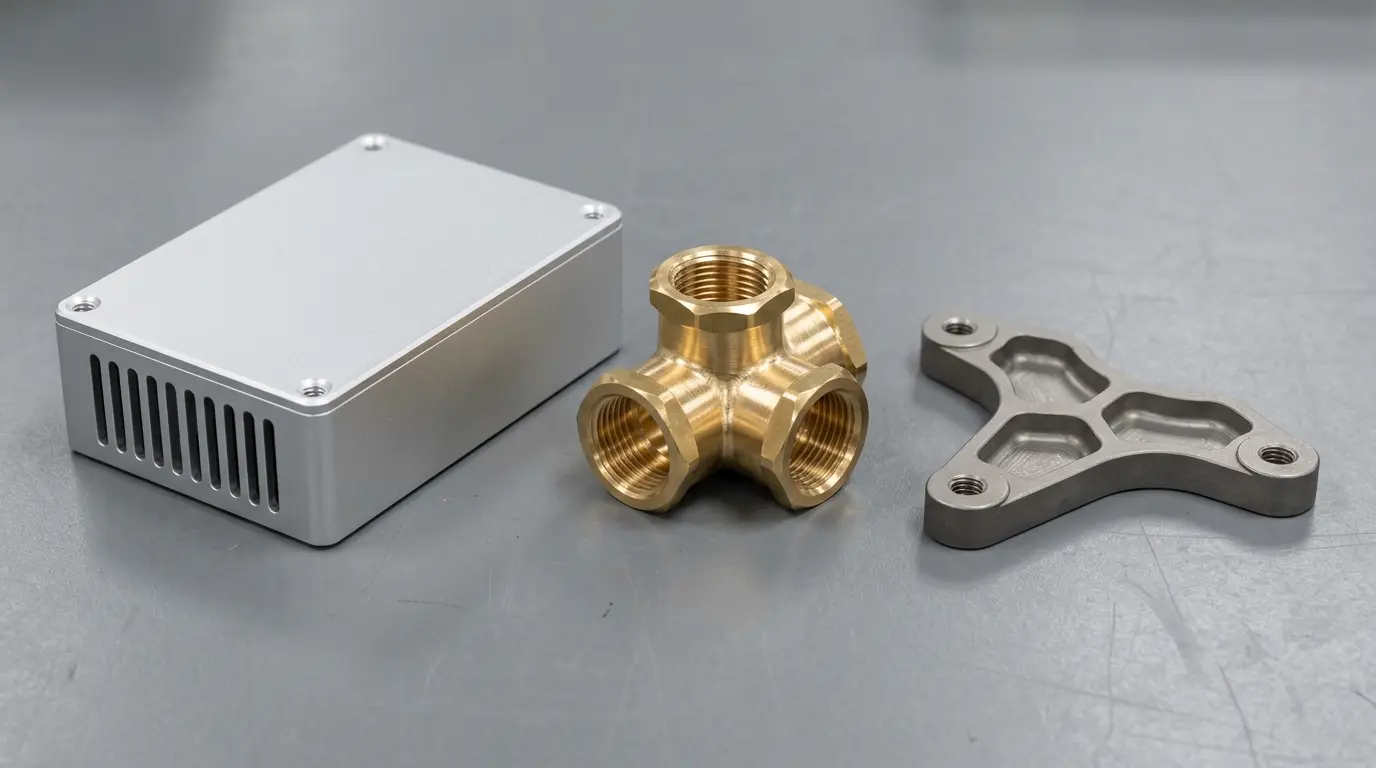
Raw weight and raw strength numbers in isolation can be misleading. The metric that engineers use to compare structural efficiency across different metals is the specific strength, also called the strength-to-weight ratio. It is calculated by dividing tensile strength by density.
| Metal and Grade | Tensile Strength (MPa) | Density (g/cm³) | Specific Strength (kN·m/kg) | Ranking |
|---|---|---|---|---|
| Aluminum 7075-T6 | 572 | 2.81 | 204 | 1st (highest) |
| Titanium Grade 5 (Ti-6Al-4V) | 950 (typical) | 4.43 | 214 | Close to 7075; wins at higher loads |
| Aluminum 6061-T6 | 310 | 2.70 | 115 | Good for general structural use |
| Brass C360 | 400 (typical) | 8.50 | 47 | Last (lowest structural efficiency) |
The data shows that 7075-T6 aluminum and Ti-6Al-4V titanium have remarkably similar specific strength values. This is why 7075 aluminum is sometimes chosen over titanium for structural aerospace components where the design can accommodate the larger cross-section that aluminum requires. Brass has the lowest structural efficiency and is never chosen for load-bearing applications where weight matters.
Cost Per Unit of Strength
While titanium and 7075 aluminum have similar strength-to-weight ratios, their costs are not similar. Titanium raw material typically costs 5 to 10 times more per kilogram than aluminum, and CNC machining costs multiply that gap further. This is why aluminum remains the default structural material for over 90% of commercial and industrial machined parts. Titanium is reserved for applications where no aluminum alloy can meet the load, temperature, corrosion, or biocompatibility requirements. Meco's CNC machine costs guide provides additional context on how material choice affects total part cost.
Corrosion Resistance: How Each Metal Performs in Service
All three metals offer good corrosion resistance, but in very different environments and through different mechanisms.
Aluminum forms a thin natural oxide layer that protects it well in atmospheric conditions. When anodized, this layer becomes 1,000 to 10,000 times thicker, providing excellent protection against moisture, salt spray, and most industrial chemicals. However, aluminum is vulnerable to galvanic corrosion when in direct contact with dissimilar metals (especially copper, brass, or steel) in the presence of an electrolyte.
Brass resists corrosion very well in freshwater and marine environments due to the copper content that forms a protective patina. Brass is the standard material for plumbing fittings, marine hardware, and fluid-handling valves. Its main weakness is dezincification, where zinc leaches out of the alloy in certain water chemistries, leaving a porous and weakened copper structure.
Titanium is the clear winner for corrosion resistance in aggressive environments. It resists seawater, chloride solutions, body fluids, and many acids that would attack both aluminum and brass. This is why titanium is the standard material for surgical implants, offshore equipment, and chemical processing hardware.
Thermal and Electrical Conductivity: Choosing for Heat and Current
If the part needs to transfer heat or conduct electricity, aluminum is the strongest choice among the three. Aluminum's thermal conductivity of 167 W/m·K (6061) makes it the standard material for heat sinks, cooling plates, battery thermal management components, and electronics housings. Brass offers moderate thermal conductivity at 115 W/m·K and is used where a combination of heat transfer, corrosion resistance, and machinability is needed (such as heater blocks and nozzles). Titanium's thermal conductivity of just 6.7 W/m·K makes it a poor heat conductor and effectively rules it out for thermal management applications.
For electrical conductivity, aluminum and brass both perform well. Aluminum at 43% IACS is widely used in power transmission, bus bars, and electrical enclosures. Brass at 26% IACS is used for electrical connectors, terminals, and switch components where its combination of conductivity and machinability is valuable. Titanium at roughly 1% IACS is essentially non-conductive and is never selected for electrical applications.
Frequently Asked Questions About Aluminum vs Brass vs Titanium
Is aluminum softer than brass?
Yes, in most standard grades. Free-machining brass (C360) typically measures 100 to 120 HV on the Vickers hardness scale, while the most common structural aluminum alloy (6061-T6) measures 85 to 100 HV. Pure aluminum (1100) is even softer at 25 to 35 HV. However, aerospace-grade aluminum 7075-T6 reaches 150 to 180 HV, which exceeds most standard brass alloys. The answer depends entirely on the specific alloy and heat treatment being compared.
How does titanium weight compare to aluminum weight?
Titanium is approximately 67% heavier than aluminum by volume. Aluminum has a density of 2.70 g/cm³ while titanium (Grade 5, Ti-6Al-4V) has a density of 4.43 g/cm³. A 100 mm cube of aluminum weighs about 270 grams versus 443 grams for the same cube in titanium. However, titanium's much higher strength (roughly 2 to 3 times that of most aluminum alloys) means a titanium part can sometimes be designed with less material to carry the same load, partially offsetting the weight difference.
Which metal has the best strength-to-weight ratio: aluminum, brass, or titanium?
Titanium (Grade 5) and high-strength aluminum (7075-T6) have very similar strength-to-weight ratios, both around 200 to 215 kN·m/kg. Standard aluminum (6061-T6) is lower at about 115 kN·m/kg. Brass has the lowest structural efficiency at roughly 47 kN·m/kg because its high density (8.50 g/cm³) heavily penalizes its strength-to-weight calculation. For load-bearing structures where weight matters, aluminum and titanium are both excellent choices, while brass is chosen for other reasons such as machinability, corrosion resistance in water systems, or aesthetics.
Which is easier to CNC machine: aluminum, brass, or titanium?
Brass (C360) is the easiest to machine and is used as the benchmark for machinability in the metals industry. It produces short, clean chips and delivers excellent surface finishes with minimal tool wear. Aluminum is also very easy to machine with high cutting speeds, though it can cause built-up edge on cutting tools if feeds and coolant are not properly managed. Titanium is the most difficult of the three due to its low thermal conductivity, tendency to gall on tooling, and requirement for slow cutting speeds with rigid setups. Titanium CNC machining typically costs 2 to 5 times more than equivalent aluminum parts.
Is titanium stronger than aluminum?
Yes, significantly. Titanium Grade 5 (Ti-6Al-4V) has a tensile strength of approximately 895 to 1,000 MPa, while the most common structural aluminum alloy (6061-T6) is rated at 310 MPa. Even the strongest commonly machined aluminum alloy, 7075-T6, tops out at 572 MPa. Titanium also maintains its strength at elevated temperatures up to approximately 350°C, whereas aluminum begins to lose significant strength above 150°C.
Is brass heavier than aluminum?
Yes, brass is more than three times heavier than aluminum. Brass (C360) has a density of 8.50 g/cm³ compared to aluminum's 2.70 g/cm³. This means a brass part of identical geometry would weigh 3.15 times more than its aluminum counterpart. This weight penalty is the main reason brass is not used for structural applications where minimizing mass is important, but it is acceptable in applications where machinability, corrosion resistance in water, or decorative appearance are the priority.
Which metal is best for heat dissipation?
Aluminum is the best choice for heat dissipation among the three metals. Aluminum 6061 has a thermal conductivity of 167 W/m·K, compared to 115 W/m·K for brass and just 6.7 W/m·K for titanium. This is why aluminum is the standard material for heat sinks, electronics enclosures, battery cooling systems, and LED lighting housings. Titanium is essentially unsuitable for thermal management applications due to its extremely low thermal conductivity.
Can you make aluminum as hard as brass through surface treatment?
Yes. Anodizing increases the surface hardness of aluminum far beyond brass levels. Type II anodizing raises the surface to 200 to 350 HV, which is 2 to 3 times harder than standard brass (100 to 120 HV). Type III hardcoat anodizing reaches 400 to 600 HV, comparable to hardened tool steel. This means an anodized aluminum part can combine the lightweight properties of aluminum with surface hardness that exceeds not only brass but also titanium in many comparisons.
Get Aluminum, Brass, or Titanium Parts Machined and Finished Under One Roof
Selecting the right metal is only half the decision. The machining parameters, tooling strategy, surface finish, and quality controls must all be matched to the material. Meco machines all three metals across 40+ in-house processes, with integrated surface finishing (anodizing, powder coating, plating), heat treatment, and assembly under one IATF 16949:2016 certified quality system.
With 30+ years of turnkey manufacturing experience, Meco's engineering team helps you select the right alloy, optimize the design for machinability, and deliver finished parts globally.
- Full Material Range: Aluminum (6061, 7075, 5052, 2024), brass (C360, C464), titanium (Grade 2, Grade 5), plus steel, stainless steel, copper, and bronze.
- Integrated Surface Finishing: Type II and Type III anodizing, powder coating, chrome plating, nickel plating, PVD, and more, all managed in-house.
- IATF 16949:2016 Certified: Automotive-grade quality applied across every industry. 99.99% quality rate. 99.8% on-time delivery.
- DFM and Material Selection Guidance: Engineering review with every quote, including material alternatives and cost optimization recommendations. Quotes returned in under 24 hours.
- Prototype to Mass Production: From 10 pieces to 10 million+. No minimum order quantities.
Submit your drawings and let Meco's engineering team recommend the optimal material and process combination for your project.
Request a Quote Today