6061 Aluminum Properties: 6061-T6 vs. T651 & T6511 Specs

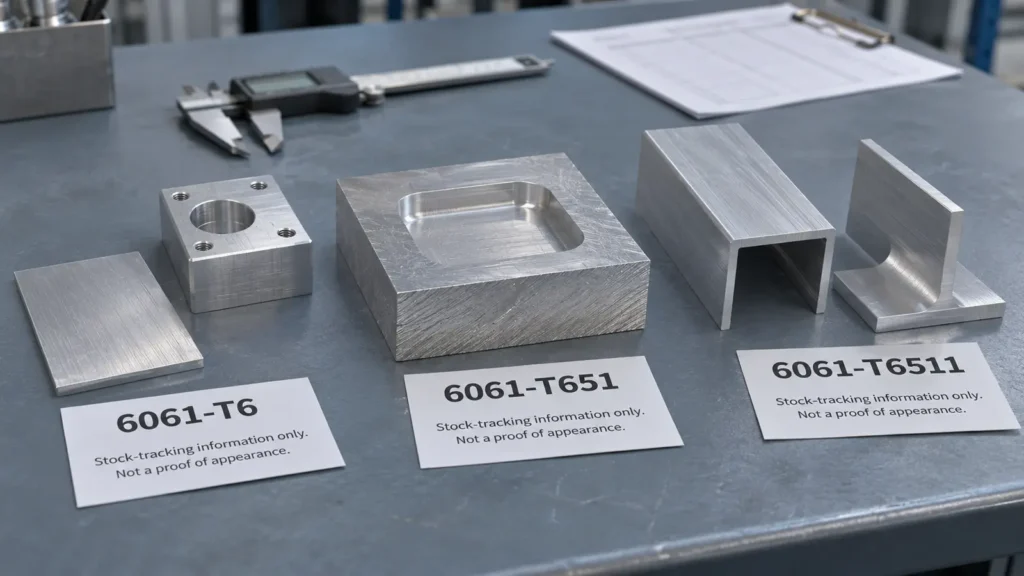
6061 aluminum T6, T651 and T6511 stock forms with machined parts on an engineering bench
Meco Whole Product Manufacturing Engineering Technical Guide

${articleTitle}

Source: ${window.location.href}  |  Generated: ${todayStr}
${clone.innerHTML}
`); frameDoc.close(); // Wait briefly for images and fonts inside the clean document before opening the PDF dialog const frameImages = Array.from(frameDoc.images); const imagePromises = frameImages.map(img => { if (img.complete) return Promise.resolve(); return new Promise(resolve => { img.onload = resolve; img.onerror = resolve; }); }); Promise.race([ Promise.all(imagePromises), new Promise(resolve => setTimeout(resolve, 1800)) ]).then(() => { if (btnSpan) btnSpan.textContent = originalText; printFrame.contentWindow.focus(); printFrame.contentWindow.print(); }); }); } });
Short answer

For 6061 t6 vs t651, the main difference is controlled stretch stress relief, not a new aluminum alloy. Both use the 6061 chemistry and T6 heat-treatment family, but T651 is commonly specified for plate and T6511 for extruded sections where minor post-stretch straightening is allowed.

Published tensile and yield strength requirements depend on product form, thickness and specification. A 6061-T651 plate and a 6061-T6511 extrusion cannot be treated as identical stock just because both designations end in 51.

Two aluminum brackets may be made from the same 6061 alloy but come from very different stock. A machined plate bracket and a cut extrusion do not go through the same mill route, even if both are artificially aged.

For a purchasing team, the temper suffix is a manufacturing instruction. It tells the supplier how the stock was treated and which product specification should be used to confirm its properties.

The material also affects how you cut pockets, machine long faces, inspect flatness, and order the finish. You can review the broader Meco materials selection hub when you are comparing other metals or production routes.

This article uses specific published material limits rather than claiming one universal 6061 strength number. It explains what the three tempers mean and which details to put on an OEM drawing or RFQ.

Key takeaways

  • 6061 is one aluminum-magnesium-silicon alloy. T6, T651 and T6511 describe different processed conditions, not different chemistries.
  • T651 is commonly associated with stretched plate; T6511 is used with stretched extrusions and permits minor straightening after stretching.
  • For specific commercial products, 35,000 psi (about 241 MPa) minimum yield may be specified, but the tensile minimum and elongation can change with form and thickness.
  • Stretch relief reduces some residual stress. It does not guarantee a distortion-free part after heavy machining.
  • Specify alloy, full temper, stock form, governing standard, section size and inspection requirements before quoting.

What are the key 6061 aluminum properties?

6061 is a heat-treatable aluminum alloy valued for its combination of moderate structural strength, relatively low weight, good CNC machinability and practical corrosion resistance.

The grade belongs to the 6xxx series. Magnesium and silicon support the strengthening response during heat treatment. It is widely used in machined housings, plates, extruded members and fabricated equipment structures.

The following values separate typical physical properties from published acceptance minimums. Do not use the table as a substitute for the ordered material standard.

Property6061 valueHow to interpret it
Density2.70 g/cm³ (0.098 lb/in³)Typical physical property for weight estimates.
Elastic modulusAbout 68.9 GPa (10,000 ksi)Typical stiffness; temper changes strength more than elastic modulus.
Thermal conductivity, T6About 167 W/m·KTypical value near room temperature; useful for housings and heat transfer.
Thermal expansionAbout 23.6 µm/m·°CTypical mean linear expansion over approximately 20 to 100 °C.
Electrical conductivity, T6About 43% IACSTypical value, not an electrical acceptance limit.
Brinell hardness, T6About 95 HBIndicative hardness, dependent on test method and stock condition.
Tensile strength, common T6 dataAbout 310 MPa (45,000 psi)Often-quoted typical value, not a minimum across all products.
Yield strength, common T6 dataAbout 276 MPa (40,000 psi)Often-quoted typical value, not a universal guaranteed minimum.
Physical property examples are based on Kaiser Aluminum technical data and Meco published material guidance. The source and product form matter.

A typical 276 MPa yield value is useful for early material screening. It is not safe to put that number in every drawing as the guaranteed 6061-T6 minimum. The full specification and thickness must be checked first.

6061 T6 vs T651 vs T6511: What exactly changes?

All three designations belong to the solution heat-treated and artificially aged temper family. T651 and T6511 additionally identify controlled stress relief by stretching.

After quenching, uneven cooling can leave residual stresses in stock. Later cutting may remove material unevenly and allow some of that stress to relax. Stretching can reduce the amount of stress carried into the machine shop.

The Aluminum Association explicitly warns that temper designations identify different processing requirements and must not be treated as automatically interchangeable.

TemperProcessing distinctionTypical ordered formPractical selection
6061-T6Solution heat treated and artificially aged; stretch relief not part of the T6 designation.Sheet, bar, extrusion and other permitted forms under their own standards.General structural and machined components when a T6 stock form meets the drawing.
6061-T651T6-family condition with controlled stretching for stress relief; no further straightening after stretching.Commonly rolled plate and certain cold-finished products.Machined plate parts where reducing residual stress can help hold flatness.
6061-T6511Stretch stress relief similar in intent; minor straightening is permitted after stretching.Extruded bar, rod, tube and profiles where the applicable specification permits it.Extrusions needing a stated strength temper and practical straightness control.
Product form and standard are part of the designation. Processing steps are simplified for orientation, not an instruction to perform heat treatment.
Concept diagram showing T6 aging, T651 stretch stress relief, and T6511 permitted straightening
T651 and T6511 add controlled stretch stress relief. T6511 also permits minor post-stretch straightening.

Does the extra digit mean better strength?

No. The suffix does not define a simple strength ranking. The property limits come from the alloy-temper-product specification and may differ even when two stock types share a similar nominal yield strength.

A drawing should not authorize replacement of T651 plate with T6511 extrusion without engineering review. The material may have a different certified product form, section geometry or acceptance range.

How strong are 6061-T6, T651 and T6511 in MPa and psi?

Published minimum yield values for common 6061 products can be 35 ksi, or about 241 MPa. The minimum tensile strength is not identical for every product form.

Kaiser Aluminum lists 42 ksi tensile and 35 ksi yield minimums for many 6061-T6 sheet and 6061-T651 plate thicknesses. Alro lists 38 ksi tensile and 35 ksi yield for representative commercial extruded 6061-T6/T6511 round stock.

These are product-specific published minimums, not tested values for one batch and not universal design allowables. Some thickness ranges and standards carry different minimums.

Representative stock and temperUltimate tensile min.0.2% yield min.Source scope
6061-T6 sheet42,000 psi / 290 MPa35,000 psi / 241 MPaKaiser, sheet in listed ASTM B209 thickness ranges.
6061-T651 plate42,000 psi / 290 MPa35,000 psi / 241 MPaKaiser, typical listed plate range 0.250 to 4.000 in; thicker plate may vary.
6061-T6/T6511 extruded round38,000 psi / 262 MPa35,000 psi / 241 MPaAlro commercial extrusion round example; not every profile or thickness.
Approximate conversion: 1 ksi = 6.895 MPa. For design approval, check the purchased product standard, thickness, orientation and inspection certificate.

Why do some charts say 276 MPa yield?

The widely cited 276 MPa (40 ksi) yield and 310 MPa (45 ksi) tensile values describe typical 6061-T6 performance in many datasets. Standards may instead specify lower minimum limits to allow normal manufacturing variation.

Compare like with like. A "typical" material property, an ASTM minimum and an aerospace design allowable are different things. They should not be used interchangeably in a load calculation.

What about elongation and fatigue?

Elongation depends on stock dimensions, testing direction and standard. The Kaiser plate table, for example, changes its minimum elongation with thickness even when the listed yield minimum stays at 35 ksi.

Fatigue life is not guaranteed by the T6 suffix. Surface quality, notches, loading direction, joints and cyclic stress range deserve a separate evaluation, especially on thin brackets and fastened assemblies.

What are the 6061 aluminum chemical composition and physical limits?

6061 is an aluminum-magnesium-silicon alloy with controlled additions of copper and chromium. The alloy chemistry stays 6061 across T6, T651 and T6511.

According to Kaiser Aluminum 6061 product data, magnesium is specified at 0.80% to 1.20% by weight and silicon at 0.40% to 0.80%. Other alloying elements have smaller controlled ranges.

ElementTypical specification limits by weightWhy it matters
Magnesium (Mg)0.80% to 1.20%Works with silicon in the heat-treatable strengthening system.
Silicon (Si)0.40% to 0.80%Supports age-hardening response and alloy behavior.
Copper (Cu)0.15% to 0.40%A smaller controlled addition in 6061.
Chromium (Cr)0.04% to 0.35%Influences microstructure during processing.
Aluminum (Al)BalanceMain metal in the alloy.
Shown for orientation from Kaiser Aluminum 6061 composition limits. Buy against the current applicable alloy and product specification.

You cannot reliably identify T651 from its color, surface grain or hardness alone. Stock markings, mill documentation and the specified procurement route are needed to establish the actual temper.

Does T651 reduce CNC machining distortion?

T651 plate is often preferred for heavy CNC material removal because controlled stretching can lower residual stress. It cannot prevent every part from moving during machining.

Consider a thick plate that must become a shallow equipment enclosure. Removing a large pocket from one side changes the balance of internal stress. A plate with lower residual stress gives the machinist a better starting point, but setup and cut sequence still matter.

For custom CNC machining, review plate thickness, pocket depth, wall stiffness and final flatness together. A premium temper will not make up for a weak thin wall or one-sided clamping.

Machine the part, not just the alloy name

  • Start with credible stock. Confirm temper, mill condition, thickness tolerance and flatness before programming.
  • Support the work. Use stable fixtures and avoid clamping a bowed blank flat only to see it spring back after release.
  • Balance stock removal. Rough opposite sides where practical, leave finishing allowance and inspect after unclamping.
  • Manage heat and chips. Sharp aluminum-appropriate tools and clean chip evacuation help control finish and size.
  • Inspect in the right condition. Allow for temperature and springback; specify the datums and the timing of inspection.

CNC milling of plate pockets and long faces has different holding needs from turning round bar. The CNC milling service page covers the broader process, while this article focuses on material and temper selection.

Enclosed CNC mill cutting an aluminum plate component fixed with rigid low-profile clamps
Stable workholding and a balanced cutting plan help limit movement when machining aluminum plate.

Can Meco hold ±0.01 mm on 6061 parts?

Meco publishes CNC machining capability down to ±0.01 mm on relevant features. That is a capability reference, not a blanket guarantee for large pockets, every profile length or every machined face.

Actual tolerances depend on the drawing, part size, geometry, stock stress and inspection method. When a flat plate must mate to a sealed cover, its flatness callout may matter more than a tight diameter elsewhere.

How do extrusion, forging and finishing affect the 6061 specification?

The manufacturing route determines which 6061 stock form and temper should be ordered. A machined plate, a structural extrusion and a forged blank are not interchangeable starting materials.

6061 extrusions and T6511

A hollow channel or long structural profile is commonly produced by custom aluminum extrusion. For extruded material, T6511 addresses controlled stretching and allows minor straightening, subject to the governing standard.

A long profile still needs a stated straightness tolerance, cross-section dimensions and cut length. The T6511 suffix does not itself prove that the delivered profile will meet every assembly fit.

Meco compares this route with other alloys in its aluminum extrusion alloys guide. Keep the extrusion form, section thickness and applicable standard visible when you compare published strength values.

Forged 6061 stock uses a different qualification route

6061 can also be supplied for forming and forging routes, but a forged blank is not automatically T651 plate or T6511 extrusion. The required final heat treatment, test coupons and properties need their own specification.

If grain flow or preform geometry favors a forging, discuss that route with a forging supplier before copying strength limits from a plate table. Tooling, volume and post-forge machining may change the full part cost.

Anodizing, welding and critical dimensions

6061 is commonly anodized to improve the surface and appearance. Anodizing changes dimensions at the surface, and color uniformity depends on stock and process. Specify any tight fits that must be protected or checked after coating.

For machined and anodized components, surface finishing requirements should be reviewed with the drawing. Do not assume the anodized film or cosmetic finish identifies the aluminum temper.

Welding can soften the heat-affected zone of a T6-family part. If a welded assembly carries load, evaluate its as-welded properties and any permitted post-weld treatment rather than assuming the unwelded T6 minimum still applies locally.

Inspection bench with a straight 6061 aluminum extrusion, reference straightedge and measuring indicator
Extruded profiles require a stated temper, shape tolerances and a suitable inspection plan.

Choosing plate or extrusion? Send the 6061 drawing, required stock form, tolerances and annual volume. Meco can review the manufacturing route and the details needed for a usable quote.

Talk to an Engineer

Which 6061 temper fits common OEM parts?

Choose the temper only after deciding the geometry, stock form and loading requirements. The shortest path is usually to match the available product form to the planned manufacturing process.

These examples describe starting choices, not approved substitutions. They assume the design can use 6061 rather than a higher-strength or higher-corrosion-resistance aluminum alloy.

Part exampleTypical starting form and temperMain check before approval
Machined plate mounting block6061-T651 platePocket depth, clamping movement, final flatness and plate thickness.
Thin machined sheet component6061-T6 sheetDrawing minimums for sheet thickness, bend needs and machining depth.
Long extruded equipment rail6061-T6511 extrusionProfile wall thickness, straightness, installation length and certificate.
Precision milled enclosureOften 6061-T651 plateResidual stress, two-sided machining sequence, post-machining finish.
Extruded housing with machined ends6061-T6 or T6511 extrusion, by availabilityEnd-machining distortion, wall stiffness and part straightness.
Forged structural lugSpecified 6061 forging conditionForging qualification, final heat treatment and load analysis.
Illustrative selection matrix, not an engineering approval or product substitution list.

What if another aluminum grade makes more sense?

6061 is a strong general-purpose choice, but it is not always ideal. Thin architectural profiles often favor easier-to-extrude alloys, while higher loads may point toward an alloy with greater strength.

For those questions, compare 6061 and 6063 aluminum by extrusion and surface needs, and 6061 and 7075 aluminum by strength and machining cost. Those comparison pages are separate planned material guides, not substitutes for the temper data here.

Meco also explains wider material tradeoffs in its aluminum, brass and titanium comparison. That article answers which metal family fits an application; this page narrows the answer to 6061 stock and temper.

What must a 6061 aluminum drawing or RFQ specify?

A complete 6061 order names the exact temper, product form, specification and critical inspection requirements. Writing only "6061 aluminum" leaves the stock condition open.

The purchase order must tell the mill and machine shop which requirements are contractual. For precision parts, add flatness, straightness, surface finish and the condition in which measurements must be taken.

  • Alloy and temper: 6061-T6, 6061-T651 or 6061-T6511, as applicable.
  • Stock form: sheet, plate, extruded rod, bar, tube, profile or qualified forging.
  • Governing specification: relevant ASTM, AMS or EN document and edition, plus permitted tolerances.
  • Size and direction: thickness, section dimensions, orientation and inspection location.
  • Part definition: 3D CAD, 2D drawing, datums, critical tolerances, quantity and finish.
  • Documentation: mill certificate, heat or lot traceability and first-article inspection where required.

For a CNC-machined part, ask the supplier to confirm the stock form before a final price is accepted. A cheaper bar may add unnecessary setups if the geometry was designed for plate.

Meco supports projects from prototypes through volume production. The most reliable RFQs connect material selection to the planned route, then confirm inspection conditions and production quantities.

How should you choose between 6061-T6, T651 and T6511?

Match the desired part to an available stock form first, then verify the applicable strength minimums and dimensional requirements for that stock.

  1. Define the finished shape. Is it mostly a flat pocketed plate part, an extruded profile or another stock form?
  2. Choose a candidate stock form. For pocketed plate machining consider T651; for a long extrusion evaluate T6511.
  3. Check property requirements. Use the specified standard and size range instead of a general 6061 property chart.
  4. Review stress and machining. For thin walls and deep pockets plan clamping, cutting sequence and flatness inspection.
  5. Confirm the finish. Allow for anodizing, assembly fits and any welded heat-affected zones.
  6. Lock the order. State exact temper, product form, certificates and substitution rules before production.

For many OEM brackets, a conservative and cost-effective starting point is to specify the required final performance, then let the supplier quote the suitable stock form and process. Approve any change of temper explicitly rather than treating the suffix as optional.

Review Your 6061 Part

Meco can review your material callout, drawing and manufacturing route before a 6061 plate or extrusion moves into production. Share the details that control cost, stress, fit and inspection.

  • Material. Exact alloy, temper, form and specification.
  • Machining. Pocket depths, wall thickness and datums.
  • Finish. Anodizing and assembly-fit requirements.
  • Quality. IATF 16949:2016 certified processes, FAI and traceability.
Talk to an Engineer

About the author

Meco Engineering Team

The Meco Engineering Team draws on over 30 years of turnkey manufacturing experience across CNC machining, aluminum extrusion, forging, surface finishing and assembly.

Our engineers work with product designers, buyers and manufacturing teams to balance material requirements, tolerances and lead time from prototype through production.

For 6061 parts, the starting stock form and temper affect how a part is machined, finished and inspected, not just its place on a property chart.

  • Specialisms. Aluminum selection, CNC process planning, extrusion, DFM and inspection.
  • Equipment. CNC milling and material measurement systems within the scope of published Meco capabilities.
  • Quality systems. FAI, PPAP, CMM inspection and full material traceability.
  • Reviewed by. Meco process engineering and quality leads.

Meet the engineering team or talk to an engineer directly.

IATF 16949:2016 certified. 30+ years in turnkey manufacturing. 40+ in-house processes. Global production with North American support.

References and sources

Published 6061 strength values must be interpreted by standard, product form, temper and thickness. These references establish the distinctions and representative figures used in this article.

  1. Aluminum Association interpretation (temper interpretation or published aluminum product data)
  2. Kaiser Aluminum sheet and plate data (temper interpretation or published aluminum product data)
  3. Kaiser Aluminum tube and extrusion data (temper interpretation or published aluminum product data)
  4. Alro Steel metals guide (temper interpretation or published aluminum product data)