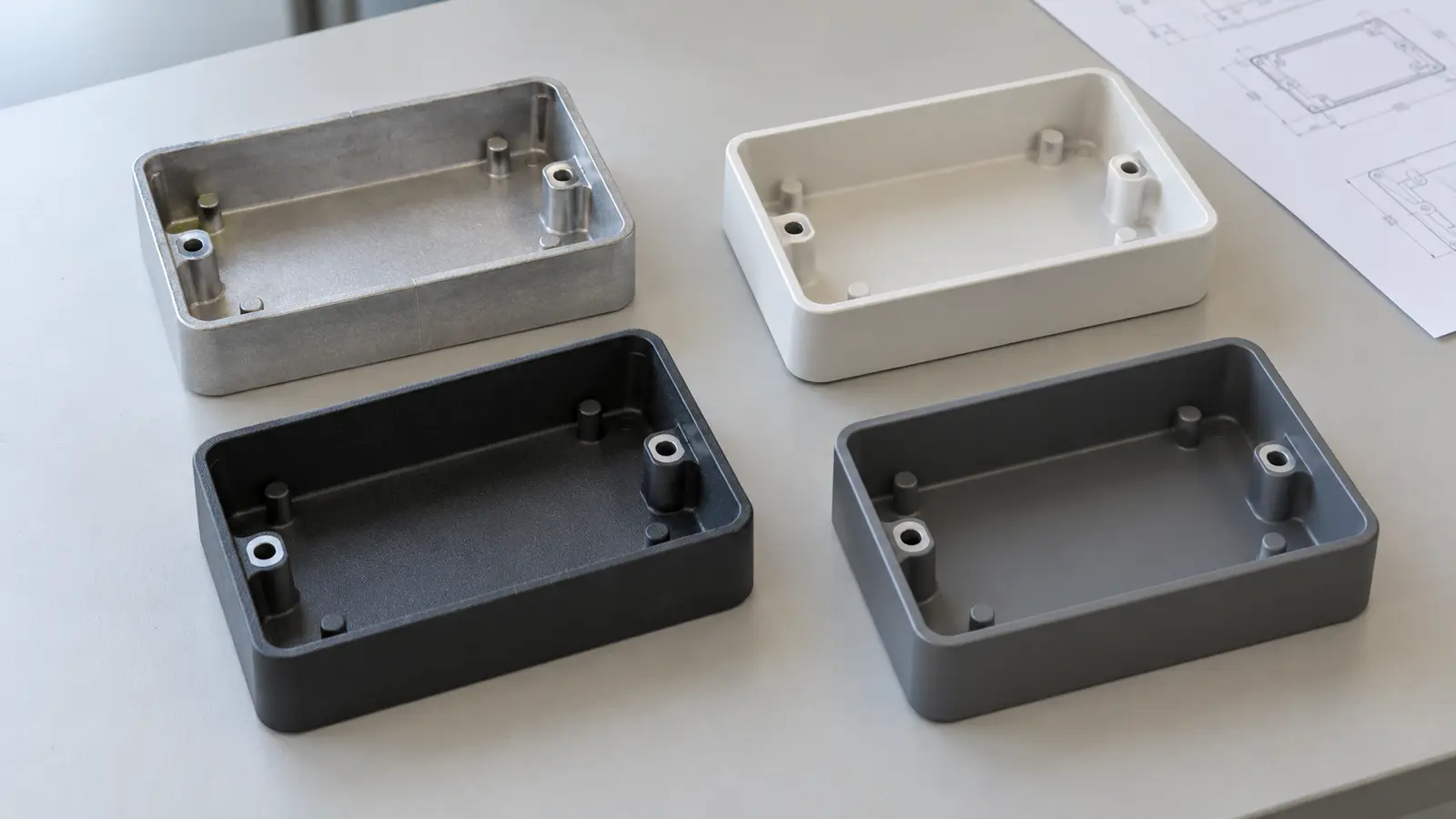
Die casting surface finishes include powder coating, anodizing, chrome plating, e-coating, paint and conversion coatings. The right one depends on the base alloy, appearance, corrosion exposure and how the part fits with others.
For an even colored exterior, powder coating is often a practical starting point. Anodizing needs extra care on silicon-rich cast aluminum; decorative copper-nickel-chromium plating is common on zinc hardware.
A die-cast part may be visible on a door, tucked inside an electronic enclosure or exposed to rain on an outdoor light. Those uses call for different surface treatments.
The finish can change how a part looks and how long it resists corrosion. It can also change its dimensions, electrical contact points and assembly fit.
The metal matters. Aluminum, zinc and magnesium do not react to each coating process in the same way, even when the finished products look similar.
This guide compares common options and shows how to choose a finish without adding unnecessary steps or cost. It also explains what to check before releasing the drawing.
Key takeaways
- Not every casting needs coating. Start with the part's exposure and function.
- Powder coating is useful for durable color, but preparation and curing matter on castings.
- Anodizing silicon-rich die cast aluminum can produce uneven gray color. Approve a real sample first.
- Chrome plating zinc die castings normally involves copper and nickel under the thin decorative chrome layer.
- Mask critical areas. Threads, bearing seats, sealing faces and electrical ground contacts may need protection from finish buildup.
Do Die Cast Parts Need a Surface Finish?
No. A die casting can be left as cast if its appearance, corrosion exposure and function allow it.
An internal bracket in a dry, sealed product might not need decoration. A housing mounted outdoors may need both cleaning and a protective coating. Zinc hardware that customers touch may be plated for appearance as well as protection.
Check where moisture can collect, whether the surface will be seen and whether it will rub against another part. Also check electrical grounding, heat transfer and any sealing requirements before adding a finish.
A finish cannot repair hidden casting porosity or turn an unsuitable alloy into a corrosion-proof one. Casting quality, preparation and coating performance all have to match the end use.
What Does a Die Casting Surface Finish Do?
Surface finishing can improve appearance, protect against corrosion or wear, and prepare a part for later assembly.
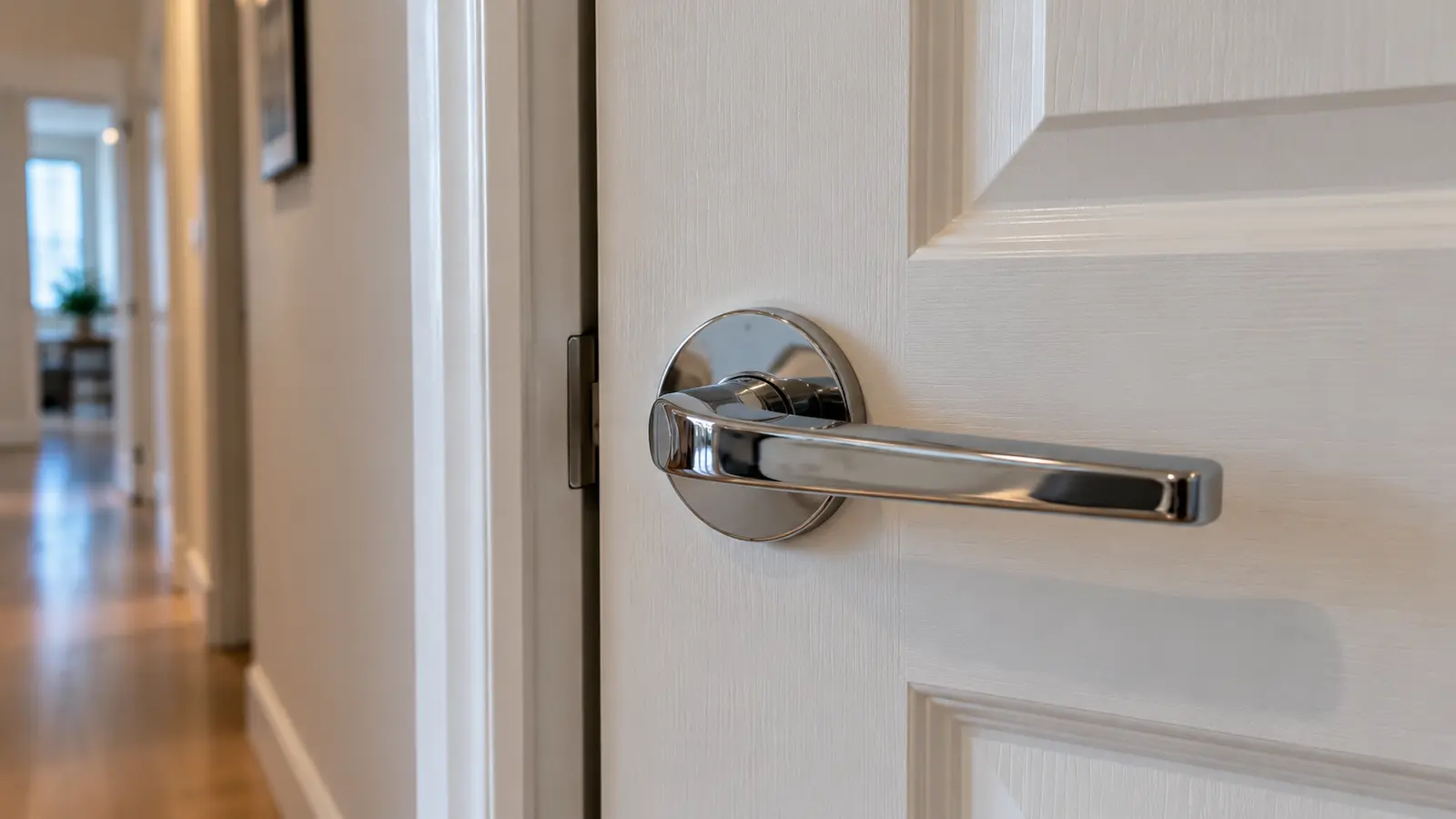
Decorative finishes give an intended color, gloss or surface feel. Chrome-plated door levers and black-coated outdoor lighting housings are easy examples.
Functional finishes protect a part in service. E-coat can cover complex shapes, while aluminum conversion coatings can provide corrosion protection with low electrical contact resistance when the right class is specified.
Many treatments do both. The first decision is not which process sounds most advanced, but what the finished part must do.
What Surface Finishes Are Used on Die Cast Parts?
The common choices are powder coating, anodizing, decorative plating, e-coating, paint, conversion coatings, polishing and selected PVD coatings.
Use this surface finish comparison table as a short list. Exact performance depends on the alloy, surface preparation, coating system and test requirements.
| Finish | Main purpose | Typical die-cast use | Relative cost |
|---|---|---|---|
| Powder coating | Color and corrosion protection | Aluminum or magnesium housings with suitable pretreatment | Low to medium |
| Anodizing | Oxide layer and wear resistance | Selected aluminum castings; cosmetic color can vary | Low to medium |
| Decorative chrome plating | Bright or satin metal appearance | Zinc alloy door and appliance hardware | Higher |
| E-coating | Even film and corrosion protection | Complex metal castings and undercoats | Medium |
| Wet painting | Color and protective topcoat | Cast housings and cosmetic covers | Low to medium |
| Aluminum chem film | Conversion layer, grounding where specified | Aluminum electronics housings and contact surfaces | Low to medium |
| Mechanical polishing | Smoother or brighter exposed surface | Zinc trim or decorative cast details | Medium to high |
| PVD coating | Thin specialty decorative/wear film | Qualified premium hardware over prepared substrates | Higher |
For broader texture measurements and process comparisons, consult the surface finish chart.
Why Is Anodizing Die Cast Aluminum Difficult?
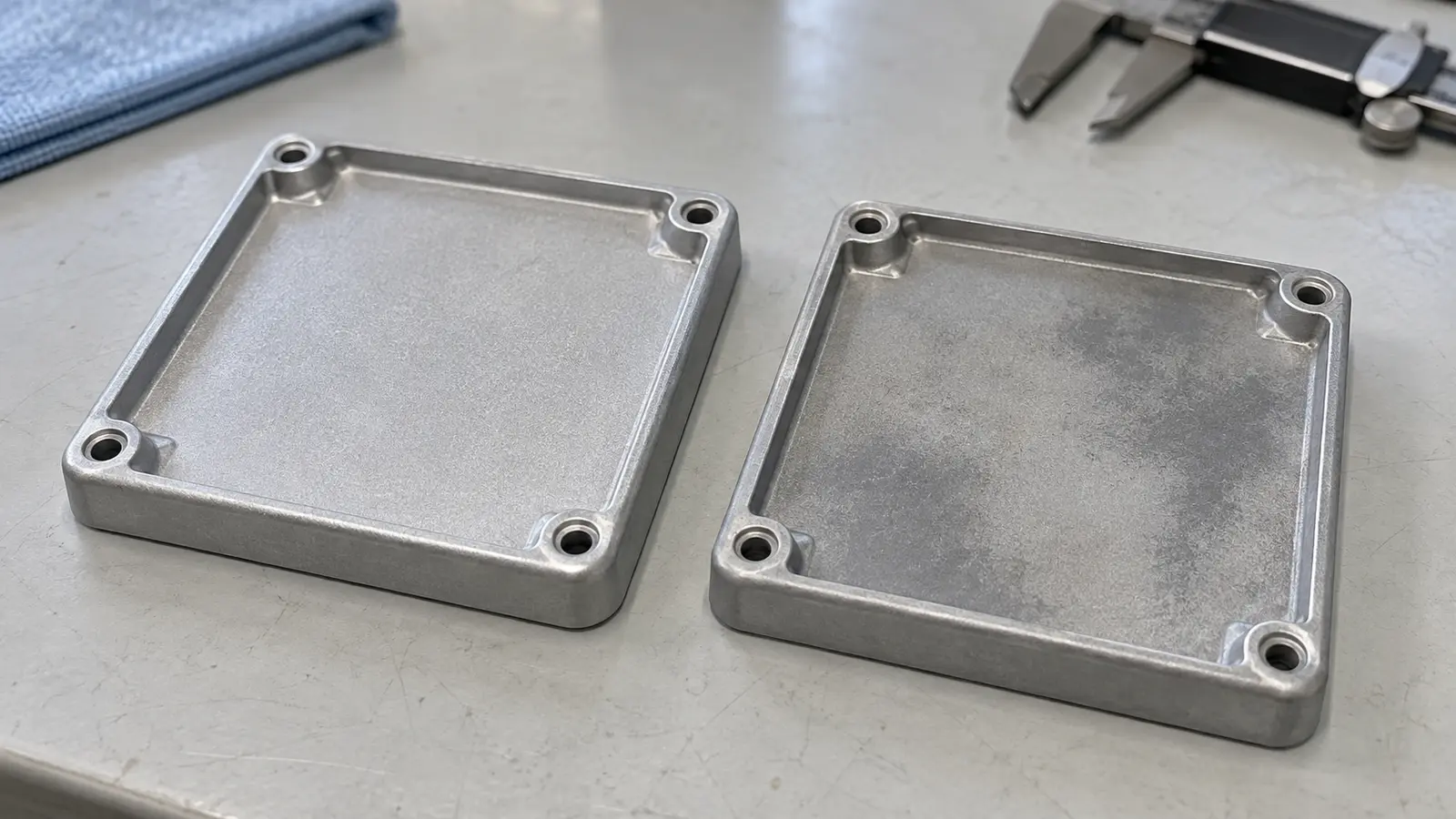
Silicon-rich aluminum castings can develop dull, uneven anodized color, even when the oxide treatment works.
Anodizing changes the aluminum surface into an oxide layer using an electrolytic process. It is not a paint film sitting on top of the metal. The anodizing specification used for many non-architectural applications is MIL-PRF-8625.
Why A380 may show gray patches
Die casting alloys such as A380 contain significant silicon. Silicon-rich regions and other alloy phases do not react like pure aluminum, so the final anodized appearance can be gray, flecked or less uniform than on wrought 6061 aluminum.
That does not mean every die casting will look defective. Pretreatment, alloy selection, casting condition and the approved visual standard all affect the result. Confirm samples from the actual casting process before promising an even decorative color.
When to choose a different finish
If the main requirement is a consistent opaque black, white or colored finish, powder coating may be easier to specify. If the job needs the properties of an anodized oxide layer, ask the supplier to test the chosen casting and define what appearance is acceptable.
Our guide on how to identify anodized aluminum explains what visual clues can and cannot prove.
How Does Powder Coating Work on Die Cast Parts?
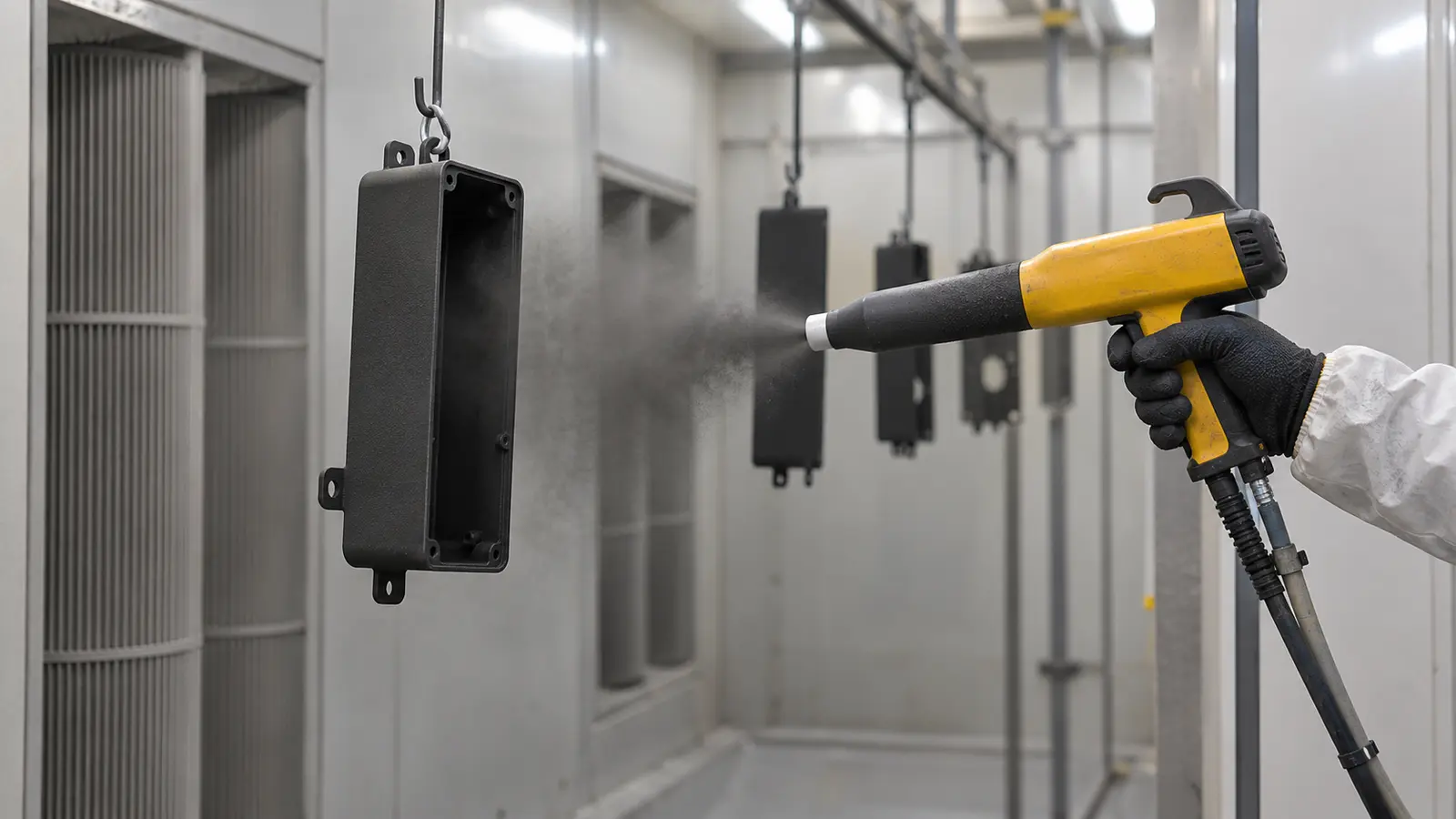
Powder coating sprays charged resin powder onto a prepared conductive part, then cures it in heat to form a protective film.
A hanging casting is usually grounded through its rack. An electrostatic spray gun applies dry powder to the exposed surfaces. After curing, the part has a continuous coating that can be matte, textured or glossy.
Die castings need extra attention because trapped gas or surface contamination can produce pinholes during heating. The right cleaning, pretreatment and trial cure are more important than making the part look perfect in a rendering.
Mask areas that must still fit
Threads, close-tolerance bores, sealing faces, bearing seats and grounding pads may need plugs or masking. A thick coating adds material to both sides of a narrow opening and can prevent a good assembly fit.
For exterior lighting and automotive covers, specify the color, gloss or texture, coating system, exposure requirement and coating-free zones on the drawing. Our surface finishing services page covers the available downstream operations.
Why Is Chrome Plating Common on Zinc Die Castings?
Zinc die castings can be prepared for decorative copper-nickel-chromium plating, which creates a bright or satin metal finish.
A typical decorative system first prepares the zinc surface, then builds copper and nickel layers beneath a thin chromium top layer. That is why a plated door lever can look like solid polished chrome even though the structural part is cast zinc alloy.
The relevant ASTM specification is ASTM B456, which explicitly covers copper-nickel-chromium and nickel-chromium coatings on zinc alloys. ASTM B633 is for zinc deposited on iron or steel, so it is not the right standard for this example.
Decorative chrome is not hard chrome
Decorative chrome is a thin final layer in a multi-layer finish chosen for appearance and corrosion protection. Hard chrome is a different engineering process typically chosen for wear on other types of components. Do not specify them as interchangeable.
Avoid promising a salt-spray result without a complete coating specification, service condition and test method. Appearance, adhesion and corrosion performance should be approved as a system.
Choosing between two finishes? Send the casting drawing, alloy, target appearance and service environment. Meco can review coating options and identify where preparation or masking may affect price.
Discuss Your ProjectHow Are E-Coating and Painting Different?
E-coating deposits paint using electrical current in a bath; ordinary wet painting sprays or applies liquid coating to the surface.
E-coating
After pretreatment, the conductive casting enters a paint bath and receives an electrical charge. Paint deposits as a film; the part is then rinsed and cured. E-coating can protect recesses and complex shapes that are awkward to reach with a spray gun, although coverage still depends on part geometry and process settings.
As PPG explains, e-coat can be a primer beneath a powder or paint topcoat. E-coat does not make every surface automatically weatherproof: choose the chemistry for the intended UV and corrosion exposure.
Liquid painting
Wet paint offers many color and gloss options without the same curing setup as powder coating. Performance varies widely by primer, pretreatment, paint chemistry and application. A qualified exterior paint can outperform a poorly prepared powder coat, so avoid a one-size-fits-all ranking.
When Should You Use Chem Film, PVD or Polishing?
These finishes solve specific needs that a general colored coating may not address.
Aluminum chemical conversion coating
Chem film is a thin chemical conversion treatment for aluminum, sometimes called by the trade name Alodine. MIL-DTL-5541 covers chemical conversion coatings on aluminum and its alloys. The specified class matters, especially when the part needs electrical contact.
Magnesium uses separate, alloy-appropriate conversion treatments. Do not assume a process qualified for aluminum will work on magnesium.
PVD coatings
Physical vapor deposition (PVD) can add a thin decorative or wear-resistant film to a prepared surface. Many die-casting discussions use the term for coating the steel die itself, so confirm whether a drawing means the tool or the finished product.
Polishing
Mechanical polishing can brighten a zinc casting before plating. It will also reveal some pits, parting lines and casting defects if the surface was not designed for a decorative result.
Which Finish Works on Aluminum, Zinc and Magnesium?
Powder coating and paint can be used on all three alloys with suitable preparation, but anodizing and conversion treatments are alloy-specific.
| Finish | Aluminum casting | Zinc casting | Magnesium casting |
|---|---|---|---|
| Powder coating | Common with correct pretreatment | Possible with correct pretreatment | Possible with magnesium-specific preparation |
| Anodizing | Possible; appearance sensitive to alloy | Not conventional aluminum anodizing | Only specialized magnesium anodizing systems |
| Decorative chrome | Possible with specialized preparation | Common for decorative hardware | Uncommon; specialty process |
| E-coating | Suitable after pretreatment | Suitable after pretreatment | Suitable with validated preparation |
| Wet painting | Common | Common | Common with validated preparation |
| Aluminum chem film | Suitable, use correct class | Not the aluminum process | Use a different magnesium conversion process |
| Polishing | Possible; casting porosity may show | Common preparation before plating | Possible, limited corrosion protection alone |
For an alloy-level view of the process, read aluminum versus zinc and magnesium die casting or explore die casting services.
How Much Does Die Casting Surface Finishing Cost?
Total cost depends more on preparation, masking, batch size and quality requirements than on the finish name alone.
The order below is a rough planning guide, not a quote. A simple high-volume coating can cost less per part than a heavily masked, small-batch finish of the same type.
| Finish | Rough cost tier | Main cost variables |
|---|---|---|
| Wet painting | Lower to medium | Color changeovers, primer, labor |
| Aluminum chem film | Lower to medium | Bath setup, qualification, batch size |
| Powder coating | Lower to medium | Pretreatment, masking, cure and powder type |
| Anodizing | Lower to medium | Alloy, pretreatment, finish specification |
| E-coating | Medium | Rack handling, bath line, preparation and volume |
| Mechanical polishing | Medium to higher | Surface flaws, manual labor, finish grade |
| Decorative chrome plating | Higher | Multistage plating, polishing and rejection risk |
| PVD coating | Higher | Vacuum processing, substrate preparation, batch size |
For cost across the full manufacturing route, see what a finished metal part costs. The coating price must be considered alongside die-casting quality, optional CNC machining and final inspection.
How Do You Choose a Die Casting Surface Finish?
Start with the alloy and service conditions, then set appearance, critical dimensions and inspection requirements.
- Identify the casting alloy. Record the actual aluminum, zinc or magnesium grade, not just the metal family.
- Define the environment. Note moisture, salt, sunlight, heat, handling and wear.
- Choose the appearance target. Specify color, gloss, texture and which surfaces the customer will see.
- Protect fit and function. Call out masking for threads, bores, sealing faces and electrical contacts.
- Approve real samples. Inspect representative cast parts after the full coating process, including any required adhesion or corrosion tests.
The earliest decision often saves the most work. A supplier who sees the coating need during die casting process planning can review parting lines, cosmetic faces and finish access before tooling is complete.
For exposed cosmetic parts, casting defects may remain visible after plating or even become more obvious. See common die casting defects before specifying a mirror finish.
Specification tip
Put the alloy, finish type, coating requirement, visible cosmetic zones, masking locations and acceptance method on the same drawing package. A sample approved without those notes can still cause disagreements in production.
Discuss Your Die Cast Finish
Meco can review the casting alloy, finish requirements and assembly-critical surfaces before tooling or coating begins.
- Engineering review. Alloy, finishing and masking questions.
- Integrated process planning. Casting through finishing and assembly.
- Quality documentation. IATF 16949:2016, FAI and CMM inspection.
- Commercial planning. DFM feedback and a quote under 24 hours.
References and sources
- U.S. Defense Logistics Agency. MIL-PRF-8625: Anodic Coatings for Aluminum and Aluminum Alloy. Active performance specification, 2020.
- ASTM International. ASTM B456: Electrodeposited Copper-Nickel-Chromium and Nickel-Chromium Coatings. B456-17(2022).
- PPG Coatings Services. E-Coat Process Specifics. Technical process explanation.
- U.S. Defense Logistics Agency. MIL-DTL-5541: Chemical Conversion Coatings on Aluminum and Aluminum Alloys. Active detail specification, validated 2024.
Cost tiers are illustrative planning comparisons, not quotations. Finish suitability and corrosion performance require qualification for the chosen part and operating conditions.
