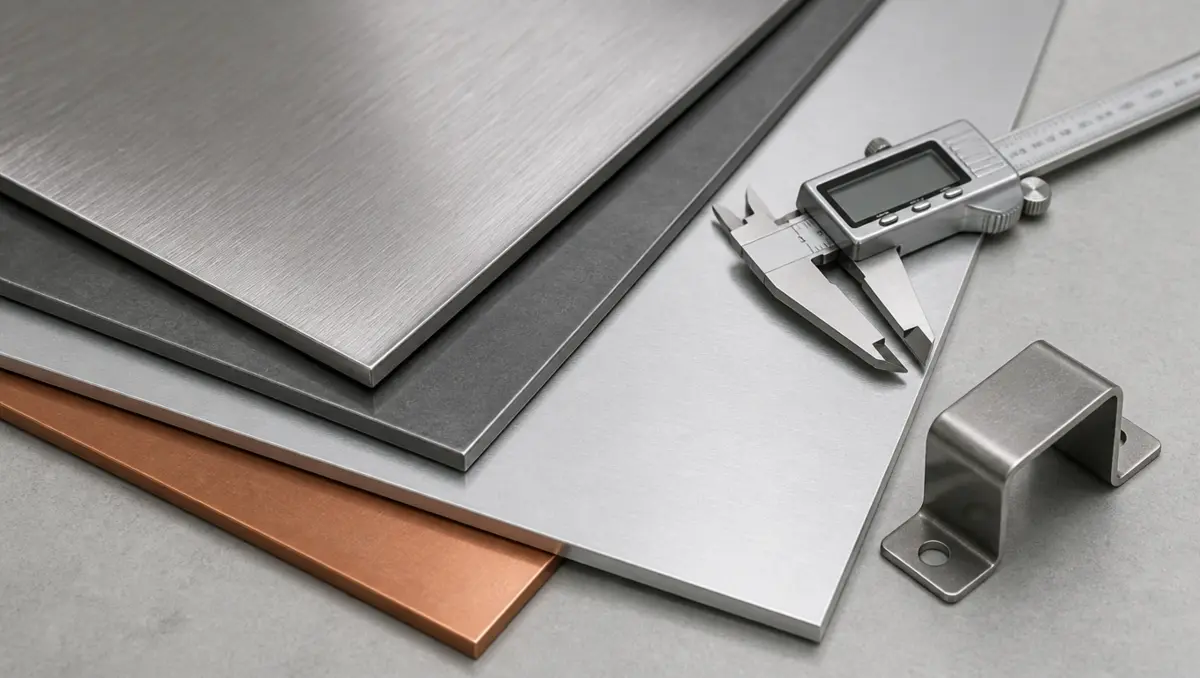
Sheet metal is metal that has been rolled into flat sheets between 0.5 mm and 6 mm thick, or roughly 0.020 to 0.250 inches. It is thicker than foil and thinner than plate. Because it is thin, it can be cut, bent, and welded into finished parts quickly and cheaply.
What Is Sheet Metal?
Sheet metal is not a material. It is a form. Steel, aluminum, copper, and brass can all be sold as sheet, and the word only tells you the shape and thickness you are buying, not what the metal is made of.
Metal starts life as a thick slab. Mills squeeze that slab through rollers again and again until it comes out flat and thin, then coil it or cut it into rectangles. What you receive is a flat blank waiting to be turned into something.
That flatness is the whole point. A flat sheet can be cut into any outline, folded into a box, and joined to another sheet, all without melting anything or cutting away expensive material. It is one of the cheapest ways to get from a drawing to a real part.
Sheet Metal vs Plate vs Foil: Where the Lines Fall
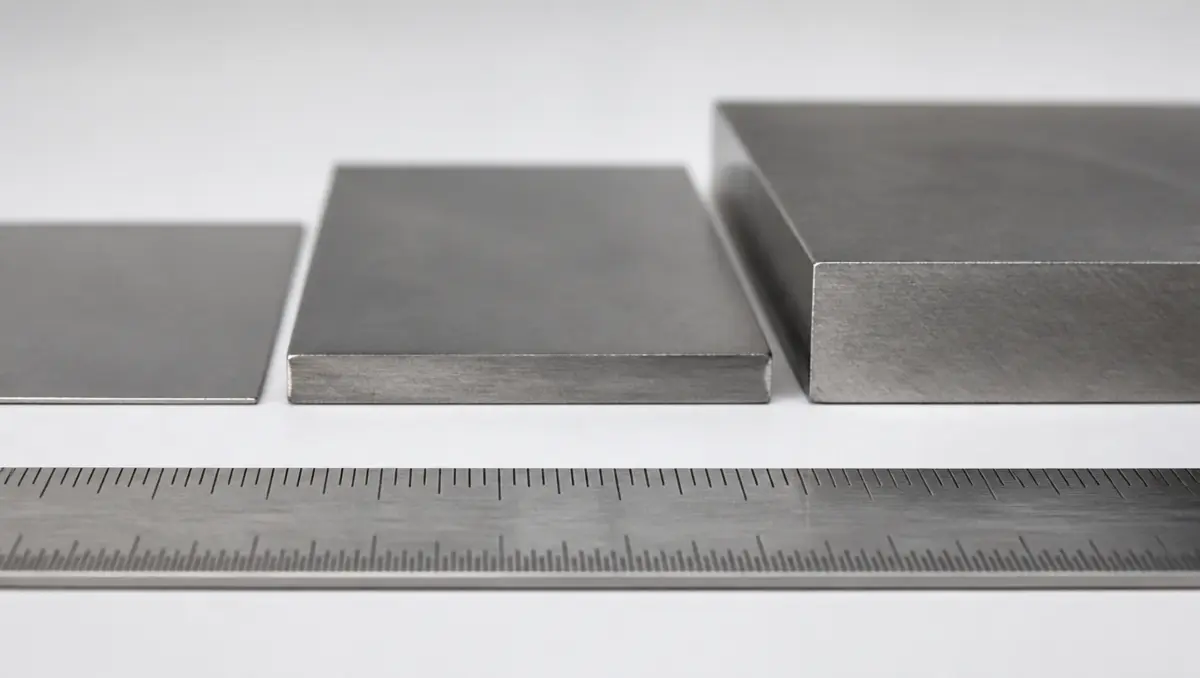
Foil, sheet, and plate are the same idea at three thicknesses. The names change because the way you work with each one changes completely.
| Form | Thickness (mm) | Thickness (inches) | Typical use |
|---|---|---|---|
| Foil | Under 0.5 mm | Under 0.020 in | Shielding, gaskets, packaging, heat barriers |
| Sheet | 0.5 mm to 6 mm | 0.020 in to 0.250 in | Enclosures, brackets, panels, chassis, car bodies |
| Plate | Over 6 mm | Over 0.250 in | Structural frames, pressure vessels, heavy machine bases |
The 6 mm line is not a law of physics. It is a working convention, and different suppliers shade it slightly. What matters is what happens at that boundary: below it you can usually bend a part on a press brake, above it you often need to heat, machine, or heavily press the metal instead.
The Quick Answer
If you can fold it cold on a press brake, it is sheet. If it is thin enough to tear by hand, it is foil. If it needs a heavy press or a torch to shape, it is plate.
How Thick Is Sheet Metal?
Most sheet metal parts you touch every day sit between 0.5 mm and 3 mm. A laptop chassis might be 0.8 mm. A control cabinet is often 1.5 mm. A heavy equipment guard could run 4 mm or more.
Thickness drives almost everything downstream. It sets how stiff the part is, how tight a bend it can take, how it has to be welded, and what it costs. Getting it wrong by one step is the most common reason a design has to be revisited.
Why Is Sheet Metal Measured in Gauge?
In North America you will constantly see thickness written as a gauge number, like 16 ga or 18 ga. The system is backwards on purpose: a higher gauge number means a thinner sheet. 22 gauge is thin. 10 gauge is thick.
The reason is historical. Gauge originally counted how many times a wire or sheet had been pulled through a drawing die. More passes meant thinner metal, so more passes meant a higher number. The habit stuck long after the process changed.
The Gauge Trap: Why 18 Gauge Is Not One Thickness
Here is the part that catches people out. Gauge was never one universal scale. Each metal family has its own, so the same gauge number gives you a different thickness depending on the material.
| Gauge | Mild steel | Stainless steel | Aluminum |
|---|---|---|---|
| 18 ga | 0.0478 in (1.21 mm) | 0.0500 in (1.27 mm) | 0.0403 in (1.02 mm) |
| 16 ga | 0.0598 in (1.52 mm) | 0.0625 in (1.59 mm) | 0.0508 in (1.29 mm) |
Look at 18 gauge. Steel comes in at 1.21 mm, aluminum at 1.02 mm. That is a 19% difference hiding behind an identical number, and it is more than enough to change how a part fits, how stiff it feels, and whether a pressed-in fastener holds.
So here is our opinion, and it goes against how half the industry still writes drawings. Stop specifying gauge alone. Write the actual thickness in millimetres or inches, and put the gauge in brackets if you want it for reference. Standards bodies have been discouraging gauge for years. A drawing that says "1.5 mm CRS" can only be read one way.
What Are the Types of Sheet Metal?
Five material families cover the vast majority of real parts. Picking between them is usually a question of what the part has to survive, not what it has to do.
| Material | Common grades | Strength | Corrosion resistance | Formability | Relative cost | Best used for |
|---|---|---|---|---|---|---|
| Cold rolled steel | 1008, 1018 | High | Poor, needs coating | Good | Low | Painted enclosures, frames, brackets |
| Galvanized steel | G60, G90 | High | Good | Good | Low | Outdoor and utility housings |
| Stainless steel | 304, 316, 430 | Very high | Excellent | Fair, work hardens | High | Food, medical, marine, washdown |
| Aluminum | 3003, 5052, 6061 | Moderate | Very good | Excellent (5052) | Medium | Weight-critical panels, heat sinks, chassis |
| Copper and brass | C110, C260 | Low to moderate | Very good | Excellent | High | Grounding, shielding, decorative trim |
One distinction inside that table saves more projects than any other. Not all aluminum bends the same way. 5052 folds tightly and forgives a small radius. 6061 is stronger but far more likely to crack on a sharp bend, especially in the harder tempers.
If your part has bends, ask for 5052 unless you specifically need 6061's strength. If you are working with coated steel and are not sure what you already have, our guide on how to tell if steel is galvanized walks through the visual checks.
Hot Rolled vs Cold Rolled: What Changes
The same steel can arrive in two very different conditions. Hot rolled steel is shaped while glowing hot. It is cheaper, but it comes with a dark scaly surface and loose thickness tolerances.
Cold rolled steel is squeezed again at room temperature. That gives you a smooth, clean surface, tighter thickness control, and higher strength, for maybe 15 to 25 percent more money.
The rule of thumb is simple. If the part will be painted, plated, or seen by a customer, buy cold rolled. If it is a hidden structural piece and nobody cares what it looks like, hot rolled is the cheaper answer. Both are covered by published standards from ASTM International, which is worth citing on your drawing so there is no argument later.
What Is Sheet Metal Used For?
Sheet metal is used anywhere you need a strong, light, hollow shape rather than a solid lump of metal. It is the default choice for anything with a skin, a housing, or a frame.
- Automotive: body panels, brackets, heat shields, battery enclosures, and structural reinforcements.
- Electronics and telecom: server chassis, cabinets, shielding cans, and rack panels, where a sheet metal enclosure protects the electronics inside.
- Home appliances: washing machine drums, oven cavities, refrigerator panels, and control fascias.
- Industrial equipment: machine guards, control cabinets, conveyor frames, and access covers.
- Lighting and furniture: luminaire housings, reflectors, desk frames, and locker bodies.
- Medical equipment: stainless cart frames, instrument housings, and washdown-rated covers.
Notice the pattern. In almost every case the finished item is not a single bent part. It is several parts joined together, which is why most real projects end up needing sheet metal assemblies rather than loose components.
How Sheet Metal Parts Are Made
Every sheet metal part goes through the same four stages. You cut it, you form it, you join it, then you finish it. The fabrication and welding market that supports this work is substantial. Grand View Research put the global welding equipment market at USD 21.7 billion in 2025, growing at 5.2 percent a year.
Stage 1: Cutting
The flat outline is cut from a larger sheet. Laser cutting is the workhorse for most jobs because it handles complex outlines and small holes with a clean, burr-free edge and no tooling cost.
Punching and stamping become cheaper at high volume, once you are making enough parts to justify a die. Waterjet and plasma cover thicker or heat-sensitive material.
Stage 2: Forming
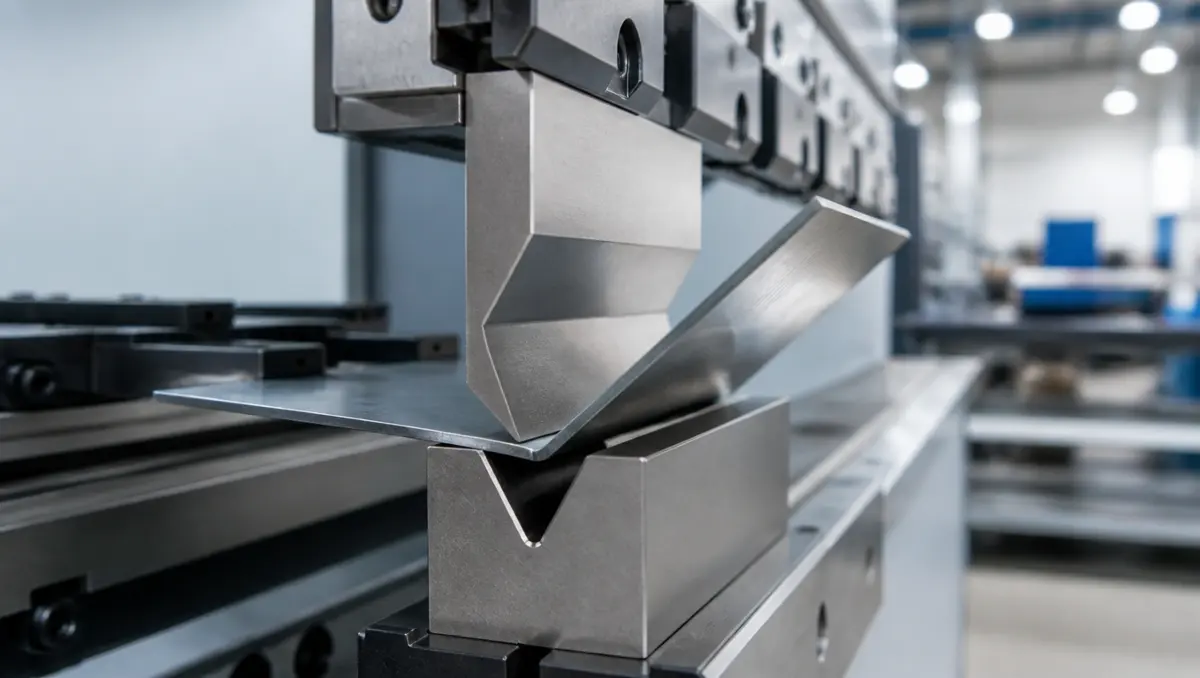
The flat blank becomes three dimensional. CNC bending on a press brake does most of this work, folding flanges, lips, and boxes to a programmed angle.
Rolling curves the sheet into cylinders. Deep drawing stretches it into cups and pans. Stamping does the whole job in one hit when volumes justify the tooling.
Stage 3: Joining
Separate pieces become one unit. Spot welding is the cheapest option for overlapping panels where the joint is hidden. TIG and MIG give you continuous, full-strength seams for frames and sealed boxes.
Pressed-in PEM hardware creates strong threads in thin sheet without any welding heat at all, and riveting joins dissimilar or already-coated metals safely. Our overview of the types of welding covers how each method behaves, and the broader fabrication and welding capabilities sit behind all of it.
Stage 4: Finishing
Bare steel rusts, so almost every part gets a finish. Powder coating is the most common, followed by anodizing on aluminum, zinc plating on steel, and passivation on stainless after welding.
Finish is not just cosmetic. It adds physical thickness to the part, which is a detail we will come back to. Our surface finishing services cover the full range, and the surface finish chart explains how finishes are actually specified.
The GAUGE Check: Five Things to Confirm Before You Order
Our engineers review sheet metal drawings every working day. The same five gaps come back over and over, and they are all cheap to fix on screen and expensive to fix in steel.
We call it the GAUGE Check.
The GAUGE Check
G, Grain direction. Which way was the sheet rolled, and do your bends run across that grain or along it?
A, Alloy and grade. Not "aluminum" but 5052 or 6061. Not "steel" but CRS 1008 or 304 stainless.
U, Use environment. Indoor, outdoor, washdown, or coastal. This decides material before anything else does.
G, Gauge or real thickness. State it in millimetres or inches. Never a gauge number on its own.
E, Edges and joins. How is it held together, and does the finish go on before or after assembly?
Answer those five and a quote comes back in hours instead of days, because nobody has to email you asking what you meant.
Why Sheet Metal Parts Crack, Warp, or Do Not Fit
Most sheet metal problems are not bad workmanship. They are predictable physics that nobody budgeted for at the design stage.
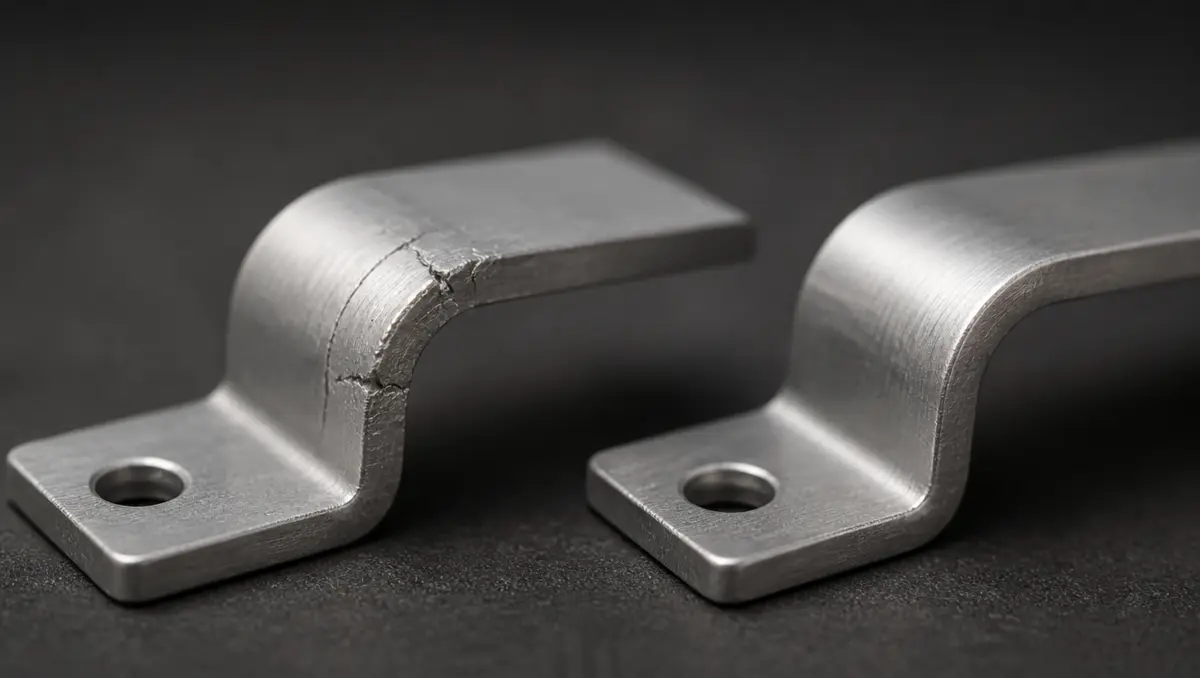
Grain direction causes cracked bends. Rolling stretches the metal's internal structure into long fibres running one way down the sheet. Bend across those fibres and the metal stretches happily. Bend along them and it can split open. As The Fabricator explains, the tighter the inside radius, the worse this gets. It is invisible on a drawing and obvious on a cracked part.
Bend radius that is too tight tears the metal. A safe starting point is an inside radius at least equal to the material thickness. Harder alloys and tempers need more.
Tolerances stack up across bends. A single cut feature or bend can typically be held to around 0.13 mm. String several bends together and the drift can reach 0.76 mm by the far end of the part. Each bend is accurate, and the assembly still misses.
That is why we design in 0.13 to 0.25 mm of clearance between mating parts, and take the upper end of that range when the parts are getting powder coated, because the coating itself adds 0.05 to 0.13 mm of thickness per surface.
Thin material warps under welding heat. Below roughly 1.6 mm, a continuous seam weld risks burn-through and visible distortion. We move to spot welding or laser welding at that point, where the heat-affected zone is much smaller.
These numbers are why owning the whole chain matters. When cutting, bending, welding, and finishing happen in one shop, the stack-up is managed across every step rather than inherited from the last vendor. Our sheet metal assembly guide goes deeper into tolerance stack-up if you are designing a multi-part unit.
What Sheet Metal Actually Costs to Make
Raw material is rarely the biggest line on a sheet metal quote. Labour, setup, and secondary operations usually are.
Four things move the number most:
- Number of bends. Each bend is a separate setup and handling step on the press brake. A six-bend part is not twice the cost of a three-bend part, it is often more.
- Material use on the sheet. Parts that nest tightly together waste less stock. An awkward outline can quietly double material cost.
- Tolerances you asked for. Calling out tight tolerances everywhere, rather than only on the features that matter, adds inspection time to every unit.
- Finishing and hardware. Powder coat, plating, and pressed-in fasteners are each extra handling. They are often the difference between a cheap part and an expensive one.
For a fuller breakdown of how quotes are built, see our guide to what a metal part costs in 2026.
Advantages and Disadvantages of Sheet Metal
Sheet metal is the right answer surprisingly often, and the wrong answer often enough to be worth saying out loud.
| Advantages | Disadvantages | Choose this instead |
|---|---|---|
| Low or no tooling cost for cut and bent parts | Cannot produce thick solid sections | Forging or casting for solid, load-bearing bodies |
| Excellent strength for the weight | Bend tolerances are looser than machined tolerances | CNC machining where 0.01 mm precision is required |
| Fast from drawing to first part, often days | Complex curves and organic shapes are difficult | Casting or injection molding for flowing geometry |
| Scales from one prototype to millions on the same equipment | Thin sections can distort under welding heat | Heavier gauge, or spot and laser welding |
| Wide material choice with easy finishing | Sharp internal corners and undercuts are not possible | Machining or metal injection molding for fine detail |
The honest summary is this. If your part is essentially a skin, a box, a bracket, or a frame, sheet metal will almost always be the fastest and cheapest route. If it is a dense, precisely machined block or a smoothly curved body, look elsewhere.
Before You Send a Drawing
Four things send more quotes back for clarification than anything else: a gauge number with no material named, no finish specified, no note on which surfaces are cosmetic, and tight tolerances applied to every feature instead of only the critical ones. Fixing those four before you hit send usually cuts a day off your quote turnaround.
Frequently Asked Questions About Sheet Metal
What is sheet metal made of?
Sheet metal can be made from almost any workable metal. The most common are cold rolled steel, galvanized steel, stainless steel grades 304, 316 and 430, and aluminum grades 3003, 5052 and 6061. Copper and brass are also supplied as sheet for electrical, shielding, and decorative work. The term describes the flat form and thickness, not the metal itself.
Is sheet metal the same as steel?
No. Steel is a material and sheet metal is a shape. Steel is the most common material sold as sheet, which is why the two words get mixed up, but aluminum, stainless steel, copper, and brass are all sold as sheet metal too. When ordering, always name both the material and the grade, for example 1.5 mm cold rolled steel or 2 mm 5052 aluminum.
What is the most common type of sheet metal?
Cold rolled steel is the most widely used sheet metal in general manufacturing. It is inexpensive, strong, easy to bend and weld, and takes powder coating well. Its main weakness is that it rusts without a protective finish, so it is nearly always coated or plated. Galvanized steel and 5052 aluminum are the next most common choices.
Is sheet metal strong?
Sheet metal is very strong for its weight, particularly once it is formed. A flat sheet flexes easily, but adding bends, flanges, and ribs makes it dramatically more rigid without adding material. This is why car bodies, aircraft skins, and machine guards are made from relatively thin sheet rather than thick solid metal. Strength comes from the geometry as much as from the thickness.
Can sheet metal be welded?
Yes, and several welding methods are designed specifically for thin material. TIG welding gives precise, low-distortion seams on visible joints, MIG is faster and more economical for heavier frames, and spot welding is the cheapest option for overlapping hidden panels. Below roughly 1.6 mm, continuous seam welding risks burn-through and warping, so spot welding or laser welding is usually the better choice.
What is the thinnest sheet metal you can get?
Sheet metal generally starts around 0.5 mm, or about 0.020 inches. Anything thinner than that is classified as foil rather than sheet. Very thin sheet in the 0.5 to 0.8 mm range is common in electronics shielding and lightweight covers, but it needs careful handling because it dents easily and distorts under welding heat.
What thickness of sheet metal can be bent?
Most sheet metal from 0.5 mm up to about 6 mm can be bent cold on a press brake. What limits you is not usually the thickness but the bend radius and the material. A safe starting point is an inside bend radius at least equal to the material thickness, with more allowed for harder alloys like 6061 aluminum or work-hardened stainless. Bending along the sheet's grain direction rather than across it also raises the risk of cracking.
Is sheet metal cheaper than casting or machining?
For enclosures, brackets, panels, and frames, sheet metal is usually the cheapest option because cutting and bending need little or no tooling. Casting becomes more economical for complex solid shapes at higher volumes, once the die cost is spread across enough parts. CNC machining costs more per part but delivers far tighter tolerances, so it wins where precision matters more than price.
Do I need to specify gauge or millimetres on my drawing?
Specify the actual thickness in millimetres or inches, and add the gauge number in brackets only as a reference. Gauge scales differ by material, so 18 gauge steel is 1.21 mm while 18 gauge aluminum is 1.02 mm, a difference of about 19 percent. Stating a real dimension removes any ambiguity and prevents a supplier from quoting the wrong thickness.
Not Sure Which Gauge You Need?
Meco cuts, bends, welds, and finishes sheet metal parts in house, then ships them as one finished assembly.
- IATF 16949:2016: certified quality system
- 40+ processes: cutting through assembly
- DFM with every quote: returned in 24 hours
