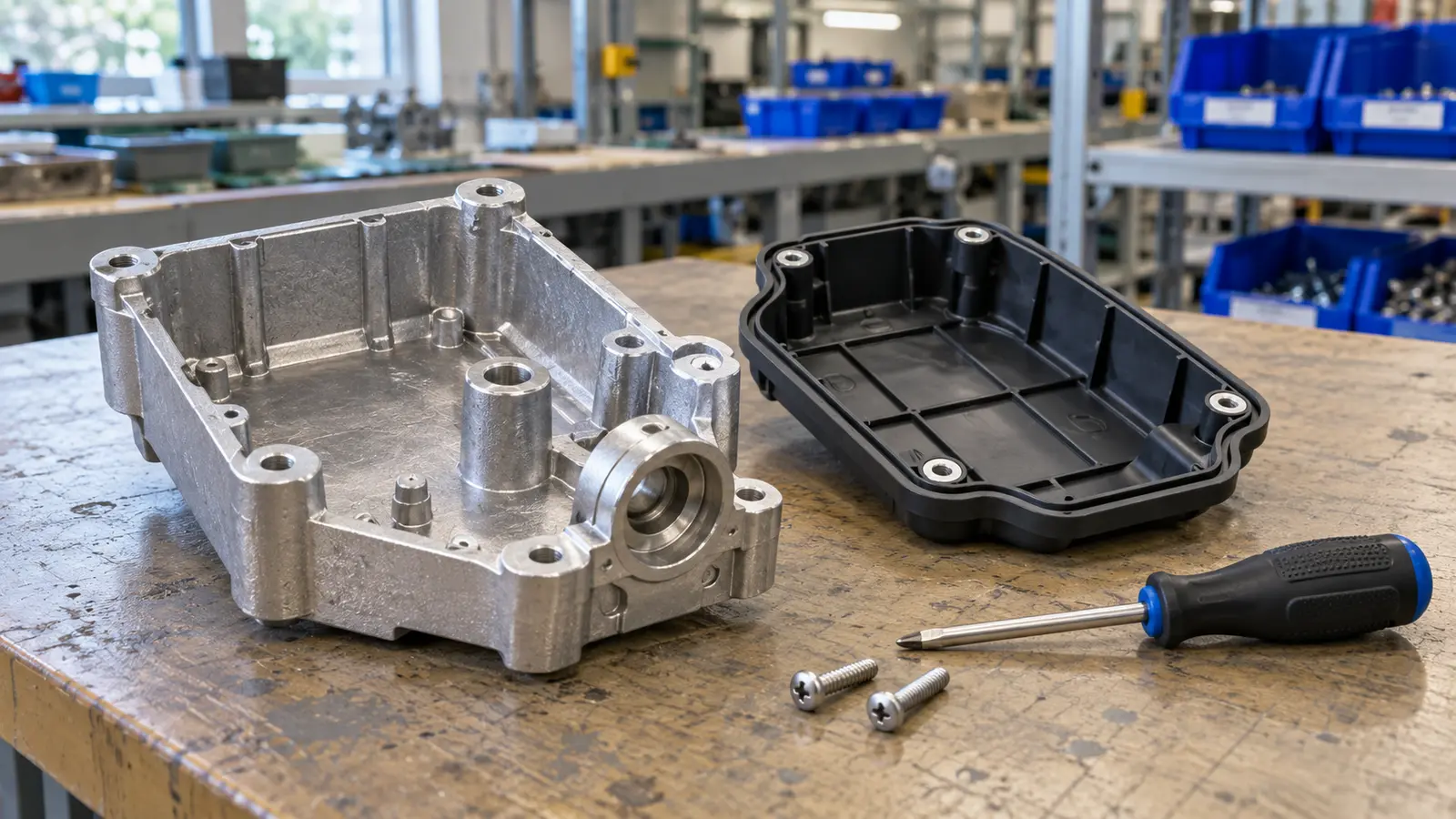
Choose die casting when a suitable metal alloy meets the part’s requirements, and plastic injection molding when a suitable resin meets them at lower total cost.
Check load, heat, tolerances, lifetime quantity and schedule together. Products that need both materials also need a shared assembly-fit plan.
Key takeaways
- Material comes first. Compare the exact alloy or resin against real service conditions.
- Compare finished-part cost. Include tooling, machining, finishing and assembly.
- Volume is a calculation. Use lifetime quantity, rather than a fixed minimum.
- Precision needs a plan. Mark critical features, datums and inspection conditions.
- Own the interfaces. Metal and plastic parts must fit as an assembly, not just pass separate drawings.
Die casting and injection molding both force hot material into a tool, let it cool, then eject a part. In a die casting vs injection molding comparison, the starting question is whether the design needs metal or plastic. Material choice comes first; geometry, volume and cost determine the best process within that choice.
That question narrows the options, but it does not settle every project. Cost, strength, tolerances and lead time can pull in different directions. Compare the finished part and its service conditions, rather than choosing on one headline number.
This guide compares the processes, tooling ranges and production tradeoffs. The price ranges are planning references, not quotes for your design. Material values are examples, not guaranteed finished-part performance.
What Is the Difference Between Die Casting and Injection Molding?
Die casting shapes molten metal; plastic injection molding shapes molten thermoplastic. The chosen material drives tool design, cost and part performance.
Die casting uses melted metal. Injection molding uses melted plastic. Everything else follows from that.
Both processes close the two halves of a metal tool, fill its cavity and allow the material to cool. The tool opens and ejector pins release the part. Injection molds can be aluminum or steel; die-casting tools need steel selected for the hot-metal process.
A well-controlled tool repeats the same shape over many cycles. Tool wear, temperature and material variation still affect results, so inspection remains part of the process. At sufficient volume, that repeatability can reduce cost compared with cutting every part from solid stock.
Die casting works mainly with non-ferrous alloys, where iron is not the base metal. Think aluminum, zinc and magnesium. This guide uses injection molding to mean thermoplastic molding, with materials that soften when heated and harden when cooled.
Start with the service conditions
Ask whether the part needs high stiffness, heat transfer, electrical shielding or strength under sustained load. Those needs often favor metal, but some reinforced or specialty plastics can meet them. Check the exact grade, temperature, load and environment before deciding; 150°C is not a universal boundary between metal and plastic.
How Does Die Casting Work?
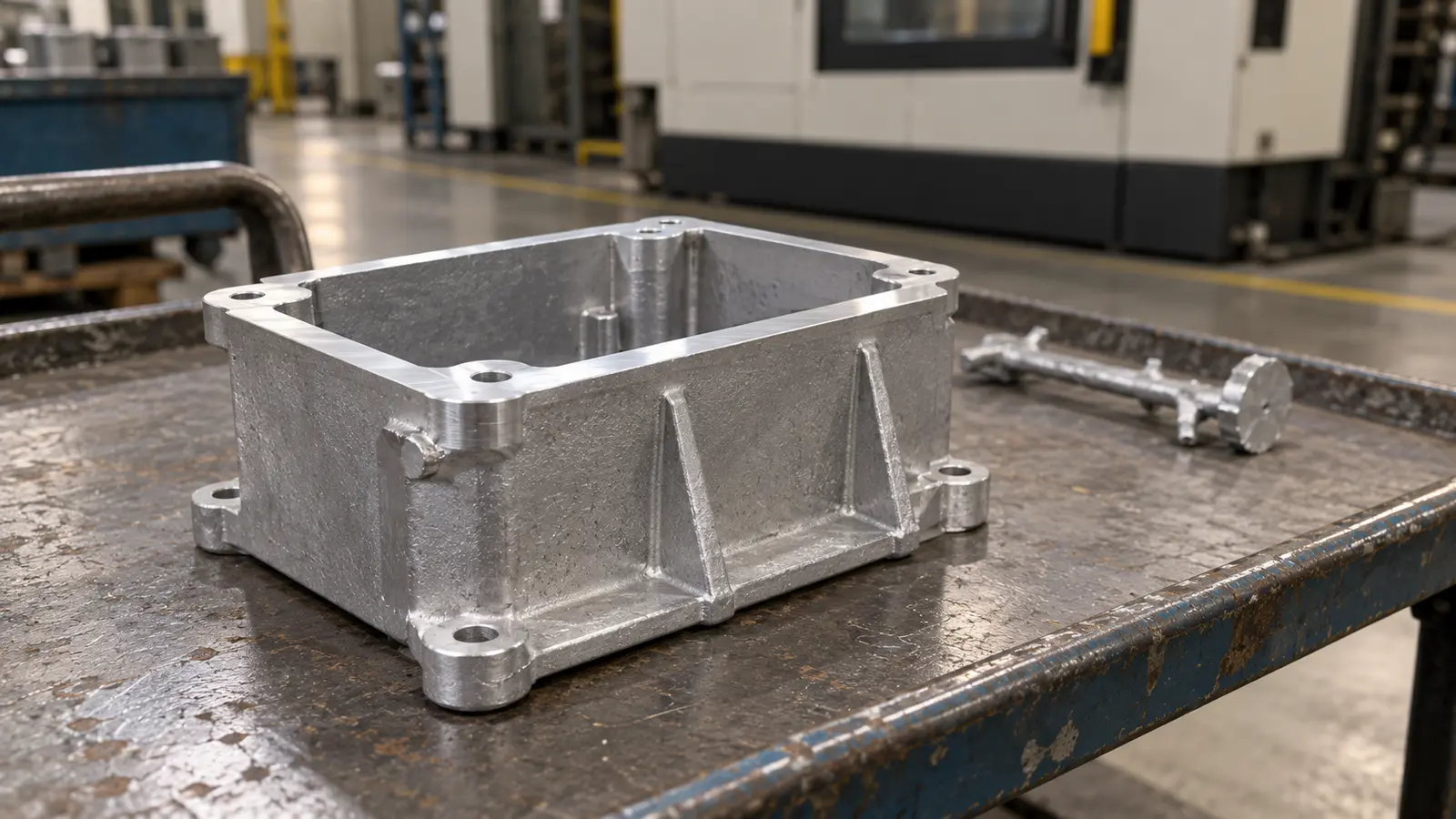
Die casting forces molten alloy into a closed die, then cools, ejects and trims the part. Critical faces or bores may need machining afterward.
Die casting melts metal in a furnace, then rams it into a hardened steel die at very high pressure. The fill happens in a fraction of a second.
The basic die casting process steps look like this:
- Melt and prepare. The alloy is melted and the die is sprayed with a release agent so parts come out clean.
- Inject. A plunger forces the molten metal into the closed die under pressure.
- Cool and eject. The metal solidifies in seconds, the die opens, and ejector pins push the part out.
- Trim and finish. Extra material around the edges gets trimmed off, then the part moves to machining or finishing if it needs it.
At Meco, our die casting services run presses from 25 tons up to 800 tons, which covers parts from about 1 gram to 5 kilograms. Common die casting materials include A380 and A360 aluminum, ADC12, Zamak 3 and Zamak 5 zinc, and AZ91D magnesium.
Each one behaves differently in the die, and picking the wrong one is a common and expensive mistake. Our guide on which metal is best for die casting walks through the tradeoffs.
Want the full step by step? We cover it in detail in the complete die casting process guide.
How Does Injection Molding Work?
Plastic injection molding melts pellets, fills a mold and cools the part before ejection. The resin, wall thickness and tooling plan drive the result.
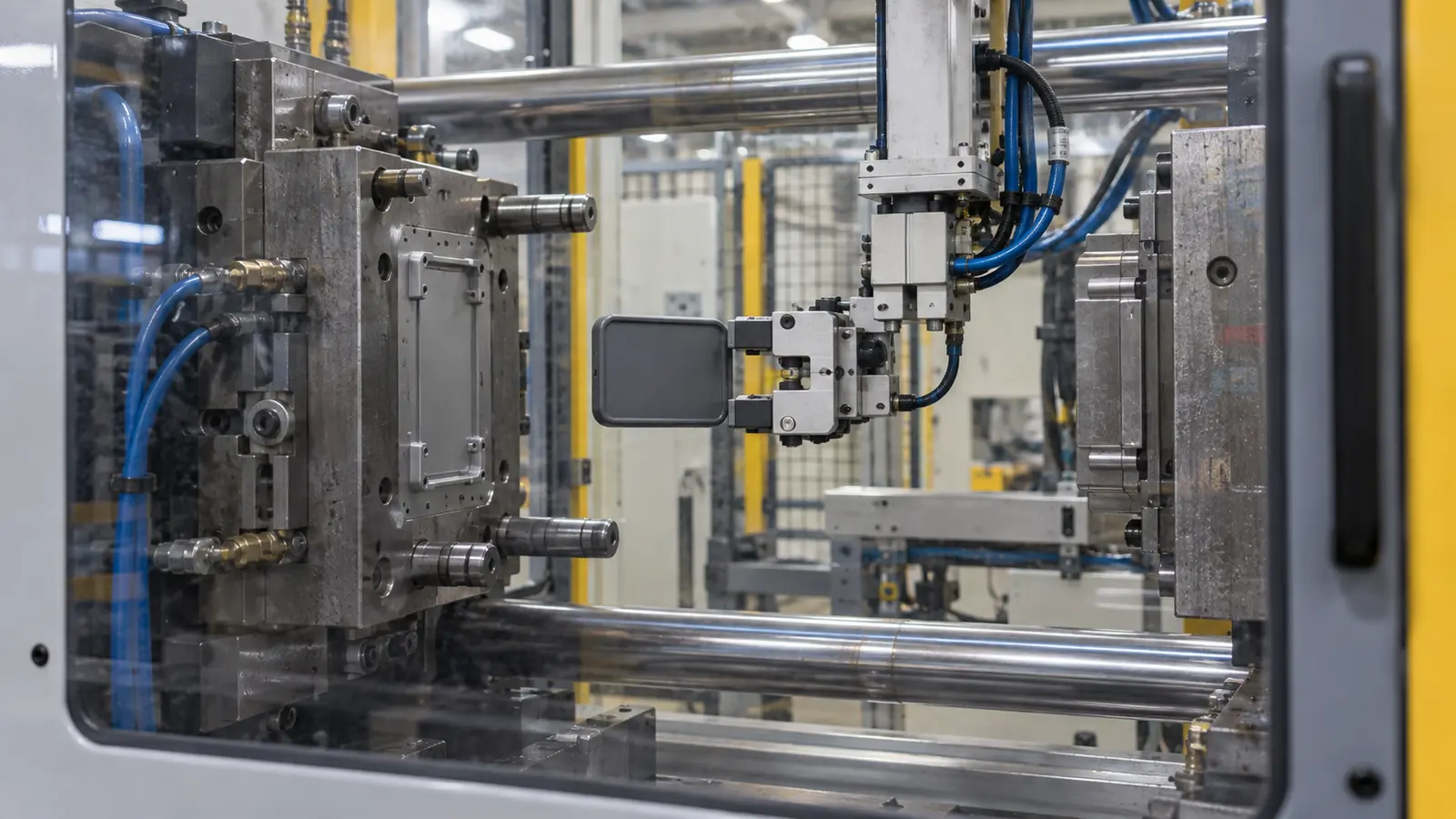
Injection molding melts plastic pellets and screws them forward into a mold cavity, then holds pressure while the plastic cools.
Plastic pellets enter a hopper. A heated screw melts and pushes the resin through a nozzle into the closed mold. After cooling, the tool opens and ejects the part.
One big advantage is material choice. Meco’s plastic injection molding capability covers 50+ resins, from ABS and polypropylene to glass-filled nylon and high-temperature engineering plastics. Color can be added to the resin, which can remove a painting step when the finish requirements allow it.
Injection molds can use aluminum for selected test or bridge programs, or steel for longer production runs. Die-casting tools must withstand molten metal and repeated thermal cycling. Aluminum injection tooling is not a substitute for an aluminum die-casting die; tool steel and treatment depend on the alloy and required life.
Is Metal Injection Molding the Same Thing?
No, and this trips up a lot of people searching metal injection molding vs die casting. There are three processes here, not two.
- Die casting injects fully molten metal into a die.
- Plastic injection molding injects molten plastic into a mold.
- Metal injection molding (MIM) mixes fine metal powder with a plastic binder, molds it like plastic, then burns off the binder and sinters the part in a furnace.
MIM suits small, complex metal parts where powder metallurgy and sintering can meet the design needs. An under-100-gram part is a useful screening example, not a fixed process limit. MIM can use steels and stainless steels that conventional die casting does not process, but its tooling and furnace steps must fit the order volume.
Die Casting vs Injection Molding: Side by Side
Compare both routes against the same finished-part requirements. A lower tooling price alone does not establish a lower lifetime cost.
Here is the full comparison in one place.
| Factor | Die Casting | Injection Molding |
|---|---|---|
| Material type | Non-ferrous metal | Thermoplastic |
| Common materials | A380, A360, ADC12 aluminum, Zamak zinc, AZ91D magnesium | ABS, PP, PC, nylon, POM, glass-filled grades (50+ resins) |
| Processing temperature | Alloy-specific; metal melt | Grade-specific; plastic melt |
| Tool material | Tool steel suited to alloy and tool life; H13 is common | Aluminum or steel, suited to the production plan |
| Typical tooling cost | $20,000 to $150,000+ | $2,000 to $80,000+ |
| Tooling lead time | 4 to 14 weeks | 2 to 8 weeks |
| Cycle time | 30 to 60 seconds as an illustrative screening range | 15 to 60 seconds as an illustrative screening range |
| Typical part weight | 1 g to 5 kg | Under 1 g to several kg |
| Tolerance | Use the relevant NADCA class, alloy and feature table | Meco reference: 0.05 mm, subject to resin and geometry |
| Thin-wall screening | About 1 mm is a screening example, not a general minimum | About 0.5 to 1 mm is a screening example, not a general minimum |
| Strength | A380 example: about 324 MPa tensile | Exact resin, reinforcement and conditions determine strength |
| Heat resistance | Check alloy strength and creep at service temperature | Check grade, load, exposure time and thermal data |
| Secondary operations | Trimming and machining are often needed on critical features | Trimming, inserts, coatings or assembly may still be needed |
| Volume screening | 5,000+ per year is a screening point, not a minimum | 1,000+ per year is a screening point, not a minimum |
Which Process Costs Less?
Injection molding often costs less when plastic meets the specification. Compare tooling, each production step and lifetime quantity to find the real saving.
Injection molding often costs less when plastic can meet the same requirements. That is the useful answer to is injection molding cheaper than die casting. It is not a fair saving if the plastic design fails the load, temperature or finish requirement.
Many common plastics weigh less and cost less per part than metal, though specialty resins can be expensive. Mold temperature, tool life, cycle time and cavity count also affect cost. Include trimming, machining, coatings and assembly in both quotes; neither process always produces a ready-to-use part.
Tooling is where the gap really shows up.
| Tooling type | Cost range | Lead time | Best for |
|---|---|---|---|
| Aluminum injection mold | $2,000 to $8,000 | 2 to 3 weeks | Test runs, bridge production, low volume |
| Soft steel injection mold | $8,000 to $25,000 | 4 to 6 weeks | Mid volume, tens of thousands of parts |
| Hard steel injection mold | $20,000 to $80,000+ | 6 to 8 weeks | High volume, hundreds of thousands of parts |
| Die casting die, commonly tool steel | $20,000 to $150,000+ | 4 to 14 weeks | Metal parts; confirm life for the alloy and die design |
The listed ranges overlap: a complex injection mold can cost more than a simple casting die. H13 is a common die steel, but it is not the only possible tool material. Ask how the selected steel, heat treatment and tool-life target suit your alloy and production plan.
A Quick Reality Check on Volume
Tooling cost spreads across the quantity made. A $40,000 die across 2,000 parts adds $20 per part; across 100,000 parts it adds $0.40. This is a worked example, not a quote.
This example covers tooling allocation only. Add material, conversion, scrap, secondary work, inspection and freight to estimate the landed part cost. Use lifetime quantity, not just the first order, and ask how revisions or tool maintenance are charged.
For the full cost picture, see Meco’s metal part pricing guide. Compare the same scope in each quote, including material, tooling, secondary work and delivery.
Design is another cost lever. Small changes to wall thickness, draft, ribs and machining access can reduce waste and cycle time, but there is no guaranteed saving percentage. Meco provides design for manufacturing (DFM) feedback with quotes, so you can compare a proposed change before committing to tooling.
Choose the process before cutting tools. Send your drawing, target quantity and service requirements. Meco can review metal and plastic options and provide DFM feedback for the next decision.
Get DFM Feedback on Your DesignWhich Makes Stronger Parts?
Die-cast metals often outperform unfilled plastics in tensile strength and stiffness. Reinforced resins can close some of that gap, so compare grades and actual loads.
Die-cast metal often offers much higher tensile strength and stiffness than unfilled plastic. Tensile strength measures resistance to failure in tension; it does not cover fatigue, impact, creep or the geometry of the part. Compare the exact grades and test conditions, rather than treating every metal or plastic as the same material.
Published comparison data gives A380 aluminum about 324 MPa tensile strength and an example ABS about 55 MPa. Those are material-data examples, not acceptance limits for an entire part. The CWM design guide’s property table shows why alloy and resin selection matter.
| Material | Process | Approx. tensile strength | Service-temperature check |
|---|---|---|---|
| A380 aluminum | Die casting | About 324 MPa | Check strength at temperature and sustained load |
| Zamak 3 zinc | Die casting | About 283 MPa | Check creep and the alloy’s service limits |
| AZ91D magnesium | Die casting | About 234 MPa | Check alloy data at the operating temperature |
| 30% glass-filled nylon | Injection molding | About 151 MPa in the cited example | Check conditioning, fiber direction and creep |
| Polycarbonate | Injection molding | Grade-specific; verify the supplier datasheet | Check load-dependent heat and long-term thermal data |
| ABS | Injection molding | About 55 MPa in the cited example | Check grade-specific heat and load requirements |
Glass-filled nylon can close part of the strength gap. A reinforced resin may reduce weight and cost when its stiffness, moisture response and long-term load behavior fit the design. Fiber direction and molding conditions also matter, so validate the actual molded part.
Metal often provides heat transfer, electrical shielding and stiffness in one part. Ordinary unfilled plastics are much less conductive, though filled grades or coatings can add thermal or shielding functions. Both metal and plastic can creep or change size under heat and load; check the duty cycle and service environment.
Lightweighting helps explain demand for aluminum castings. Grand View Research’s June 2026 aluminum die casting market report values the market at USD 84.6 billion in 2025 and projects USD 134.1 billion by 2033. Transportation accounted for over 64% in 2025; a market forecast is context, not a reason to select a process for a particular part.
Which Holds Tighter Tolerances?
Neither process is always tighter. Mark the critical features and agree the material-specific tolerance and inspection plan before tooling.
Neither process is always more precise. As-cast tolerance depends on the alloy, feature length, die layout and tolerance class. Molded-plastic tolerance also depends on the resin, shrinkage, tool and measurement conditions.
Put the tolerance plan on the drawing
- Datums: show how the part locates in the assembly.
- Critical features: mark the dimensions that control fit, sealing or motion.
- Measurement conditions: define temperature, resin conditioning and the inspection method.
Meco’s plastic-molding reference tolerance is 0.05 mm, subject to the grade and geometry. A tighter requirement, such as ±0.025 mm on a selected feature, needs a drawing review and a control plan. Neither value proves that molding will hold a full-part tolerance better than casting.
The North American Die Casting Association (NADCA) standards distinguish standard and precision tolerances. They also separate dimensions formed in one die half from those affected by parting lines or moving cores. Do not apply ±0.076 mm to every first 25 mm dimension without identifying the applicable table and class.
A tighter number in a process table is not proof that the complete part will hold it. Ask how the supplier will control the specified features and demonstrate repeatability across the run.
Watch Out For This
Critical cast features such as bearing bores, sealing faces and threaded holes often need machining. Meco’s CNC reference includes ±0.02 mm, subject to the feature and setup. If a supplier offers the same tight value as cast, ask which standard, tool controls and inspection evidence support it.
Our CNC machining capability can support selected cast features that need a tighter size or finish. Put that work on the process plan and quote, rather than assuming the as-cast price includes it.
Metal can offer useful dimensional stability, but it still expands with heat and can deform under load. Plastic shrinkage, creep and moisture uptake need separate checks; nylon is especially sensitive to conditioning. Define the test temperature and moisture state, then compare the assembly over its expected service life.
How Fast Can You Get Parts?
Aluminum injection test tooling can be faster than a casting die. Confirm the full route through sampling, approval and delivery.
Injection molding can reach first parts sooner when aluminum test tooling fits the project. Meco’s published benchmark is 2 to 3 weeks for aluminum injection tooling, compared with 4 to 14 weeks for die-casting tooling. Tool complexity, sample approval and delivery add time, so confirm the full schedule.
Use the interim build to find fit problems before cutting the final die. Keep the same interface dimensions and record which tests the model can answer. Separate those results from the tests that still require the final alloy and process.
An aluminum test mold can be cut in 2 to 3 weeks. A die casting die takes 4 to 14 weeks depending on complexity. On a tight launch schedule, that difference can decide the project on its own.
If a metal design cannot wait for casting tooling, plastic models can support early fit and assembly checks. An aluminum injection test mold is one option; a printed or machined prototype may avoid that second tool. A plastic model does not validate metal strength, heat transfer, shrinkage or the final casting process.
Which Industries Use Each Process?
Most industries use both processes for different functions within one product. End-use requirements still determine the material, design and validation needed.
Most industries use both, just for different parts of the same product.
| Industry | Typically die cast | Typically injection molded |
|---|---|---|
| Automotive | Transmission housings, engine brackets, EV battery trays, structural mounts | Interior trim, clips, connectors, air vents, fluid reservoirs |
| Consumer electronics | Heat sinks, structural frames, shielded enclosures | Outer casings, buttons, light guides, cable housings |
| Home appliances | Motor housings, pump bodies, load-bearing brackets | Control panels, knobs, water tanks, fan blades |
| Lighting | LED heat sinks, luminaire bodies | Diffusers, lenses and end caps; gasket material may need a different molding process |
| Industrial equipment | Gearbox housings, valve bodies, mounting plates | Guards, handles, hoppers, protective covers |
| Medical devices | Equipment frames, instrument housings | Disposable components, casings, fluid paths |
How Do You Choose? Four Questions
Choose by material, lifetime volume, critical features and schedule. Use the questions below as a screen, then compare the feasible routes.
Run the part through four questions in order. Use them to identify the key constraint, then review the whole design. A clear material requirement narrows the options, but it does not automatically select die casting over every other metal process.
- Material. Does the design need metal for stiffness, heat transfer, shielding or sustained load? If it does, compare die casting with machining and other metal processes. If a plastic grade passes the requirements, evaluate molding.
- Volume. Use 5,000 annual metal parts and 1,000 plastic parts as screening examples, not fixed minimums. Calculate tooling cost across the expected lifetime quantity and compare the total with machining or printing.
- Precision. Identify the critical features and assembly datums. Casting followed by machining may suit a few tight features; molding needs a resin-specific tolerance plan. Very tight requirements across the whole part may change the process choice.
- Schedule. For a short deadline, compare test tooling, machining and printing. An aluminum injection mold can be quick, but it is not the only route to parts within six weeks. Confirm sample approval and delivery as well as tool completion.
If two answers pull in opposite directions, protect the required performance first. A cheaper part that fails in the field is not a saving. Then compare the processes that can meet the specification on lifetime cost and schedule.
What If Your Product Needs Both?
A product can use a metal chassis and molded covers in one program. The partner needs to own the interface and final assembly fit.
Most finished products do, and almost nobody writing about die casting vs plastic injection molding mentions it.
Check the metal-to-plastic interface
Use a shared assembly drawing to define the gap, fasteners and locating features. The metal chassis and plastic cover can each pass inspection while their combined tolerance range prevents fit. Check the worst-case stack before sample approval.
- Clearance: allow for shrinkage and thermal movement at the interface.
- Fastening: check bosses, inserts and tightening loads in the actual resin.
- Validation: test the assembled product with the intended materials and service conditions.
Meco’s whole-product manufacturing service can coordinate design, tooling, parts, assembly and delivery as one program. If only selected operations are needed, agree that scope before the quote.
Picture a piece of equipment with a die cast aluminum chassis, injection molded plastic covers, a molded control panel, and metal brackets inside. That is not unusual. That is normal.
The problem starts when you split that across two suppliers. The metal shop and the plastic shop each hit their own drawings, and the parts still do not fit, because tolerance stack-up across two processes and two factories is nobody's job to own.
Aluminum and plastic also expand at very different rates when they heat up, so a snap fit that works on the bench can bind or rattle in the real world. Then you are on a call with two vendors, each one confident the other is at fault.
A single partner can own the metal-to-plastic interface plan across a program. One engineering team can coordinate datums, clearance, thermal movement and inspection. Confirm who owns assembly fit, especially when individual components pass their own drawings.
Meco offers die casting and injection molding, with machining, finishing and assembly available in one manufacturing program. Our production footprint is in Thailand and China, with Canadian headquarters and North American support. Confirm the process site and inspection plan for your project rather than assuming every operation shares one building.
Supplier handoffs add coordination work when schedules or specifications change. A combined program gives you one route for managing those changes, but the scope still needs to be written down. Agree interface ownership, approved samples, revision control and delivery milestones before production.
Compare Your Metal and Plastic Options
Send the drawing, target quantity and service conditions. Meco can compare the manufacturing routes and quote a coordinated parts or whole-product program.
- DFM feedback with your quote
- 40+ in-house manufacturing processes
- No minimum order quantity
- Tooling, finishing and assembly support
References and sources
Technical and market sources checked 7 October, 2026. Use current grade data and the applicable standard when specifying a part.
- Technical Standards: die-casting product specifications. NADCA.
- Die Casting Design and Specification Guide, 2017; material property examples. Chicago White Metal Casting.
- Aluminum Die Casting Market Size and Share Report, June 2026. Grand View Research.
Tooling prices are representative planning ranges, not project quotes. The photos are AI-generated illustrations, not photographs of Meco facilities or customer products.
