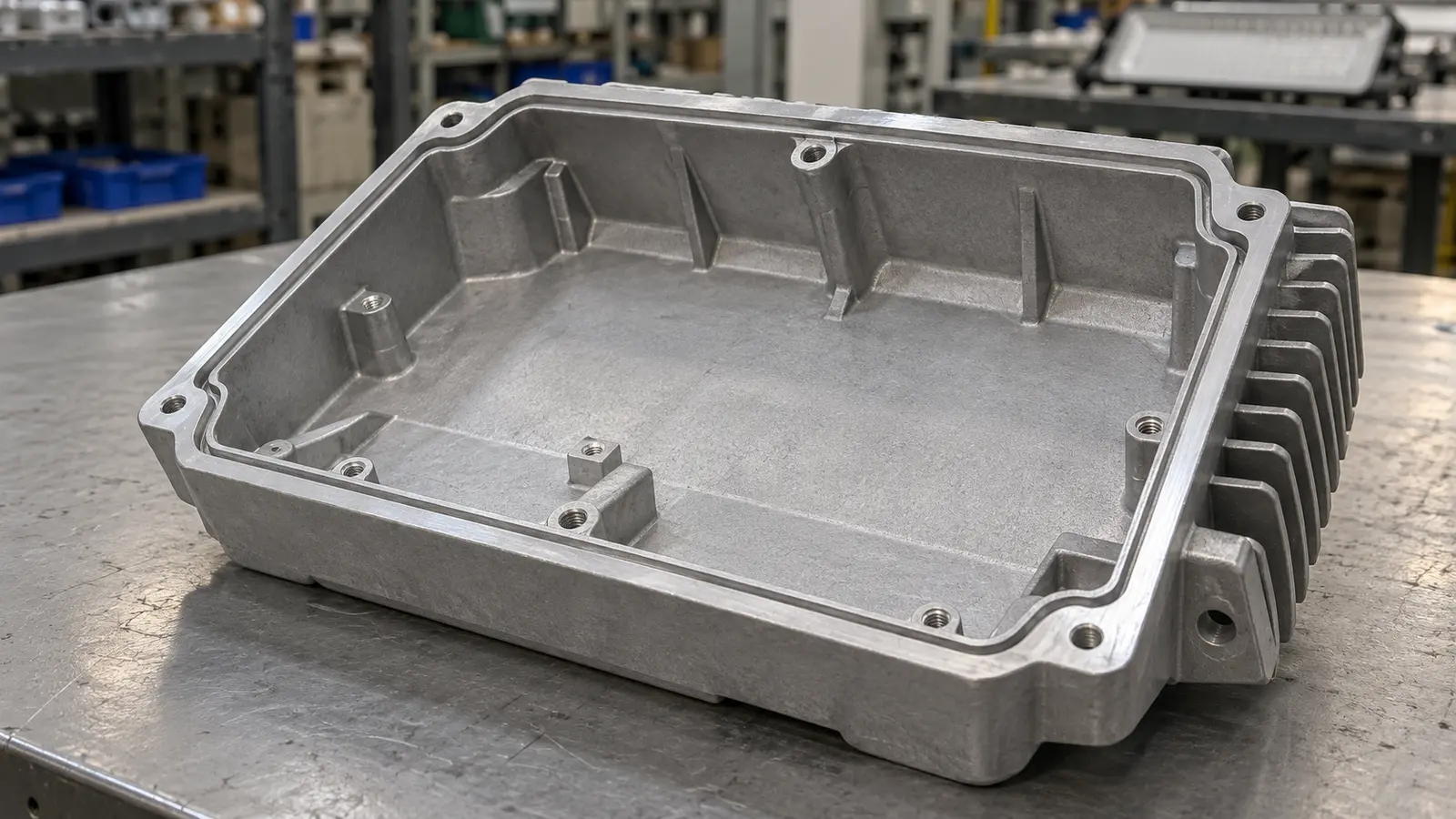
The die casting process forces molten aluminum, zinc or magnesium alloy into a reusable steel die, then cools, ejects and trims the casting for repeatable production.
A complete project has six stages, from die design and preparation to injection, solidification, ejection and finishing. The choice between hot-chamber, cold-chamber and other casting routes depends on alloy, shape and volume.
The die casting process is a manufacturing method that pushes molten metal into a reusable steel mold at high pressure, then cools and ejects the part.
It's used to produce strong, complex metal parts at high speed and low cost per piece. Most die-cast parts are made from aluminum, zinc, or magnesium, and the same die can run for hundreds of thousands of cycles before it wears out.
For engineers and sourcing teams, die casting is the go-to method when you need thousands or millions of identical metal parts with tight dimensions and smooth surfaces.
Think engine brackets, gearbox housings, laptop frames, light fixtures, and door handles. The process is fast, repeatable, and built for scale but it's not the right choice for every project.
This guide walks you through the full die casting process step by step. You'll see the 6 production stages, the main types of die casting, the metals that work best, real tolerance numbers from the North American Die Casting Association (NADCA) , and a clear comparison with sand casting and CNC machining. By the end, you'll know exactly when die casting is the right call and when it isn't.
Key takeaways
- High-pressure die casting uses a reusable tool-steel die for consistent production of non-ferrous metal parts.
- Tool making is a separate up-front stage. Filling, cooling, ejection and trimming repeat for each shot.
- Cold-chamber machines are common for aluminum, while hot-chamber systems suit zinc and selected magnesium alloys.
- Precise bores, threaded holes and sealing surfaces may need CNC machining after casting.
- Choose the process using tooling cost, yearly volume, alloy, geometry, porosity risk and testing needs.
What Is Die Casting?
Die casting is a metal forming process where molten metal is forced into a steel mold (called a "die") under pressure. The mold has been custom designed to shape a part or product of your design. Once the metal cools and hardens, the mold opens and the finished part is pushed out by ejector pins. The die is then reused for the next cycle and the next, often tens of thousands of times.
Die casting works best with non-ferrous metals that is, metals that don't contain iron. Aluminum, zinc, magnesium, and copper alloys are the big four.
These alloys melt below most steels, allowing a reusable tool-steel die to form many parts. For how the two die halves are designed, read our guide to dies in manufacturing .
What Are the 6 Steps of the Die Casting Process?
The workflow has six stages: die design and build, preparation and release-agent application, melting and injection, cooling, ejection, and trimming. Die design happens before production ; the often-cited 30 to 90-second aluminum cycle refers to repeated production shots, not to the time required to design and build the die.
- Die Design and Build , Engineers design the steel mold and machine it to spec.
- Die Preparation and Lubrication , The mold is cleaned, heated, and sprayed with release agent.
- Metal Melting and Injection , Molten metal is forced into the die under pressure.
- Cooling and Solidification , The metal hardens inside the mold.
- Ejection , The die opens and ejector pins push the part out.
- Trimming and Finishing , Excess metal is removed and the part is finished.
Step 1: Die Design and Build
Everything starts with the die itself. Engineers design the mold in CAD software, simulate metal flow with CFD (computational fluid dynamics - software that predicts how liquid metal will move through the mold), and then machine the die from hardened tool steel.
A typical die has two halves: a fixed half that stays attached to the injection system, and a moving half that opens to release the finished part. Inside, you'll find the cavity (the negative shape of your part), runners (channels for the metal to flow through), gates (the entry points into the cavity), and ejector pins (the rods that push the part out).
Tooling is a major up-front cost. As a planning benchmark, Meco lists $20,000 to $150,000+ for production die-casting dies, depending on their size and complexity. Higher volumes spread this investment across more parts.
Step 2: Die Preparation and Lubrication
Before each cycle, the die is cleaned and sprayed with a release agent (a lubricant that stops the metal from sticking). The die is also pre-heated. A cold die would shock the molten metal and cause defects, so the steel is brought up to a working temperature usually 150°C to 300°C (300°F to 570°F) depending on the alloy.
After spraying and preheating, the two die halves close under machine clamping force. The required tonnage depends on the projected casting area, alloy and injection pressure, so the machine must be sized for the specific design.
Step 3: Metal Melting and Injection
The chosen alloy is melted in a furnace at a temperature well above its melting point. Aluminum melts around 660°C (1,220°F), zinc around 420°C (790°F), and magnesium around 650°C (1,200°F). The molten metal is then injected into the die.
In high-pressure die casting, molten metal fills thin-walled cavities very quickly, often in only a fraction of a second. Pressure and fill time must be selected for the alloy and part design, not assumed from one universal machine setting.
Step 4: Cooling and Solidification
Once the cavity is full, pressure is held while the part cools and solidifies. Cooling is controlled with water channels built into the die. Too fast and the metal can shrink unevenly, causing warpage. Too slow and you waste cycle time.
This step usually takes 2 to 30 seconds for most parts. Thicker walls take longer; thin walls cool almost instantly.
Step 5: Ejection
After cooling, the moving half of the die pulls away and ejector pins push the part out. The casting still has the runners, gates, and any flash (thin webs of extra metal that squeezed between the die halves) attached to it.
On automated lines, a robot arm grabs the part as it ejects and drops it onto a conveyor. Manual cells have an operator do the same job by hand.
Step 6: Trimming and Finishing
The final step removes the runners, gates, and flash. This is done by a trim press (basically a punch that cuts the extras away) or by manual deburring. The leftover metal goes back into the furnace and gets reused die casting wastes very little material.
Secondary operations may include CNC machining for bearing bores and sealing faces, alloy-compatible surface finishing , and assembly. Meco integrates these processes within its turnkey manufacturing offering.
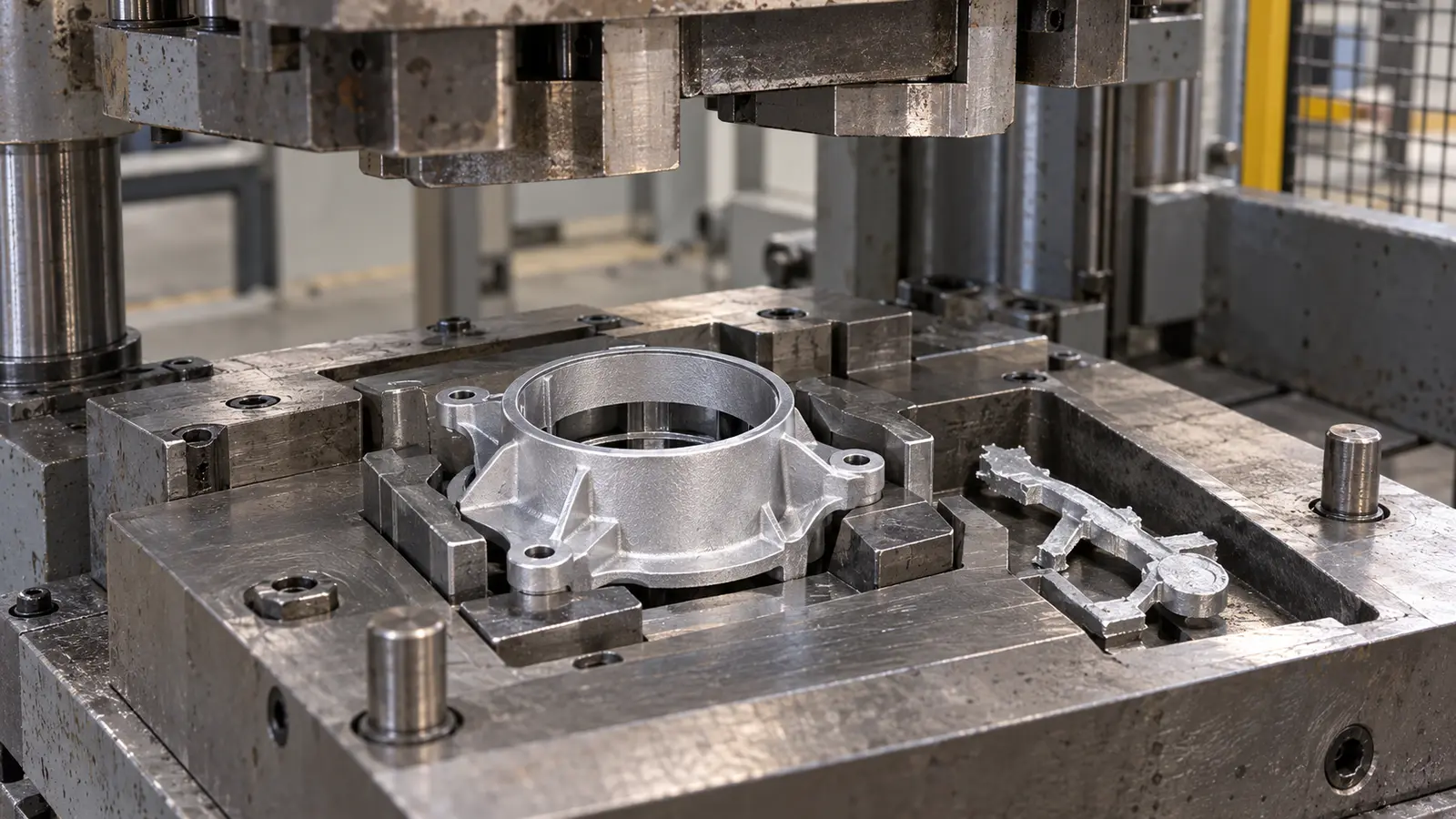
Design review before cutting steel
Die rework after first samples can delay a program. A design for manufacturability (DFM) review checks wall thickness, draft angles, undercuts, gating and ejector access while changes are still easier to make. Request DFM feedback before approving the tool design.
Types of Die Casting: Hot Chamber, Cold Chamber, and Pressure Variants
Hot-chamber and cold-chamber machines are the two main high-pressure die casting configurations. Low-pressure permanent-mold casting and gravity casting are related, but different, ways to fill a reusable metal mold. Vacuum-assisted HPDC adds air evacuation to a high-pressure process. Compare the configurations below.
Hot Chamber Die Casting
In hot-chamber machines, an injection mechanism with a submerged gooseneck draws metal from the holding pot and drives it into the die. This can support short shot-to-shot cycles because the metal supply is already integrated; actual cycle time depends on the part and alloy.
Because the immersed pumping system contacts molten metal, hot-chamber machines suit compatible lower-temperature alloys, especially zinc and some magnesium alloys. They are commonly used for small, high-volume fittings, locks and decorative hardware. For a detailed contrast, see hot chamber vs cold chamber die casting .
Cold Chamber Die Casting
The separate furnace feeds measured metal to a horizontal shot sleeve, where a plunger injects it into the closed die. This architecture is commonly used for aluminum alloys and allows the shot sleeve and die to be designed around their different thermal demands.
This is the method for aluminum, brass, copper, and high-melting-point magnesium alloys. Most aluminum die castings, including the vast majority of automotive structural parts, come from cold chamber machines.
High Pressure Die Casting (HPDC)
HPDC is what most people picture when they hear "die casting." It uses very high injection pressure (approximately 10,000 to 20,000 psi, depending on the process) to fill the die in milliseconds. The result is thin walls, sharp details, smooth surfaces, and very fast cycle times. Both hot and cold chamber machines can be set up for HPDC.
The downside: that violent fill can trap air, which leads to porosity (tiny gas bubbles) inside the part. Vacuum-assist and clever gating reduce the risk, but it's still a real concern for parts that need to be welded or pressure-tested later.
Low Pressure Die Casting (LPDC)
LPDC takes the opposite approach. Instead of slamming metal into the mold, it gently pushes it upward from a sealed furnace below the die using pressurized air (about 7 to 100 PSI). The fill is slow and smooth, which means much less air entrapment and much denser parts.
LPDC is used for aluminum wheels and other parts where controlled filling and lower gas entrapment are important. Suitability for a safety-critical design still depends on alloy selection, testing, process control and the part specification. Meco offers low-pressure casting for suitable applications.
Gravity Die Casting (Permanent Mold)
No pressure at all, just gravity. Molten metal is poured into the die from above and allowed to flow into the cavity under its own weight. It's slower and less detailed than HPDC, but the parts are very dense and have excellent mechanical properties.
This method is great for medium-volume aluminum parts where strength matters more than thin walls or fine features. See Meco's gravity casting capabilities for typical specs and materials.
Vacuum Die Casting
Vacuum assistance can reduce air trapped in the casting, but it does not make every high-pressure die casting automatically weldable, pressure-tight or suitable for heat treatment. These requirements must be validated by the alloy, die design and process settings.
| Type | Pressure Range | Best For | Typical Metals | Trade-off |
|---|---|---|---|---|
| Hot Chamber HPDC | 10,000 to 20,000 psi | High-volume small parts | Zinc, magnesium, lead | Can't handle high-temp alloys |
| Cold Chamber HPDC | 10,000 to 20,000 psi | Aluminum & higher-temp alloys | Aluminum, brass, copper, magnesium | Slower cycle than hot chamber |
| Low Pressure (LPDC) | 7 to 100 PSI | Wheels, suspension, safety parts | Aluminum (A356) | Slower cycle, larger footprint |
| Gravity Casting | Gravity only | Medium-volume strong parts | Aluminum (A356, ZL101) | Lower detail than HPDC |
| Vacuum Die Casting | HPDC + vacuum | Weldable, heat-treatable parts | Aluminum, magnesium | Higher tooling and equipment cost |
What Materials Are Used in Die Casting?
The vast majority of die-cast parts are made from one of four metal families: aluminum, zinc, magnesium, or copper alloys. Each has its own strengths, weight, and price point.
Steel and cast iron are normally made by other casting routes, because conventional non-ferrous die-casting equipment and steel tooling are not suited to those melt temperatures. Consider investment casting or sand casting instead.
| Material | Common Alloys | Key Properties | Typical Applications |
|---|---|---|---|
| Aluminum | ADC12, A360, A380, AlSi12, AlSi10Mg | Lightweight, corrosion-resistant, good strength, thermally conductive | Automotive housings, gearbox cases, heat sinks, brackets, EV battery enclosures |
| Zinc | Zamak 2, 3, 5, 27 | High precision, fine detail, low melting point, dense | Locks, decorative hardware, small gears, electrical connectors |
| Magnesium | AZ91D, AM50, AS41 | Ultra-lightweight (33% lighter than aluminum), good strength-to-weight | Laptop frames, camera bodies, automotive structural parts |
| Copper / Brass | Brass alloys | Conductive, corrosion-resistant, antimicrobial | Plumbing fittings, electrical components |
Aluminum is widely used for gearbox cases, electronic enclosures and automotive housings because of its low density and thermal conductivity. For cast aluminum alloys, ASTM B85 gives a recognized alloy specification framework. Grade and process must be matched to the part requirements.
Die Casting Tolerances and Precision
Die casting is one of the most accurate casting processes available, but it's not a substitute for CNC machining when you need micron-level precision. Tolerances depend on the alloy, part size, and whether you specify NADCA's "Standard" or "Precision" tolerance grade.
The North American Die Casting Association (NADCA) publishes industry tolerance guidance that varies with alloy, dimension and production class. The values below are simplified planning examples , not guarantees for every dimension or geometry. See our detailed NADCA tolerance guide for design decisions.
| Tolerance Grade | First Inch (Basic) | Each Additional Inch | When to Use |
|---|---|---|---|
| NADCA Standard | ±0.010" (±0.25 mm) | ±0.001" (±0.025 mm) | Most general applications |
| NADCA Precision | ±0.002" (±0.05 mm) | ±0.001" (±0.025 mm) | Tight-fit features, mating surfaces |
Draft is important because the solidified casting must come out of the steel die without damage. Typical starting points are about 0.5 to 2 degrees depending on the wall, depth and alloy. Very tight bearing bores, threads and mating surfaces often need post-cast CNC machining .
Quick Reference: Tolerance Reality Check
For a feature that needs particularly tight fit or accurate sealing, do not force the full casting to the same tolerance. Put precision requirements on the critical bore, face or thread and leave suitable as-cast allowances elsewhere. Confirm the exact grade with the die caster.
Die Casting vs. Sand Casting vs. CNC Machining: Which Should You Choose?
Die casting isn't always the right answer. Here's a side-by-side look at how it stacks up against the two most common alternatives.
| Factor | Die Casting | Sand Casting | CNC Machining |
|---|---|---|---|
| Tooling Cost | High ($20K to $150K+) | Low ($500 to $5K) | None (programming only) |
| Cost Per Part (at volume) | Very low | Medium | High |
| Minimum Economical Volume | Part-dependent, often thousands | Low to medium volume | 1+ parts |
| Surface Finish | Excellent (as-cast) | Rough (needs machining) | Excellent |
| Tolerance | ±0.05 mm (NADCA Precision) | ±1.5 mm | ±0.01 mm |
| Best For | High-volume Al/Zn/Mg parts | Large, low-volume iron/steel parts | Prototypes, ferrous metals, precision |
CNC machining is often the better route for prototypes and smaller orders because it avoids a costly permanent die. At larger recurring volumes, die casting can lower unit costs, but the crossover depends on geometry, material, tool cost and secondary operations. Read our guides to sand casting and gravity casting .
Comparing routes for your part? Send your drawing, alloy and target volume for process advice and DFM feedback before committing to permanent tooling.
Discuss Your ProjectAdvantages and Disadvantages of Die Casting
Die casting is powerful, but it comes with real trade-offs. Here's the unvarnished version.
Advantages
- Short shot-to-shot cycle times make die casting attractive at volume. Cycle time varies widely with alloy, casting size, wall thickness and cooling conditions.
- Excellent dimensional accuracy. NADCA Precision tolerances of ±0.05 mm beat almost every other casting process.
- Smooth as-cast surfaces. As-cast surfaces are often smooth, but visible and functional features may still require finishing.
- Complex geometries. Thin walls (thin walls for suitable zinc designs), tight ribs, undercuts with slides, and integral features all work.
- The cost per part can fall as the tool is amortized, although alloy, part weight, rejection risk and secondary operations still matter.
- High material yield. Runners and flash are remelted, so material waste is minimal.
- With suitable tool steel, cooling and maintenance, production dies can run for many thousands of cycles; actual life varies with alloy, geometry and process settings.
Disadvantages
- Tooling can be difficult to justify for small prototype volumes unless production-like testing is essential.
- Limited to non-ferrous metals. No steel, no cast iron. If you need a ferrous part, look elsewhere.
- Porosity risk. The high-speed fill can trap air. This limits welding and pressure-tight applications unless vacuum assist is used.
- The permitted size and weight depend on the available machine, shot system, clamping force and handling equipment.
- Tool design, manufacture and validation require a longer lead time than machining a single prototype. Meco lists six to fourteen weeks as a planning range for die-casting production programs, depending on scope.
Common Applications and Industries
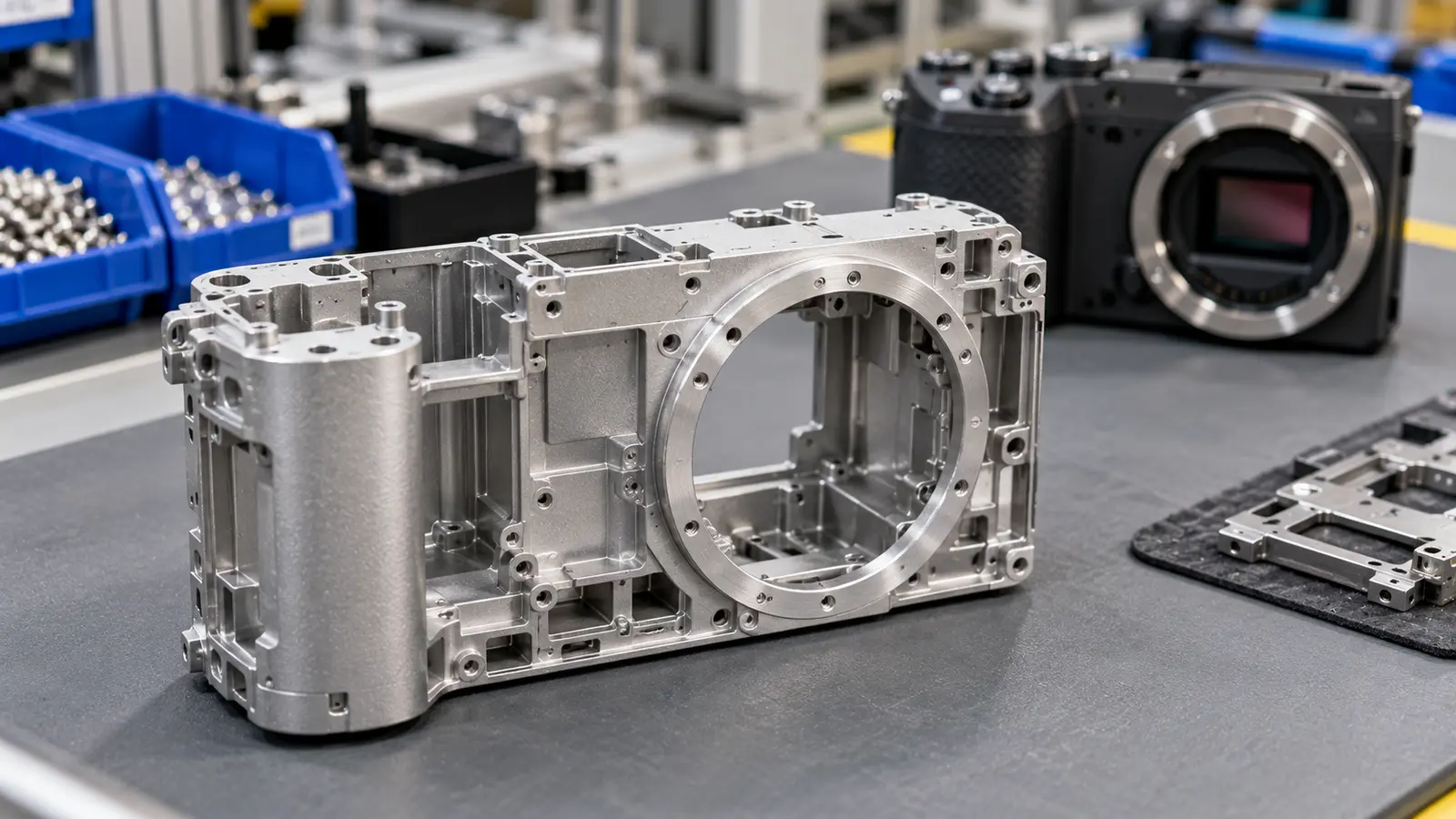
Die-cast parts are everywhere. Look around any vehicle, appliance, or electronic device and you'll find them.
- Large one-piece castings show how automotive manufacturers can consolidate components, while conventional die casting remains useful for gearbox cases, housings, brackets and other smaller parts.
- Consumer electronics: Laptop chassis, smartphone frames, camera bodies, set-top box housings.
- Aerospace: Brackets, housings, instrument bezels (non-critical structural parts).
- Home appliances: Washing machine motor housings, fan brackets, range hood components.
- Lighting: Streetlight housings, LED heat sinks, decorative fixtures.
- Industrial: Pump bodies, valve housings, gear cases, hydraulic blocks.
- Telecommunications: 5G base station housings, network equipment chassis, RF shielding.
How Much Does Die Casting Cost?
Die casting cost breaks into two buckets: tooling (one-time) and per-part (recurring).
Production die-casting tooling generally falls in the $20,000 to $150,000+ planning range published by Meco. Complex slides and cooling channels tend to raise tool cost. Soft tooling and prototype routes need separate checks for life and repeatability.
For small to medium metal parts, Meco publishes representative high-volume die-casting unit costs of $1 to $10 and lower-volume estimates of $8 to $25 at 1,000 parts , excluding any project-specific changes. These are broad planning bands, not a quote.
Break-even quantity is not a fixed industry number. Compare the one-time die cost, expected annual volumes, cycle time, alloy cost and any machining or finishing that remains after casting.
Choosing a Die Casting Partner
The die casting process itself is mature and well understood , but the quality of your finished parts comes down to your partner. A good die caster catches design issues during quoting, builds a die that survives a full production run, and runs a quality system that catches problems before they ship.
Here's what to look for:
- IATF 16949:2016 certification indicates a defined automotive quality-management system. Ask whether the required inspection, process controls and documentation apply to your specific part and project.
- In-house finishing and machining. If your part needs CNC features, surface treatments, or assembly, having all of that under one roof eliminates handoff delays and quality gaps.
- DFM support. Your partner should review your design before quoting and flag issues , wall thickness, draft angles, ejector pin locations, gating strategy.
- Tonnage range. Make sure their machines fit your part size. Tiny parts need tiny machines; large structural castings need 800-ton clamping force or more.
- Alloy depth. A good die caster handles multiple alloys across aluminum, zinc, and magnesium families.
Meco offers die casting services for aluminum, zinc and magnesium alloy programs. Its IATF 16949:2016 certified quality system supports integrated casting, machining , finishing and assembly. Read the turnkey manufacturing overview for the wider workflow.
Deciding between metal and plastic for your part? Our guide to die casting vs injection molding compares cost, strength, tolerances, and lead times side by side.
Plan Your Die Casting Project
Meco combines alloy selection, die design, casting, machining and finishing to help OEM teams assess the full production route.
- Tooling and DFM. Design review before steel cutting.
- Materials. Aluminum, zinc and magnesium options.
- Production scale. Process selection for target volumes.
- Quality planning. Inspection and traceability options.
- Integrated finishing. Machining and assembly coordination.
Explore die casting services and casting capabilities .
Request a QuoteReferences and sources
- North American Die Casting Association: Die Casting FAQs . Die design, metal flow, vents, cooling and ejection.
- ASTM International: ASTM B85 . Aluminum-alloy die-casting specification.
- NADCA: Product Design for Die Casting (2015, seventh edition) . Hot- and cold-chamber machine sequence and die design.
Image research references in the separate Word handoff document are design aids, not photographs taken at Meco.
