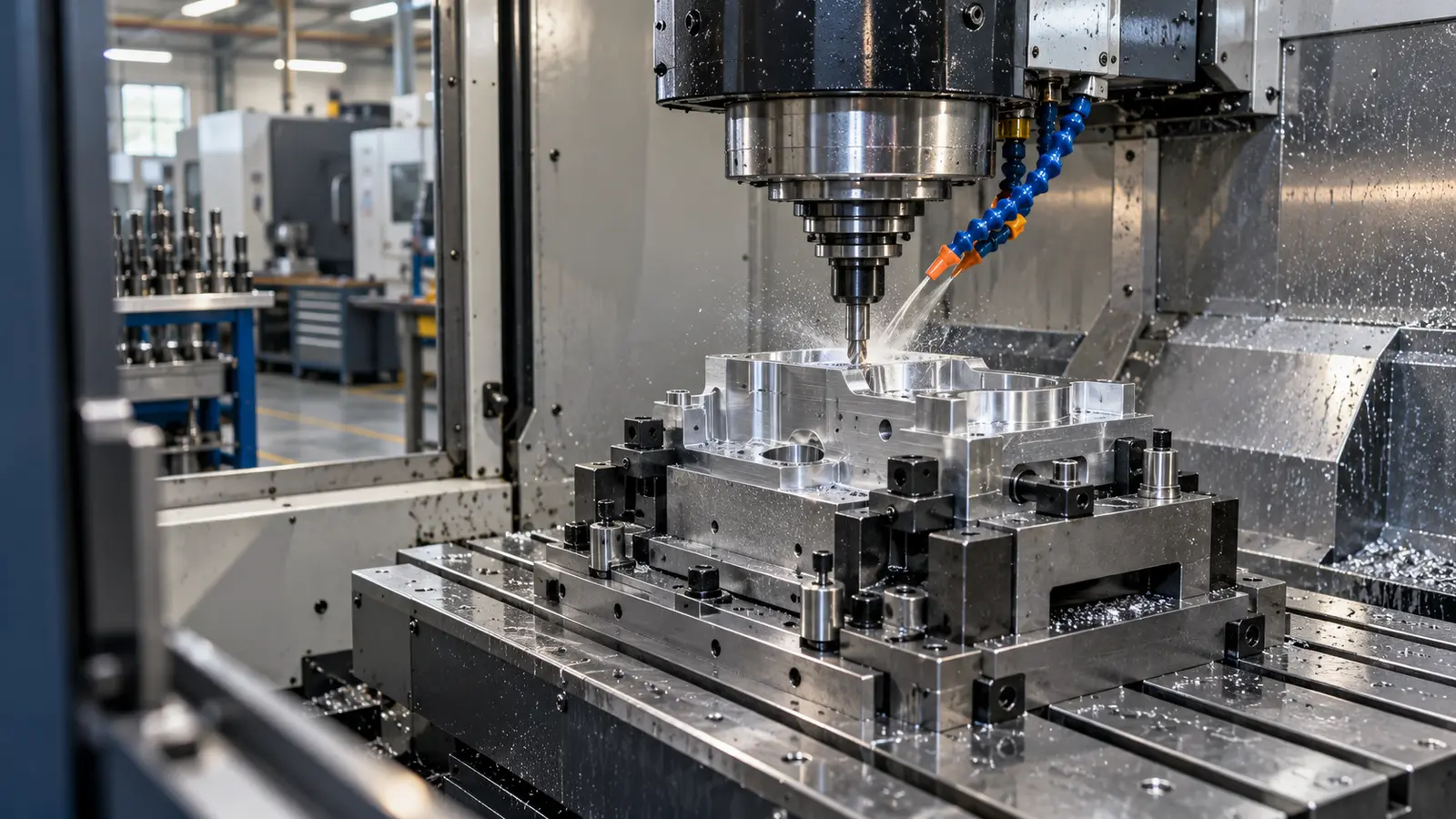
Choose a CNC machining partner on engineering depth, inspection evidence and process breadth, not on the machine list. A supplier who reviews your drawing before quoting typically removes 15 to 30% of the cost, which is more than you will win by shopping the same drawing around.
The main lever is how many companies touch the part. Every handoff between a machinist, a heat treater and a finisher adds coordination cost and blurs accountability when a dimension drifts.
Picking a machining supplier used to be simple. You sent a drawing, you collected three prices, you took the lowest one that came back on time.
That model breaks on modern parts. Tolerances are tighter, materials are harder to cut, and most machined components now need heat treatment, a finish or an assembly step before they ship. The supplier who quotes only the milling is quoting only part of your cost.
This guide gives sourcing teams a practical way to compare machining suppliers. It covers the engineering questions that predict quality, the inspection evidence you should ask for, and the reason multi-process capability changes your risk profile.
It is written from the perspective of a manufacturer who has run this work since 1993, so it is opinionated in places. Where Meco does something differently, we say so plainly rather than hiding it in a comparison table.
Key takeaways
- Engineering, not equipment. Any shop can buy a 5-axis machine. Far fewer can tell you which two tolerances on your drawing are costing you money.
- DFM is the biggest single lever. Design changes agreed before the first cut typically remove 15 to 30% of part cost.
- Ask for evidence, not adjectives. A CMM report, a material certificate and a first article inspection report tell you more than any capability brochure.
- Count the companies, not the operations. Multi-vendor routing adds 15 to 30% in coordination cost that never appears on a quote.
- Certification scope matters more than the logo. Ask which standard the supplier actually holds, and ask to see the certificate number.
- Check the whole lifecycle. A partner who can carry you from prototype through pilot to volume saves you a requalification later.
Engineering depth beats the machine list
The most useful thing a machining supplier can do is tell you what is wrong with your drawing. Machine ownership is a commodity. Judgement about how a part should be made is not.
Most evaluations open with the wrong question. Asking whether a shop has 3-axis, 4-axis or 5-axis capability tells you what they can physically cut. It tells you nothing about whether they will cut it efficiently, or whether they will spot that your datum scheme forces an extra setup.
Better questions sound like this. Who reviews the drawing before the quote goes out? Will I get manufacturability notes with the price, or just the price? Who designs the fixture, and does that cost sit inside the quote or arrive later as a surprise?
Look for a supplier who runs a formal design review, simulates the toolpath before the machine moves, and designs their own fixtures and workholding. Simulation matters more than it sounds. A collision found on screen costs an hour. The same collision found on a 5-axis machine can cost a spindle.
The commercial side of this is worth naming too. Meco publishes its process, tolerance and lead-time reference on the materials pages precisely so buyers can check the claims before they call. A supplier who will not put numbers in writing before you engage is unlikely to become more specific afterwards.

What a real DFM review actually changes
Design for manufacturability is not a courtesy call, it is a costed list of alternatives. At Meco, DFM adjustments agreed before tooling typically reduce part cost by 15 to 30%.
The changes are usually unglamorous. Adding a standard corner radius so a common cutter can run at full feed. Opening a non-functional tolerance that was tightened out of habit. Reducing a deep pocket that forces a long, fragile tool. Consolidating four setups into two by moving a datum. Choosing a more machinable grade where the application allows it.
A worked example, using published Meco ranges
Take an aluminum bracket in 6061-T6, 2,000 pieces a year, roughly palm sized.
As drawn, every feature carries ±0.01 mm and the datum scheme needs four setups on a 3-axis mill. North American 3-axis time runs $30 to $75 per hour, setup and programming runs $50 to $1,000 per job, and a machined part at this volume sits in the $50 to $300 band.
After review, two bearing bores keep ±0.01 mm because they locate a shaft. Everything else moves to ISO 2768-m, where the general tolerance is wide enough that the machine no longer has to creep. Standard radii replace sharp internal corners. A fourth axis brings two of the four setups into one operation.
Nothing about the function changed. The part simply stopped paying for precision it never used, and at this volume that lands inside the 15 to 30% band.
At 5,000 pieces a year the conversation changes shape. Now the question is whether the part should be machined at all, or die cast and then machined only on the faces that matter. Die casting tooling runs $5,000 to $150,000 and takes 6 to 14 weeks, but the per part cost at volume falls to $1 to $10 against $15 to $50 for a fully machined part. A machining-only supplier has no reason to raise that option. A supplier who also runs die casting has every reason to.
That is the real argument for engineering depth. The most valuable answer a partner can give you is sometimes that your process choice is wrong.
What to send for a useful DFM review
A 3D model in STEP or IGES, a 2D drawing with the functional tolerances marked, the target annual volume, the material or a statement of what the part has to survive, and the finish requirement. Volume is the field buyers most often leave blank, and it is the one that decides the process.
Match the axis count to the part, not to the brochure
More axes is not better, it is different. The right question is how many setups your part needs, because every setup adds a chance for error to stack.
3-axis machining
Prismatic parts, flats, pockets, plates, brackets, housings and fixtures. Well used, 3-axis machining is the most cost-efficient route for medium-complexity work. The advantage comes from rigid machines, sensible tooling and disciplined programming rather than from the axis count.
4-axis machining
Adding rotation reaches multiple faces without re-fixturing. 4-axis work suits parts with axial and radial features and mid to high volumes, where removing a setup removes both cycle time and tolerance stack-up.
5-axis machining
Compound angles, undercuts and tight-tolerance geometry that would otherwise need several operations. 5-axis machining earns its cost when it collapses multiple setups into one, which is common in aerospace structures, medical components and precision housings.
Turning and mill-turn
Round parts, shafts, fittings and bushings belong on a lathe. Ask whether the supplier can combine turning and milling in one operation, because that decides whether your shaft leaves the machine finished or travels to a second one.
Meco runs 3-axis through 5-axis machining and turning in house, and holds ±0.01 mm as a typical machined tolerance with 0.005 mm achievable on key features. Full process detail sits on the custom CNC machining page, and grade-by-grade behaviour is covered in the CNC machining materials guide.
What actually drives your machining cost
Five things move a machining price, and only one of them is the machine. Understanding the other four is what lets you negotiate on something real.
| Process | Typical tolerance | Tooling | Per part, low volume | Per part, high volume | Lead time |
|---|---|---|---|---|---|
| CNC machining | ±0.01 mm, ISO 2768 | $0 to $1,000 fixtures | $50 to $300 | $15 to $50 | 1 to 3 weeks |
| Die casting | NADCA standard ±0.010 in | $5,000 to $150,000+ | $8 to $25 at 1,000 | $1 to $10 | 6 to 14 weeks |
| Investment casting | Near net shape per ICI | $600 to $30,000 | $15 to $100+ | $5 to $40 | 6 to 12 weeks |
| Hot forging | ASTM B247 / BS EN 10243 | $10,000 to $100,000+ | $10 to $50 | $3 to $20 | 6 to 12 weeks |
| Metal stamping | DIN 6930 / GB/T 13914 | $3,000 to $250,000 | $1 to $10 at 1,000 | $0.05 to $5 | 4 to 10 weeks |
| Metal injection molding | Near net shape | $10,000 to $50,000+ | $10 to $50 | $1 to $5 | 8 to 16 weeks |
Geometry. Thin walls, deep pockets and compound angles all add time and tool wear. Complexity is priced in minutes, not in opinions.
Material. Titanium, Inconel and 17-4PH stainless cut slower and eat tooling. Aluminum cuts fast. The material line on your drawing often moves the price more than the geometry does.
Tolerance. Tightening a tolerance adds setups, slower passes and more inspection. It is the most common place buyers overpay, which is why choosing tolerances deliberately is worth a dedicated read.
Volume. Setup and programming amortise. The same part is a different price at 10, 100 and 10,000 pieces, so quoting without a volume figure produces a number nobody can use.
Secondary operations. Heat treatment, anodising, powder coating, plating and assembly are often quoted separately and shipped separately. The surface finish reference covers what each process will actually hold. For a full breakdown across processes, see the metal part cost guide.
Certifications, read honestly
A certification tells you a system was audited, not that your part will be good. Ask which standard the supplier holds, ask for the certificate number, and ask what that certificate actually covers.
Here is what the common standards signal to a buyer.
ISO 9001:2015 is the general quality management baseline. It indicates documented process control, traceability and corrective action, across any industry.
IATF 16949:2016 is the automotive standard and is built on all ISO 9001:2015 requirements. It adds automotive-grade discipline: APQP, PPAP, SPC, PFMEA and a strong emphasis on defect prevention rather than detection. It is the most demanding of the general manufacturing quality standards.
AS9100D is aerospace specific, with heavy emphasis on configuration management, counterfeit part control and documentation. ISO 13485 is the medical device equivalent, built around risk management and design control.
Meco's position is straightforward. IATF 16949:2016 is our sole formal quality certification, certificate 136359/A/0001/SM/En. We are not separately certified to ISO 9001, because IATF 16949 incorporates all of its requirements, and we are not certified to AS9100D, ISO 13485 or registered under ITAR.
For aerospace and medical work we support programmes through capability rather than through a certificate: first article inspection reports, PPAP documentation, CMM inspection with SPC, non-destructive testing, material certificates and full lot and serial traceability. If your programme requires a certified supplier under AS9100D or ISO 13485, you need one, and you should ask any supplier to send the certificate rather than accepting the word "aligned".
That last point is worth pressing generally. "AS9100-aligned" and "ISO-compliant" are marketing phrases with no audited meaning. A certificate has a number, a scope and an expiry date. Ask for all three.
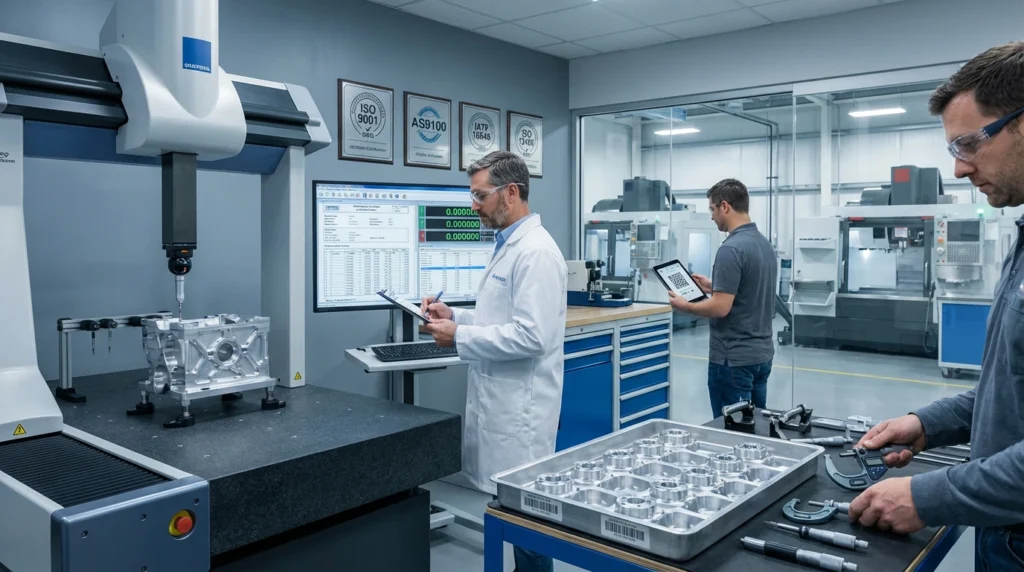
Inspection and traceability: ask for the evidence
Precision only counts if it can be measured and proven afterwards. The fastest way to grade a supplier is to ask for a sample inspection report from a job like yours.
On the measurement side, look for coordinate measuring machines, granite tables and height gauges, surface roughness testers, thread and plug gauges, and optical measurement for small features. Meco verifies CMM accuracy to ±0.002 mm, which is what makes a ±0.01 mm part tolerance meaningful rather than aspirational.
In-process control matters at least as much as final inspection. A supplier who only checks the last part in the box finds out about tool wear after it has already produced scrap. Ask about offset checks during the run, tool life tracking, SPC data collection and fixture alignment verification.
On documentation, the list you should be able to request is short and specific: material certificates, EN 10204 3.1 certificates where required, heat treatment records, lot and serial traceability, first article inspection reports, PPAP submissions and certificates of analysis. If a supplier hesitates on any of these, that is your answer.
One practical test. Ask what happens when a nonconforming part reaches you. A mature supplier describes containment, sorting responsibility and corrective action without being prompted.
Why multi-process suppliers change your risk
The hidden cost in machining is rarely the machining, it is the coordination between vendors. Multi-vendor routing adds roughly 15 to 30% that never appears on any single quote.
The arithmetic is checkable. A part that moves through machining, heat treatment, finishing and assembly crosses four to six handoffs, each carrying $50 to $200 in administration and transfer cost per lot. Add the engineering hours burned establishing whose fault a warped part is, and the freight legs between sites, and the gap between unit price and landed cost opens up.
There is a quality dimension too. When a machined face on a casting runs out of tolerance, the casting supplier blames the machining stock and the machinist blames the casting. Nobody is lying. The interface was never engineered by one team.
Integration helps most in a few specific pathways.
Casting into machining. Gate placement, draft angles, shrinkage and machining stock all determine whether the machined faces come out clean. Meco runs die, gravity, low pressure, sand and investment casting under the casting hub, with die casting from 25T to 800T and parts from 1 g to 5,000 g.
Forging into machining. Knuckles, levers, gears and powertrain parts need a machinist who understands grain flow and post-forge distortion. Hot and cold forging sit in the same production flow as the machining and heat treatment.
Fabrication into machining. Laser-cut blanks, CNC-bent enclosures and welded frames often need machined mating faces afterwards. Controlling both under one roof removes warp-related surprises, which is the argument for a single fabrication and welding source.
Plastics alongside metal. Hybrid products need a housing and a bracket to fit each other. Running injection molding next to machining keeps those two tolerance stacks in one conversation.
Finishing and assembly at the end. Anodising, powder coating, plating and polishing all change dimensions slightly. Whoever machines the part should know what the finishing line will add to it.
Unsure what your part should cost? Send a STEP file and a target annual volume, and you will get manufacturability notes alongside the price rather than a number with no reasoning.
Get DFM Feedback on Your DesignThree tiers of machining supplier, compared
Most suppliers fall into one of three tiers, and each is right for a different job. A local job shop is often the correct answer for a one-off fixture, and a mistake for a production programme.
| Evaluation factor | Local job shop | Mid-tier CNC supplier | Engineering-led turnkey partner |
|---|---|---|---|
| DFM support | Rare, quotes as drawn | Informal comments | Formal review with costed alternatives |
| Process breadth | Machining only | Machining plus outsourced steps | Casting, forging, machining, finishing and assembly in house |
| Quality system | Often uncertified | Typically ISO 9001 | IATF 16949:2016 with APQP, PPAP and SPC |
| Inspection | Hand tools | Hand tools plus some CMM | CMM verified to ±0.002 mm, in-process SPC, NDT |
| Volume range | 1 to a few hundred | Hundreds to thousands | 10 pieces to 10 million plus |
| Documentation | On request, informal | Inconsistent | FAI, PPAP, material certs, lot traceability as standard |
| Accountability | Single process only | Split at each handoff | One owner across the whole route |
| Best suited to | Prototypes, fixtures, repairs | Steady mid-volume machining | Multi-process programmes and scale-up |
The tradeoff is real in both directions. An engineering-led partner asks for more of your time up front, because the design review is real work. A job shop will quote faster. Which is cheaper depends entirely on whether the part is going to be made once or a hundred thousand times.
If your requirement runs past machining into a finished product, the comparison shifts again, and choosing a turnkey manufacturing company becomes the more relevant framework.
CNC machining supplier evaluation checklist
Work through these in order, because the early answers make the later questions unnecessary. A supplier who cannot answer the engineering questions rarely improves further down the list.
Engineering and DFM
- Do you provide manufacturability feedback before quoting, in writing?
- Who reviews the drawing, and what is their background?
- Do you simulate toolpaths before cutting?
- Do you design and build your own fixtures, and is that cost in the quote?
- Will you tell me if a different process would be cheaper at my volume?
Machining capability
- Which axis configurations and turning capability do you run in house?
- What is the tightest tolerance you hold routinely, as opposed to occasionally?
- Can you run my material, and have you run it before?
- What is your largest and smallest part envelope?
Quality and evidence
- Which quality standard are you certified to, and what is the certificate number?
- Can I see a CMM report and an FAI report from a comparable job?
- What inspection happens during the run, not just at the end?
- Can you supply material certificates and lot traceability as standard?
- What is your documented process when a nonconforming part reaches me?
Scale and continuity
- Can you carry the part from prototype through pilot into volume without requalification?
- What is your quote turnaround, and your typical first-order lead time?
- Who owns the tooling and fixtures, and where do they live at end of life?
- Do you offer casting, forging, fabrication, finishing and assembly, or will you subcontract them?
- Will you sign an NDA before seeing my design?
On the last point, Meco signs NDAs and provides IP protection as standard from first quote through production. If a supplier treats that as unusual, take it seriously.
Want the wider view of what Meco runs? The capabilities index lists all 40 plus processes, and CNC engineering services covers the design review and fixture work in more detail.
Compare Meco against your shortlist
Send one part you are unhappy with the price of. You will get a quote, manufacturability notes, and an honest answer on whether machining is even the right process at your volume.
- 24-hour quotes. With DFM feedback, not just a number.
- 40+ in-house processes. Casting through assembly, one roof, no vendor handoffs.
- IATF 16949:2016 certified. FAI, PPAP and CMM reports available.
- No minimum order. 10 pieces to 10 million plus.
- Manufacturing since 1993. NDA signed before we see your design.
Browse all 40+ processes, check the materials we run, or go straight to a quote.
Request a Quote