CNC engineering services are the design and process support a machine shop adds before and during production. They cover design for manufacturability, tolerance and GD&T review, fixture design, tooling choices, programming, and material selection. The goal is simple: make a part easier to machine, cheaper to produce, and more reliable, without changing what the part has to do. Good CNC engineering catches problems on the screen instead of on the shop floor.
Here's the thing most buyers learn the hard way. A part can be perfectly designed and still be expensive to make. A radius that's a touch too small, a tolerance that's tighter than it needs to be, a wall that's thinner than the cutter likes: any of these can quietly add cost to every single piece. That's the gap CNC engineering services are built to close.
In this guide we'll walk through what these services include, how they differ from plain machining, and how they cut cost from prototype all the way to full production. By the end you'll know exactly when to bring an engineering team in, and what to ask them.

What are CNC engineering services?
CNC engineering services are the technical work that happens around the actual cutting of a part. Machining makes the part. CNC engineering makes sure the part is worth making the way it's drawn.
Think of it as a second set of expert eyes on your design. Before a single chip is cut, an engineer studies your CAD model, your tolerances, and your material. They look for anything that will drive up cost, slow down production, or cause quality problems later. Then they suggest fixes.
At Meco, this engineering layer sits in front of our custom CNC machining work. After more than 30 years of building parts across casting, machining, and assembly, we've found that the cheapest fix is always the one made on the screen, not the one made after the first run fails.
The short version
CNC engineering services = design for manufacturability, tolerance and GD&T review, fixture design, tooling selection, programming, and material guidance. One job: a part that's easier and cheaper to machine, with the same performance.
CNC engineering vs CNC machining: what's the difference?
People mix these two up all the time. They're related, but they do different jobs.
CNC machining is the act of cutting material. A machine follows code to mill, turn, drill, or tap a part to spec. CNC engineering is the thinking that comes before and during that cutting. It decides how the part should be held, which tools to use, what order to machine features in, and whether the design itself can be improved.
Put simply: machining answers "how do we cut this?" Engineering answers "should we cut it this way at all, and can we make it better?"
| Area | CNC Machining | CNC Engineering |
|---|---|---|
| Main job | Cutting the part to spec | Optimizing the part and the process |
| When it happens | During production | Before and during production |
| Key questions | How fast? How accurate? | Is this manufacturable? Is it cost-smart? |
| Typical output | Finished parts | DFM notes, fixtures, tool plans, programs |
| Cost impact | Per-part runtime | Locks in most of the part's total cost |
That last row matters more than it looks. Industry studies have long held that design and engineering decisions set the stage for most of what a part eventually costs. The often-cited figure is that 70 to 80 percent of total product cost gets locked in during the design phase. Once tooling is cut and production starts, your room to save shrinks fast.
What's included in CNC engineering services?
There's no single universal list, but a strong CNC engineering offering usually covers six core services. Here's what each one actually does for your part.
Design for manufacturability (DFM)
DFM, which stands for design for manufacturability, is the practice of shaping a design so it's easy and cheap to make without hurting how it works. This is the heart of CNC engineering services.
An engineer reviews your model for the usual cost traps: thin walls, deep narrow pockets, tiny internal corners that need expensive small tools, and features that force extra setups. A common rule of thumb is to keep internal corner radii as large as the design allows, since sharper corners need smaller, slower, more fragile cutters. Small changes here ripple into real savings.
Tolerance evaluation and GD&T
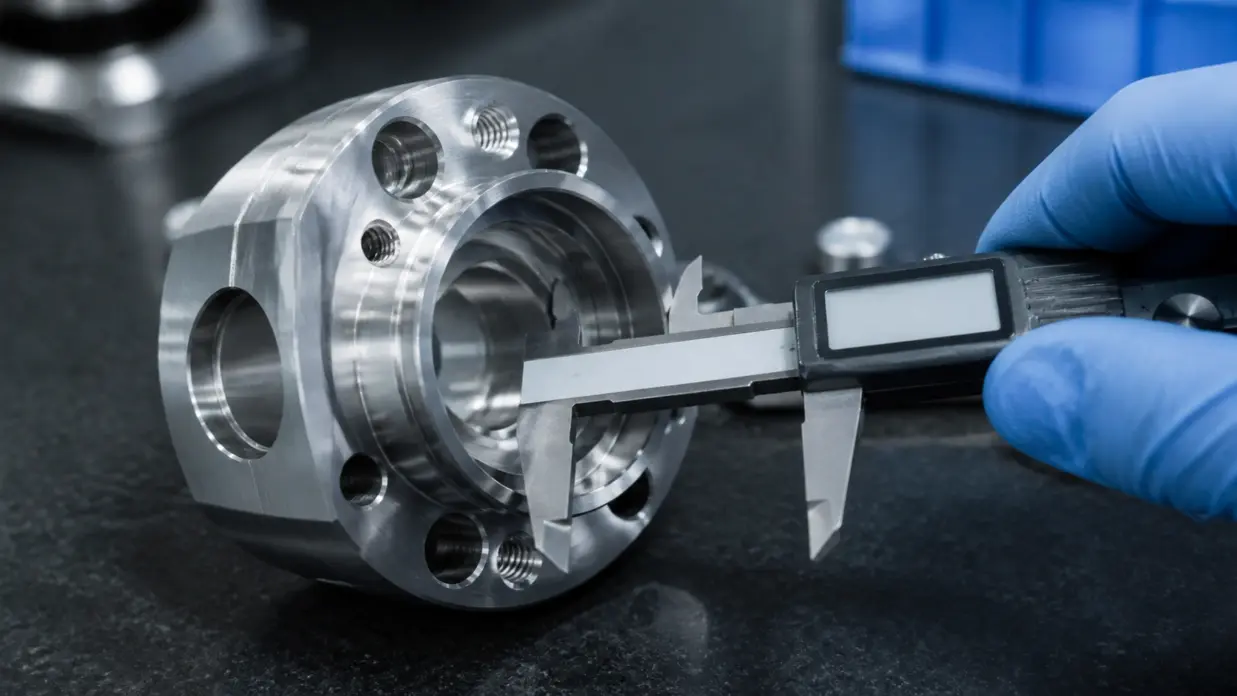
Tolerances tell the shop how much a dimension is allowed to vary. Tighter tolerances cost more, full stop. They mean slower cutting, extra passes, more inspection, and sometimes a different machine.
This is where GD&T comes in. GD&T, short for geometric dimensioning and tolerancing, is a standard drawing language that defines exactly where precision matters and where it doesn't. Used well, it lets you hold tight CNC machining tolerances only on the features that need them and loosen everything else. The governing standard is ASME Y14.5, while many shops also reference ISO 2768 for general tolerances.
CNC fixture design
CNC fixture design is the work of building the jigs and clamps that hold your part steady while it's cut. It sounds minor. It isn't.
A smart fixture lets a part be machined in fewer setups, which cuts handling time and improves accuracy from one piece to the next. A poor fixture causes vibration, marks, and scrap. In our experience, fixture strategy is one of the biggest hidden levers on both cost and quality, especially in higher-volume runs.
Tooling and cutting-tool selection
Every feature on a part needs a tool to cut it. Choosing the right tooling means fewer tool changes, longer tool life, and faster cycle times. Engineers also look for chances to use common tooling across features, so the spindle isn't constantly swapping cutters.
Here's a real example of the payoff. If a design calls for several slightly different hole sizes, standardizing them to one or two common sizes can drop tool changes and shave cost from every part. Multiply that across thousands of pieces a year and it adds up quickly.
CNC programming and process engineering
CNC programming turns the approved design into the toolpaths the machine follows, usually through CAM software. CNC process engineering decides the bigger picture: which machine runs the job, the order of operations, and how the part flows from raw stock to finished piece.
This is also where the right axis count gets chosen. A part with complex angles might move from 3-axis to 4-axis or 5-axis CNC machining to cut it in one setup instead of three. Fewer setups means tighter accuracy and lower cost.
Material selection
Material selection for CNC balances three things: how the part needs to perform, how easily the material machines, and what it costs. A free-machining alloy can run faster and tool-friendlier than a tough one, sometimes with no real loss in function.
Engineering input here can also bridge processes. Sometimes a part that's being fully machined would be cheaper as a near-net casting with light finish machining. Catching that early is exactly the kind of call a turnkey engineering team is positioned to make.
How CNC engineering services reduce machining cost
So where does the money actually come from? Cost savings in CNC engineering come from removing waste before it's built into the process. Loosen a tolerance that doesn't need to be tight, simplify geometry, cut a setup, standardize a tool: each one trims the per-part cost, and they stack.
Tolerances are usually the single biggest lever. The table below shows how tolerance choices change relative cost and where each band fits.
| Tolerance band (approx.) | Relative cost | Best used for |
|---|---|---|
| ±0.1 mm or looser | Lowest | Non-critical features, brackets, covers |
| ±0.05 mm | Moderate | General fits and mounting surfaces |
| ±0.01 mm | High | Bearing seats, mating precision parts |
| ±0.005 mm or tighter | Highest | Critical interfaces only |
The lesson buyers miss: don't spec your whole part to the tolerance of its tightest feature. That one habit can double machining cost for no functional gain. A good engineering review tags only the features that truly need precision and relaxes the rest.
A quick tolerance example
Say a housing is drawn at ±0.05 mm everywhere, but ±0.13 mm would work fine on most surfaces. Relaxing the non-critical features can save a couple of dollars per part in tooling and extra passes. On a run of 20,000 pieces a year, that's tens of thousands of dollars from a five-minute drawing change.
Want to see how the full cost picture comes together? Our guides on how much CNC machining costs and what it costs to get a metal part made break down every line item, with 2026 figures.
From prototype to production: where engineering pays off
CNC engineering isn't a one-time gate. It works hardest when it follows your part the whole way, from first prototype to full production. That's the idea behind CNC prototyping to production: the same team that proves the design also scales it.
A prototype answers "does it work?" Production answers "can we make 50,000 of these, the same, on budget?" Those are different questions, and a part that machines fine as a one-off can be a nightmare at volume. Engineering bridges that gap by adjusting fixtures, tooling, and process before scale-up, not after.
This is also why our R&D and engineering support runs through every stage, from product sampling and pilot runs to volume production. One partner who carries the design forward means fewer handoffs and fewer surprises.
Bring engineering in early
The cheapest design change is the one made before tooling is cut. Involve a CNC engineering team at the prototype stage, not after the first production run goes wrong.
When should you involve a CNC engineering team?
Not every part needs a deep engineering review. A simple bracket in a soft alloy at loose tolerances will be fine. But some signs tell you it's time to call engineering early. Watch for these:
- Your part has tight tolerances, complex curves, or thin walls.
- You're moving from a one-off prototype to real production volume.
- Your quotes are coming back higher than expected and you don't know why.
- The part involves more than one process, such as machining plus casting or assembly.
- You're unsure whether your material choice is the cheapest one that still works.
If two or more of these apply, an upfront review will almost always pay for itself. The earlier you ask, the more an engineer can change.
How to choose a CNC engineering partner
The best partners ask a lot of questions before they quote. That's a good sign, not a slow one. A shop that wants to know your material, tolerances, finish, and end use is one that's actually engineering your part, not just pricing it.
Look for a partner who can carry you from design through production under one roof, who holds a real quality standard, and who has depth across more than one process. Meco runs to IATF 16949:2016, the top-tier automotive quality standard, and applies that same rigor across every industry we serve. You can see the full range on our CNC engineering services page.
Last thing: ask how they handle the prototype-to-production jump. A partner who treats those as two separate jobs will hand you two separate sets of problems. One who treats them as a continuous path, the way good manufacturing engineering practice suggests, will save you both money and headaches.

Frequently Asked Questions
What are CNC engineering services?
CNC engineering services are the design and process support a machine shop provides around the cutting of a part. They include design for manufacturability, tolerance and GD&T review, fixture design, tooling and material selection, and programming. The aim is a part that's cheaper and easier to make with the same performance.
What's the difference between CNC engineering and CNC machining?
CNC machining is the act of cutting the part to spec. CNC engineering is the planning and optimization that happens before and during that cutting, such as deciding how to hold the part, which tools to use, and whether the design can be improved. Machining makes the part; engineering makes it worth making that way.
What does a CNC engineer actually do?
A CNC engineer reviews your CAD model, tolerances, and material to spot cost and quality risks before production. They design fixtures, pick tooling, write or guide the programming, and suggest design tweaks through DFM. Their work sets up the whole job to run faster, cheaper, and more reliably.
How does DFM reduce CNC machining cost?
Design for manufacturability cuts cost by removing features that are hard to cut, loosening tolerances that don't need to be tight, and simplifying geometry. Since most of a part's cost is locked in during design, these early changes save far more than tweaks made on the shop floor. Even small edits can trim cost from every part you make.
What tolerances can CNC machining hold?
General CNC work commonly holds around ±0.05 mm, with precision machining reaching ±0.01 mm or tighter on critical features. Tighter CNC machining tolerances cost more because they need slower cutting, extra passes, and more inspection. The smart approach is to apply tight tolerances only where the part truly needs them.
What is GD&T and why does it matter?
GD&T, or geometric dimensioning and tolerancing, is a standard drawing language that defines exactly where precision is required on a part. It lets you hold tight tolerances only on the features that matter and loosen the rest, which lowers cost. The main reference standard is ASME Y14.5.
What is CNC fixture design?
CNC fixture design is the engineering of the jigs and clamps that hold a part steady during machining. Good fixtures cut the number of setups, improve accuracy from part to part, and reduce scrap. It's one of the biggest hidden levers on both cost and quality, especially at higher volumes.
When should I involve a CNC engineering team?
Bring them in early if your part has tight tolerances, complex shapes, or thin walls, or if you're scaling from prototype to production. It's also worth it when quotes come back surprisingly high or the part spans more than one process. The earlier engineering gets involved, the more they can change.
Can one partner handle both prototyping and production?
Yes, and it's usually the better path. CNC prototyping to production with one team means the engineers who proved the design also scale it, adjusting fixtures and tooling before volume ramps. That continuity reduces handoffs, surprises, and cost as you grow.
Do CNC engineering services include material selection?
They do. Material selection for CNC balances performance, machinability, and cost, since a free-machining alloy can run faster with no loss in function. Engineering input can also flag when a part would be cheaper as a near-net casting with light finish machining instead of cutting it from solid.
Get a smarter, cheaper part before you cut a single chip
Send us your design and our engineers will review it for manufacturability, tolerances, fixturing, and material, then quote it. From first prototype to full production, you get one accountable partner and a free DFM review with every quote.
Request a Free DFM Review