Sheet Metal Materials
From precision stamping to custom fabrication, we form a wide range of ferrous, non-ferrous, and galvanized metals directly from coil and sheet stock in-house.
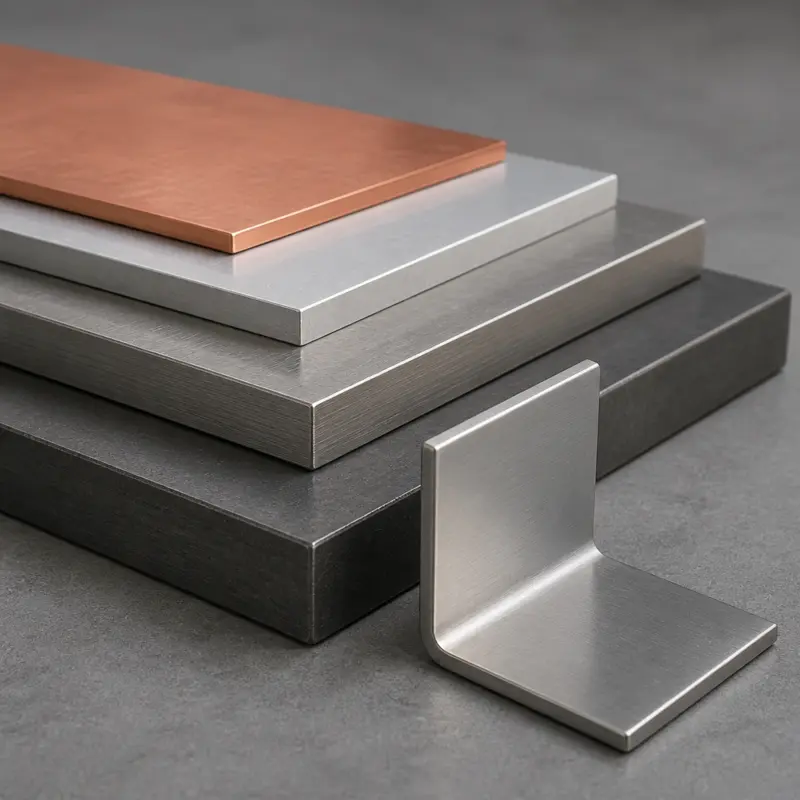
What Materials Are Used in Sheet Metal Fabrication
The common metals used for stamping and fabricating in volume are steel, stainless steel, aluminum, brass and copper.
Grades below are what we cut and form day to day. For the processes themselves, see fabrication and welding and metal stamping. For grades in other routes, start at the materials hub.
Metals
5 Families
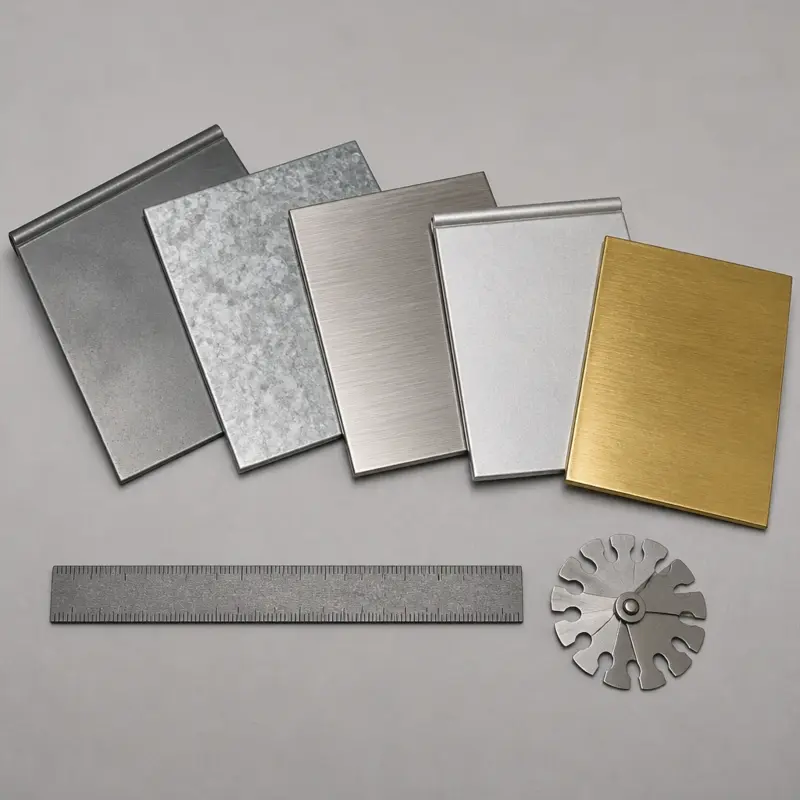
Steel, stainless, aluminum, brass and copper, plus galvanized and galvannealed coated steel.
Stock Form
Coil and Sheet
Coil feeds the presses. Sheet feeds the laser and brake for lower volumes.
Formed Tolerance
ISO 2768-mK
Laser cut edges to ±0.1 mm. Machined features hold ±0.01 mm.
Documentation
EN 10204 3.1
Mill certificates, CoA, RoHS and REACH on request.
Swipe for all four
Metal Gauge vs. Actual Thickness
The same gauge number represents a completely different decimal thickness depending on the metal family. This is the most common drawing error we catch during quotes and it is worth understanding before you release a print.
| Gauge | Steel | Aluminum | Stainless | Spread |
|---|---|---|---|---|
| 10 ga | 3.42 mm | 2.59 mm | 3.57 mm | 0.98 mm |
| 12 ga | 2.66 mm | 2.05 mm | 2.78 mm | 0.73 mm |
| 14 ga | 1.90 mm | 1.63 mm | 1.98 mm | 0.35 mm |
| 16 ga | 1.52 mm | 1.29 mm | 1.59 mm | 0.30 mm |
| 18 ga | 1.21 mm | 1.02 mm | 1.27 mm | 0.25 mm |
| 20 ga | 0.91 mm | 0.81 mm | 0.95 mm | 0.14 mm |
| 22 ga | 0.76 mm | 0.64 mm | 0.79 mm | 0.15 mm |
| 26 ga | 0.45 mm | 0.40 mm | 0.47 mm | 0.07 mm |
Scroll inside the table to see all rows and columns
Always specify the exact decimal or metric thickness on your drawings instead of a gauge number. This simple habit prevents manufacturing delays and first-article failures. If your print lists a gauge, we will verify the intended decimal thickness with you before starting production.
Sheet Metal Grades by Metal Family
Temper matters as much as grade here. The same alloy in a harder temper will hold a sharper form but split at a radius the soft temper would survive.
| Metal Family | Grades and Tempers | Why It Gets Specified | Usual Finish | Typical Parts |
|---|---|---|---|---|
| Cold Rolled Steel | 1008, 1010, 1018, SPCC, DC01, ST12 | Cheapest metal that forms cleanly, with a smooth surface and consistent springback batch to batch. DC01 and ST12 are the European and Chinese deep drawing equivalents of SPCC | Zinc plate, powder coat, e-coat | Brackets, chassis plates, clips, covers |
| Hot Rolled Steel | A1011, Q235, SAPH440, SPHC | Heavier sections at lower cost, accepting a rougher surface and looser flatness. SPHC is the Japanese and Chinese equivalent of A1011 | Paint over primer, hot dip galvanize | Frames, base plates, structural gussets |
| Galvanized Steel | A653 G60, G90, galvannealed | Corrosion protection applied at the mill instead of after fabrication, so cut edges stay protected | Coating is the finish, galvannealed paints best | Enclosures, HVAC panels, cable trays |
| Stainless Steel | 301, 304, 304L, 316, 316L, 430, annealed to half hard | Corrosion and hygiene in the austenitic grades, high work hardening in 301 for spring temper parts, and lower cost with a magnetic response in ferritic 430 | 2B mill, #4 brush, passivate, PVD | Food equipment, marine fittings, medical trays, appliance and architectural trim |
| Aluminum | 1050, 3003-H14, 5052-H32, 6061-T4 and T6, 6063, 7075 | Weight, and the fact that 3003 and 5052 bend tighter than any steel on this table | Anodize, chromate, powder coat | Enclosures, panels, heat sinks, chassis |
| Brass Strip | C260 cartridge, C270, C464 | Deep drawing and severe cold work, plus a finish that plates and solders without preparation | Nickel or chrome plate, clear lacquer | Terminals, contacts, decorative trim |
| Copper Strip | C101, C110, soft to half hard | Electrical and thermal conductivity that no other metal here approaches | Tin plate, nickel plate, left bare | Busbars, lugs, grounding straps, shields |
Scroll inside the table to see all rows and columns
How Tight Each Grade Will Bend
Minimum inside bend radius is expressed as a multiple of material thickness, written as t. A 1.5 mm part at 1.0 t needs a 1.5 mm inside radius as a floor, not a target.
| Grade | Minimum Inside Radius | Springback | Forming Notes |
|---|---|---|---|
| 1008 and 1010 CRS | 0.5 to 1.0 t | Low and repeatable | The benchmark. Predictable enough that one setup runs the whole batch |
| Hot rolled A1011 | 1.0 to 1.5 t | Variable | Properties drift across a sheet, so bend angles need checking through the run |
| Galvanized G90 | 1.0 to 1.5 t | Low | Coating flakes at tight radii and picks up on tooling. Galvannealed is worse |
| 304 annealed | 0.5 to 1.0 t | Moderate | Bends well, but work hardens as it goes, so re-forming a bend is not an option |
| 316 and 316L | 1.0 to 1.5 t | Moderate | Stiffer than 304 under the punch and harder on tool edges |
| 430 ferritic | 1.0 to 1.5 t | Moderate to high | Forms close to annealed 304 but hardens less predictably batch to batch, so springback gets checked at DFM |
| 301 half hard | 1.5 to 2.0 t | High | Springs back several degrees. Chosen for spring parts, not for tight forms |
| 3003-H14 | 0.5 to 1.0 t | Low | The most forgiving metal here. Takes deep draws without splitting |
| 5052-H32 | 0.5 to 1.0 t | Low to moderate | Formability close to 3003 with far more strength. The default for bent aluminum |
| 6061-T6 | 2.0 to 3.0 t | Moderate | Cracks at radii other aluminums accept. Specify T4 or anneal, then age after forming |
| C260 brass | 0.5 to 1.0 t | Low | Deep draws and severe forms. Anneal between stages on multi hit parts |
| C110 copper | 0.5 to 1.0 t | Low | Very soft. Handling marks and tool witness show more than on any other grade |
Scroll inside the table to see all rows and columns
DC01 and ST12 form like the 1008 and 1010 CRS row above, and SPHC forms like the A1011 row. If your print specifies one of these regional standards, use the matching row's radius and springback figures as your starting point.
Mechanical Properties by Grade
The same grades as the bend table above, with the numbers that decide whether a section is thick enough. Temper moves all of these: half hard 301 is more than twice the strength of the annealed material, and elongation falls by roughly the same factor.
| Grade and Temper | TensileMPa | YieldMPa, 0.2% offset | Elongation%, 50 mm | Densityg/cm³ | Corrosion Resistance | Weldability |
|---|---|---|---|---|---|---|
| 1008 / 1010 CRS | 290–340 | 170–230 | 35–42 | 7.85 | Poor, needs coating | Excellent |
| A1011 hot rolled | 310–380 | 205–250 | 25–30 | 7.85 | Poor, needs coating | Excellent |
| A653 G90 galvanized | 310–380 | 205–260 | 20–30 | 7.85 | Good, sacrificial zinc | Fair, zinc fume and burn back |
| 304 annealed | 515–620 | 205–310 | 40–55 | 8.00 | Excellent | Excellent |
| 316 / 316L annealed | 485–620 | 170–290 | 40–50 | 8.00 | Excellent, chloride resistant | Excellent |
| 430 annealed | 450–520 | 205–310 | 22–30 | 7.70 | Fair to good, not for chlorides | Fair, grain coarsens in the HAZ |
| 301 half hard | 860–1100 | 515–760 | 10–18 | 7.90 | Good | Fair, temper lost at the weld |
| 3003-H14 | 140–180 | 115–145 | 8–16 | 2.73 | Good | Good |
| 5052-H32 | 210–260 | 160–210 | 12–18 | 2.68 | Excellent, marine grade | Excellent |
| 6061-T4 | 205–240 | 110–145 | 16–22 | 2.70 | Good | Good |
| 6061-T6 | 290–310 | 240–275 | 8–12 | 2.70 | Good | Good, but HAZ drops toward T4 |
| C260 brass, half hard | 370–460 | 250–350 | 20–35 | 8.53 | Good, dezincifies in some waters | Poor, braze or solder instead |
| C110 copper, soft | 220–250 | 60–100 | 30–45 | 8.94 | Good, patinates | Fair, high heat input needed |
Scroll inside the table for every row and column
Read strength alongside density rather than on its own. 5052-H32 looks weak next to cold rolled steel until you divide by density, at which point a 2 mm aluminum panel and a 1 mm steel one weigh about the same and the aluminum is the stiffer part. Where a grade appears in more than one temper, the annealed row is the one to use for anything with a tight bend in it, and we will tell you at DFM review if the temper on your print cannot survive the form.
How to Choose a Sheet Metal Material
Work backwards from the environment and the geometry, in that order. Corrosion decides the family, then the tightest bend on the drawing decides the grade and temper inside that family. Strength usually falls out of those two choices rather than driving them.
| If Your Priority Is | Look At | Route |
|---|---|---|
| Lowest cost per piece | Cold rolled 1008 and 1010, plated or coated | Progressive stamping |
| Outdoor service without painting | Galvanized A653 G90, or 5052 aluminum | Stamping or laser and brake |
| Decorative or appliance trim on a budget | Ferritic stainless 430, or plated cold rolled steel | Stamping or laser and brake |
| Washdown, food or marine | Stainless 304, then 316 for chlorides | Laser cutting and forming |
| Tightest bends and deep draws | Aluminum 3003-H14, brass C260, annealed 304 | Stamping with draw stages |
| Lowest weight | Aluminum 5052-H32, 6061-T4 formed then aged | CNC bending |
| Electrical or thermal conduction | Copper C110, brass C260 for contacts | Stamping from strip |
| Spring or clip action | Stainless 301 half hard, spring temper | Stamping, tooling compensated for springback |
| Heavy plate and welded structure | Hot rolled A1011 and Q235 | Fabrication and welding |
Swipe the table sideways to see every column
Tracing a Formed Part Back to Its Coil
Sheet metal traceability runs to the coil or heat number, not just the metal type. These are the records that travel with your shipment.
Coil and Heat Certificates
Mill test reports to EN 10204 3.1, recording grade, temper and coating weight for the coil that fed your run.
Coating Verification
Zinc coating class confirmed against A653, with thickness readings where a G60, G90 or galvannealed callout is critical.
Dimensional Records
First article inspection, CMM reports on formed features and in process checks on bend angle through the production run.
REACH and RoHS
Compliance documentation at coil and finished part level, covering plating and coating chemistry, plus conflict minerals reporting.
Swipe for all four
Sheet Metal Materials FAQ
What materials are used in sheet metal fabrication?
Steel, stainless steel, aluminum, brass and copper, with galvanized and galvannealed steel covering corrosion sensitive work. Meco forms all five families from coil and sheet. Steel takes the largest share because it is the cheapest metal that bends reliably, and formability rather than strength is usually what decides the grade.
Is 18 gauge the same thickness in every metal?
No, and this catches out experienced designers. 18 gauge is 1.21 mm in steel, 1.02 mm in aluminum and 1.27 mm in stainless, because the three metals use different gauge systems. That 25 percent spread changes your bend allowance and flat pattern, so call out the decimal or metric thickness on the drawing and treat the gauge number as a note.
Which sheet metal is strongest?
Of the grades we stamp, half hard 301 stainless is the strongest at 860 to 1100 MPa tensile, and spring temper 301 goes higher still. Annealed 304 and 316 sit at 485 to 620 MPa, and cold rolled carbon steel at 290 to 340 MPa. Strength per unit weight tells a different story, though: 5052-H32 aluminum is roughly a third the density of steel, so on a weight budget it often beats a steel grade with three times its tensile figure. Full numbers are in the property table above.
Which sheet metal is easiest to bend?
Aluminum 3003-H14 and cartridge brass C260 form the most easily, both accepting an inside radius around half the material thickness and tolerating deep draws. Cold rolled 1008 steel and annealed 304 stainless are close behind. Half hard 301 stainless and 6061-T6 aluminum are the two that most often crack on a radius the drawing assumed was safe.
What is the minimum bend radius for sheet metal?
It is expressed as a multiple of material thickness, and it runs from roughly 0.5 times thickness on soft aluminum and annealed stainless up to 3 times thickness on 6061-T6. A bend line parallel to the rolling direction needs a larger radius than the same bend across the grain. We confirm the achievable radius against your thickness and tooling during DFM rather than assuming the table value.
Should I use 5052 or 6061 aluminum for a bent part?
5052-H32 for almost any part with bends in it. It forms at roughly half the radius 6061-T6 needs and it is not heat treatable, so the strength you specify is the strength that survives forming. Choose 6061 when the finished part needs the higher strength, and either form it in T4 and age afterwards or open the radii out to 2 or 3 times thickness.
What is the difference between galvanized and galvannealed steel?
Both are zinc coated, but galvannealed is annealed after coating so the zinc alloys with the iron underneath. That gives a dull matte surface which paints and powder coats far better than the spangled surface of standard hot dip galvanized. Galvannealed is slightly less corrosion resistant for the same coating weight and is the harder of the two to form at tight radii.
Should I stamp 301 or 304 stainless?
304 for general formed parts, 301 when the part needs spring action. 301 work hardens much more aggressively, so it reaches higher strength in the harder tempers but springs back several degrees where annealed 304 barely moves. That springback is a tooling compensation problem, so it has to be known before the die is cut. Both are harder on tool edges than carbon steel, which shows up in die maintenance cost.
Are SPCC, DC01, ST12 and SPHC the same steel?
They are regional standards for the same two base grades rather than four different materials. SPCC (Japan and China), DC01 (Europe) and ST12 (China) are all cold rolled, deep drawing grades that behave like the 1008 and 1010 CRS on our bend table, while SPHC (Japan and China) is the hot rolled commercial grade that matches A1011. If your drawing calls out one of these standards, we quote the equivalent grade we already run rather than asking you to reissue the print.
Can you stamp 430 stainless steel?
Yes, and it is worth considering when a part needs the look of stainless without the cost of 304. 430 is a ferritic grade, so it is magnetic and less corrosion resistant than 304 or 316, but it costs less and is common on appliance trim, range hoods and architectural panels that see limited exposure to moisture or chlorides. It forms similarly to annealed 304 at moderate bend radii, though it work hardens less predictably across a batch, so we check springback during DFM before committing to a die.
Do stamped and fabricated parts come with material certificates?
Yes. Mill test reports to EN 10204 3.1, certificates of analysis, coating class verification against A653, REACH and RoHS documentation, conflict minerals reporting, PPAP packages, first article inspection and CMM results are available on request, with traceability from the coil or heat number through to the finished part.
How We Confirm Your Grade and Gauge
STEP or IGES plus a 2D drawing. Give us the thickness as a decimal, the bend schedule, the finish and the annual volume through the quote form.
Our engineers verify every bend against the grade and temper, check relief and hole to bend distances, and flag any radius that will crack or any coating that will not survive the form.
Where your volume sits between laser and brake and a stamping die, we quote both inside 24 hours with the breakeven quantity shown, so the tooling decision is yours to make on numbers.
Reading That Goes Deeper on Flat Metal
Three guides covering tolerances on assembled sheet metal, identifying coated steel and what a formed part actually costs.

Sheet Metal Assembly: Processes and Tolerances
Joining methods, tolerance stack up across formed parts and the DFM rules that keep an assembly buildable.
Read the guide →
How to Tell If Steel Is Galvanized
Visual signs and simple tests that separate coated from bare steel before it reaches the press brake.
Read the guide →
What It Costs to Get a Metal Part Made
Where the money goes across tooling, material, cycle time and finishing, with real ranges by process.
Read the guide →Swipe for all three guides
