Forging Materials: Steel, Stainless, Brass and Bronze
Carbon steel, alloy steel, stainless, aluminum, brass and copper, hot and cold forged in our own presses.
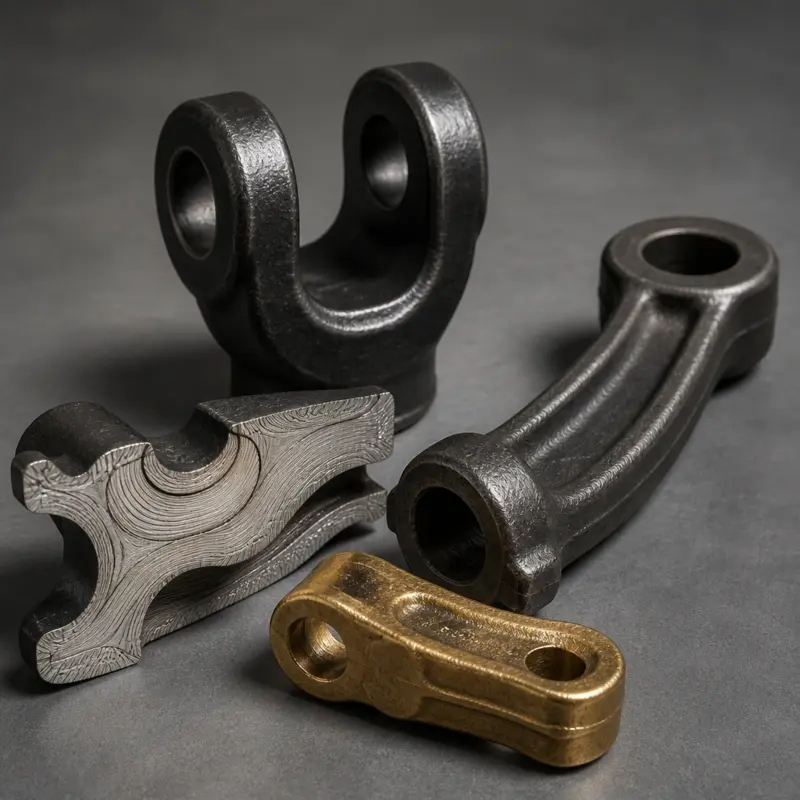
What Materials Are Used in Forging
Steel, aluminum, brass, copper, and bronze are forged due to strength, while zinc and magnesium are strictly die-cast.
Forging shapes solid metal under pressure instead of cutting or melting it. The grain flows around the part shape rather than being severed, so the alloy you pick behaves differently than the same alloy machined from bar.
This page lists the grades we run as routine production, not every grade that exists. For the process side, see custom metal forging services.
Metals
6 Families
Carbon steel, alloy steel, stainless, aluminum, brass and copper. Wrought aluminum bronze C63000 on request.
Net Forged Weight
0.01 to 50 kg
Cold forged pins and fasteners through structural steel arms.
Tightest Class
Class F
BS EN 10243-1 fine class. Machined features hold ±0.01 mm.
Documentation
EN 10204 3.1
Mill certificates, CoA, RoHS and REACH on request.
Swipe for all four
Forging Materials by Metal Family
Each family forges by a different route and needs a different heat treatment after the press. These are the grades we run as routine production.
| Metal Family | Grades We Forge | Route | Heat Treatment | Typical Parts |
|---|---|---|---|---|
| Carbon Steel | 1020, 1035, 1045 | Hot and cold | Normalise, quench and temper | Shafts, pins, levers, couplings |
| Alloy Steel | 4140 (42CrMo GB equivalent), 4340, 40Cr, 52100 (GCr15 GB equivalent, bearing steel) | Hot, cold on smaller sections | Quench and temper; through-harden for bearing steel grades | Knuckles, arms, gear blanks, hubs, bearing races |
| Stainless Steel | 304, 316, 17-4PH (UNS 630), 2205, 2207 (duplex) | Hot, narrower window for duplex | Solution anneal; age harden for 17-4PH | Valve bodies, flanges, fittings, high-corrosion duplex trim |
| Aluminum | 6061, 6082, 7075, 2024, 1070 (cold forged) | Hot for 6061/6082/7075/2024, cold for 1070 | T6 solution and age; 1070 used as forged, not heat treatable | Structural fittings, brackets, arms, cold-forged heat sink pins |
| Brass | C36000, C37700, C46400, C48500 (naval brass) | Hot | Stress relieve | Plumbing fittings, valve stems, marine hardware and lighting housings |
| Copper | C10100 (TU1), C12200 (TP2), C11000 (T2) | Hot and cold | Anneal | Terminals, connectors, busbar lugs |
| Bronze | C63000 aluminum bronze (QAl10-4-4 GB equivalent) | Hot, quoted case by case | Anneal or stress relieve | Bushings, bearings, marine hardware |
Scroll inside the table to see all rows and columns
C377 is the industry-designated forging brass; its 58–61% copper content earns an excellent forgeability rating of 100, enabling it to fill finer details than C360. Conversely, C93200 and C95400 are casting bronzes found on our casting materials page, while unforgeable metals like zinc and magnesium are excluded entirely.
How to Choose a Forging Material
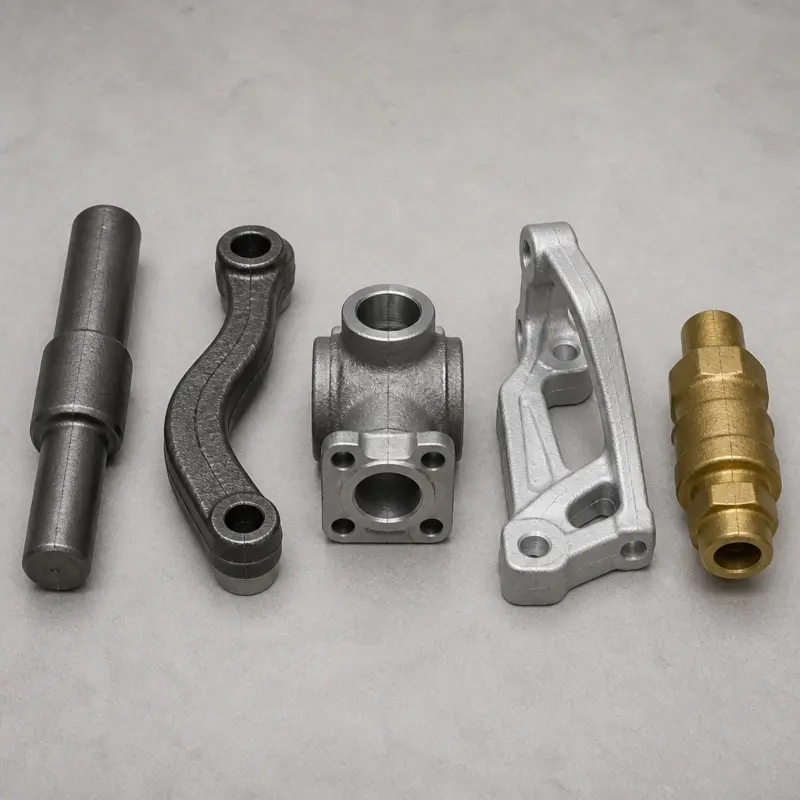
Select materials based on load case (fatigue, impact, or corrosion) rather than price to immediately narrow your choices.
Material choices directly impact die wear; stainless and high-alloy steels accelerate tooling costs, while aluminum and brass extend tool life. For ultra-tight tolerances, forge near-net-shape parts and finish complex features via CNC machining.
| If Your Priority Is | Look At | Route |
|---|---|---|
| Lowest cost per piece | Carbon steel 1045 and 1035 | Hot forging |
| Fatigue and impact strength | Alloy steel 4140, 4340, 42CrMo, 40Cr | Hot forging, then quench and temper |
| Corrosion resistance | Stainless 304 and 316 | Hot forging |
| Strength with corrosion resistance | Stainless 17-4PH, age hardened, or duplex 2205 / 2207 for higher strength than 316 | Hot forging |
| Marine and seawater service | Naval brass C48500, aluminum bronze C63000 | Hot forging |
| Lowest weight | Aluminum 6061 and 6082, 7075 for strength | Hot forging |
| Fine detail and easy machining | Brass C377, then C360 | Hot forging |
| Bright finish at high volume | Carbon steel and copper, small sections | Cold forging |
Swipe the table sideways to see every column
What Each Forging Route Will Hold in Your Material
The same alloy behaves differently depending on the route it takes. These are the numbers to design against before you commit.
| Route | Materials | Weight Range | Typical Tolerance | Ideal Volume | Lead Time |
|---|---|---|---|---|---|
| Closed die, hot | Carbon steel, alloy steel, stainless, aluminum, brass, bronze | 0.1 to 50 kg | BS EN 10243-1 Class F, ASTM B247 for aluminum | 1,000 to 500,000+ | Die 6 to 12 weeks |
| Open die, hot | Carbon steel, alloy steel, stainless | 5 kg and up | 3 to 6 mm, machined after | 1 to 500 | No die required |
| Cold forging | Carbon steel, stainless, copper, aluminum 1070 | 0.01 to 5 kg | 0.05 to 0.2 mm | 5,000 to 1,000,000+ | Tooling 6 to 10 weeks |
| CNC machining | All of the above | Any | ±0.01 mm, ISO 2768 | 1 to 10,000 | 1 to 3 weeks |
Scroll inside the table to see all rows and columns
BS EN 10243-1 Class F, Steel Drop Forgings, in mm
| Dimension (mm) | Class F, fine | Class C, coarse |
|---|---|---|
| Up to 50 | 0.6 | 1.2 |
| 50 to 120 | 0.8 | 1.6 |
| 120 to 200 | 1.0 | 2.0 |
| 200 to 300 | 1.3 | 2.6 |
Scroll inside the table to see all rows and columns
We do not quote forging tooling from a table. Published die prices vary widely across the industry because they describe very different parts. Send the drawing and you get an itemised tooling and piece price, with the DFM notes behind it, inside 24 hours. Below roughly 200 pieces a die rarely amortises, and we will say so rather than sell you tooling. For the full process detail, see custom metal forging services.
Proving the Grade Is What We Said It Is
A grade callout is worth what the paperwork behind it is worth. Every shipment can carry the documents your incoming inspection will ask for.
Mill Certificates
Material certificates to EN 10204 3.1 and certificates of analysis, tied to the billet lot that made your parts.
Full Lot Traceability
Tracking from incoming billet through forging, heat treatment, machining and finishing, with a complete audit trail.
Subsurface Inspection
Ultrasonic, dye penetrant and X-ray inspection, plus CMM reports and first article inspection on request.
REACH and RoHS
Compliance documentation at both material and finished part level, plus conflict minerals reporting.
Swipe for all four
Forging Materials FAQ
What materials are used in forging?
Carbon steel, alloy steel, stainless steel, aluminum, brass, copper and bronze. Meco forges the first six as routine production, from 0.01 kg to 50 kg net weight. Steel takes the largest share because it responds to heat treatment and carries load. Zinc and magnesium cannot be forged and are die casting alloys instead.
Which material is best for forging?
There is no single best grade, only the best fit for the load case. 1045 carbon steel is the low cost default for shafts and pins. 4140 alloy steel wins when the part must hold hardness through a thick section. 316 stainless wins on corrosion. 6061 and 7075 aluminum win on weight. Brass C377 wins on fine detail and easy machining.
Can aluminum be forged?
Yes. We forge 6061, 6082, 7075 and 2024, then solution treat and age to T6. Forged aluminum tolerances follow ASTM B247 rather than the steel standard. 7075 gives the highest strength of the four but is the hardest to fill, so it needs more generous fillets and draft than 6061. We also cold forge 1070, a pure aluminum grade, for heat sink pins; it is used as forged rather than heat treated.
What is the difference between forging 1045 and 4140?
1045 is a medium carbon steel. It is cheaper, forges easily, and normalises or quench tempers to moderate strength, which suits shafts, pins and levers. 4140 adds chromium and molybdenum, so it hardens deeper and holds strength in thicker sections. That is why knuckles, arms and gear blanks run in 4140. It costs more in both material and heat treatment.
Can stainless steel be forged?
Yes, in 304, 316, 17-4PH and the duplex grades 2205 and 2207. Stainless needs higher press force and a narrower working temperature window than carbon steel, so die life is shorter and the piece price is higher, and duplex needs an even narrower window than 304 or 316. 17-4PH is age hardened after forging and, along with duplex, is the grade to ask about when the part needs both strength and corrosion resistance.
What is forging brass?
Forging brass is the copper industry name for C37700, which runs 58 to 61 percent copper and carries an excellent forgeability rating of 100. It fills fine detail that C360 will not, which is why valve bodies and plumbing fittings are forged in it. We also run C360, C46400 and the naval brass C48500 for marine hardware.
Can bronze be forged?
Yes, in aluminum bronze C63000, also produced to the GB equivalent QAl10-4-4. It forges on the same hot route as brass and holds up to seawater better than naval brass, which is why we specify it for marine bushings, bearings and hardware. The leaded tin bronzes C93200 and C95400 are cast rather than forged.
Does forging change the material properties?
Yes, and that is the point of the process. The grain flows around the part contour instead of being cut through, so fatigue and impact strength rise against a machined or cast part in the same alloy. There is also no solidification porosity as there can be in a casting. Heat treatment after the press then sets the final hardness.
Do forgings come with material certificates?
Yes. Mill certificates to EN 10204 3.1, certificates of analysis, REACH and RoHS documentation, conflict minerals reporting, PPAP packages, first article inspection reports, CMM results and non destructive testing are available on request, with lot traceability from billet to finished part.
How to Get a Forging Material Recommendation
STEP or IGES plus a 2D drawing. Tell us net weight, load, operating environment, tolerance class and annual volume through the quote form.
Our engineers check draft, fillets, parting line and machining allowance, and confirm the grade will fill as drawn. DFM changes made before the design freezes typically remove 15 to 30 percent from the part price.
An itemised tooling and piece price, the tolerance class we will hold in that grade, and the heat treatment route behind it.
Guides Behind These Material Choices
Three reads that go deeper into grade selection, properties and what a metal part actually costs.

Aluminum vs Brass vs Titanium
Hardness in HV, density, strength, machinability and cost, in grade specific tables for material selection.
Read the guide →
Best Materials for CNC Machining
What machines easily and what fights the cutter, with machinability ratings and cost for each grade.
Read the guide →
What It Costs to Get a Metal Part Made
Where the money actually goes across tooling, material, cycle time and finishing, with real ranges.
Read the guide →Swipe for all three guides
