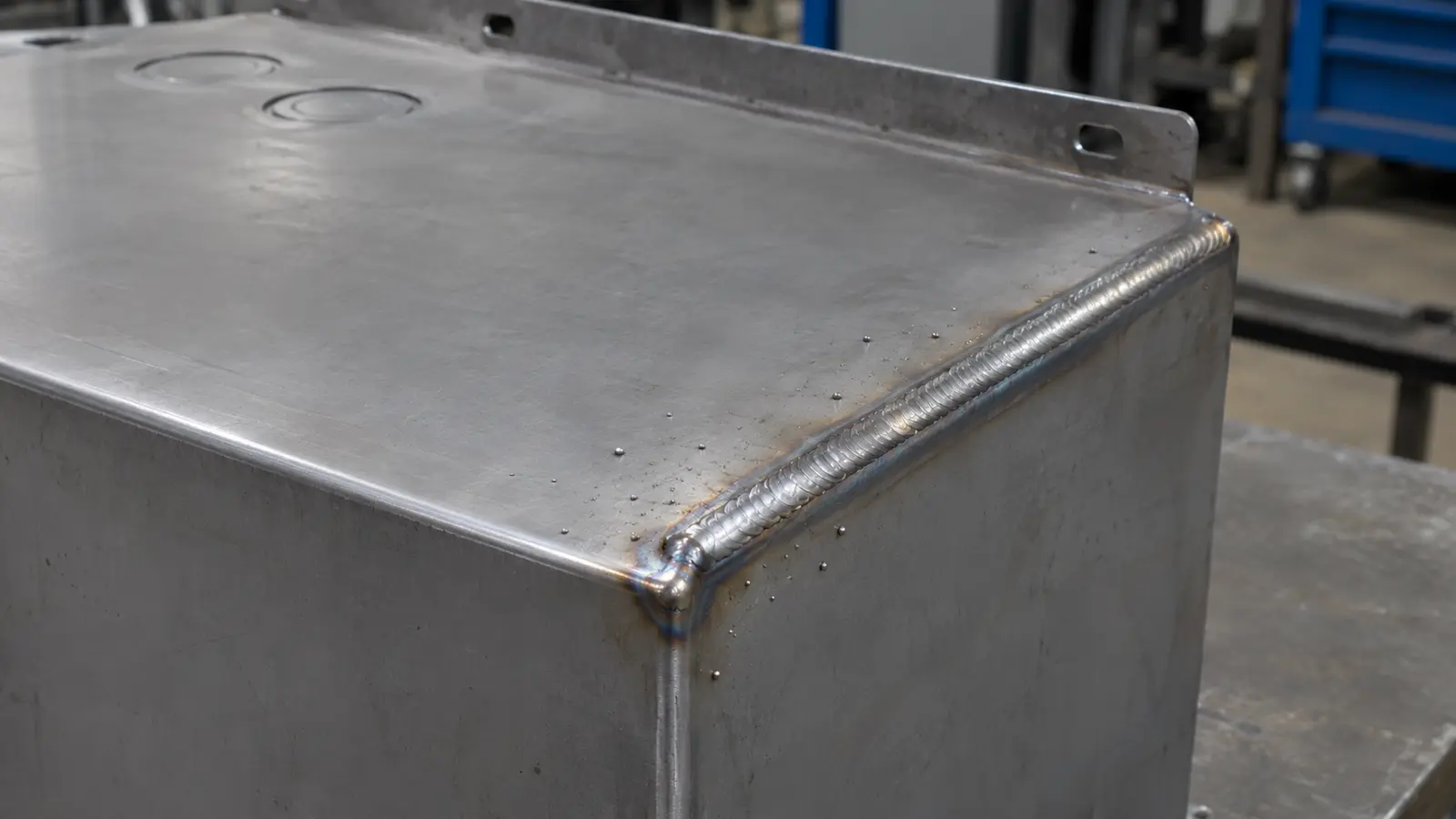
Welding spatter is worth controlling when metal droplets make cleanup harder, threaten a finished surface, or point to an unstable welding setup. The best first step is to check the arc, wire feed, shielding, and joint condition rather than simply scrape off every mark.
Some spatter is expected with certain welding methods. How much is acceptable depends on the part, its finish, and the approved requirements, not on one universal rule.
A steel electrical enclosure can leave a welding station with a solid-looking seam and dozens of small metal beads around it. Those beads may be easy to ignore while the part is still bare. After powder coating, however, they can stand out on a visible panel.
The same droplets can matter for a different reason on a mounting face. A raised spot may keep a bracket from sitting flat against another part. That is a fit problem, even if the weld itself is sound.
This article focuses on what welding spatter looks like, what makes it worse, and how a production team can reduce it without guessing at machine settings. For the wider picture, Meco's welding defects overview explains how spatter differs from other joint problems.
Because the process and finished product both matter, a good plan has two parts: reduce unwanted droplets during welding, then remove and verify any material left where it could affect the next operation.
Key takeaways
- Spatter is ejected material, usually seen as small metal beads around a weld. It is not the same as a pore inside the weld.
- MIG welding can produce more spatter when voltage, wire feed, transfer mode, and equipment conditions do not work well together.
- The location of droplets often matters more than a rough count, especially near seals, mating faces, and visible panels.
- Cleaning removes the result. Stable welding conditions address the source. Most production plans need both.
- Changes should be checked on actual parts before a team signs off on surface quality or downstream finishing.
What is welding spatter and where does it come from?
Welding spatter is material thrown out of the welding area as small hot droplets. When these droplets cool, some remain as round beads on nearby metal surfaces.
During arc welding, heat melts the base metal and often the filler wire. The small area of liquid metal is called the weld pool. In some conditions, droplets leave that pool or break away from the wire before they settle into the seam.
They can land beside the joint, on a fixture, or on another face of the part. A loose bead may fall away, while a hot droplet can stick firmly to metal. The result depends on how and where it lands.
Spatter is different from slag, a protective layer left by certain flux-based processes. It also differs from weld porosity, which consists of gas spaces in solid weld metal. A spattered surface does not, by itself, prove the weld contains internal pores.
TWI describes spatter as droplets ejected from the wire or weld pool. That physical explanation helps us focus on the behavior of the arc and molten metal instead of treating every bead as a cleaning problem.
When does spatter become a quality problem?
A few droplets are not automatically a rejected weld. Their size, location, how firmly they stick, and the part's next manufacturing step determine the concern.
Consider the outside of a painted machine guard. Raised beads can remain visible after coating, spoil the intended texture, or require extra preparation. On a hidden support inside the same machine, similar marks may have no effect if they meet the job requirements.
Location is even more important near a seal, threaded feature, sliding guide, or assembly interface. Spatter on a gasket seat can affect contact. A bead on a part that must fit into a tight channel can interfere with assembly.
The question is not simply whether droplets exist. It is whether the finish, fit, cleanliness, or drawing allows them. For a larger product, sheet metal assembly adds another layer of planning because welding is only one step before the final build.
A weld can also have other faults at the same time. A heavy spatter pattern may suggest unstable conditions worth investigating, but visible beads cannot tell an inspector whether the joint has adequate fusion or penetration. Those require their own checks.
What causes excessive welding spatter?
Spatter grows when metal transfer becomes less stable or the pool is disturbed. The likely causes depend on the welding process, filler wire, gas, material, and joint position.
Arc settings and droplet transfer
In gas metal arc welding (GMAW, commonly called MIG welding), a moving wire both carries current and supplies filler metal. Wire feed speed controls how quickly this wire enters the arc. Voltage helps set the arc length and how the metal transfers.
If the settings do not suit each other, the wire may repeatedly push into the pool or break into large, uneven drops. The resulting splashes can create much more spatter than a stable setup. Miller's parameter guide identifies low voltage and excessive wire feed as possible contributors in MIG welding.
Transfer mode also matters. Short-circuit transfer repeatedly touches the wire to the pool and breaks that contact. Globular transfer moves larger drops through the arc. Their spatter behavior differs from suitable spray or controlled-pulse modes. No one mode is best for every thickness or position.
Shielding, wire condition, and electrical contact
Shielding gas helps protect the hot metal from surrounding air. Gas composition can also change arc behavior; a mixture suited to one process may not give the same spatter level as another. More flow is not automatically better, and a draft or blocked nozzle can upset coverage.
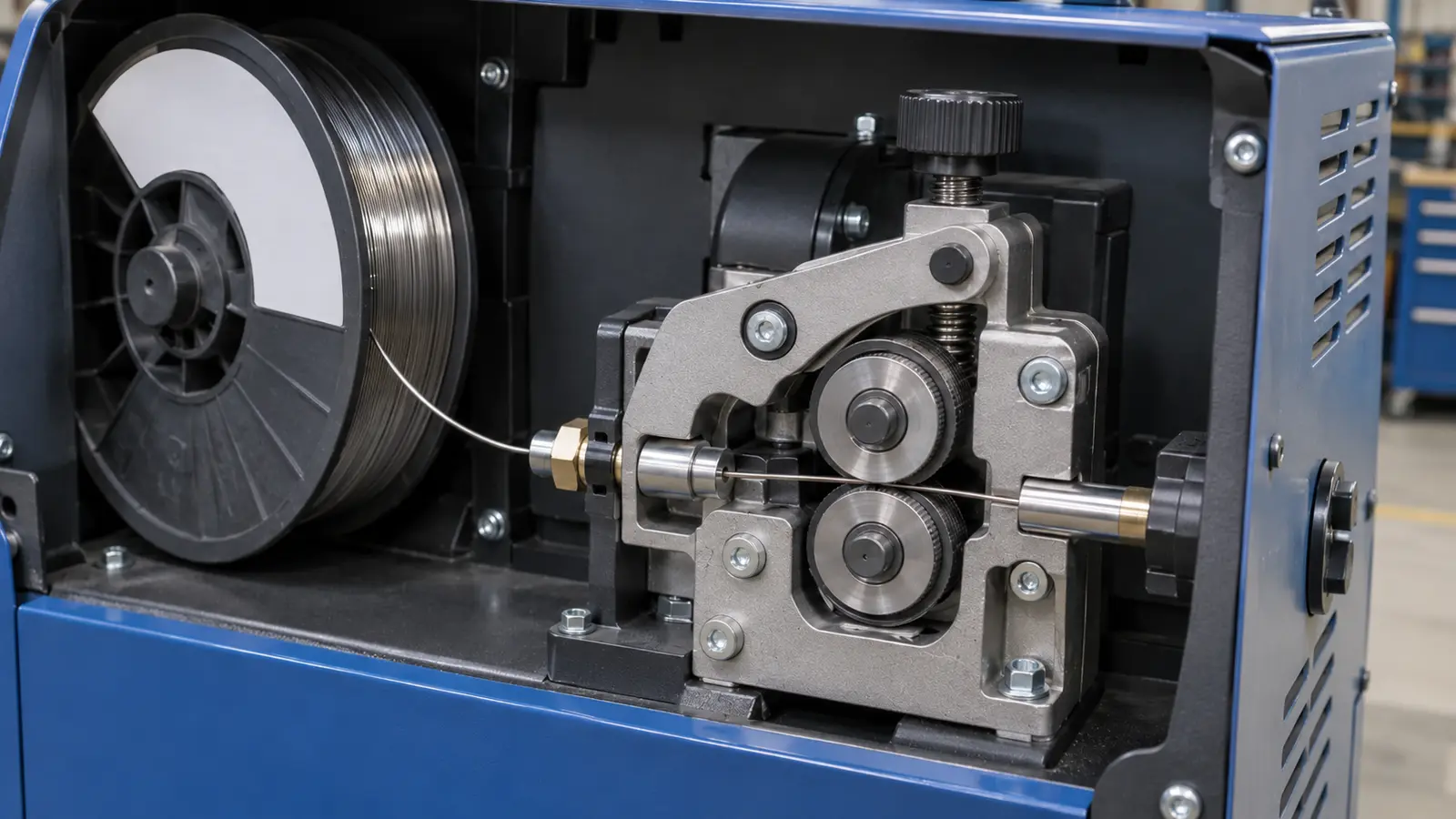
Dirty wire, worn contact tips, uneven feeding, or poor work-cable contact may make the arc less steady. These are equipment checks, not reasons to change every welding parameter at once. Meco's gas shielded welding service provides the broader process context.
Surface preparation, torch position, and access
Oil, scale, rust, coating residue, or moisture near the joint can upset welding conditions. An awkward torch angle or long wire stickout can add more variation. Stickout is the wire length extending beyond the contact tip before the arc reaches the work.
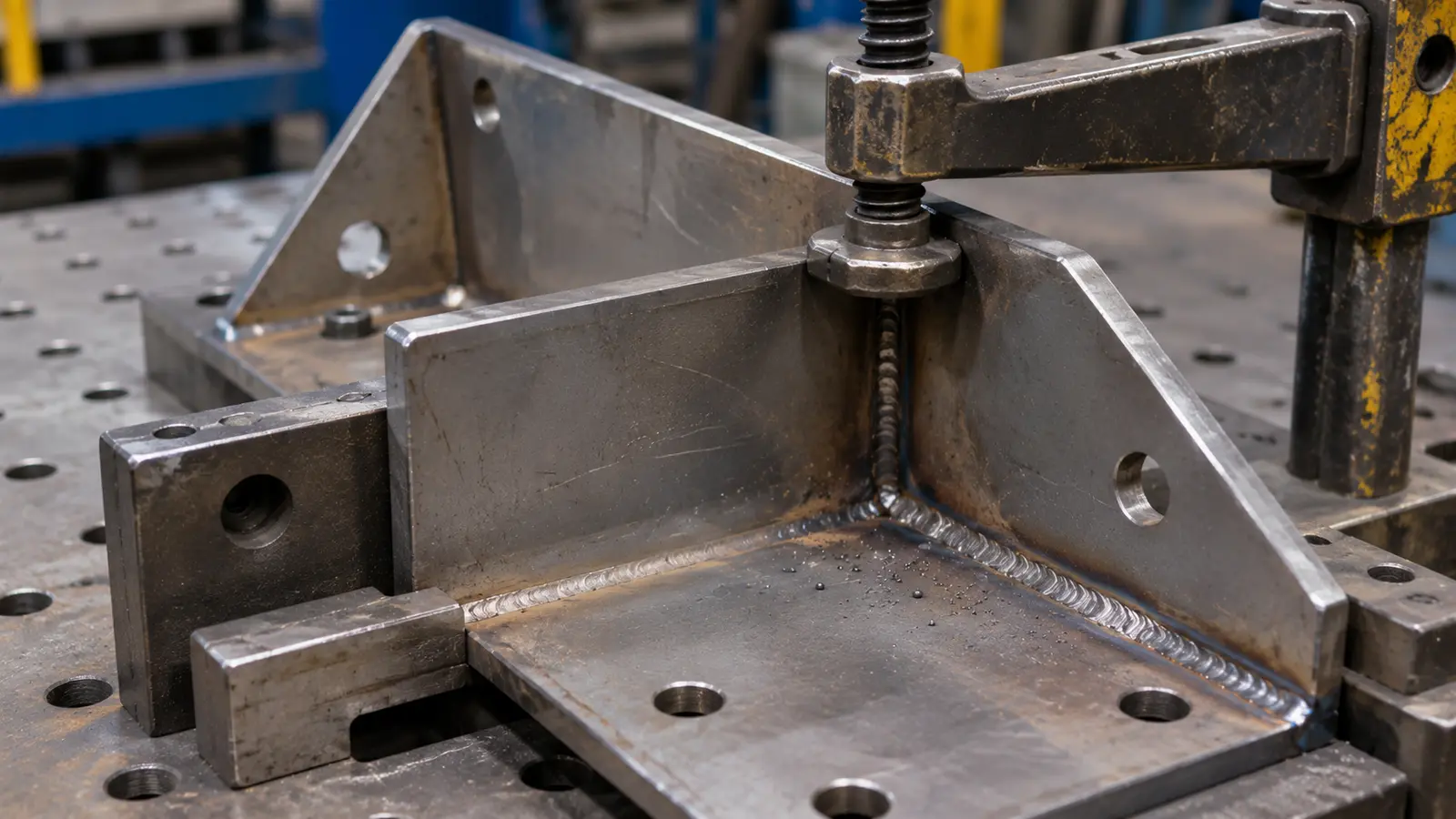
A difficult corner may force the gun into a less stable position. That means part design and fixturing can affect spatter even when the machine settings have not changed. For a basic comparison of methods, see Meco's types of welding guide.
How can you trace the main cause instead of guessing?
Start by recording when the spatter changes and what changed just before it. One clue rarely proves a root cause, but it can tell the team which condition to check first.
A useful record includes material, thickness, wire grade and size, gas, the approved setup, joint location, torch access, and the point in the production run when the problem appeared. Take photographs before cleaning so the pattern is not lost.
| OBSERVED CLUE | FIRST CHECKS | WHAT IT DOES NOT PROVE |
|---|---|---|
| More droplets after changing wire | Wire size and grade, feed-roll setup, contact tip, stored wire condition | That the base metal is defective |
| Irregular popping during a MIG pass | Voltage and wire-feed relationship, work connection, stickout | That simply raising voltage is safe for this joint |
| Spatter rises near one tight corner | Gun angle, access, fixture position, coating trapped at the joint | That the whole process must change |
| More spatter after a gas change | Gas specification, cylinder and line, flow, nozzle and drafts | That more shielding gas will always help |
| Droplets stick to one visible face | Part orientation, local exposure, downstream finish requirements | That the weld itself has failed |
Use clues to prioritize checks, not to assign blame or replace the approved welding procedure.
For example, imagine a run of steel brackets that suddenly shows more droplets along one vertical joint. If nothing in the power source has changed but a new fixture makes that joint harder to reach, the team should check gun access before making broad changes to voltage.
Change one suspected factor within the qualified procedure and compare representative test welds. A small controlled check is more useful than several adjustments that make the result impossible to explain.
How can manufacturers reduce spatter at the source?
The strongest long-term control is a repeatable weld setup that gives steady metal transfer and proper joint quality. Removing droplets later does not correct an unstable arc.
Match wire feed, voltage, and the transfer method
Use the approved welding procedure and the equipment or wire maker's guidance for the specific metal, wire, gas, and joint. The goal is not the lowest possible spatter at any cost; it is a sound weld with a stable process and acceptable surface condition.
A change that produces fewer droplets may also alter heat input, bead shape, or fusion. That is why new settings should be checked against the drawing and procedure. On some jobs, a suitable controlled metal-transfer option can help, but it must be qualified for the work.
Keep the physical welding setup consistent
Inspect the wire path, drive rolls, liner, contact tip, nozzle, work connection, and shielding supply. Clean the joint according to the approved method and make sure consumables are suitable and stored correctly.
Keep torch angle, travel, stickout, and access repeatable. A fixture that holds the part in a practical position can be more useful than asking an operator to compensate for a hard-to-reach seam. This is where fabrication and welding planning connects joint design with production quality.
Engineering check: A smoother arc is useful evidence, not a final acceptance test. Verify the bead profile, joint quality, and finished-part requirements after any approved process change.
Spatter slowing production? Share your drawing, weld location, finish and quantity. Meco can discuss welding access, process planning and the checks needed before finishing.
Discuss Your ProjectIs it better to prevent spatter or clean it afterward?
Source control and post-weld cleaning solve different parts of the problem. Reducing droplets can lower repeated rework, while cleaning handles material that still lands on a sensitive surface.
| APPROACH | BEST USE | MAIN LIMITATION |
|---|---|---|
| Improve welding stability | Repeated spatter driven by process variation across a production run | Must preserve the weld procedure and joint quality |
| Shield a sensitive area with an approved product or cover | Protect a nearby face that must stay clean during welding | Some products leave residues or introduce finish compatibility questions |
| Remove stuck droplets after welding | Clear isolated beads before coating, sealing, or assembly | Adds labor and may scratch or remove base metal |
| Combine prevention with a final surface check | Products with visible faces, close fits, or a specified coating system | Requires a defined inspection and cleanup standard |
The practical choice depends on frequency, accessibility, coating requirements, and acceptance criteria.
For a small prototype, removing a few beads after a qualified weld may be reasonable. Across a high-volume run, repeated cleaning can become a planned operation with added handling and inspection. The article does not assume a fixed cost saving because actual labor and finish requirements vary.
Anti-spatter sprays, gels, and protective covers can reduce sticking in suitable areas. They are not a substitute for stable welding, and residues must not be left where they could interfere with coatings, adhesives, sealing, or later joining.
How should spatter be removed before finishing?
Remove only the unwanted material using a method approved for the part and its finish. Protect the weld profile and base metal instead of grinding every raised spot without checking it.
A brush, scraper, or chisel may release light deposits. Firmer beads can need controlled mechanical removal. Grinding can be effective but may leave scratches or thin an edge if used carelessly. The choice depends on the metal, bead size, surface location, and required final appearance.
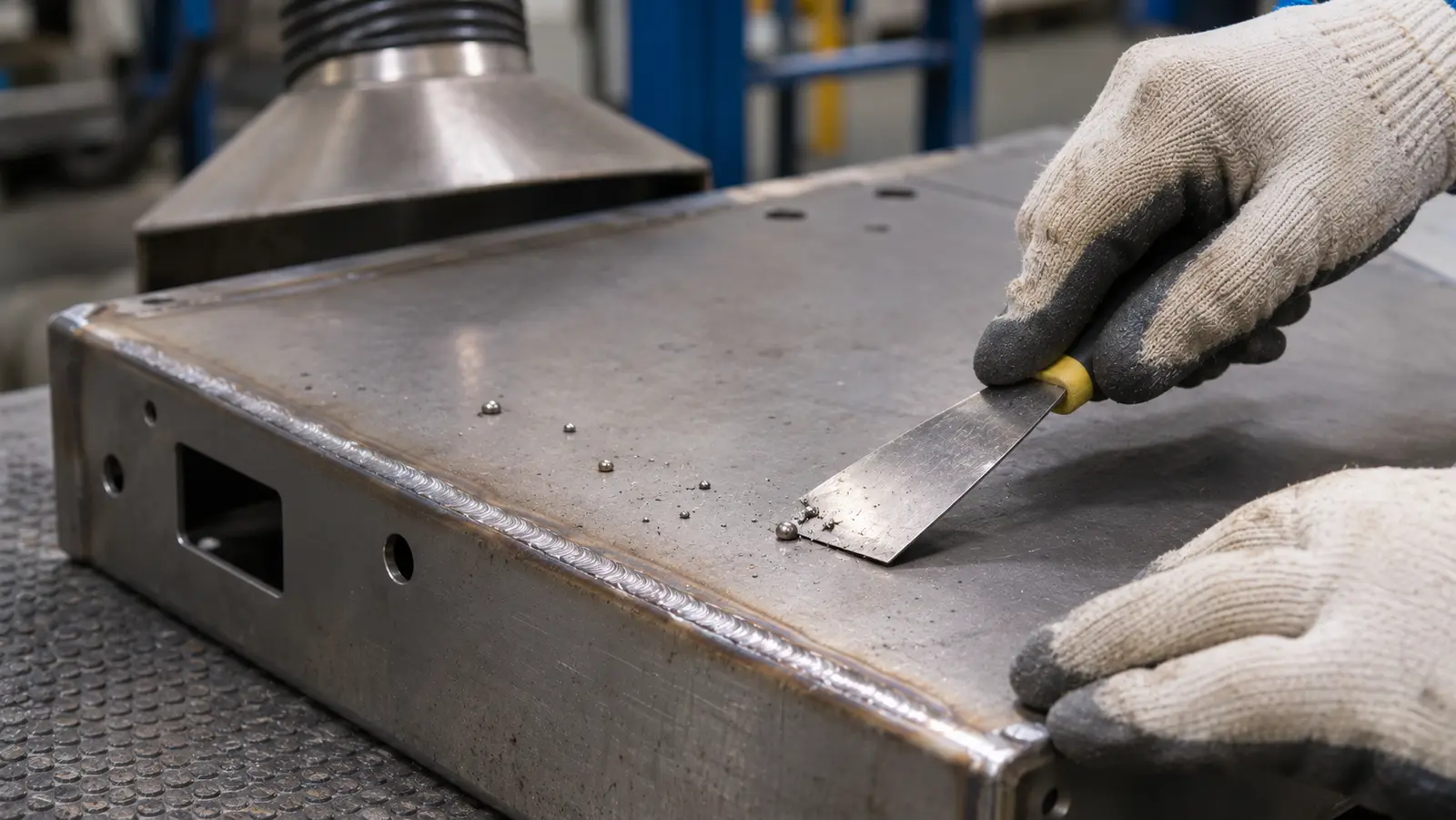
The work should be cool and safe to handle. Operators need suitable personal protection and must follow shop controls for sparks, dust, fumes, and chemical products. Never assume a cleaning method is harmless because the bead looks small.
A coating line adds another requirement. Before paint or powder coating, inspect for remaining projections, oil, anti-spatter residue, and surface damage. Meco's surface finishing services and surface preparation guide describe later operations where surface condition matters.
For example, a visible equipment-panel seam may be accepted after controlled removal and refinishing, while a gasket mating surface may require a stricter flatness check. The drawing and agreed finish standard decide, not the cleaning tool itself.
How can a team verify that spatter control is working?
A cleaner-looking part is only one result to check. The team should confirm that the welding conditions are stable and that the product still meets its weld and finishing requirements.
Use a representative first-off part made with the intended material, fixture, filler, gas, and approved parameters. Inspect the weld for the conditions required by the job, then look at the areas where droplets could affect finish or fit.
Record the number or coverage of spatter only if the project has a useful, repeatable way to measure it. For many parts, a defined location check and a clear reference photograph are easier to apply than an arbitrary droplet count.
Where coating or assembly is critical, verify after the actual next step rather than relying only on a bare-metal photo. A part that looks acceptable before coating may reveal a raised spot once the finish is applied.
For new designs, early R&D engineering review can help assess joint access, surface exposure, and inspection needs before the process moves into volume production.
What information helps Meco review a spatter problem?
Share the part requirements and process evidence, not just a photo of the droplets. That lets an engineering team discuss source control and downstream cleanup as one manufacturing issue.
Useful details are the drawing, material and thickness, joint type, welding method, expected quantity, exposed surfaces, and required finish. Add a photograph showing the whole part and a closer view of the affected area.
If the issue started after a change, include the changed wire, gas, fixture, or work instructions. Meco can discuss fabrication, process planning, and assembly needs, but a final acceptance decision still follows the project's approved criteria.
Plan Cleaner Welded Parts
Share your drawing, weld location, surface finish, and production quantity. Meco can discuss welding setup, finishing and inspection needs across the complete part.
- Drawing. Drawing, material, and thickness
- Weld process. Joint type and welding method
- Finish. Visible surface and coating requirements
- Evidence. Photos of spatter and affected locations
Explore fabrication and welding capabilities for complete-part planning.
Talk to an Engineer