
A sand blasted finish is a controlled surface texture created by propelling abrasive media at high velocity against a metal workpiece. The process strips contaminants, removes CNC tool marks, and produces a measurable surface profile (typically Ra 0.3 to 3.6 micron) that dramatically improves downstream coating adhesion or serves as a final decorative matte appearance.
Whether the goal is a satin texture on a consumer electronics enclosure or a rugged anchor pattern ahead of powder coating, understanding media selection, resulting surface roughness, and the applicable preparation standards is essential for any sourcing manager or design engineer specifying finishes. According to Grand View Research, the global abrasive blasting equipment market exceeded USD 520 million in 2024 and continues growing at roughly 4.5% CAGR, reflecting how central this process remains across aerospace, automotive, and industrial manufacturing.
This guide covers the full scope of abrasive blasting for metal parts. It explains the differences between dry sandblasting and bead blasting, breaks down the most common media types with data-driven Ra values, maps blasting grades to SSPC/NACE and ISO 8501 standards, and provides a practical decision framework for pairing the right blast profile with the right topcoat. If you have already read our companion article on anodized aluminum vs raw aluminum, you know that surface preparation is the bridge between a bare substrate and a high-performance finish. This article is that bridge in detail.
How Does Abrasive Blasting Work?
Abrasive blasting directs a stream of fine particles against a metal surface using compressed air (typically 40 to 100 PSI) or, in the case of vapor blasting, a mixture of air and water. On impact, each particle either cuts into the surface (if it is angular) or plastically deforms the surface (if it is spherical). The cumulative effect of millions of impacts per second accomplishes three things simultaneously: it cleans the substrate by stripping oxides, oils, and old coatings; it profiles the substrate by creating a pattern of microscopic peaks and valleys; and, in the case of round media, it work-hardens the outermost layer through peening action that introduces beneficial compressive stress.
Three variables govern the outcome of every blast operation. The first is media type, meaning the material composition, shape, and hardness of the particles. This is the single most influential variable and the primary focus of this article. The second is air pressure (PSI), which determines impact velocity and the depth of the resulting surface profile. The third is technique, encompassing nozzle diameter, standoff distance, and angle of attack, all of which affect coverage uniformity and localized heat buildup.
Angular vs. Spherical: The Core Distinction
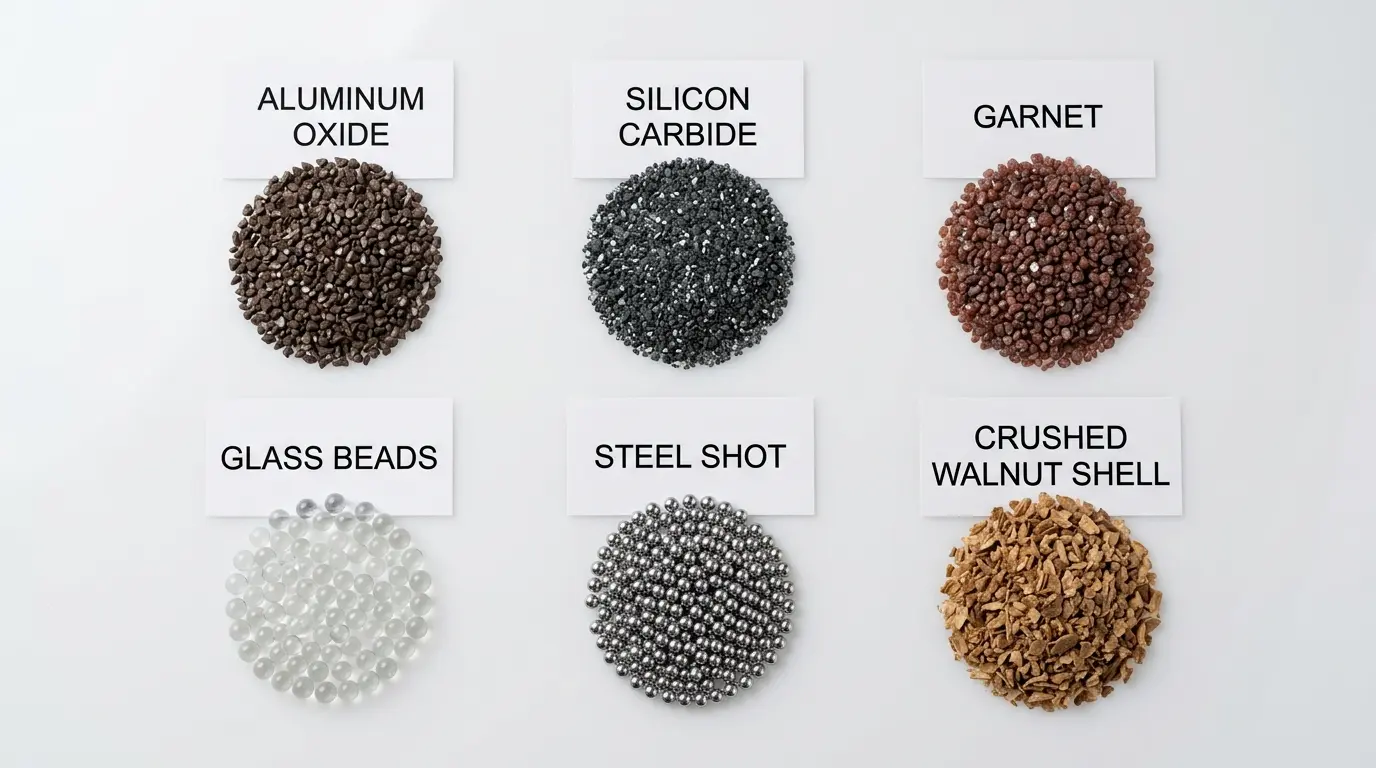
Angular media (aluminum oxide, garnet, silicon carbide) cut and etch the surface, producing high Ra values ideal for coating adhesion. Spherical media (glass beads, steel shot) peen and polish, producing lower Ra values ideal for decorative or fatigue-improvement finishes. Choosing the wrong shape class is the most common specification error in abrasive blasting.
Blasting Media Types: Properties, Applications, and Resulting Surface Roughness
Choosing the right abrasive media is the most consequential decision in any blasting specification. The table below consolidates data from the MicroGroup grit-to-Ra conversion chart, Kramer Industries media specifications, and the Engineering Toolbox grit-roughness reference to give engineers a single reference for the six most common media used on aluminum, steel, and stainless-steel parts.
| Media | Mohs Hardness | Particle Shape | Typical Grit Range | Resulting Ra (micron) | Recyclability | Best Application |
|---|---|---|---|---|---|---|
| Aluminum Oxide | 9 | Angular, sharp | 36 to 220 | 0.5 to 3.6 | 5 to 8 cycles | Heavy coating removal, deep anchor profiles for powder coat and thermal spray |
| Silicon Carbide | 9.5 | Angular, very sharp | 60 to 240 | 0.4 to 2.2 | 3 to 5 cycles | Hardened steel, tungsten carbide, ceramics; ultra-aggressive etching |
| Garnet | 7 to 8 | Sub-angular | 36 to 200 | 0.8 to 3.0 | 1 to 3 cycles | Industrial coating prep with low dust; OSHA-compliant environments |
| Glass Beads | 5.5 to 6 | Spherical | 60 to 325 | 0.3 to 1.2 | Up to 30 cycles | Decorative satin/matte finish, deburring, pre-anodize treatment, shot peening |
| Steel Shot | 40 to 50 HRC | Spherical | S110 to S780 | 0.8 to 2.5 | Up to 3,000 cycles | Descaling castings, shot peening for fatigue life, preparing structural steel |
| Crushed Walnut Shell | 2.5 to 3 | Angular, soft | 12 to 40 mesh | Minimal change | 1 cycle | Cleaning gaskets, seals, and soft substrates without dimensional change |
Grit Size and Ra: A Quick-Reference Chart
The relationship between grit size and achieved surface roughness is approximately logarithmic. Finer grits produce smoother surfaces. Based on the MicroGroup data, here are the most commonly specified grits and their estimated Ra values for angular media on 6061-T6 aluminum at 60 PSI with a 6 mm nozzle at 150 mm standoff. Because drawings often call out roughness in micro-inches, N-grades, or RMS rather than Ra microns, cross-reference our surface finish chart to translate any blast-derived Ra target into the measurement system your print uses.
| Grit Size | Ra (micron) | Ra (micro-inch) | Typical Use Case |
|---|---|---|---|
| 36 | 3.61 | 142 | Heavy stripping, structural steel preparation |
| 60 | 2.21 | 87 | Aggressive coating removal |
| 80 | 1.80 | 71 | General-purpose industrial blasting |
| 120 | 1.32 | 52 | Powder coat prep on aluminum |
| 150 | 1.06 | 42 | Balanced profile for paint adhesion |
| 180 | 0.76 | 30 | Fine prep before primer |
| 220 | 0.48 | 19 | Precision parts, thin coatings |
| 320 | 0.30 | 12 | Near-polished substrates |
Sand Blasted Finish vs Bead Blasted Finish: How to Choose the Right Process
Sandblasting and bead blasting describe fundamentally different surface outcomes, even though the terms are often used interchangeably in casual conversation. Choosing the wrong process can damage a delicate part or cause a coating failure, so understanding the distinction prevents costly specification errors.
Sandblasting (Angular Media)
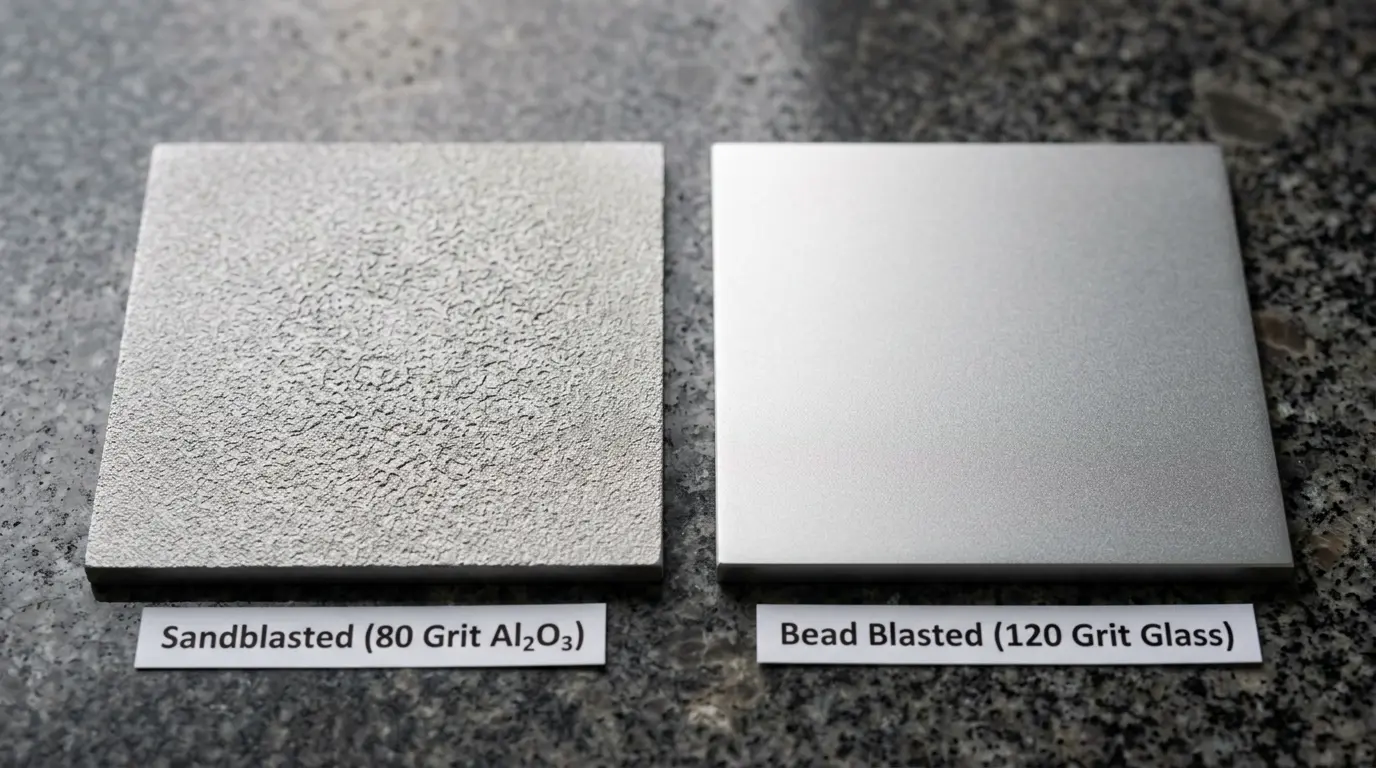
Modern sandblasting no longer uses actual silica sand, which poses severe silicosis risk and is restricted or banned in many jurisdictions under OSHA's permissible exposure limit (PEL) of 50 micrograms per cubic meter. Instead, the term refers to blasting with angular abrasives such as aluminum oxide, garnet, or silicon carbide. The sharp, irregular particles act as microscopic cutting tools, shearing away the surface layer and carving a deep, jagged anchor pattern. The resulting profile provides maximum mechanical bonding area for thick protective coatings.
Sandblasting is a preparatory process, not a final finish. The surface looks rough, deeply matte, and feels coarse to the touch. It is the correct specification when the next step is powder coating, thermal spray, or industrial paint.
Bead Blasting (Spherical Media)
Bead blasting uses spherical glass beads that impact the surface and create overlapping dimples through plastic deformation. No material is removed from the substrate in any meaningful quantity. The result is a smooth, uniform, satin or matte finish that is aesthetically pleasing and dimensionally stable.
Bead blasting simultaneously work-hardens the surface layer, introducing compressive residual stress that can improve fatigue life by 10% to 20% in critical components. This makes bead blasting both a cosmetic finishing process and a functional treatment, commonly specified as a pre-treatment before anodizing on aluminum extrusions and CNC machined parts.
Head-to-Head Comparison
| Attribute | Sandblasting (Angular Media) | Bead Blasting (Spherical Media) |
|---|---|---|
| Primary purpose | Surface preparation for coatings | Decorative finishing or pre-anodize treatment |
| Material removal | Yes (subtractive, 1 to 5 micron per pass) | Negligible (deformation only) |
| Surface profile | Deep, angular anchor pattern | Shallow, uniform dimpled texture |
| Typical Ra | 1.5 to 3.6 micron | 0.3 to 1.2 micron |
| Appearance | Rough, deeply matte, grey | Smooth, satin, pearlescent |
| Fatigue improvement | Minimal (can introduce micro-cracks) | Yes (compressive stress via peening) |
| Coating adhesion | Excellent for thick coatings (powder, epoxy, thermal spray) | Good for thin coatings and anodize |
| Dimensional impact | Slight material loss | Negligible |
| Best for | Powder coat, thermal spray, industrial paint | Consumer electronics, medical devices, architectural panels |
What Is Vapor Blasting and When Should You Specify It?
Vapor blasting (also called wet blasting) mixes water with the abrasive stream, eliminating airborne dust and cushioning the media impact. The water film prevents media from embedding in softer metals like aluminum, producing an exceptionally clean, bright satin finish. Vapor blasting is increasingly specified for restoring vintage automotive and motorcycle parts, cleaning aerospace turbine components without introducing surface contamination, and preparing thin-walled aluminum parts that would warp under dry blasting.
The trade-off is slower cycle times and higher equipment cost compared to dry methods. Closed-loop water recycling systems can reduce fresh water consumption by up to 90%, making vapor blasting an increasingly attractive option for facilities prioritizing environmental performance.
Surface Preparation Standards: SSPC/NACE and ISO 8501
When a sand blasted finish is specified for coating adhesion, the cleanliness level must be defined using an industry standard. Two dominant frameworks exist: the SSPC/NACE joint standards (used primarily in North America) and ISO 8501-1 (used internationally). Both classify the degree of surface cleanliness achieved after blast cleaning, but they use different naming conventions and grade ordering.
| SSPC/NACE Grade | ISO 8501 Equivalent | Common Name | Residual Contamination Allowed | Typical Specification |
|---|---|---|---|---|
| SSPC-SP 5 / NACE 1 | Sa 3 | White Metal Blast | 0% stains, shadows, or residue | Nuclear, turbine, immersion service |
| SSPC-SP 10 / NACE 2 | Sa 2.5 | Near-White Metal Blast | Max 5% staining (SSPC) / 15% (ISO) | High-performance coatings, marine |
| SSPC-SP 6 / NACE 3 | Sa 2 | Commercial Blast | Up to 33% tightly-adhered stains | Non-corrosive environments, general industrial |
| SSPC-SP 7 / NACE 4 | Sa 1 | Brush-Off Blast | 100% tightly-adhered residue may remain | Low-cost, short-life coatings |
| SSPC-SP 14 / NACE 8 | No ISO equivalent | Industrial Blast | Up to 10% tightly-adhered residue | Maintenance recoating |
For aluminum parts destined for powder coating, SSPC-SP 10 / Sa 2.5 (Near-White Metal Blast) is the most commonly specified grade. It strikes the right balance between thorough cleaning and practical cost, producing a surface with no more than 5% residual staining and a profile depth of 1.5 to 3.0 mil (38 to 76 micron) depending on media and pressure. For thin-film primers on non-critical parts, SP 6 / Sa 2 (Commercial Blast) may be acceptable. White Metal (SP 5 / Sa 3) is reserved for immersion service, chemical containment, and aerospace applications where coating failure is unacceptable.
Profile Depth Matters as Much as Cleanliness
Most coating manufacturers specify a minimum anchor profile in their technical data sheets. Typical epoxy powder coatings require 1.5 to 3.0 mil (38 to 76 micron) profile depth, while thin zinc-rich primers may require only 1.0 to 2.0 mil (25 to 50 micron). Always cross-reference the coating TDS with the blast profile before locking in media and pressure. Meco's engineering team reviews coating compatibility as part of every surface finishing specification.
Why Is Sandblasting Before Powder Coating Essential?
Sandblasting before powder coating is not optional for high-quality, long-lasting finishes. The process serves three critical functions that directly determine whether the finished coating will survive its intended service life.
First, it removes all surface contaminants including oils, mill scale, oxides, old coatings, and fingerprints that would prevent the electrostatic powder from bonding to the bare metal. Second, it creates a surface profile (anchor pattern) of microscopic peaks and valleys that increases the effective bonding area by as much as 300% compared to a smooth, untreated surface. Third, it exposes chemically active bare metal that readily bonds with both the electrostatic charge during powder application and the molecular cross-linking that occurs during oven curing at 180 to 200 degrees Celsius.
The consequences of skipping or poorly executing the blast step are well documented. Without adequate surface preparation, powder coatings exhibit premature adhesion failure in the form of peeling, chipping, and blistering, often within the first year of service. Industry testing per AAMA 2604 and AAMA 2605 confirms that properly blasted and powder-coated aluminum assemblies achieve 100% adhesion retention in cross-hatch tape pull tests, while inadequately prepared surfaces can fail at less than 50% adhesion.
For aluminum specifically, Meco's engineering team recommends the following protocol: degrease with a non-residue solvent, blast with 80 to 120 grit aluminum oxide at 50 to 70 PSI to achieve a 1.5 to 2.5 mil profile, blow off residual dust with clean dry air, and apply powder within four hours of blasting. Delay beyond four hours allows the natural aluminum oxide layer to reform, reducing the chemical reactivity of the surface. For a breakdown of powder coating cost factors, see our dedicated pricing guide.
Industry Applications of Sand Blasted Finishes
Sand blasted and bead blasted finishes appear across virtually every manufacturing sector. Each application aligns with a specific media type, surface roughness target, and downstream process.
Aerospace
Components such as turbine blades, structural brackets, and landing gear assemblies are blasted to SSPC-SP 10 or SP 5 before primer and topcoat application. Aluminum oxide (120 grit) is the dominant media for structural parts, while glass bead peening is specified for fatigue-critical titanium and high-strength aluminum alloy components to extend service life. MIL-A-8625 anodizing specifications frequently call for bead blasting as a pre-treatment to achieve a uniform matte anodized appearance. Meco supports aerospace manufacturing with CMM inspection, SPC, full lot/serial traceability, and calibrated NDT processes.
Automotive
Engine blocks, suspension components, and die-cast aluminum housings undergo blast cleaning before e-coat or powder coat application. Steel shot is preferred for cast iron and steel parts because of its extreme recyclability (up to 3,000 cycles), which reduces consumable costs on high-volume production lines. For decorative aluminum trim, bead blasting with fine glass beads (200 to 325 grit) produces the satin texture seen on luxury vehicle interior panels and audio equipment bezels. Meco serves the automotive industry with IATF 16949:2016 certified processes.
Consumer Electronics
Consumer electronics is one of the largest markets for bead blasted aluminum finishes. Laptop enclosures, smartphone frames, speaker housings, and tablet bodies are routinely bead blasted with glass beads before Type II sulfuric anodizing to achieve the non-reflective matte appearance that defines premium product design. The surface roughness target for these applications typically falls between Ra 0.4 and Ra 0.8 micron, fine enough to feel smooth but textured enough to resist fingerprints and light scratches. Meco provides custom electronics manufacturing with integrated finishing capabilities.
Medical Devices
Titanium and stainless-steel surgical instruments and implant housings require precisely controlled surfaces for biocompatibility and sterility. Glass bead blasting followed by passivation per ASTM A967 is a standard sequence. The bead blast creates a uniform surface that is easy to clean and sterilize while the peening action closes surface porosity, reducing sites where bacteria could colonize.
Industrial Equipment and Structural Steel
Heavy fabrication relies on aggressive sandblasting (garnet or aluminum oxide, 36 to 80 grit) to prepare beams, piping, tanks, and heavy machinery for high-build epoxy or polyurethane coating systems. These applications almost universally specify SSPC-SP 10 / Sa 2.5 and a profile depth of 2.0 to 3.5 mil, as the coating systems involved are thick (250 to 500 micron DFT) and demand aggressive mechanical anchoring. Meco's heavy equipment manufacturing capabilities include casting, forging, machining, and integrated surface finishing for large-scale industrial components.
How to Specify Sand Blasted Finishes: A Decision Framework
Selecting the optimal blast specification requires answering four questions in sequence. What is the substrate material? What is the next process step? What surface roughness range does the coating system require? And what cleanliness standard does the end-use environment demand?
For CNC machined aluminum parts going to powder coat, the specification would typically read: "Blast clean per SSPC-SP 10 using aluminum oxide, 80 to 120 grit, to achieve Ra 1.0 to 2.0 micron and a profile depth of 1.5 to 2.5 mil. Coat within 4 hours of blasting." For the same aluminum part destined for Type II anodizing with a decorative matte finish, the specification would be: "Bead blast with glass beads, 100 to 200 grit, to achieve Ra 0.4 to 0.8 micron. No additional profiling required."
| Scenario | Recommended Media | Grit Range | Target Ra (micron) | Cleanliness Standard | Notes |
|---|---|---|---|---|---|
| Aluminum to powder coat | Aluminum oxide | 80 to 120 | 1.0 to 2.0 | SP 10 / Sa 2.5 | Coat within 4 hr; degas at 200 C if casting |
| Aluminum to anodize (matte) | Glass beads | 100 to 200 | 0.4 to 0.8 | Visual cleanliness | Do not use aluminum oxide; embeds in surface |
| Steel to epoxy primer | Garnet or aluminum oxide | 60 to 80 | 1.5 to 3.0 | SP 10 / Sa 2.5 | Profile depth 2.0 to 3.0 mil per coating TDS |
| Stainless steel decorative | Glass beads | 150 to 325 | 0.3 to 0.6 | Visual cleanliness | Follow with passivation per ASTM A967 |
| Cast iron to industrial paint | Steel grit | G40 to G80 | 2.0 to 3.5 | SP 6 / Sa 2 | Remove casting sand and scale |
| Titanium fatigue-critical | Glass beads (peening) | 100 to 170 | 0.5 to 1.0 | Visual cleanliness | Almen strip intensity control per AMS 2430 |
| Restoration / cleaning only | Walnut shell or soda | 12 to 40 mesh | Minimal change | Visual cleanliness | No profile; non-damaging on gasket surfaces |
How Sand Blasted Finishes Connect to Upstream and Downstream Processes
A sand blasted finish rarely exists in isolation. It is almost always one step in a multi-stage finishing sequence, and knowing how blasting connects to upstream machining and downstream coating processes is what separates a well-specified part from a warranty claim.
If a part starts as a CNC machined aluminum component, the as-machined surface typically carries an Ra of 1.6 to 3.2 micron with visible tool marks. A bead blast with 150-grit glass beads brings that down to a uniform Ra 0.5 to 0.8 micron and eliminates all directional machining lines, creating the ideal substrate for anodizing. Alternatively, if that same part requires a durable powder coat for outdoor exposure, a more aggressive blast with 100-grit aluminum oxide raises the profile to Ra 1.3 to 1.8 micron, providing the anchor pattern the powder needs.
For cast aluminum or die-cast parts, blasting also serves a degassing function. Trapped gases in the casting porosity can outgas during the 200-degree-Celsius powder cure cycle, causing pinholes and craters in the finish. A thorough blast followed by a pre-bake at 200 degrees Celsius for 15 to 30 minutes drives out residual volatiles before powder application.
Safety and Environmental Considerations
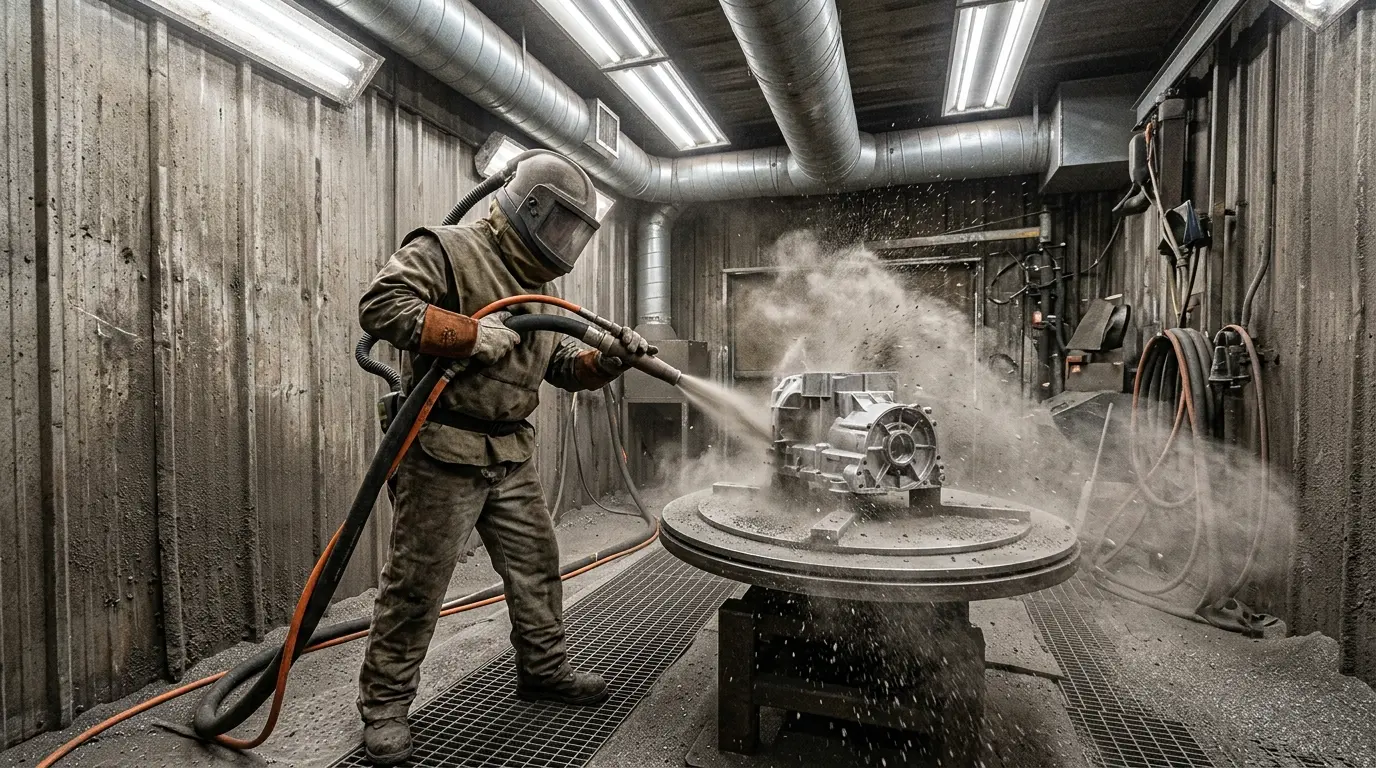
Abrasive blasting generates significant airborne particulate, noise, and in some cases toxic dust. Crystalline silica sand, once the default blasting medium, is responsible for silicosis, an irreversible lung disease. Its use is restricted under OSHA's permissible exposure limit (PEL) of 50 micrograms per cubic meter, and many facilities have eliminated it entirely in favor of garnet, aluminum oxide, and glass beads that produce non-siliceous dust.
Mandatory personal protective equipment includes a supplied-air respirator (NIOSH-approved Type CE), full-body blast suit, hearing protection rated for at least 95 dB, and heavy-duty leather gloves. Blast cabinets and rooms must be equipped with dust collection systems sized to maintain negative pressure and capture at least 99.97% of airborne particles (HEPA filtration). Spent media containing lead paint, cadmium, or chromium residues must be tested and disposed of as hazardous waste per EPA Resource Conservation and Recovery Act (RCRA) guidelines.
Vapor blasting addresses many of these concerns by suspending the media in water, eliminating nearly all airborne dust. The environmental trade-off is the generation of wastewater that must be filtered, tested, and recycled or discharged in compliance with local water-quality regulations.
How Sand Blasted Finishes Relate to Other Articles in This Series
This article is part of a four-part series on metal surface identification, properties, and finishing. Our guide on anodized aluminum vs raw aluminum explains how bead blasting integrates with the Type II and Type III anodizing process and covers identification tests, alloy compatibility, and coating-over-coating scenarios including powder coat over anodized aluminum and paint over powder coat. The aluminum vs brass vs titanium comparison discusses how substrate hardness and density affect media selection. And the guide on identifying cast iron, cast steel, and galvanized steel covers how material identification determines which blast media and cleanliness grade to specify.
Frequently Asked Questions About Sand Blasted Finishes
What is a sand blasted finish?
A sand blasted finish is a surface texture produced by propelling abrasive media (such as aluminum oxide, garnet, or glass beads) at high velocity against a metal part. The process cleans the surface, removes tool marks or old coatings, and creates a controlled roughness profile, typically Ra 0.3 to 3.6 micron depending on media and grit size. The finish either improves downstream coating adhesion or serves as a final decorative matte or satin appearance.
What is the difference between sandblasting and bead blasting?
Sandblasting uses angular abrasives (aluminum oxide, garnet) that cut into the surface, creating a rough, high-Ra anchor pattern (1.5 to 3.6 micron) for maximum coating adhesion. Bead blasting uses spherical glass beads that peen the surface without removing material, producing a smooth satin or matte finish with lower Ra values (0.3 to 1.2 micron). Sandblasting is a preparatory process for coatings, while bead blasting is typically a final cosmetic finish or a pre-treatment for anodizing.
Is sandblasting before powder coating necessary?
Yes. Sandblasting before powder coating removes contaminants, strips old coatings, and creates an anchor profile that increases effective bonding area by up to 300%. Without it, powder coatings are prone to peeling, blistering, and chipping within the first year. For aluminum parts, blast with 80 to 120 grit aluminum oxide at 50 to 70 PSI to achieve a 1.5 to 2.5 mil profile, and apply powder within four hours of blasting for optimal adhesion.
What blasting media should I use on aluminum?
For coating preparation, use aluminum oxide (80 to 120 grit) at moderate pressure (50 to 70 PSI) to avoid warping thin-walled parts. For decorative or pre-anodize finishes, use glass beads (100 to 200 grit). Avoid silicon carbide on soft aluminum alloys because it removes excessive material. Never use steel grit or steel shot on aluminum, as embedded ferrous particles cause galvanic corrosion.
What Ra value does sandblasting produce?
Ra values depend on media type, grit size, and pressure. Aluminum oxide at 80 grit produces approximately Ra 1.8 micron, while 120 grit yields approximately Ra 1.3 micron. Glass bead blasting at 150 grit produces approximately Ra 0.5 to 0.8 micron. Actual results also depend on substrate hardness, nozzle distance, and dwell time. The MicroGroup grit-to-Ra conversion chart and Engineering Toolbox are the standard references for estimating roughness from grit size.
What SSPC standard should I specify for powder coating?
SSPC-SP 10 / NACE 2 (Near-White Metal Blast), equivalent to ISO 8501-1 Sa 2.5, is the most commonly specified grade for powder coating on both aluminum and steel. It allows no more than 5% residual staining and provides the cleanliness and profile depth needed for high-performance powder systems. For immersion or chemical-containment service, upgrade to SSPC-SP 5 / Sa 3 (White Metal Blast).
Can I bead blast aluminum before anodizing?
Yes. Bead blasting with glass beads is one of the most common and recommended pre-treatments before Type II sulfuric anodizing. It creates a uniform matte texture (Ra 0.4 to 0.8 micron) that results in a non-reflective, satin anodized finish popular in consumer electronics, architectural panels, and medical device housings. Do not use aluminum oxide before anodizing, as embedded abrasive particles can cause discoloration and uneven oxide growth.
What is vapor blasting and when should I use it?
Vapor blasting (wet blasting) mixes water with abrasive media, eliminating airborne dust and cushioning particle impact. It produces a bright, clean satin finish without media embedment, making it ideal for thin-walled aluminum parts, vintage automotive restoration, aerospace turbine components, and facilities with strict dust-control requirements. The main trade-offs are slower cycle times and the need for wastewater management systems.
How do I prevent warping when blasting thin aluminum parts?
Reduce air pressure to 40 to 50 PSI, increase nozzle standoff distance to 200 to 300 mm, use softer media such as glass beads or walnut shell, and keep dwell time short by making multiple light passes rather than one aggressive pass. Fixturing the part on a backing plate also helps distribute stress evenly. For very thin-walled aluminum (under 1.5 mm), vapor blasting is the safest option because the water cushion absorbs impact energy and prevents localized deformation.
What is the difference between surface profile and surface roughness?
Surface roughness (Ra) is the arithmetic average of peak-to-valley deviations measured in microns or micro-inches, and it describes the overall texture of the surface. Surface profile (measured in mils or microns) specifically describes the depth of the anchor pattern created by abrasive blasting, measuring the distance from the deepest valley to the highest peak. Coating manufacturers typically specify a minimum profile depth in their technical data sheets, while machining drawings reference Ra. Both measurements are critical when specifying a sand blasted finish for coating adhesion. For converting between Ra, RMS, Rz, and ISO N-grade values, see our surface finish chart.
Need Sand Blasted or Bead Blasted Finishes on Your Next Project?
Coordinating separate vendors for machining, blasting, anodizing, and powder coating creates lead time risk, quality gaps at handoff points, and unnecessary cost. Meco eliminates that complexity by managing the entire surface preparation and finishing workflow under one quality system, from raw material through globally delivered finished parts.
With 30+ years of turnkey manufacturing experience and IATF 16949:2016 certified quality, Meco is built for OEM programs where adhesion performance, surface consistency, and on-time delivery are non-negotiable.
- 40+ In-House Processes: CNC machining, die casting, forging, stamping, abrasive blasting, anodizing (Type II/III), powder coating, painting, e-coating, and mechanical assembly.
- IATF 16949:2016 Certified: Automotive-grade quality applied across every industry. 99.99% quality rate. 99.8% on-time delivery.
- DFM Feedback with Every Quote: Engineering review of blast specifications, media selection, and coating compatibility included as standard. Quotes returned in under 24 hours.
- Prototype to Mass Production: From 10 pieces to 10 million+. No minimum order quantities.
- Global Logistics: Warehousing in the U.S. (Ohio and Florida), Canada, Japan (Tokyo and Osaka), and Thailand. JIT and VMI delivery programs available.
Submit your drawings and let Meco's engineering team recommend the optimal blast media, Ra target, and coating sequence for your application.
Request a Quote Today