
Key Takeaways (Quick Summary)
- A contract manufacturer is a specialized partner that produces parts, components, or assemblies to an OEM’s exact specifications.
- The process follows a structured workflow: RFQ, DFM review, tooling, sample approval, and full production with rigorous QC.
- Types include build‑to‑print suppliers, ODMs, white/private label producers, component specialists, and turnkey manufacturers.
- Outsourcing boosts speed, reduces costs, improves quality, and provides technical expertise—but requires strong communication and alignment.
- Contract manufacturing supports nearly every major industry, including aerospace, automotive, electronics, medical, heavy equipment, and consumer products.

Why Contract Manufacturing Matters Today
Manufacturers across North America are under pressure to launch products faster, cut operational costs, and keep quality consistent despite labor shortages and supply‑chain volatility. In that environment, many teams start by asking a simple question: what is a contract manufacturer?
At the most practical level, a contract manufacturer is a specialized partner that produces components, sub‑assemblies, or full assemblies on behalf of another company. This model often referred to as contract manufacturing allows Original Equipment Manufacturers (OEMs) to scale production without expanding their own facilities, headcount, or equipment. It’s a modern response to the rising need for flexibility, especially in industries where speed‑to‑market and precision define competitiveness.
The broader contract manufacturing meaning goes beyond outsourcing. It’s about tapping into a partner’s engineering depth, machinery, and process expertise to stabilize output and reduce internal strain. For many teams, that partnership becomes essential during rapid growth or new product introduction.
As turnkey manufacturing providers like Meco demonstrate through capabilities such as Whole Product Manufacturing, contract manufacturing has evolved into a strategic collaboration that blends production, problem‑solving, and technical support across metal, plastic, and electronic product lines.

Contract Manufacturing Definition
In North American industry, terminology matters. When teams evaluate production partners, they need a precise contract manufacturing definition not a vague idea of outsourcing.
A contract manufacturer is a third‑party production expert that enters a formal manufacturing contract to produce parts, components, or assemblies to an OEM’s exact specifications.
Unlike general vendors, these partners operate under detailed manufacturing agreements that define scope, tolerances, materials, production volumes, inspection requirements, testing protocols, IP ownership, and commercial terms.
This arrangement creates a clear definition of contract manufacturer: a specialized supplier responsible for manufacturing a product (or a portion of it) on behalf of another company, usually at scale.
In many industries, you’ll hear shorthand phrases like contract manufacturing def, contract of manufacturing, or even just contract manufacture and manufacturing contractor, but the premise is the same production is delegated to a qualified external provider.
In layman term, contract manufacturing is a manufacturing plant you go to with your product or design idea and have them create a prototype or mass production once finalized.
Clear definitions matter because they reduce ambiguity, protect both sides, and strengthen the foundation of any high‑precision manufacturing relationship.
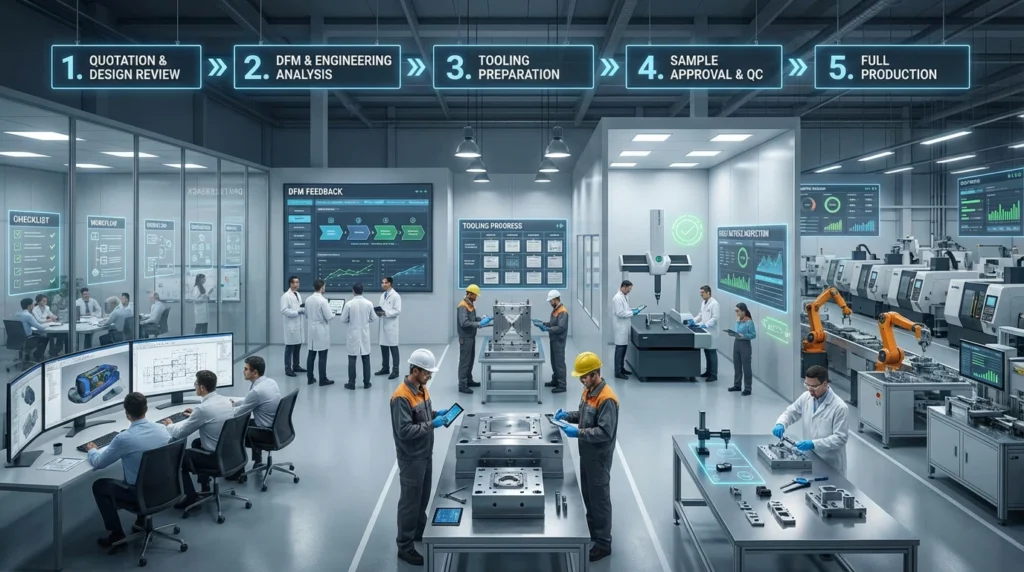
What Occurs in Contract Manufacturing? (Step by Step Workflow)
When companies evaluate outsourced production, they want a clear picture of what occurs in contract manufacturing from first contact to final shipment. Although every project has its own nuances, the core contract manufacturing workflow follows a disciplined sequence built around quality, traceability, and predictable outcomes. Providers like Meco formalize this through a structured 5‑step process that reduces risk and accelerates production readiness.
Step 1: Price Quotation Request
The process begins when the OEM sends drawings, 3D models, expected quantities, material specifications, surface finish requirements, and any testing or compliance standards.
This is the point where early alignment sets the tone for the entire contract manufacturing process. Good partners flag gaps immediately rather than letting issues slip into production.
Step 2: Quotation and DFM Notes
Once engineering reviews the data package, the contract manufacturer provides an itemized quotation along with Design For Manufacturing (DFM) suggestions.
This stage defines manufacturability, potential cost drivers, tolerance risks, and opportunities for process optimization.
Many OEM teams treat this as a technical collaboration, not merely a pricing exercise, because strong DFM input prevents problems later.
This early exchange is also where responsibilities tied to manufacturing contract labor or production manager contract expectations are discussed.
Step 3: Tooling Order
After acceptance, the partner begins producing any required tooling dies, molds, jigs, fixtures, or machining setups. Clear T0/T1 sampling plans guide how parts will be tested and validated.
Tooling is often where inexperienced providers fall short, which is why it is a critical part of manufacturing contract management. Proper documentation, change control, and communication prevent costly rework.
Step 4: Sample Approval
With tooling complete, the first articles are produced. Dimensional checks, functional tests, and material certifications confirm whether the component meets spec.
This milestone determines whether the contract manufacture can proceed. Misalignment here can jeopardize the entire project, making the sample approval phase essential for risk mitigation.
Step 5: Production, QC, and Delivery
Once samples are signed off, full production begins. A disciplined contract mfg environment includes in‑process inspections, final Quality Control (QC), packaging verification, serialization or traceability when required, and logistics planning.
At this point, effective manufacturing contract management keeps schedules on track and ensures the OEM receives consistent output.
A well‑structured contract manufacturing workflow transforms outsourced production into a reliable, repeatable engine for OEMs. When executed correctly, contracted manufacturing behaves less like a vendor relationship and more like a specialized extension of internal operations.
If you would like to learn more about this process and how Meco can produce and delivery your prototype product contact us.
What Do You Need From a Manufacturing Partner?
Select the requirement that best matches your project.
How Much Design Ownership Do You Want?
Select your preferred design approach.
Do You Need Exclusivity or Customization?
This determines whether white label or private label is better.
Recommended: White Label Manufacturer
Ideal for standardized, low‑cost products with fast market entry.
Recommended: Private Label Manufacturer
Perfect for brands needing exclusivity with moderate customization.
Recommended: ODM Manufacturer
Best for rapid development using manufacturer‑created designs.
Contact Meco – Turnkey Manufacturing Partner
Do You Need a Complete Product or Only Components?
Do You Need End‑to‑End Turnkey Support?
Recommended: Full‑Service / End‑to‑End Manufacturer
Ideal for complex products requiring machining, molding, PCBA, assembly, QC, and logistics.
Contact Meco – Turnkey Manufacturing Partner
Recommended: OEM (Build‑to‑Print) Manufacturer
Ideal when your engineering team owns the design and needs reliable execution.
Contact Meco – Turnkey Manufacturing Partner
What Type of Component Do You Need?
Choose the manufacturing discipline required.
Recommended: Component Manufacturer
Perfect for CNC parts, plastic molding, metal stamping, forging, and PCB assemblies.
Contact Meco – Turnkey Manufacturing Partner

Types of Contract Manufacturers
Contract manufacturers aren’t a single category they operate across several distinct models, each offering different levels of control, engineering involvement, and supply‑chain impact.
For OEMs weighing capacity, cost, and long‑term production stability, understanding these models is essential.
Build-to-print contract manufacturer (supplier)
In this structure, the manufacturer builds a product exactly to the client’s specifications. The design authority rests with the client; the manufacturer executes with precision. Automotive and industrial components are classic examples tight tolerances, strict material specs, and zero room for deviation. This model suits companies that own strong engineering capabilities but lack internal capacity.
Original Design Manufacturer (ODM)
Here, the manufacturer provides the design and the production. The client brands the final product. This is common in consumer electronics, lighting, and fashion accessories. ODMs offer speed, pre‑validated designs, and simplified New Product Introduction (NPI) cycles, but the client trades some design control for efficiency.
White Label Manufacturing
A manufacturer produces a standardized product sold to multiple brands. Clients apply their own branding. It works well in categories like skincare, small appliances, and packaged foods. The trade‑off: lower engineering cost but little product differentiation.
Private Label Manufacturing
Similar to white label but with more customization formulas, colors, sizes, packaging, or minor design changes exclusive to a single brand. This model gives companies faster innovation with minimal R&D overhead.
Component Manufacturers
These partners focus on specific parts or sub‑assemblies: CNC‑machined housings, PCBA, molded plastics, stamped metal components, forged parts, or wiring harnesses. They’re essential when a project demands technical depth in a single discipline or when an OEM needs overflow support without adding CapEx.
Turnkey / End‑to‑End Manufacturers
This is the most comprehensive category. Partners manage raw material sourcing, R&D, prototyping, tooling, production, surface finishing, assembly, testing, packaging, and logistics. Pharmaceutical, cosmetic, medical, and complex electro‑mechanical products often rely on this approach.
Companies like Meco operate in this tier, providing the full solution for your product idea, from sourcing equipment to producing the parts and verifying through dedicated quality control. We deliver the best results so you can have full confidence in your product. Get in touch with us to get started.
Summary of Different Types of Manufacturer
| Type of Manufacturer | What They Provide | Best For | Pros | Cons |
|---|---|---|---|---|
| Build to Print Contract Manufacturer | Manufactures exactly to client drawings and specs | Automotive, industrial, engineered components | Full design control, high precision, IP stays with client | Requires strong internal engineering; slower if redesigns needed |
| ODM (Design + Manufacturing) | Provides design, tooling, and production; client brands it | Consumer electronics, lighting, accessories | Fastest route to market, lower design cost, validated designs | Less design ownership; limited customization |
| White Label | Generic product sold to many brands; branding applied later | Skincare, food, small appliances | Lowest cost; fastest scaling; simple onboarding | No differentiation; product features fixed |
| Private Label | Manufacturer produces a customized product exclusive to one brand | Beauty, supplements, home goods | More customization, stronger brand identity, moderate cost | Still limited by manufacturer’s base formulas or tooling |
| Component Manufacturer | Produces parts or sub-assemblies only | CNC machining, PCBA, molding, stamping, forging | High technical depth; ideal for overflow or niche capabilities | Requires client integration; more vendors to manage |
| Full Service / End to End | Raw material sourcing, R&D, tooling, production, QC, assembly, packaging, logistics | Medical, cosmetics, electro-mechanical systems | Single accountable partner; fewer vendors; best for complex builds | Higher onboarding time; requires strong alignment and documentation |
Contract Manufacturing Industries Examples
Contract manufacturing spans nearly every major manufacturing sector, and real‑world examples make it easier to understand how OEMs use outsourced production to improve quality, reduce overhead, and accelerate time‑to‑market. Below are industry‑specific contract manufacturing examples showing how companies leverage external partners to scale efficiently and reliably.
Aerospace Parts Manufacturing
Aerospace OEMs frequently outsource high‑precision machining, aluminum and magnesium casting, titanium components, and forged structural parts. Contract aerospace partners deliver tight tolerances, full traceability, and consistent quality across brackets, housings, enclosures, and complex assemblies. Learn more through our aerospace parts capabilities.
Automotive Parts Manufacturing
Automotive manufacturers and Tier‑1 suppliers rely on contract machining, die casting, forging, stamping, welding, and assembly to support powertrain, suspension, EV battery housings, and body‑structure components. Outsourcing stabilizes costs, improves PPAP readiness, and absorbs high‑volume demands. Explore our automotive manufacturing solutions.
Heavy Equipment Manufacturing
Construction, agricultural, and industrial machinery brands outsource machined, forged, cast, and welded parts to manage large, high‑strength components. These contract manufacturing examples include shafts, axles, housings, frames, hydraulic parts, and pressure‑rated assemblies requiring long‑term durability. More details are available in our heavy equipment services.
Home Appliances Manufacturing
Appliance makers outsource die‑cast housings, injection‑molded plastics, stamped panels, and finished assemblies to speed up new product introduction and maintain consistent cosmetic quality. Contract manufacturers support ovens, ranges, HVAC systems, refrigeration products, and smart appliances. See our appliance manufacturing capabilities.
Industrial Manufacturing
Industrial equipment OEMs use contract manufacturing for CNC‑machined manifolds, gears, housings, forged components, stamped metal parts, welded structures, and complete assemblies. These programs require repeatability, ruggedness, and efficient multi‑process integration. Learn more about our industrial manufacturing support.
Light Manufacturing
In light manufacturing, companies outsource die‑cast housings, stamped brackets, sheet‑metal parts, CNC‑machined components, and electromechanical assemblies. These examples emphasize fast lead times, stable quality, and cost‑efficient production across prototype‑to‑scale programs. Explore our light manufacturing solutions.
Medical Equipment Manufacturing
Medical OEMs depend on contract manufacturers for precision‑machined surgical components, die‑cast housings, plastic enclosures, cleanroom assemblies, and regulatory‑ready medical subsystems. Outsourcing improves documentation, traceability, and speed through validation stages. See our medical manufacturing capabilities.
Telecommunications Manufacturing
Telecom companies outsource RF‑shielded enclosures, heat‑sink housings, waveguides, antenna brackets, stamped chassis parts, and CNC‑machined metal components. These contract manufacturing examples highlight the need for tight tolerances, high‑frequency performance, and environmental durability for 5G systems. Learn more through our telecom manufacturing offerings.
Office Furniture Manufacturing
Office furniture OEMs outsource CNC‑machined metal components, aluminum extrusions, welded frames, ergonomic parts, plastic components, and turnkey assemblies for desks, seating, storage, and conference systems. Outsourcing enables faster design cycles and consistent material quality. Explore our furniture manufacturing solutions.
Custom Electronics Manufacturing
Electronics companies rely on contract manufacturing for CNC‑machined enclosures, die‑cast housings, precision brackets, connectors, thermal structures, and integrated PCBA assemblies. These examples commonly involve multi‑material builds and cosmetic finishing for consumer and industrial electronics. More details are found in our electronics manufacturing capabilities.
Across all these industries from aerospace and automotive to medical devices, electronics, lighting, home appliances, and heavy equipment the recurring pattern is clear: contract manufacturing allows companies to scale faster, improve product quality, and reduce capital investment while accessing specialized production capabilities they cannot cost‑effectively build in‑house.
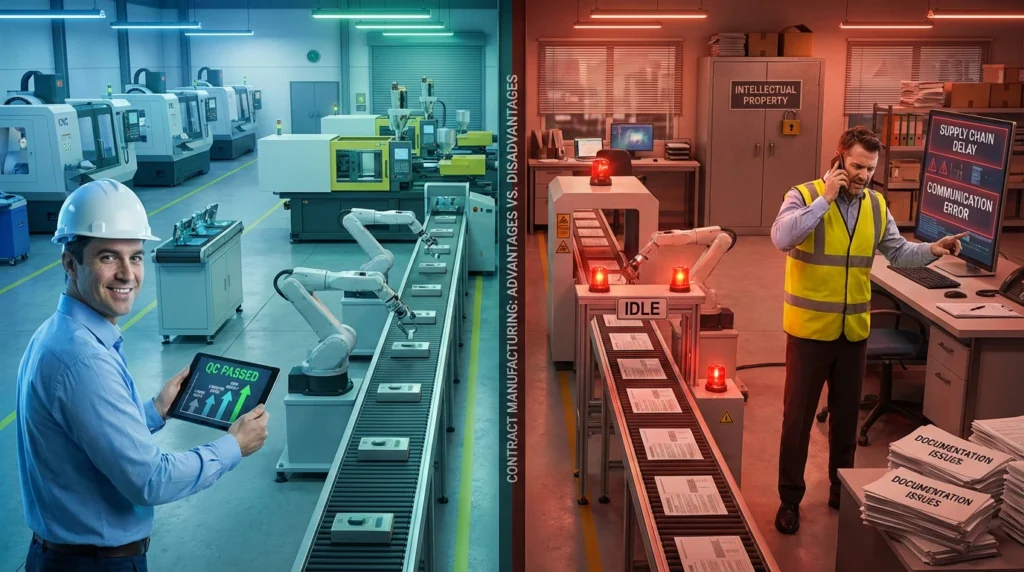
Advantages vs. Disadvantages of Contract Manufacturing
Contract manufacturing delivers clear strategic value, but like any production model, it comes with trade‑offs. OEMs evaluating partners need to weigh both sides operational gains versus structural risks to decide how outsourced production fits into their long‑term manufacturing strategy.
Advantages of Contract Manufacturing
Cost Efficiency
The most obvious advantage is financial. Contract manufacturers already own the machinery, tooling infrastructure, skilled labor, and inspection systems that OEMs would otherwise need to fund themselves.
This shared‑resource model lowers capital expenditure and stabilizes per‑unit cost, especially useful when demand fluctuates or when launching new product lines.
Speed and Scalability
Partners with established CNC machining, molding, casting, PCBA, and assembly lines can ramp quickly.
OEMs bypass the hiring curve, equipment procurement delays, and facility expansion challenges.
For industries with intense launch cycles automotive, consumer electronics, industrial equipment this speed is often decisive.
Technical Expertise and Quality
A mature contract manufacturing company brings specialized process knowledge, consistent QC systems, and familiarity with diverse materials and finishes.
OEMs struggling with internal bottlenecks or tolerance‑critical parts often see immediate quality improvements once transitioning to a capable partner.
Reduced Operational Load
Outsource contract manufacturing frees internal teams from the burden of machine maintenance, supplier coordination, tooling management, and throughput issues.
This allows engineering, procurement, and operations leaders to focus on strategy rather than firefighting.
Flexibility
A well‑structured manufacturing services agreement lets companies scale runs up or down without major disruption ideal for mixed‑volume product portfolios.
Disadvantages of Contract Manufacturing
Less Direct Control
The biggest challenge is reduced visibility into day‑to‑day production. Without strong contract manufacturing management, communication gaps can lead to delays, deviations, or unclear quality ownership.
Dependency Risk
Relying heavily on a single external partner especially one lacking multi‑process capabilities or global reach can introduce supply chain vulnerability.
IP and Confidentiality Concerns
While reputable partners follow strict protocols, companies producing proprietary tooling or sensitive components may need enhanced contract protections and regular audits.
Potential for Misalignment
If drawings, revision control, or sampling expectations aren’t crystal clear, OEMs can face issues during scaling. This is why structured collaboration models and DFM alignment are essential.
Geographical and Logistics Constraints
Global partners can provide cost advantages, but longer freight routes, customs, and time‑zone differences require robust planning. Providers with North American oversight, like Meco, help mitigate these risks.
Summary Table: Advantages vs. Disadvantages
| Category | Advantages | Disadvantages |
|---|---|---|
| Cost | Lower CapEx, reduced overhead, shared equipment costs | Long-term cost can rise if volumes are unpredictable |
| Speed | Faster ramp-up, existing equipment, rapid scaling | Delays possible if communication or approvals lag |
| Expertise | Access to specialized skills and QC systems | Potential mismatch in technical expectations |
| Operations | Reduced internal workload, fewer bottlenecks | Less day-to-day control of production |
| Flexibility | Scales easily from small to large runs | Dependency on partner capacity and stability |
| Supply Chain | Consolidation under one partner | Logistics or geopolitical risks if offshore |
How to Choose the Right Contract Manufacturing Partner
Selecting a contract manufacturing partner is a decision that shapes cost structure, supply stability, and long‑term product performance. The right partner isn’t just a supplier they become an operational extension of your engineering, procurement, and quality teams. Evaluating them requires looking far beyond price.
Start with technical depth. A qualified partner should demonstrate real capability across the materials and processes your product requires machining, casting, injection molding, stamping, electronics, or assembly.
If your build spans multiple materials, prioritize providers with integrated, multi‑process operations rather than a patchwork of subcontractors; this reduces risk and improves consistency.
Next, assess engineering strength. Strong DFM, tooling insight, and transparent sampling processes are the hallmarks of a mature manufacturer.
You want a team that challenges unclear tolerances, flags cost drivers early, and manages changes with discipline not one that simply “quotes and builds.”
Quality infrastructure matters just as much. Look for documented procedures, traceability, testing methods, and certifications aligned to your industry.
A credible partner won’t hesitate to share inspection reports, equipment lists, or past issue‑resolution examples.
Finally, evaluate communication and program management. North American OEMs perform best with partners who offer predictable updates, clear escalation paths, and local support. Meco’s model global manufacturing with North American oversight illustrates how this hybrid approach reduces lead‑time risk and improves accountability.
Choosing well means selecting a partner who protects your schedule, your margins, and your reputation. When these elements align, contract manufacturing becomes a strategic advantage rather than a fallback option.
Why Meco Is a Full Service Turnkey Contract Manufacturer
Meco stands out as a full-service contract manufacturer because its capabilities span the entire production lifecycle engineering, tooling, machining, molding, casting, electronics, assembly, finishing, and logistics. With 30+ years of delivering mechanical, electronic, and plastic manufacturing, the company provides the kind of contract manufacturing services that reduces vendor fragmentation and improve product reliability.
Its production network includes factories in Thailand and China, supported by North American program management for clear communication and faster alignment. This combination allows OEMs to scale confidently while maintaining responsiveness and technical oversight.
For multi‑process builds, Meco offers integrated contract manufacturing solutions through services such as Whole Product Manufacturing, Assembly, and CNC Machining. These strengths are reinforced by educational resources like the blog “What Occurs in Contract Manufacturing? The Complete 2025 Guide.”
For OEMs seeking an end‑to‑end outsourcing partner with global capacity and local accountability, Meco delivers a proven, turnkey path from concept to production.
Contract Manufacturing FAQs
1. What does a contract manufacturer do?
A contract manufacturer produces parts, components, or full assemblies for another company based on exact specifications. They manage materials, tooling, production, testing, quality control, and delivery—allowing OEMs to scale without expanding their own facilities or workforce.
2. What occurs in a contract manufacturing workflow?
The typical workflow includes RFQ submission, engineering review and DFM feedback, tooling production, sample approval, and full‑scale manufacturing with in‑process inspections, final QC, packaging, and logistics. This structured process ensures consistency, traceability, and reliable output.
3. What types of contract manufacturers exist?
The main categories are build‑to‑print (OEM) suppliers, ODM manufacturers, white label and private label producers, component manufacturers, and full turnkey partners. Each offers different levels of engineering support, customization, and supply‑chain responsibility.
4. Why do companies use contract manufacturing?
Brands outsource production to reduce costs, speed up development, access specialized equipment, improve quality, stabilize supply chains, and free internal teams from managing complex manufacturing operations. It enables scaling without major capital investment or facility expansion.
5. What industries rely on contract manufacturing?
Contract manufacturing is essential in aerospace, automotive, electronics, medical devices, heavy equipment, home appliances, lighting, telecommunications, and consumer goods. These industries benefit from specialized machining, molding, casting, PCBA, assembly, and turnkey production capabilities.
Author & Editorial Integrity
Author: Alex M
Manufacturing & Supply Chain Specialist
Alex has 14+ years of experience in contract manufacturing, supply chain optimization, OEM/ODM partnerships, and global sourcing across electronics, medical devices, and consumer products. He has led programs with U.S. and international manufacturers, supporting companies from startup stage through high‑volume mass production.
Reviewed by: Daniel K Senior Manufacturing Engineer
Daniel is a mechanical engineer with 18 years of hands‑on experience in process development, quality systems, DFM reviews, and production scaling for Fortune 500 and mid‑market OEMs. He reviews technical content for accuracy, clarity, and best‑practice alignment.
This article reflects current 2025 industry standards and is based on real manufacturing workflows, compliance frameworks, and supply chain methodologies.
