
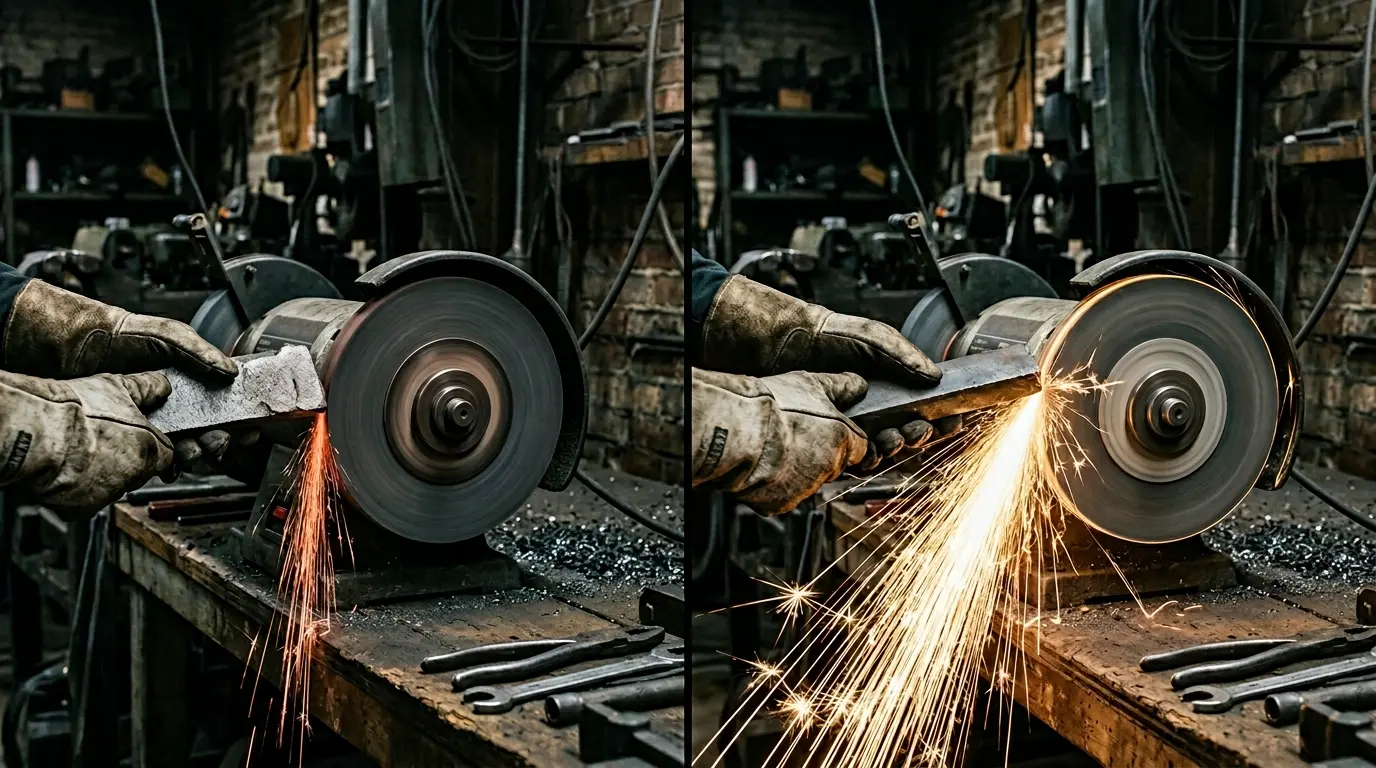
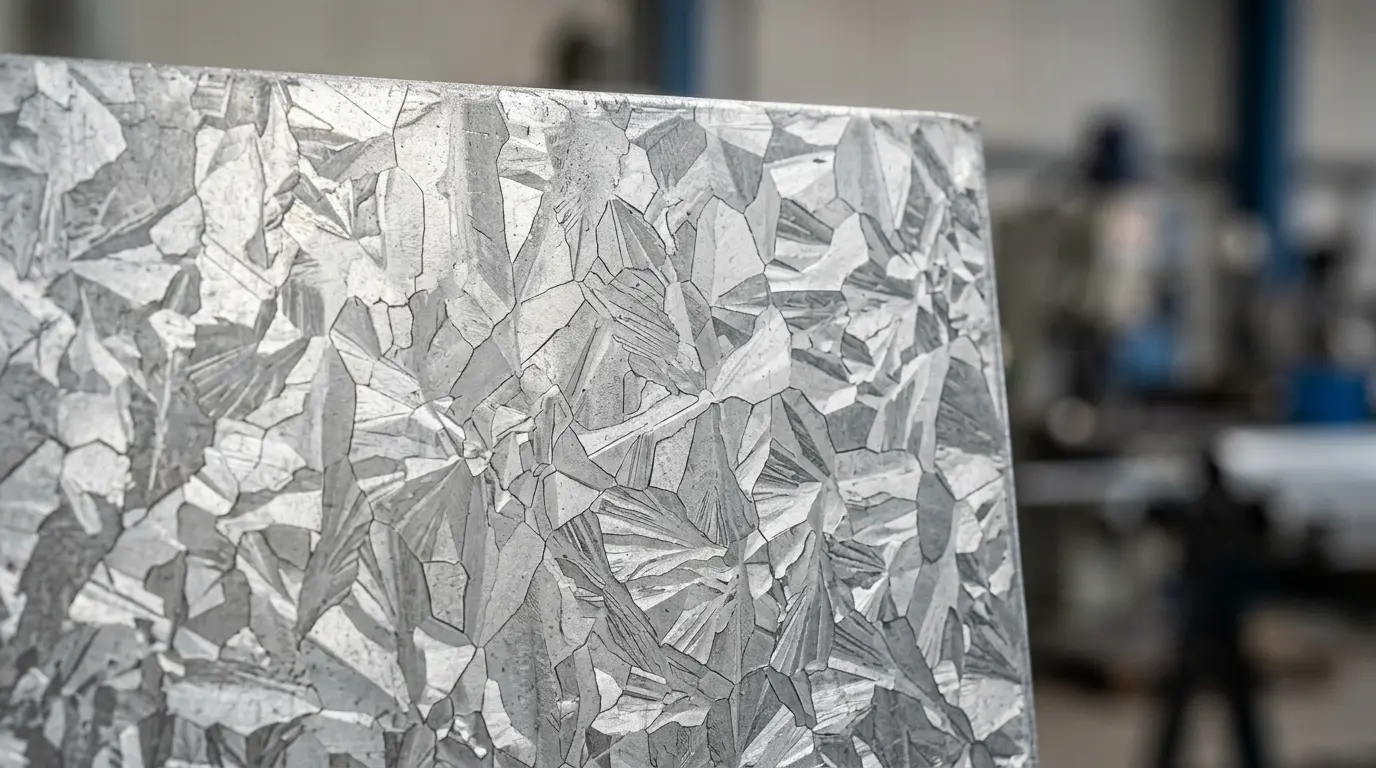
The fastest way to tell cast iron from cast steel is the spark test: touch the metal to a grinding wheel and observe the sparks. Cast iron produces short, dull red sparks that barely travel, while cast steel throws long, bright yellow-white spark streams with forking bursts. Galvanized steel is identified by its spangled silver-gray surface, rough zinc texture, and magnetic response, which distinguishes it from visually similar metals like aluminum and stainless steel.
Correctly identifying metal type matters because it determines weldability, machinability, load-bearing capacity, corrosion behavior, and safety. Welding cast iron with the wrong procedure causes cracking. Cutting galvanized steel without ventilation releases toxic zinc fumes. Specifying cast steel where cast iron would suffice wastes budget, and the reverse risks brittle failure under impact loads.
This guide covers the practical identification methods, property differences, and application guidance that engineers, sourcing managers, and shop-floor technicians need to distinguish cast iron from cast steel and to confirm whether steel has been galvanized. Every test method is ranked by reliability, speed, and whether it damages the part.
What Is the Difference Between Cast Iron and Cast Steel?
The fundamental difference between cast iron and cast steel is carbon content. Cast iron contains more than 2% carbon (typically 2.5% to 4%), while cast steel contains less than 2% carbon (typically 0.1% to 0.5%). This single compositional difference produces dramatically different mechanical properties, machinability, and application suitability.
The high carbon content in cast iron causes carbon to precipitate as graphite flakes (in grey iron) or spheroids (in ductile iron) within the metal matrix. These graphite structures give cast iron its characteristic properties: excellent compressive strength, vibration damping, and machinability, but poor tensile strength, ductility, and impact resistance. Cast steel, with its much lower carbon content, retains a fully metallic microstructure that delivers high tensile strength, ductility, toughness, and weldability.
| Property | Cast Iron (Grey/Ductile) | Cast Steel (Carbon/Low-Alloy) |
|---|---|---|
| Carbon Content | 2.0% to 4.0% | 0.1% to 0.5% |
| Tensile Strength | 150 to 400 MPa (grey); up to 800 MPa (ductile) | 450 to 700 MPa (typical carbon cast steel) |
| Compressive Strength | Excellent (3 to 4 times tensile) | Good (roughly equal to tensile) |
| Ductility / Elongation | Very Low (grey iron: less than 1%); Moderate (ductile iron: 3 to 18%) | High (12% to 25%) |
| Impact Resistance | Low (grey iron is brittle) | High (tough, absorbs energy) |
| Vibration Damping | Excellent (graphite absorbs vibration) | Poor (transmits vibration) |
| Machinability | Good to Excellent (graphite aids chip breaking) | Moderate (gummier chips, more tool wear) |
| Weldability | Poor (high carbon causes cracking; requires preheat and special rods) | Good to Excellent |
| Castability | Excellent (low melting point 1,150 to 1,250°C; flows easily) | More difficult (higher melting point ~1,500°C; more shrinkage) |
| Wear Resistance | Good (graphite acts as dry lubricant) | Moderate (improves with alloy additions) |
| Corrosion Resistance | Moderate (develops protective patina) | Low (rusts readily without coating) |
| Relative Cost | Lower | Higher (more energy, labor, and inspection required) |
Sources: Property ranges referenced from Reliance Foundry (Cast Iron vs Cast Steel) and the The Fabricator (carbon content classification).
Types of Cast Iron: Grey, Ductile, Malleable, and White
Not all cast iron is the same. The shape of the graphite within the iron matrix determines whether the casting is brittle or tough, machinable or abrasion-resistant. Knowing the type matters for identification because grey iron and ductile iron behave very differently in field tests like the hammer ring test.
| Cast Iron Type | Graphite Shape | Tensile Strength | Ductility | Key Properties | Common Applications |
|---|---|---|---|---|---|
| Grey Iron | Flakes | 150 to 300 MPa | Very Low (less than 1%) | Excellent damping, easy to machine, brittle | Engine blocks, machine beds, brake rotors, pipe fittings |
| Ductile (Nodular) Iron | Spheroids (nodules) | 400 to 800 MPa | Moderate (3 to 18%) | Strong, tough, can replace steel in many structural applications | Crankshafts, gears, suspension components, pipe |
| Malleable Iron | Irregular clusters (temper carbon) | 350 to 550 MPa | Moderate (5 to 12%) | Good shock resistance, produced by annealing white iron | Pipe fittings, electrical hardware, hand tools |
| White Iron | None (carbon as cementite Fe₃C) | Varies | None (extremely brittle) | Very hard, abrasion resistant, un-machinable by conventional methods | Wear plates, mill liners, slurry pump components |
For sourcing managers evaluating sand casting or investment casting projects, the distinction between grey and ductile iron is the most critical. Grey iron is cheaper and easier to cast but cannot tolerate impact loads. Ductile iron costs more to produce but can replace cast steel in many applications while still being easier to machine.
How to Tell Cast Iron from Cast Steel: 6 Practical Identification Methods
The following methods are listed from most practical (shop-floor ready) to most definitive (laboratory grade). Use the method that matches your situation, tools, and tolerance for surface damage.
Method 1: Spark Test (Most Reliable Field Test)
Touch the metal to a bench grinder or angle grinder and observe the sparks. According to the Washington Alloy spark identification chart, cast iron produces short, dull reddish sparks with minimal travel distance and no forking. Cast steel produces long, bright yellow-white spark streams that fork and burst at the tips. The higher the carbon content, the more branching appears in the spark pattern. This test works on grey iron, ductile iron, and all common cast steels.
Method 2: Hammer Ring Test (Quick but Limited)
Strike the part with a hammer and listen. Grey cast iron produces a dull "thud" with no sustained ring because the graphite flakes absorb vibration. Cast steel produces a clear, ringing "dang" that sustains for several seconds because its crystalline structure transmits sound energy efficiently. This test reliably distinguishes grey iron from cast steel. However, ductile iron can produce a ring similar to steel, so the hammer test alone cannot distinguish ductile iron from cast steel.
Method 3: Fracture Surface Examination
If the part is already broken or if a sacrificial test coupon is available, examine the fracture surface. Grey cast iron shows a dark gray, coarse-grained fracture with visible graphite (the surface may even feel slightly oily or chalky). Cast steel shows a bright, silvery-white, fine-grained fracture surface. Ductile iron falls in between, with a slightly brighter appearance than grey iron and visible spheroidal graphite under magnification.
Method 4: Visual Surface Inspection
Cast iron surfaces tend to be darker gray with a rougher, more granular texture. Cast steel surfaces are brighter and shinier, though still rough from the casting process. Cast steel castings also tend to show larger risers and gating remnants because steel shrinks more during solidification and requires bigger feed reservoirs. Cast iron, with its lower shrinkage and better fluidity, can achieve sharper detail and thinner walls in the casting.
Method 5: Machining Chip Test
If you have the opportunity to cut or drill into the part, examine the chips. Cast iron produces short, brittle chips that break into small fragments or powder (especially grey iron). Cast steel produces long, curling, continuous chips similar to wrought steel. This is a quick and reliable indicator during CNC machining operations.
Method 6: Chemical or Laboratory Analysis
For definitive identification, portable XRF (X-ray fluorescence) analyzers or optical emission spectrometry (OES) can measure the exact carbon, silicon, manganese, and other element percentages within seconds. Carbon content above 2% confirms cast iron. Below 2% confirms cast steel. This is the standard method for incoming material verification in quality-controlled manufacturing environments.
Which Test Should You Use?
For shop-floor identification without laboratory equipment, the spark test (Method 1) is the most reliable single test. It works on all types of cast iron and cast steel and requires only a bench grinder. For a quick non-destructive check, the hammer ring test (Method 2) works well but cannot distinguish ductile iron from cast steel. For incoming inspection in a production facility, combine visual inspection with a portable XRF analyzer for definitive results.
How to Tell If Steel Is Galvanized: 5 Identification Methods
Galvanized steel is steel that has been coated with a protective layer of zinc through hot-dip galvanizing (per ASTM A123) or electroplating. The zinc layer sacrifices itself to protect the underlying steel from rust. Identifying galvanized steel correctly matters for welding safety (zinc fumes are toxic), coating compatibility, and corrosion planning.
Method 1: Visual Inspection (Quickest Check)
Galvanized steel has a distinctive spangled or crystalline surface pattern caused by zinc crystallization during cooling. The color is typically a matte silver-gray, which can range from bright and shiny (new hot-dip) to dull gray (weathered). The surface feels rougher than bare steel or stainless steel. If you see a spangled, slightly rough, silver-gray surface on structural steel, it is almost certainly galvanized. For more on why galvanized steel changes color over time, see Meco's guide on why hot-dip galvanized steel turns dark.
Method 2: Magnet Test (Rules Out Aluminum and Stainless)
Galvanized steel is magnetic because the base material is carbon steel. A magnet will attach firmly to galvanized steel. This quickly rules out aluminum (non-magnetic) and most austenitic stainless steels (non-magnetic or weakly magnetic). However, the magnet test alone cannot distinguish galvanized steel from plain carbon steel or painted steel, so it should be combined with visual inspection.
Method 3: Scratch Test
Gently scratch an inconspicuous area with a sharp tool. Galvanized steel will reveal a bright silver zinc layer that is softer than the underlying steel. The scratch will appear silver and clean. On bare (non-galvanized) steel, the scratch reveals the same dark gray base metal beneath any surface rust. On painted steel, the scratch reveals the paint layer and then the steel beneath.
Method 4: Chemical Spot Test
Apply a drop of dilute hydrochloric acid (HCl) or white vinegar to the surface. On galvanized steel, the acid reacts with the zinc coating and produces visible bubbles (hydrogen gas) almost immediately. On bare steel, the reaction is slower and produces a dark discoloration rather than immediate bubbling. This is a quick and inexpensive field test, but it is destructive to the zinc layer at the test point.
Method 5: Coating Thickness Measurement
A magnetic coating thickness gauge can measure the zinc layer thickness directly. Hot-dip galvanizing per ASTM A123 produces coatings typically ranging from 45 to 100 µm (1.4 to 3.9 mils). Electrogalvanized coatings are thinner at 5 to 25 µm. A zero or near-zero reading confirms the steel is not galvanized. This is the standard QA method for verifying galvanizing compliance on incoming material.
Cast Iron vs Cast Steel: When to Specify Each Material
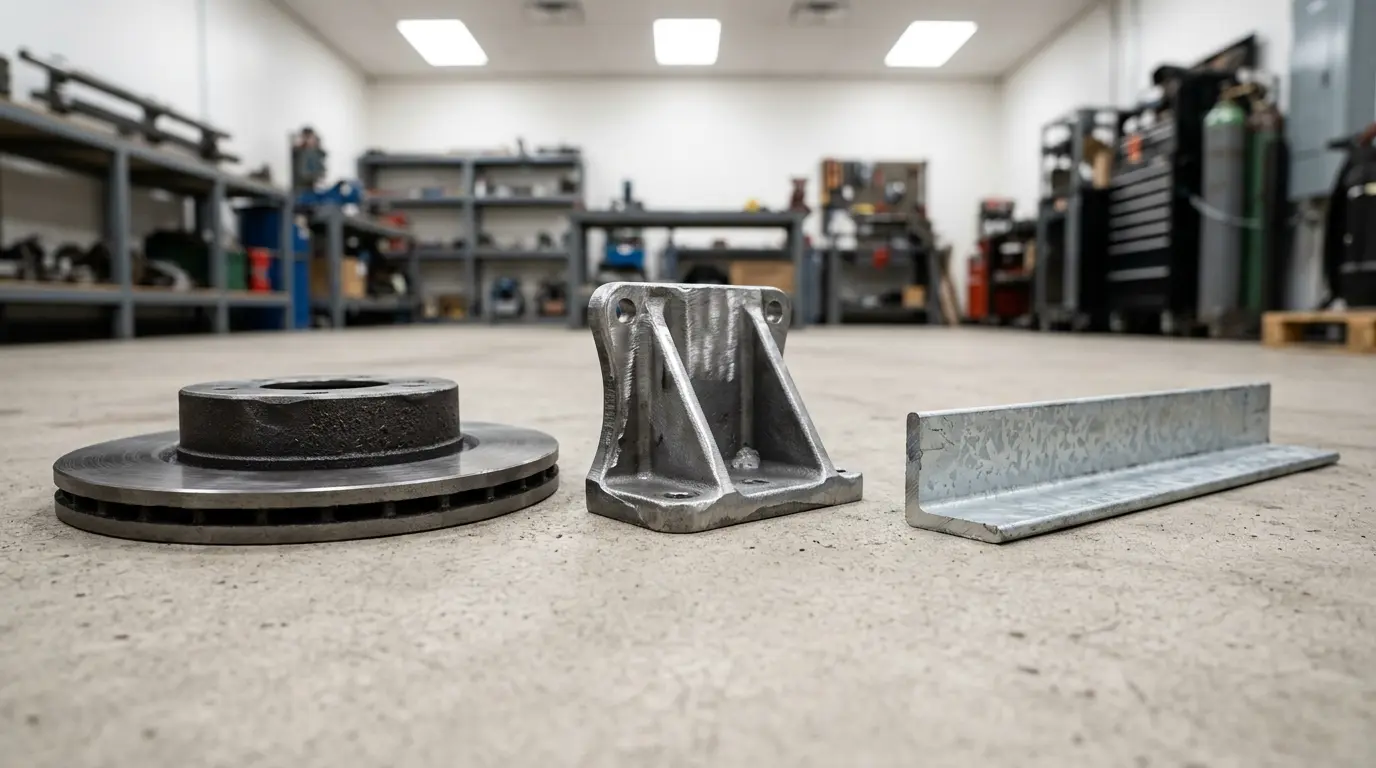
The choice between cast iron and cast steel depends on the balance of mechanical requirements, castability, machinability, and cost for the specific application.
Specify cast iron when: the part must dampen vibration (machine beds, engine blocks), compressive loads dominate (bearing housings, column bases), the geometry requires thin walls or fine detail that benefits from iron's superior castability, machinability is a priority, or the budget is tight and impact loads are low.
Specify cast steel when: the part must withstand impact or shock loading (crane hooks, structural nodes, coupling housings), tensile strength and ductility are required, the part must be welded during assembly or in the field, or the part operates under cyclic loading where fatigue resistance matters.
Meco produces both ferrous and non-ferrous castings across sand casting, investment casting, and die casting processes, with integrated CNC machining and surface finishing under one IATF 16949:2016 certified quality system.
Galvanized Steel: When It Matters and What to Watch For
Galvanized steel is specified whenever carbon steel must survive outdoor or high-moisture environments without paint maintenance. The zinc coating provides both barrier protection and cathodic (sacrificial) protection, meaning the zinc corrodes preferentially to protect the underlying steel even if the coating is scratched or damaged.
Typical service life: Hot-dip galvanized steel per ASTM A123 lasts 20 to 50 years in most atmospheric environments before the zinc layer is fully consumed, according to the American Galvanizers Association.
Galvanic corrosion warning: Avoid direct contact between galvanized steel and copper, brass, or bronze in the presence of moisture. The zinc and copper will form a galvanic cell that rapidly consumes the zinc coating. Use insulating washers or separators when dissimilar metals must be connected.
Welding safety: Heating galvanized steel releases zinc oxide fumes, which cause metal fume fever. Always grind off the zinc coating within 25 to 50 mm of any weld zone before welding, and ensure adequate ventilation or respiratory protection per OSHA standards.
Frequently Asked Questions About Identifying Cast Iron, Cast Steel, and Galvanized Steel
How can you tell cast iron from cast steel?
The most reliable field test is the spark test. Touch the metal to a grinding wheel: cast iron produces short, dull reddish sparks with minimal travel distance and no forking, while cast steel produces long, bright yellow-white spark streams that fork and burst at the tips. Other methods include the hammer ring test (grey cast iron thuds, steel rings), fracture surface examination (cast iron is dark gray and coarse, steel is bright and fine-grained), and machining chip analysis (cast iron produces short brittle chips, steel produces long curling chips). For definitive identification, portable XRF or OES provides exact carbon content.
What is the main difference between cast iron and cast steel?
The fundamental difference is carbon content. Cast iron contains more than 2% carbon (typically 2.5% to 4%), while cast steel contains less than 2% carbon (typically 0.1% to 0.5%). This carbon difference gives cast iron its characteristic graphite structures that provide excellent compressive strength, vibration damping, and machinability but poor impact resistance and ductility. Cast steel retains a fully metallic microstructure that delivers high tensile strength, toughness, ductility, and weldability.
How do you tell if steel is galvanized?
The quickest method is visual inspection. Galvanized steel has a distinctive spangled or crystalline surface pattern in matte silver-gray caused by zinc crystallization. It feels rougher than bare steel. You can confirm with a magnet test (galvanized steel is magnetic, unlike aluminum), a scratch test (reveals a bright silver zinc layer), or a chemical spot test (a drop of dilute acid on galvanized steel produces immediate bubbling). For production verification, a magnetic coating thickness gauge measures the zinc layer directly per ASTM A123.
Is cast iron stronger than cast steel?
It depends on the type of strength. Cast iron has superior compressive strength, typically 3 to 4 times its tensile strength, making it excellent for applications where the part is primarily compressed (bearing housings, machine bases). Cast steel has much higher tensile strength, ductility, and impact resistance, making it the better choice for parts that must withstand pulling forces, shock loads, or cyclic stress. Ductile iron bridges the gap with tensile strength reaching up to 800 MPa and moderate ductility, sometimes replacing cast steel at lower cost.
What is the difference between grey iron and ductile iron?
The difference is graphite shape. Grey iron contains flake-shaped graphite that makes it brittle (less than 1% elongation) but gives it excellent vibration damping and machinability. Ductile iron contains spheroidal (ball-shaped) graphite that dramatically improves toughness and ductility (3% to 18% elongation) while maintaining good castability. Ductile iron's tensile strength can reach 800 MPa, making it suitable for structural applications like crankshafts, gears, and suspension components where grey iron would fail under impact.
Can you weld cast iron?
Yes, but it is difficult and requires special procedures. Cast iron's high carbon content makes it prone to cracking during welding because the heat-affected zone becomes extremely hard and brittle. Successful cast iron welding typically requires preheating the entire part to 250 to 300°C, using nickel-based welding rods (such as ENi-CI or ENiFe-CI), maintaining slow cooling rates (often by wrapping in insulating blankets), and peening each weld pass to relieve stress. Cast steel, by contrast, is much easier to weld using standard low-hydrogen procedures.
How long does galvanized steel last before rusting?
Hot-dip galvanized steel per ASTM A123 typically lasts 20 to 50 years in normal atmospheric environments before the zinc coating is fully consumed and the underlying steel begins to rust. Service life varies by exposure: rural environments with low pollution extend life beyond 50 years, while coastal or heavily industrial environments with salt spray or acid rain can reduce life to 15 to 25 years. Coating thickness directly correlates with service life, which is why hot-dip galvanizing (45 to 100 µm) outlasts electrogalvanizing (5 to 25 µm) by a wide margin.
Get Your Cast, Machined, and Finished Parts from One Accountable Partner
Whether you need sand-cast iron housings, investment-cast steel brackets, or galvanized steel assemblies, coordinating casting foundries, machine shops, and finishing vendors creates quality gaps at every handoff. Meco eliminates that fragmentation by managing the full workflow from casting through CNC machining, surface finishing, assembly, and global delivery under one IATF 16949:2016 certified quality system.
With 30+ years of turnkey manufacturing experience and 40+ in-house processes, Meco delivers cast and machined parts that meet specification the first time.
- Full Casting Range: Sand casting, investment casting (lost wax), die casting (aluminum, zinc, magnesium), gravity casting, and low-pressure casting.
- Integrated CNC Machining: Post-casting machining to tolerances of ±0.01 mm on 3, 4, and 5-axis CNC equipment.
- Surface Finishing: Hot-dip galvanizing, powder coating, painting, anodizing, chrome plating, nickel plating, e-coating, and PVD, all managed in-house.
- IATF 16949:2016 Certified: Automotive-grade quality applied across every industry. 99.99% quality rate. 99.8% on-time delivery.
- Prototype to Mass Production: From 10 pieces to 10 million+. No minimum order quantities. Quotes in under 24 hours.
Submit your casting drawings and let Meco's engineering team help you select the right material, process, and finish for your program.
Request a Quote Today