Metal Injection Molding Materials
Eliminate supply chain risk with our single-source MIM services. We handle your entire project from raw powder blending and custom tooling to final sintering up to 99% density and precision finishing
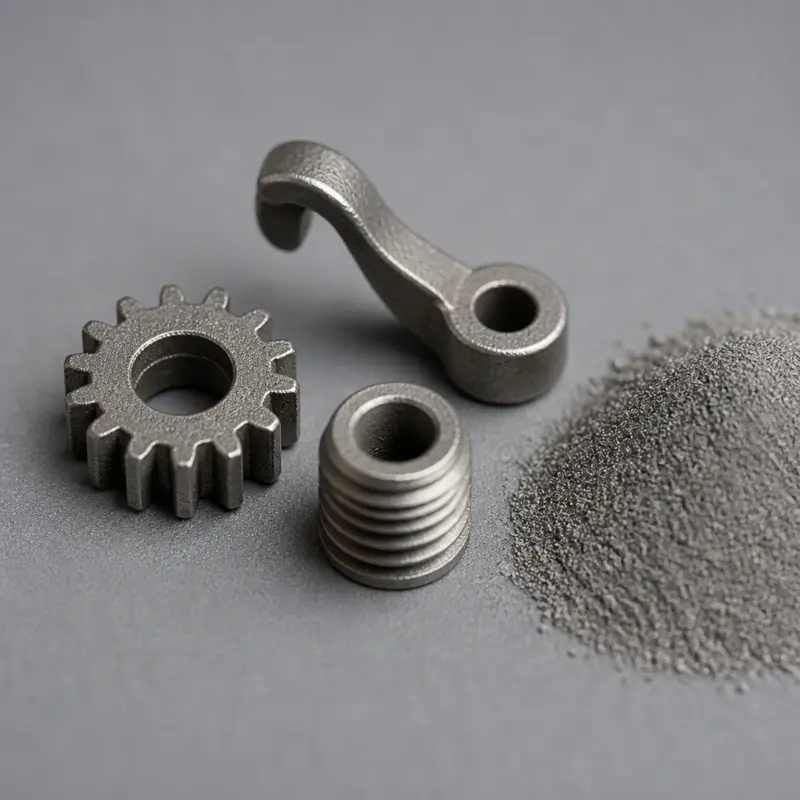
What Materials Are Used in Metal Injection Molding
Any metal that can be milled into a fine powder and sintered cleanly. In routine production that means six alloys: MIM-316L, MIM-420, MIM-440C, MIM-17-4PH, MIM-4605 and MIM-FeNi50, plus cobalt and nickel bonded tungsten carbide, titanium, brass and bronze feedstock.
Part Weight
Under 100 g
Best below 60 g. Above roughly 160 g the binder cannot leave a thick section without cracking it.
Wall Thickness
0.5 to 6 mm
Thinner will not fill. Thicker traps binder. Balanced walls matter more here than in plastic molding.
Sintering Shrinkage
15 to 20%
The tool is cut 17 to 20 percent oversize against the specific feedstock, then corrected off first articles.
Annual Volume
5,000+
Below that the tool rarely pays back. We will say so and quote a different route instead.
Swipe to see all four
Metal Materials We Sinter
Powder chemistry drives performance. Since minor carbon and oxygen pickup during debinding can push a part out of specification, we tightly control and verify every raw feedstock lot.
| Family | Grades We Run | Why It Gets Specified | Usual Secondary Work | Typical Parts |
|---|---|---|---|---|
| Austenitic Stainless | MIM-316L | Corrosion resistance with real ductility, above 40 percent elongation, and non magnetic behaviour | Passivation, polishing, light machining | Surgical instrument tips, endoscope parts, fluid fittings |
| Martensitic Stainless | MIM-420, MIM-440C | Hardness a stainless can reach once heat treated, for an edge or wear face that still has to resist rust | Heat treat, grinding, polishing | Surgical blades, cutlery, precision wear tips |
| PH Stainless | MIM-17-4PH (UNS S17400, also stocked as 630), as sintered or aged to H900 | Stainless behaviour plus strength on demand. Ageing more than doubles the yield figure | Solution treat and age, machining, passivation | Latches, levers, small gears, instrument hardware |
| Low Alloy Steel | MIM-4605 | Cheapest route to genuinely hard parts. Responds to quench and temper like wrought 4600 series | Carburising, quench and temper, plating | Cams, ratchet pawls, drive components, tool parts |
| Soft Magnetic | MIM-FeNi50 | High permeability and low coercivity in a shape that would need stacking or machining otherwise | Magnetic anneal | Sensor cores, solenoid armatures, relay parts |
| Titanium | Commercially pure (Grade 2, GB equivalent TA2), Ti-6Al-4V (Grade 5, GB equivalent TC4) | Strength to weight, and the biocompatible option where stainless is ruled out | Machining, surface treatment | Medical components, small aerospace fittings |
| Copper Alloys | Brass and bronze feedstock | Conductivity and bearing behaviour in small complex shapes | Machining, polishing | Terminals, contacts, miniature bushings |
| Hard Metal, Cobalt Bond | WC-6Co (ANSI C3), WC-8Co (ANSI C2) | Highest hardness on this table, at HRA 88 and above, with the C2 and C3 split trading toughness against wear life | Grinding, edge preparation | Cutting inserts, wear pads, forming dies |
| Hard Metal, Nickel Bond | WC-6Ni, WC-8Ni | The same carbide hardness in a binder that survives acids and moisture cobalt cannot | Grinding, edge preparation | Corrosive fluid nozzles, chemical handling wear parts |
Scroll inside the table for every row and column
Sintered Metal Performance By Grade
Sintered parts differ from wrought bar stock. Components achieve 96% to 99% density. We qualify our production to these explicit minimums so you can design with realistic, guaranteed performance figures rather than unreliable supplier averages.
| Grade | Condition | Yield Rp0.2 | Tensile Rm | Elongation | Hardness | Min Density |
|---|---|---|---|---|---|---|
| MIM-316L | As sintered | > 190 MPa | > 450 MPa | > 40% | < 90 HRB | 7.6 g/cm³ |
| MIM-420 | Heat treated | Not typically specified | > 1300 MPa | < 1% | > 48 HRC | 7.5 g/cm³ |
| MIM-440C | Heat treated | Not typically specified | > 1600 MPa | < 1% | > 55 HRC | 7.5 g/cm³ |
| MIM-17-4PH | As sintered | > 700 MPa | > 900 MPa | > 4% | < 33 HRC | 7.5 g/cm³ |
| MIM-17-4PH | H900 aged | > 1000 MPa | > 1100 MPa | > 4% | > 33 HRC | 7.5 g/cm³ |
| MIM-4605 | As sintered | > 230 MPa | > 420 MPa | > 12% | < 80 HRB | 7.4 g/cm³ |
| MIM-4605 | Quenched and tempered | > 1400 MPa | > 1600 MPa | > 1% | > 48 HRC | 7.4 g/cm³ |
| MIM-FeNi50 | As sintered | > 150 MPa | > 400 MPa | > 20% | < 70 HRB | Specified per part |
| Tungsten Carbide, Co bond | Sintered | Not applicable | Not applicable | Brittle | HRA 88+ | Specified per grade |
| Tungsten Carbide, Ni bond | Sintered | Not applicable | Not applicable | Brittle | HRA 86+ | Specified per grade |
Scroll inside the table for every row and column
How to Choose a MIM Alloy
Two questions settle it. What is the part exposed to, and does it need hardness it does not already have. The choice between those two is usually about whether the part also has to be stainless.
A part over 100 grams, or a simple shape, or a run under 5,000 pieces a year will cost less through CNC machining or investment casting. We quote it that way when it is true.
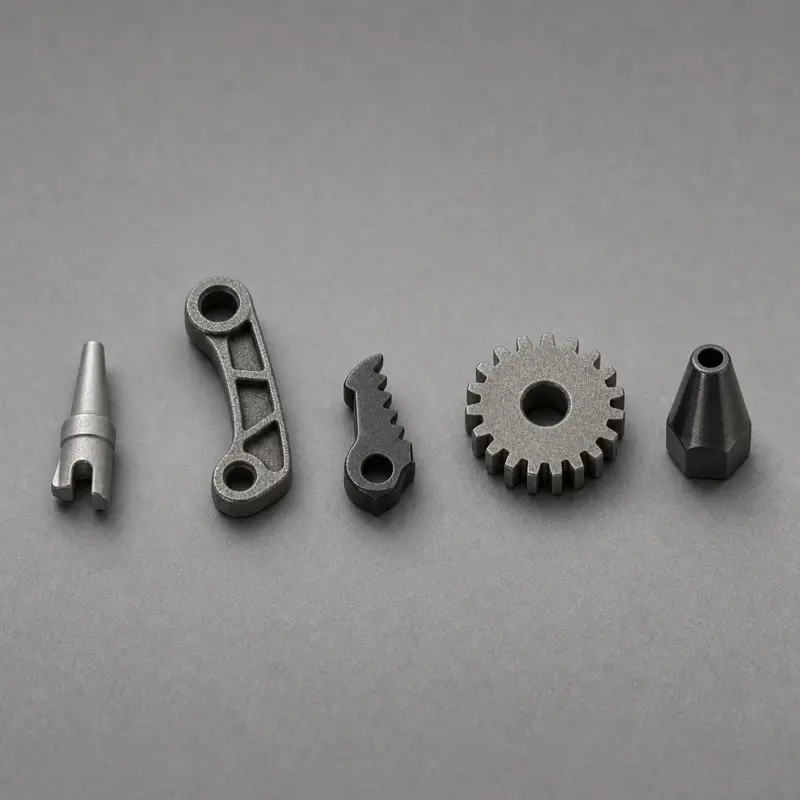
| If Your Priority Is | Look At | Route |
|---|---|---|
| Sterilisation and corrosion | MIM-316L, polished and passivated | Medical components |
| An edge that must resist rust | MIM-420 or MIM-440C, heat treated | Molding plus heat treatment |
| Strength in a stainless part | MIM-17-4PH aged to H900 | Molding plus ageing |
| Hardness at the lowest cost | MIM-4605, quenched and tempered | Heat treatment |
| Magnetic response | MIM-FeNi50 with a magnetic anneal | Molding plus anneal |
| Sliding wear and edge life | Cobalt bonded tungsten carbide, WC-6Co or WC-8Co | Powder metallurgy or MIM |
| Nozzles or fittings in corrosive fluid | Nickel bonded tungsten carbide, WC-6Ni or WC-8Ni | MIM plus grinding |
| Weight, or a biocompatible route | Commercially pure titanium Grade 2, Ti-6Al-4V Grade 5 | Molding plus finishing |
| One feature tighter than 0.3 percent | Mold near net, machine that feature only | MIM plus CNC finishing |
| Fewer than 5,000 parts a year | Same alloys, no tooling to amortise | Metal 3D printing or machining |
Swipe the table sideways for every column
What Ships With Every Sintered Lot
Traceability on a MIM part starts at the powder lot, because chemistry and particle size set the shrinkage the tool was cut for. These are the records tied to your batch.
Powder and Feedstock Certificates
Certificate of analysis for the powder lot that made your parts, naming alloy chemistry, carbon and oxygen content and particle size distribution.
Density and Hardness Records
Archimedes density to ISO 1183 confirming the part reached the qualified minimum, plus Rockwell or Vickers hardness to ISO 6507 and 6508.
Furnace and Heat Treat Evidence
Sintering profile and ageing or quench and temper records for the batch, tied to the first article inspection and CMM results on nominated features.
Compliance Files
EN 10204 3.1 certificates, REACH and RoHS declarations, conflict minerals reporting and PPAP packages where the programme calls for them.
Swipe to see all four
MIM Materials FAQ
What materials are used in metal injection molding?
Metals that can be atomised into a fine powder and sintered without contamination. Meco runs MIM-316L austenitic stainless, MIM-420 and MIM-440C martensitic stainless for hardened edges, MIM-17-4PH precipitation hardening stainless, MIM-4605 low alloy steel and MIM-FeNi50 soft magnetic alloy as core grades, plus cobalt and nickel bonded tungsten carbide, titanium, brass and bronze feedstock. Stainless dominates because it balances corrosion resistance, strength and clean sintering behaviour. Aluminum and zinc are not viable, since they melt below the temperature the process needs.
Which stainless MIM grade holds an edge?
MIM-420 and MIM-440C, once heat treated. 440C carries more carbon and takes the higher hardness of the two, above 55 HRC against roughly 48 HRC for 420, at the cost of slightly more brittleness. Neither runs the corrosion resistance of 316L, since the chromium that gives edge-holding grades their hardness is partly tied up as carbides rather than free in the matrix. For a blade or wear tip that also has to shrug off moisture, 440C is usually the better trade than 316L pushed harder than it can go.
Which MIM alloy is strongest?
MIM-4605 quenched and tempered, at above 1600 MPa tensile and 48 HRC, but it buys that with elongation above 1 percent only. MIM-17-4PH aged to H900 gives above 1100 MPa with better ductility and stays stainless. If the part sees impact rather than steady load, the higher hardness option is usually the wrong one. Name the failure mode you are designing against and the grade choice narrows immediately.
Should tungsten carbide MIM parts use a cobalt or nickel binder?
Cobalt binder for general wear and cutting duty, nickel binder when the part sees acids, salts or moisture the cobalt would corrode out of. WC-6Co and WC-8Co, corresponding to ANSI grades C3 and C2, cover most cutting inserts and wear pads, with the lower cobalt content trading a little toughness for wear life. WC-6Ni and WC-8Ni swap that binder for nickel specifically for corrosive service, spray nozzles and chemical handling parts being the usual case, at a small cost in hardness and price.
How much does a MIM part shrink?
Between 15 and 20 percent linearly during sintering, which is why the tool is cut 17 to 20 percent oversize. The exact figure belongs to the feedstock, the geometry, the gate position and how the part is supported in the furnace, so no single number applies to every job. We set the oversize from the qualified feedstock, then correct the steel off measured first articles. Long spans and uneven mass distribution are where shrinkage stops behaving predictably.
What tolerance can metal injection molding hold?
Around 0.3 to 0.5 percent of the nominal dimension straight from the furnace, so roughly 0.06 to 0.10 mm on a 20 mm feature. Surface finish comes off at 0.8 to 1.6 micrometres Ra as sintered. Where one dimension has to hold tighter than that, we mold near net shape and machine only that feature, which reaches ±0.01 mm. Marking those features on the drawing early keeps the rest of the part cheap.
Can MIM parts be heat treated?
Yes, and for three of the core grades it is the point. MIM-17-4PH is solution treated and aged to H900 or another approved condition, MIM-4605 responds to carburising or quench and temper like its wrought equivalent, and MIM-420 or MIM-440C are hardened the same way tool steel is. MIM-316L is not hardenable by heat treatment. Ageing, hardening and quenching all move dimensions, so parts with tight flatness or runout may need fixturing, sizing or final machining afterwards.
Is MIM stainless as corrosion resistant as wrought?
Close, but only with the right finishing. Chromium evaporates preferentially from the surface during sintering, and residual surface porosity holds contaminants, so an unfinished MIM stainless part can pit sooner than wrought. Polishing and passivation restore the surface chemistry and bring general corrosion performance back in line. For sterilised or chloride exposed parts, specify the finishing on the drawing rather than leaving it to the shop.
When is MIM the wrong process?
When the part is heavy, simple or low volume. Above roughly 100 grams debinding gets risky, and above 160 grams it usually fails. A simple turned or milled shape gains nothing from a mold. Below about 5,000 pieces a year the tooling will not amortise, so machining or metal 3D printing wins on total cost. Roughly one part in three brought to us for MIM gets quoted as machining or casting instead.
Do MIM parts come with material certificates?
Yes. Powder lot certificates of analysis, EN 10204 3.1 material certificates, density and hardness records, first article inspection, CMM reports and PPAP packages are all available on request. REACH, RoHS and conflict minerals documentation is issued alongside them. Everything traces back to the powder lot and furnace batch that produced your shipment, under an IATF 16949:2016 quality system.
Getting to the Right Alloy
A STEP file plus load, service temperature, corrosion exposure, any magnetic requirement and annual volume. Send it through the quote form. What the part endures decides the grade faster than the geometry does.
Our engineers set the oversize against the chosen feedstock, balance the wall sections, plan furnace support, and mark which features need machining after sintering rather than before.
DFM feedback comes back with the quote inside 24 hours, tooling separated from piece price, and the volume at which MIM beats your current route stated in writing.
Reading Around Sintered Metal
Three guides on how the process runs, what a small metal part actually costs, and where the tolerance line sits.

What Is Metal Injection Molding
Compounding, molding, debinding and sintering explained, with the size and volume limits that decide fit.
Read the guide →
What a Metal Part Really Costs
Where tooling, material and volume sit in the price, and how to compare routes on total cost rather than piece price.
Read the guide →
Choosing Machining Tolerances
ISO 2768 explained, and how to decide which features justify machining after a near net shape process.
Read the guide →Swipe for all three guides
