
How to Choose a Custom Plastic Injection Molding Service that protects your bottom line:
- The Price Trap: Why the cheapest quote is often just a down payment on future problems.
- Vetting Criteria: How to filter vendors by Volume, Quality, and Design Support (DFM).
- Sourcing Strategy: Deciding between the agility of domestic shops vs. offshore savings.
- Red Flags: Critical warning signs to spot before you cut steel.
The "Cheap" Quote is the Most Expensive Thing You’ll Ever Buy
There is no feeling quite like finally freezing the design on a complex assembly. The interference checks pass, the draft angles look clean, and the renders are beautiful. But let’s be honest: that satisfaction evaporates the moment you have to source the tooling.
You type “custom plastic injection molding” into the search bar, and you’re hit with millions of results. It’s paralyzing.
You’re staring at a spreadsheet full of potential vendors ranging from a garage shop in Ohio to a massive conglomerate in Shenzhen, and you have no idea who is telling the truth about their capacity.
Here is the mistake I see most often, and it keeps me up at night: You look at the bottom line of an injection molding quote, see a number 30% lower than the rest, and think you’ve won.
You haven’t.
In my experience, the cheapest quote is usually just the down payment on your most expensive problems. I’ve seen promising startups bleed out cash because they confused a low piece price with total landed cost. When the mold shoots flash on every cycle, the texture is wrong, or the resin spec gets quietly swapped, those supply chain risks turn into a line-down disaster.
You don’t need a vendor who just takes orders. You need a manufacturing partner who catches your mistakes before steel is cut. Let’s talk about how to find one.

Define Your Project Needs First (The Filter)
The Volume Trap: Prototyping vs. Production
Here is the hard truth: A shop optimized for high-volume production will hate your 500-unit pilot run. They might quote it, but they will bury the setup costs in the piece price, and your job will be the first one pulled from the schedule when a “real” order comes in. Conversely, a low-volume injection molding specialist or a rapid prototyping house cannot handle scale. They are great at cutting aluminum soft tools in three days, but those molds have a short mold life. If you try to run 100,000 shots on a soft tool, you’re going to see flash and dimensional drift before you hit the ROI point.- Low Volume (100 – 5,000 parts): You need speed and low NRE (Non-Recurring Engineering) costs. You are looking for single-cavity MUD frames or aluminum tooling.
- High Volume (100,000+ parts): You are not buying a mold; you are buying cycle time. You need a partner who understands multi-cavity tooling (cavitation) and conformal cooling. Saving 3 seconds per cycle here is worth paying double for the tooling.
The Industry Standard: Paying for What You Need
I once saw a procurement manager insist on using a medical molder for a consumer electronics housing. He felt “safer” with their quality standards. He blew his budget by 40%. Medical and Aerospace molders charge a premium because you are paying for their overhead the ISO 13485 certifications, the clean rooms, and the rigorous traceability. If you are making a consumer bracket that just needs to snap together and look pretty, you are paying for paperwork you will never read.- Medical/Aero: You need tight tolerances and certified resin tracking.
- Consumer/Industrial: You likely need cosmetic perfection (texture, color match) and aggressive cost targets.
Define these parameters now. If you walk into a negotiation knowing exactly where you fit on the volume and quality spectrum, you stop being a “lead” and start being a qualified buyer. That is how you get the senior engineers to look at your print.
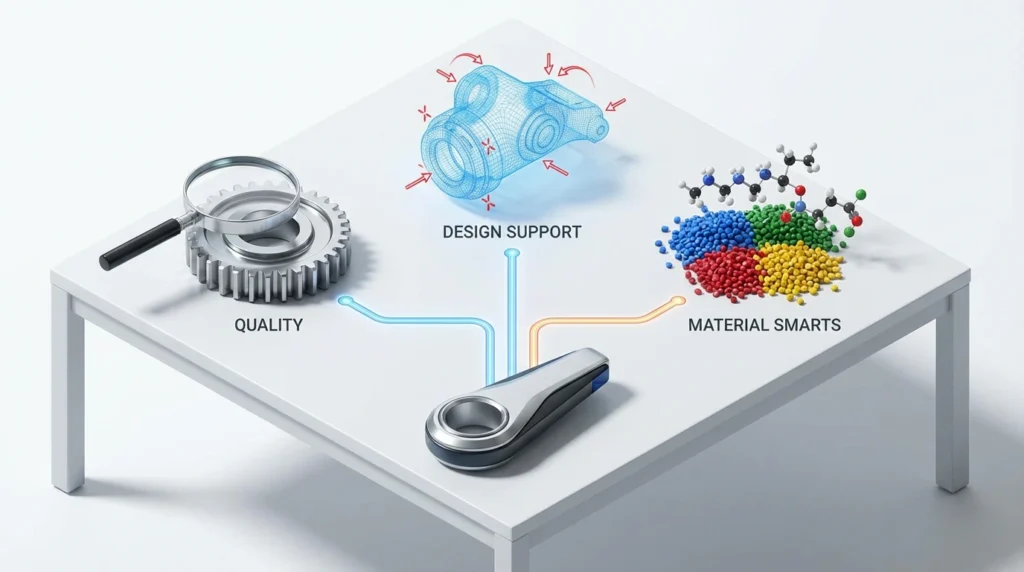
The "Big Three" Vetting Criteria (The Core)
Once you have filtered out the shops that don’t fit your volume or industry profile, you are left with a shortlist.
Now comes the interrogation. You aren’t just looking for a vendor; you are auditing a potential partner.
To do this effectively, you must look past the sales pitch and scrutinize the “Big Three”: Quality, Design Support, and Material Smarts.
A. Quality Assurance: Beyond the Badge
If a molder’s website doesn’t display an ISO badge, close the tab. That is the baseline. However, do not make the rookie mistake of assuming that being ISO 9001 certified guarantees you will get perfect parts every time. It doesn’t.
ISO 9001 is not a guarantee of quality; it is a guarantee of consistency. It means the shop has a documented process for how they handle your order, how they inspect the press, and how they handle non-conforming parts.
It means that if they make a mistake, they have a system to track why it happened so they don’t make it twice. When vetting, ask for their Quality Manual.
You don’t need to read the whole thing, but asking for it signals that you know how the game is played.
Ask them how they handle quality control inspection frequencies. Do they check every hour? Every shift? Or just the first and last shot?
For specialized industries, the stakes are higher. If you are in the medical space, ISO 13485 is non-negotiable. This certification adds layers of risk management and strict traceability.
If a specific batch of parts fails in the field three years from now, an ISO 13485 shop can tell you exactly which batch of resin was used, what day it was molded, and who was running the machine.
B. Design for Manufacturing (DFM) Support: The Litmus Test
This is the single most important indicator of a molder’s competence.
There is a dangerous type of molder out there: The Order Taker. You send them a CAD file, they quote it, they cut the steel, and then they ship you parts with warped walls, sink marks, and impossible tolerances.
When you complain, they point to your file and say, “We made exactly what you drew.”
You must avoid these shops at all costs.
A true molding partner provides a rigorous DFM analysis before a single cent changes hands for tooling. They should be tearing your design apart.
They should be calling you to say, “Hey, this rib is too thick and will cause sink marks on the cosmetic face,” or “You need to increase the draft angle here, or the part will stick in the mold.”
If a molder accepts your design without feedback, be suspicious. Injection molding is a war against physics shrinkage, flow lines, and cooling rates.
If they don’t mention tolerance requirements and gate locations with you during the quoting phase, they are planning to fix the problems with your money later (and it won’t be cheap).
C. Material Expertise: Chemistry Over Commodity
Many product designers treat thermoplastic materials as an afterthought. They pick “ABS” or “Polycarbonate” from a drop-down menu in their CAD software and move on.
A high-caliber molder understands that resin selection is a strategic decision.
They should act as your materials consultant. If you specify a generic Nylon 6/6, a good molder might ask, “This part is going to be exposed to moisture; have you considered a PBT blend to maintain dimensional stability?”
They should also be able to navigate the supply chain. We are seeing increasing volatility in resin availability. A savvy partner won’t just help you pick the best resin for performance; they will help you pick a resin that you can actually buy six months from now. They should be suggesting alternatives that lower cycle times or reduce weight without sacrificing structural integrity.
If their answer to every material question is, “We’ll run whatever you send us,” you’re talking to a machine operator, not a manufacturer. You need the latter.
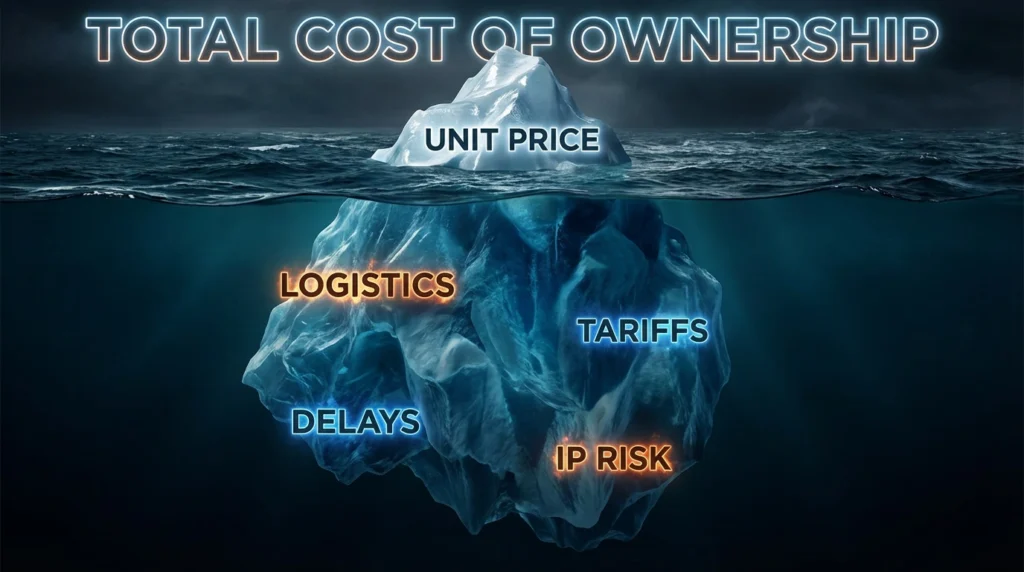
Domestic vs. Offshore Molding (The Debate)
The decision between sourcing domestically or looking overseas is rarely emotional; it is a cold calculation of risk versus reward.
For decades, the default move for hardware startups was to send tooling to Asia to capitalize on lower labor rates.
However, the global landscape has shifted and constantly evolving. To make the right choice, you must look beyond the unit price on the quote and calculate the Total Cost of Ownership (TCO).
The Case for Offshore
Offshore molding primarily in China and Southeast Asia offers undeniable advantages in upfront capital expenditure.
Tooling costs can be 30% to 50% lower than domestic equivalents. If you are producing high-volume, commodity parts where the geometry is simple and timelines are flexible, offshore is often the statistically correct financial move.
However, the savings on steel are frequently eroded by supply chain logistics. Ocean freight is slow, and the costs are volatile; air freight is fast but will destroy your margins instantly.
Furthermore, intellectual property protection remains a valid concern. While many offshore shops are reputable, enforcing a patent infringement lawsuit in a foreign court is a battle few companies can afford to fight.
The Case for Domestic
Conversely, US-based injection molding often comes with sticker shock. The tooling and piece-part prices will almost certainly be higher due to labor and overhead. But what you are paying for is agility and security.
Domestic partners eliminate the unpredictability of international shipping, customs delays, and tariffs. Communication happens in your time zone, which drastically reduces lead times for engineering changes and DFM reviews.
If a mold breaks in Ohio, it can be fixed in days. If it breaks in Shenzhen, you might be down for weeks. Additionally, the legal framework in the US provides a safety net for your proprietary designs that offshore jurisdictions cannot match.
The Verdict
The “better” option depends entirely on your project’s constraints. If you have thin margins, a simple design, and a six-month runway, the offshore savings are hard to beat. But if you are dealing with complex geometry, strict launch deadlines, or sensitive IP, the premium for domestic manufacturing is often cheaper than the cost of a single offshore delay. Do not just compare the invoice; compare the risk.

Customer Service & Communication (The Dealbreaker)
You can have the most precise steel tooling and the highest-grade resin, but if the team managing your project goes silent, your product launch is dead in the water.
Injection molding is not a vending machine transaction where you insert money and receive a part; it is a long-term relationship that often spans years.
When vetting a potential partner, look past the machinery list and evaluate their customer support infrastructure. The most critical test often happens before you sign the contract: How fast do they respond to your RFQ? If they are slow to take your money, they will be even slower to fix a problem once they have it.
Ask the hard questions early. Do they answer the phone? Do you have a dedicated project manager, or are you shouting into a generic “sales@” email void? You need a specific point of contact who knows your part geometry, understands your timeline, and practices communication transparency.
The reality of manufacturing is that things go wrong. A mold might flash, a texture might not release, or a resin shipment might get delayed. In those moments, the difference between a minor hiccup and a catastrophic failure is communication. You need a partner who calls you immediately with a solution, not one who hides behind voicemail until you force an answer.
Furthermore, look for a molder who views themselves as an extension of your factory. Are they willing to handle post-production services? A partner invested in your success will often offer assembly and packaging, streamlining your logistics and reducing the number of hands touching your product.
Ultimately, the lowest price per part is irrelevant if the vendor is impossible to work with. Do not underestimate the value of a partner who simply picks up the phone.

Red Flags to Watch Out For (The Warning)
In the rush to get a product to market, it is easy to wear rose-colored glasses.
However, a bad manufacturing partnership can bleed your budget dry and ruin your reputation.
If you encounter any of these warning signs during the vetting process, do not negotiate run.
5 Red Flags to Spot Immediately
- The “Too Good to Be True” Quote
If one bid is 40% lower than the rest, they aren’t efficient; they are cutting corners. Be prepared for hidden fees, inferior steel, or sudden price hikes once production starts. - The “Yes Man” Approach
If a molder accepts your CAD files without offering a single piece of Design for Manufacturing (DFM) feedback, they are setting you up for failure. A true partner challenges your design to improve moldability. - Ambiguous Tooling Ownership
Check the contract fine print. You paid for the mold; you should own it. If the molder claims proprietary rights or refuses to move the tool to another facility later, they are holding your asset hostage. - Silence on Maintenance
Molds wear out. If the proposal lacks a clear plan for mold maintenance and repair, you will eventually face quality defects that they will refuse to pay for. - Vague Lead Times
“We’ll fit you in soon” is not a schedule. If they cannot commit to a hard completion date for the tooling, your project is not a priority.
Protect your business by spotting these traps early. It is always cheaper to walk away from a bad quote than to rescue a failed project.
Conclusion & Call to Action (The Solution)
Finding the perfect plastic manufacturing partner or a provider for complex metal assemblies should not feel like a gamble. It is about aligning with a team that treats your product’s success as their own.
When you choose a manufacturer that offers true end-to-end ownership, you are not just purchasing components; you are securing peace of mind and protecting your bottom line.
As you finalize your decision, remember the three pillars of a successful partnership:
- Verify Capabilities: Ensure they have the proven facilities, from injection molding to CNC machining, to back up their claims.
- Demand DFM: Never settle for a silent supplier. Real engineering support refines your design for efficiency before a single tool is cut.
- Value Communication: Look for transparency. You need a partner who provides clear updates from the initial T0 sample to final logistics.
At Meco, we combine global manufacturing scale with local support to ensure your vision becomes reality without the headaches. We don’t just print quotes; we build solutions.
Ready to start your project with a partner who cares about your parts as much as you do?
Request a free DFM analysis and quote today.
Frequently Asked Questions about Injection Molding
How much does an injection mold cost?
Mold costs vary significantly based on complexity and material. A simple, single-cavity aluminum prototype mold may cost between $2,000 and $5,000. However, complex, multi-cavity hardened steel molds designed for high-volume production often range from $20,000 to over $100,000 due to the precision machining and EDM work required.
When should I switch from 3D printing to injection molding?
The switch is usually driven by volume and material requirements. While 3D printing is ideal for prototyping (1–50 parts), injection molding becomes more cost-effective once you need 100+ parts. Additionally, if your part requires specific material properties (strength, flexibility) or surface finishes that printing cannot achieve, molding is the necessary choice regardless of volume.
What is the standard lead time for a new mold?
Lead times depend on the mold class. "Rapid tooling" or aluminum molds can often be completed in 2–4 weeks. Standard steel production molds typically require 6–10 weeks for design, machining, and testing (T1 samples). Complex molds with side actions or hot runner systems may take 12 weeks or longer.
What is the difference between single-cavity and multi-cavity molds?
A single-cavity mold produces one part per cycle, lowering tooling costs but increasing the price per part. A multi-cavity mold creates several identical parts at once (e.g., 4 or 8), which drastically reduces the unit price and production time but requires a much higher upfront investment in tooling.
