
What Is 4-Axis CNC Machining? Process, Benefits, and Comparison Guide
4-axis CNC machining is a manufacturing process where a cutting tool moves along the standard X, Y, and Z linear axes while the workpiece simultaneously rotates on a fourth axis — called the A-axis. That rotation lets the machine reach multiple sides of a part in a single setup, without an operator stopping the cut to re-clamp or reposition anything.
If you've ever quoted a part that needed features on three or four faces, you know the pain. On a three axis cnc mill, every new face means a new fixture, a new alignment, and a new chance for error. A 4 axis cnc machine removes that bottleneck. The part spins to the tool instead of the other way around. Fewer setups, tighter tolerances between features, and faster cycle times.
According to Technavio, the global CNC machine tools market is expected to grow by USD 21.9 billion between 2025 and 2029. Much of that growth comes from manufacturers adopting multi-axis equipment — including 4-axis machining centers — to handle increasingly complex part geometries without inflating production costs.
This guide covers everything you need to know: how the fourth axis works, indexed vs. continuous operation, a head-to-head comparison of 3-axis vs. 4-axis vs. 5-axis, real-world applications, materials, costs, and design tips for getting the most out of four axis machining.
Quick Definition
4-axis CNC machining adds a rotary A-axis (rotation around the X-axis) to the three linear axes (X, Y, Z) of a standard CNC mill. This lets the workpiece rotate during or between cuts, so multiple sides of a part can be machined without removing it from the fixture. The result: fewer setups, better accuracy, and the ability to produce complex geometries that a 3-axis machine can't reach.
How Does a 4-Axis CNC Machine Work?
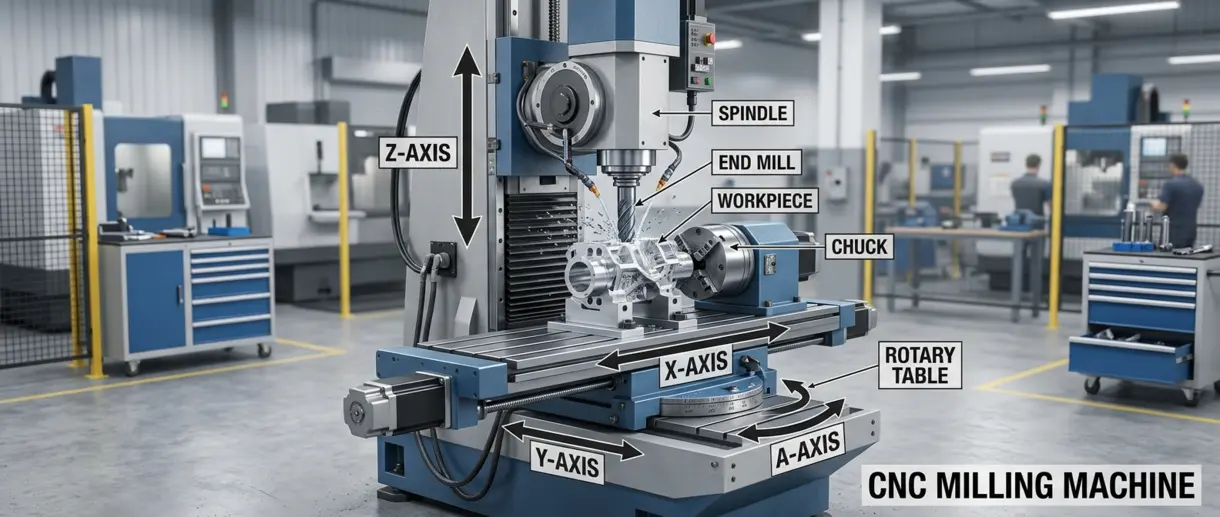
A four axis cnc machine follows the same basic workflow as any CNC mill — CAD design, CAM toolpath generation, machine setup, cutting, and finishing. The difference is what happens during the cut. While the spindle moves the tool through X (left-right), Y (front-back), and Z (up-down), the workpiece can also rotate around the X-axis on a rotary table or chuck. That's the 4th axis.
Think of it like a rotisserie. The chicken (your part) rotates while the heat (the cutting tool) stays in position. The tool reaches every side without anyone flipping the chicken by hand.
The A-Axis Explained
In CNC terminology, linear axes are X, Y, and Z. Rotary axes follow the same sequence: A rotates around X, B rotates around Y, and C rotates around Z. A cnc with 4th axis adds the A-axis — a motor-driven rotary unit bolted to the machine table. The workpiece is gripped in a chuck on one end and supported by a tailstock on the other, similar to a lathe.
This setup gives the cutter access to four sides of a prismatic part, or 360° of a cylindrical part, without reclamping. Features on different faces — holes, pockets, slots, contours — stay perfectly aligned because the part never leaves the fixture.
Indexed (3+1) vs. Continuous 4-Axis Machining
Not all 4 axis cnc operations are the same. There are two modes, and the distinction matters.
Indexed 4-axis machining (also called 3+1) rotates the part to a set angle, locks it in place with a brake, and then runs standard 3-axis cutting on that face. Once the cuts are done, the brake releases, the part indexes to a new angle, and the process repeats. This mode is simpler to program and works well for parts that need features on multiple flat faces — like a housing with holes on four sides.
Continuous 4-axis machining is the real upgrade. Here, the A-axis rotates while the X, Y, and Z axes move simultaneously. All four axes are in motion at once. This is what you need for helical features, cam lobes, spiral grooves, and complex curved surfaces that change shape around the circumference of the part.
Continuous mode demands more advanced CAM software and a machine controller that can interpolate four axes at once. But for the right parts, it's the only way to get the geometry done in a single operation.
3-Axis vs. 4-Axis vs. 5-Axis CNC Machining: What's the Difference?
The core difference between these three machine types is how many directions the tool and workpiece can move relative to each other. More axes means more complex geometry — but also higher machine cost and programming complexity. Here's a direct comparison.
| Attribute | 3-Axis CNC | 4-Axis CNC | 5-Axis CNC |
|---|---|---|---|
| Axes of Motion | X, Y, Z (linear only) | X, Y, Z + A (one rotary) | X, Y, Z + A + B or C (two rotary) |
| Sides Machined per Setup | 1 side | 4 sides (indexed) or 360° (continuous) | 5 sides or full 360° simultaneous |
| Typical Accuracy | ±0.01 mm | ±0.01 mm (improved repeatability) | ±0.005 mm (ultra-precision) |
| Best Geometry | Flat, prismatic, 2D/2.5D parts | Multi-sided parts, cylinders, helixes, angled holes | Organic contours, deep pockets, compound curves, turbine blades |
| Setups Required | Multiple (1 per face) | 1 setup for 4 faces or cylindrical work | 1 setup ("done-in-one") |
| Programming Complexity | Low | Medium | High |
| Hourly Rate (Typical) | $50–$100/hr | $60–$120/hr | $100–$200/hr |
| Machine Cost (Industrial) | $50,000–$200,000 | $100,000–$350,000 | $200,000–$500,000+ |
| Ideal Use Case | Brackets, plates, simple housings | Gearbox housings, camshafts, multi-face enclosures | Aerospace impellers, medical implants, turbine blades |
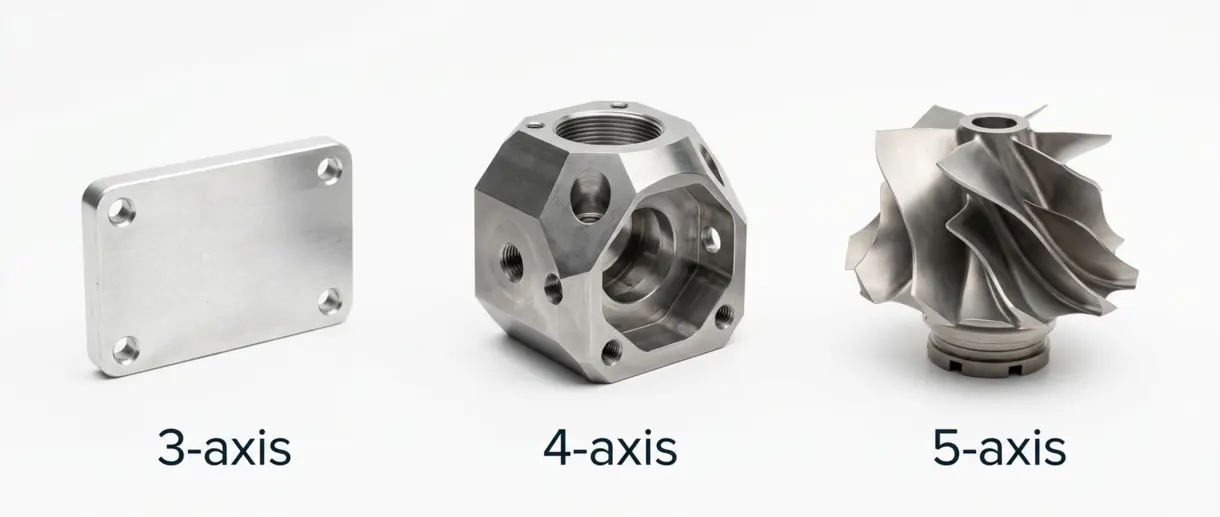
A 3 axis machine handles the majority of simple milling jobs — flat profiles, drilled holes, slots, and pockets on a single face. It's the most affordable option and the fastest for straightforward parts. But the moment your part has features on a second, third, or fourth face, you're looking at multiple setups, extra fixtures, and the tolerance drift that comes with reclamping.
A 4 axis cnc mill solves that problem by rotating the part to expose each face without breaking the setup. For parts with angled holes, side pockets, or cylindrical features, it's the sweet spot of capability and cost.
A 5-axis CNC machine goes further with two rotary axes moving simultaneously. It's essential for compound curves and organic shapes — think turbine blades, aerospace impellers, and medical implants — but the hourly rate and programming overhead are significantly higher. We wrote a full breakdown in our guide to 5-axis CNC machining.
What Are the Benefits of 4-Axis CNC Machining?
Fewer setups, faster production. The biggest win is eliminating manual re-fixturing. A part that requires four setups on a three axis cnc mill can often be completed in one setup on a four axis cnc. That alone can cut cycle time by 30–50% on multi-sided parts.
Tighter tolerances between faces. Every time you remove and reclamp a workpiece, you introduce positional error. On a 4 axis machining center, the geometric relationship between features on different faces is locked in by the rotary axis. Meco holds ±0.01 mm accuracy on 4-axis work per ISO 2768 and ASME Y14.5.
Better surface finish. Continuous rotation produces smoother tool engagement, especially on curved or cylindrical surfaces. Less vibration and more consistent chip load translates to finer surface quality — typically Ra 0.4–3.2 µm depending on the material and strategy.
Complex geometry without compromise. Helixes, cam lobes, angled holes, side pockets, and wrap-around contours are straightforward on a four axis cnc milling machine. On a 3-axis machine, some of these features are simply impossible.
Lower total cost for the right parts. The per-hour rate for a cnc 4 axis machine is higher than a 3-axis. But when you factor in eliminated setups, reduced fixture costs, fewer scrapped parts from realignment errors, and shorter lead times, the total project cost often comes out lower.
From Our Shop Floor
In our experience machining multi-sided aluminum housings for a telecom OEM, switching from a 3-axis workflow (three separate setups per part) to a 4th axis cnc configuration cut cycle time by 40% and eliminated the ±0.08 mm positional drift we were seeing between fixture changes. The part ran at ±0.01 mm across all four faces — right where the print called it. That's the kind of improvement that compounds across a 50,000-piece annual program.
What Types of 4-Axis CNC Machines Exist?
4-Axis CNC Milling Machines
The most common type. A vertical or horizontal cnc milling machine 4 axis adds a rotary table or trunnion to a standard mill. Vertical machines (spindle points down) are the workhorse for most job shops. Horizontal machines (spindle points sideways) excel at chip evacuation on deep pocket work and tombstone fixtures that hold multiple parts for batch production.
4-Axis CNC Lathes
A 4 axis lathe adds a secondary axis to a turning center — typically Y-axis travel or a sub-spindle — allowing milling, drilling, and off-center features to be cut on a turned part without transferring it to a separate machine. This is common for shafts, fittings, and threaded components that need cross-holes or flats.
4-Axis CNC Routers
A 4 axis cnc router is used primarily in woodworking, foam cutting, and large-format composite machining. The rotary axis spins long stock (like table legs or cylindrical molds) while the router carves 3D profiles. Industrial metal-cutting routers exist too, but they're less common than dedicated milling machines for precision work.
What Industries Use 4-Axis CNC Machining?
4-axis machining shows up anywhere parts need features on multiple faces or require rotational geometry. Here are the industries that rely on it most heavily.
Automotive: Gearbox housings, engine brackets, suspension knuckles, and EV battery tray components. Automotive parts manufacturing demands high-volume repeatability with PPAP documentation — exactly the kind of program where eliminating setups pays off at scale.
Aerospace: Engine mounts, structural brackets, avionics enclosures, and landing gear fittings. Aerospace manufacturing requires full traceability (lot/serial tracking, material certs) and NDT inspection — all of which Meco provides as standard.
Medical: Surgical instruments, orthopedic implant components, and diagnostic device housings. Tight tolerances and biocompatible materials (titanium, 316L stainless) make four axis cnc the right choice for parts that need precision on multiple faces.
Electronics & Telecom: RF enclosures, heatsinks with fin arrays, connector housings, and rack-mount chassis. The ability to machine pockets and mounting holes on all four sides of an enclosure in a single setup keeps costs down on mid-volume runs.
Industrial & Heavy Equipment: Hydraulic valve bodies, pump housings, manifolds, and structural weldment interfaces. These parts are often large, heavy, and expensive to re-fixture — making single-setup 4-axis machining a clear win.
-->
What Materials Can Be Machined on a 4-Axis CNC?
A 4 axis cnc machine handles the same materials as any CNC mill — the axis count changes what geometry you can cut, not what material you can cut it from. Here's what Meco machines on 4-axis equipment daily.
| Material Category | Common Grades | Key Properties |
|---|---|---|
| Aluminum | 6061, 7075, 5052, 2024 | Lightweight, corrosion-resistant, excellent machinability |
| Carbon & Alloy Steel | 1045, 4140, 4340 | High strength, toughness, weldable |
| Stainless Steel | 303, 304, 316, 17-4PH | Corrosion-resistant, durable, hygienic |
| Brass | C360, C464 | Excellent machinability, electrically conductive |
| Bronze | C932, C954 | Wear-resistant, low friction |
| Copper | C110, C145 | High thermal/electrical conductivity |
| Titanium | Grade 2, Grade 5 (Ti-6Al-4V) | High strength-to-weight, biocompatible |
| Engineering Plastics | PA (Nylon), POM (Delrin), PTFE, PMMA | Lightweight, chemical-resistant, low friction |
After machining, most parts go through surface finishing — anodizing for aluminum, zinc or nickel plating for steel, powder coating for cosmetic and corrosion protection. Meco handles finishing in-house so the part moves from the 4-axis machine to the coating line without leaving the facility.
How Much Does 4-Axis CNC Machining Cost?
Hourly rates for a 4 axis cnc mill typically fall between $60 and $120 per hour in North America, depending on the machine size, material, and required tolerances. That's roughly 20–40% more than a standard 3-axis mill — but the reduced setup count usually brings the total part cost down, not up.
Here's what drives cost on a 4 axis cnc machining job:
- Material: Titanium and Inconel cost more to cut than aluminum or brass. Tool wear is the main factor.
- Complexity: Continuous 4-axis toolpaths take longer to program (and verify) than indexed operations.
- Tolerances: Holding ±0.01 mm costs more than ±0.05 mm. Tighter specs mean slower feed rates and more inspection time.
- Volume: Setup cost is amortized across quantity. A 10-piece prototype run costs more per part than a 10,000-piece production order.
- Finishing: Anodizing, plating, or painting adds cost downstream.
For a deeper breakdown of CNC pricing factors — including machine hourly rates, tooling costs, and DFM strategies that reduce cost by 15–30% — read our full guide on how much CNC machining costs. And for a look at what CNC machines themselves cost to buy, our CNC machine costs breakdown covers everything from desktop units to production-grade machining centers.
Meco delivers DFM feedback and detailed quotes in under 24 hours. If 4-axis is overkill for your part, we'll tell you — and route it to a 3-axis machine to save you money. Request a quote to get started.
When Should You Use 4-Axis Instead of 3-Axis?
Not every part needs a fourth axis cnc machine. Here's a simple five-question checklist. If you answer "yes" to two or more, 4-axis is probably the right call.
The 5-Question 4-Axis Checklist
1. Does your part have features (holes, pockets, slots) on more than one face?
2. Are there tight positional tolerances between features on different faces?
3. Does the part include angled holes, helical grooves, or cam-like profiles?
4. Are you currently running 3+ setups per part on a 3-axis machine?
5. Is your production volume high enough that saving 1–2 minutes per part matters?
Two or more "yes" answers → strong candidate for 4-axis machining.
Zero → stick with 3-axis CNC. It's cheaper and faster for simple geometry.
We recommend 4-axis as the default for any part that needs work on three or more faces. The setup time savings alone justify it on runs as small as 25 pieces in most cases. For parts with compound curves or organic 3D surfaces that change in two rotational directions, you'll want to step up to 5-axis CNC machining instead.
For more context on how 4-axis CNC is reshaping production strategies across the continent, check out our article on why 4-axis CNC is powering North America.
Design Tips for 4-Axis CNC Parts
Getting the most out of a cnc 4th axis starts at the design stage. A few DFM (Design for Manufacturability) decisions early on can shave 20–30% off your machining cost and lead time.
Consolidate features onto the A-axis rotation plane. In indexed mode, all angled features must share the same rotation axis. If your part has features at different compound angles, it may need a 5-axis machine — or multiple indexed setups that reduce the 4-axis advantage. Design around a single rotation axis whenever possible.
Keep critical features in the same clamping. The whole point of 4-axis is maintaining alignment between faces. Put the tightest-tolerance features on faces accessible in a single setup so the machine can hit them all without reclamping.
Design for chip clearance. On cylindrical parts, deep slots and narrow pockets can trap chips and cause re-cutting damage. Add draft angles or relief features where possible to let chips fall away from the cut.
Specify tolerances based on function, not habit. Not every dimension needs ±0.01 mm. Over-tolerancing increases cycle time because the machine runs slower to hold tighter specs. Tolerance the features that matter and relax everything else. Meco's engineers flag this during DFM review — it's included with every quote.
If you want engineering support before you've even finalized drawings, Meco's R&D engineering team can help optimize your part for 4-axis production from the concept stage.
Specifications and Tolerances for 4-Axis CNC Machining
Here are the specifications Meco holds on 4-axis CNC machining work, verified by CMM inspection to ±0.002 mm measurement precision.
| Specification | Value |
|---|---|
| Positional Accuracy | ±0.01 mm |
| Repeatability | Improved vs. 3-axis (no re-fixturing drift) |
| Surface Finish (Fine) | Ra 0.4 µm (16 RMS) |
| Surface Finish (Medium) | Ra 1.6 µm (64 RMS) |
| Surface Finish (Coarse) | Ra 3.2 µm (125 RMS) |
| Tolerance Standards | ISO 2768, ISO 286 |
| Inspection | CMM (±0.002 mm), gauge R&R, SPC |
| Quality Certification | IATF 16949:2016 |
| Metals | Aluminum, Steel, Stainless Steel, Brass, Bronze, Copper, Titanium |
| Plastics | PA (Nylon), POM, PTFE, PMMA |
Meco's custom CNC machining capabilities span 3-axis through 5-axis milling, turning, drilling, and tapping — all under one roof at IATF 16949:2016 certified facilities in Thailand (20,000 m²) and China (16,000 m²). U.S.-based engineering support handles DFM review and program management across time zones.
Frequently Asked Questions About 4-Axis CNC Machining
What is 4-axis CNC machining?
4-axis CNC machining is a manufacturing process where a cutting tool moves along three linear axes (X, Y, Z) while the workpiece rotates on a fourth rotary axis called the A-axis. The A-axis rotates around the X-axis, giving the cutter access to multiple sides of the part in a single setup. This reduces fixturing, improves accuracy between features on different faces, and enables complex geometries like helixes, cam lobes, and angled holes that are impossible on a 3-axis machine.
How does a 4-axis CNC machine work?
A 4-axis CNC machine works by adding a rotary table or chuck to a standard 3-axis mill. The workpiece is clamped in the chuck and can rotate around the X-axis (the A-axis) while the spindle moves the cutting tool through X, Y, and Z. In indexed mode, the part rotates to a set angle and locks before cutting. In continuous mode, all four axes move simultaneously, allowing complex curved surfaces to be machined in a single operation.
What is the difference between 3-axis and 4-axis CNC machining?
A 3-axis CNC machine moves the cutting tool in three linear directions (X, Y, Z) while the workpiece stays fixed. A 4-axis machine adds an A-axis that rotates the workpiece around the X-axis. This means a 4-axis machine can reach four sides of a part in one setup, while a 3-axis machine requires manual repositioning for each face. The result is fewer setups, tighter positional tolerances between faces, and the ability to cut angled and rotational features.
What is the difference between 4-axis and 5-axis CNC machining?
A 4-axis CNC machine has one rotary axis (A-axis, rotating around X). A 5-axis machine has two rotary axes (typically A and B, or B and C), allowing the cutting tool or workpiece to tilt in two rotational directions simultaneously. This gives 5-axis machines the ability to produce compound curves, organic 3D surfaces, and deep undercuts that a 4-axis machine cannot reach. However, 5-axis machines cost more per hour ($100–$200+) and require more complex programming.
What is indexed vs. continuous 4-axis machining?
Indexed 4-axis machining (also called 3+1) rotates the part to a fixed angle, locks it with a brake, and then performs standard 3-axis cutting on that face. Continuous 4-axis machining rotates the part while the other three axes move simultaneously, allowing complex helixes, cam lobes, and curved surfaces to be cut in a single pass. Indexed is simpler and cheaper to program; continuous is needed for parts with constantly changing curvature around the rotation axis.
What are the advantages of 4-axis CNC machining?
The main advantages are fewer setups (up to 40–50% reduction in cycle time for multi-sided parts), tighter positional tolerances between features on different faces, better surface finishes from smoother tool engagement, and the ability to machine complex geometry like helixes and angled holes. For medium-to-high-volume production, the setup savings often offset the higher hourly rate, making 4-axis more cost-effective than running multiple 3-axis operations.
What industries use 4-axis CNC machining?
4-axis CNC machining is widely used in automotive (gearbox housings, engine brackets), aerospace (structural brackets, avionics enclosures), medical (surgical instruments, implant components), electronics and telecom (RF enclosures, heatsinks), and industrial/heavy equipment (hydraulic valve bodies, pump housings). Any industry that produces parts with features on multiple faces benefits from the reduced setup and improved accuracy of 4-axis machining.
How much does 4-axis CNC machining cost per hour?
Typical hourly rates for 4-axis CNC machining in North America range from $60 to $120 per hour, depending on machine size, material type, and tolerance requirements. This is roughly 20–40% higher than 3-axis rates ($50–$100/hr) but lower than 5-axis rates ($100–$200+/hr). The total project cost for multi-sided parts is often lower with 4-axis because eliminated setups, reduced fixture costs, and fewer scrapped parts offset the higher hourly rate.
What materials can be machined on a 4-axis CNC machine?
A 4-axis CNC machine can cut the same materials as any CNC mill. Common metals include aluminum (6061, 7075), carbon steel (1045, 4140), stainless steel (303, 304, 316, 17-4PH), brass, bronze, copper, and titanium (Grade 2, Grade 5). Engineering plastics like PA (Nylon), POM (Delrin), PTFE, and PMMA are also commonly machined on 4-axis equipment. The axis count determines the geometry you can achieve, not the material compatibility.
When should I choose 4-axis machining over 3-axis?
Choose 4-axis when your part has features on more than one face, when you need tight positional tolerances between features on different sides, when the part includes angled holes or helical grooves, or when you're currently running three or more setups per part on a 3-axis machine. If your part is flat with features on a single face only, 3-axis is faster and cheaper. If it has compound curves or organic 3D surfaces, consider 5-axis instead.
Need Multi-Sided Parts Machined in One Setup?
Coordinating multiple setups on a 3-axis machine burns time, inflates cost, and introduces tolerance drift between faces. Meco's 4-axis CNC machining eliminates that complexity — your part stays in one fixture from the first cut to the last.
With 30+ years of turnkey manufacturing experience and IATF 16949:2016 certified quality, Meco is built for OEM programs where precision, traceability, and on-time delivery are non-negotiable.
- 4-Axis CNC Capability: Indexed and continuous machining with ±0.01 mm accuracy, CMM-verified. Metals, plastics, and engineering alloys.
- IATF 16949:2016 Certified: Automotive-grade quality applied across every industry. 99.99% quality rate. 99.8% on-time delivery.
- DFM Feedback with Every Quote: Our engineers review your design and flag cost-saving opportunities — quotes returned in under 24 hours.
- Prototype to Mass Production: From 10 pieces to 10 million+. No minimum order quantities.
- Global Logistics: Factories in Thailand (20,000 m²) and China (16,000 m²). Warehousing in the U.S. (Ohio & Florida), Canada, Japan (Tokyo & Osaka), and Thailand.
Submit your CAD files and let Meco's engineering team show you how 4-axis machining can reduce your setup count, tighten your tolerances, and cut your lead time.
Request a Quote Today