
CNC Milling and Turning: Processes, Differences, and How to Choose the Right One
CNC milling and turning are the two most common machining processes used to produce precision metal and plastic parts. Milling uses a rotating cutting tool to shape a stationary workpiece. Turning spins the workpiece itself while a fixed cutting tool removes material. Together, they cover nearly every geometry an OEM or engineer needs — from flat housings and complex brackets to shafts, bushings, and threaded fasteners.
According to Fortune Business Insights, the global CNC machine market is projected to reach $108.58 billion in 2026, growing at an 11.1% CAGR through 2034. That growth is driven by demand for tighter tolerances, faster lead times, and the kind of repeatable accuracy only CNC can deliver. Whether you're sourcing your first prototype or scaling to millions of parts, understanding the difference between CNC milling and turning — and knowing when each process fits — saves time, money, and engineering headaches.
This guide breaks down how each process works, compares them head-to-head on tolerances, materials, cost, and speed, and gives you a practical framework for choosing the right one. We wrote it for engineers, sourcing managers, and product designers who buy machined parts — not for people shopping for a CNC machine to put in their garage.
Quick Answer: CNC Milling vs. Turning
CNC milling spins the cutting tool and keeps the workpiece still — best for flat surfaces, pockets, slots, and complex 3D shapes. CNC turning spins the workpiece and keeps the cutting tool still — best for round, cylindrical, and symmetrical parts like shafts and pins. Many parts need both processes, and some machines (called mill-turn centers) combine them in a single setup.
How Does CNC Milling Work?
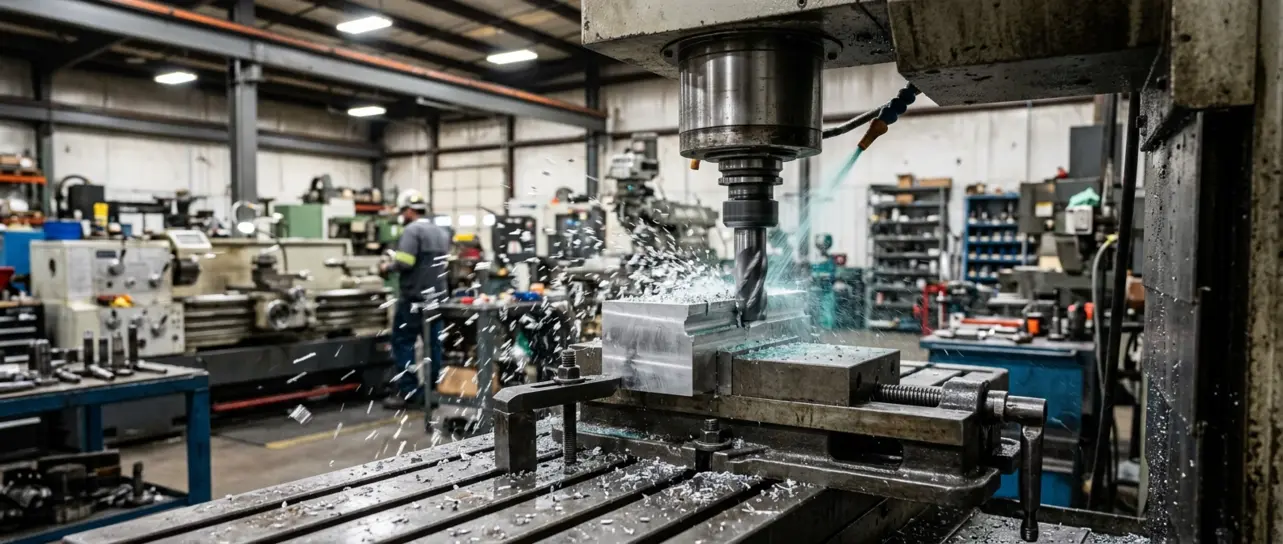
CNC milling removes material by feeding a spinning multi-point cutting tool into a workpiece that's clamped to a table. The machine follows a toolpath generated from your 3D CAD file, moving the cutter (or the table) along multiple axes to carve out the shape you need.
Think of it like a very precise router. The cutter spins at thousands of RPM, and the CNC controller moves it through the material in exactly the right sequence — pocketing, profiling, drilling, slotting — until the finished part emerges. A skilled programmer can produce parts with tolerances down to ±0.01 mm and surface finishes as smooth as Ra 0.4 µm.
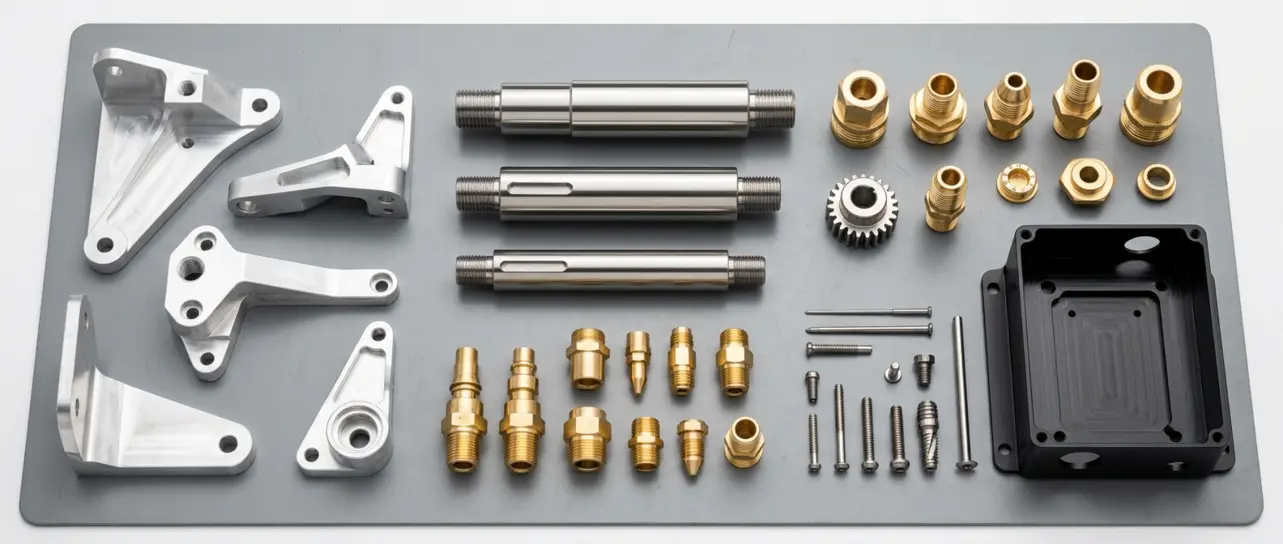
CNC milling handles a wide range of part types: housings, brackets, enclosures, mold cavities, mounting plates, and anything with flat faces, angled features, or complex contours. It's the go-to process when your part isn't round.
Types of CNC Milling Machines
3-axis CNC mills move the cutter along X, Y, and Z axes. They're the most economical option for flat and prismatic parts — plates, simple brackets, and shallow pockets. Most general machining work starts here.
4-axis mills add a rotary axis, so the workpiece can rotate during cutting. This lets you machine multiple sides without reclamping — fewer setups, tighter positional accuracy, and faster cycle times for parts like angled housings or cylindrical features on a prismatic part.
5-axis CNC mills move simultaneously in five directions: three linear and two rotational. They're built for organic contours, deep pockets, undercuts, and aerospace-grade geometries. A 5-axis machine can finish a turbine blade or an impeller in a single setup — something that would take multiple operations on a 3-axis.
How Does CNC Turning Work?
CNC turning flips the script. Instead of spinning the tool, the workpiece itself rotates in a chuck at high speed while a stationary single-point cutting tool advances into it. Picture a pottery wheel — except it's spinning a bar of 4140 steel at 3,000 RPM and shaving it down to ±0.01 mm.
The process runs on a CNC lathe. The raw material (usually a round bar) is loaded into the chuck, and the cutting tool moves along the X (radial) and Z (axial) directions to create the final shape. CNC turning services produce shafts, pins, bushings, rollers, threaded rods, nozzles, and any other part with rotational symmetry.
Modern CNC lathes are far more capable than basic two-axis machines. Most production turning centers include live tooling — small milling spindles mounted in the tool turret — that can drill off-center holes, cut flats, and mill keyways without moving the part to a separate machine. This blurs the line between turning and milling and is one reason the term "precision turning" now covers a lot more than just making round shapes.
What Is a Mill-Turn Machine?
A mill-turn machine (also called a turn-mill center) combines both processes in one setup. The workpiece can rotate for turning operations, and the machine can lock the spindle and engage a milling cutter for non-cylindrical features — all without unclamping the part.
The benefit? Every time you unclamp and reclamp a part, you introduce positional error. Mill turn machining eliminates those handoffs. That means better concentricity, tighter total tolerances, and shorter cycle times. For parts that need both turned and milled features — a shaft with a keyway, or a nozzle with cross-drilled holes — a CNC turning and milling machine can drop the part complete in one operation.
CNC Milling vs. Turning: Side-by-Side Comparison
Here's a direct comparison of CNC milling and CNC turning across the factors that matter most when you're choosing a process for your part.
| Factor | CNC Milling | CNC Turning |
|---|---|---|
| What moves | Cutting tool rotates; workpiece is stationary | Workpiece rotates; cutting tool is stationary |
| Best geometry | Flat, prismatic, angular, complex 3D shapes | Cylindrical, conical, spherical, rotationally symmetric |
| Typical parts | Housings, brackets, mold cavities, plates, enclosures | Shafts, bushings, pins, rollers, threaded rods, nozzles |
| Axes | 3, 4, or 5 axes | 2 axes (X, Z) + optional live tooling (C, Y axes) |
| Tolerance (standard) | ±0.025 mm (±0.001") | ±0.025 mm (±0.001") |
| Tolerance (precision) | ±0.01 mm or tighter on 5-axis | ±0.01 mm with CMM verification |
| Surface finish | Ra 0.4–3.2 µm | Ra 0.4–3.2 µm (smoother on concentric surfaces) |
| Setup time | Moderate — multi-axis setups take longer | Fast — especially for bar-fed production runs |
| Cycle time for round parts | Slower (not optimized for rotation) | Faster (continuous cutting via rotation) |
| Cost per part (typical) | Higher for simple round parts | Lower for cylindrical parts; higher for complex shapes |
| Best volume range | Prototype to medium-high volume | Prototype to very high volume |
The simplest rule of thumb: if your part is round, start with turning. If it's any other shape, start with milling. If it's round with non-cylindrical features (flats, holes, keyways), consider a mill-turn setup or plan a turning + milling sequence.
What Tolerances Can CNC Milling and Turning Achieve?
CNC machining tolerances define how much a finished dimension is allowed to deviate from the drawing. The general tolerance standard used worldwide is ISO 2768, which specifies four classes: fine (f), medium (m), coarse (c), and very coarse (v). Most CNC machined parts are specified to ISO 2768-m (medium) unless tighter control is needed on specific features.
In practice, what you can hold depends on the machine, the material, and the feature. Here are realistic ranges for 2026 production work.
| Process | Standard Tolerance | Precision Tolerance | Surface Finish (Ra) | Notes |
|---|---|---|---|---|
| CNC Milling (3-axis) | ±0.025 mm (±0.001") | ±0.01 mm | 0.8–3.2 µm | Tighter on smaller features; envelope up to 1016 × 508 × 635 mm |
| CNC Milling (5-axis) | ±0.013 mm (±0.0005") | ±0.005 mm | 0.4–1.6 µm | Best for complex contours and single-setup "done-in-one" parts |
| CNC Turning | ±0.025 mm (±0.001") | ±0.01 mm | 0.4–3.2 µm | Diameters up to ⌀360 mm; lengths up to 1,000 mm |
| Mill-Turn (combined) | ±0.025 mm | ±0.01 mm | 0.4–3.2 µm | Concentricity benefits from single-setup machining |
From our experience, the most common tolerance mistake OEM buyers make is over-tolerancing non-critical features. Tighter tolerances mean slower feeds, more inspection, and higher per-part cost. A good machining partner will flag this during DFM review and help you apply tight tolerances only where they actually affect fit or function.
Materials for CNC Milling and Turning
Both milling and turning handle the same broad material families — metals, plastics, and some composites. The specific grades you can machine depend on the process, the tooling, and the part geometry. Here's a breakdown of the most commonly machined materials and the grades Meco stocks or sources regularly.
| Material | Common Grades | Milling | Turning | Typical Applications |
|---|---|---|---|---|
| Aluminum | 6061, 7075, 5052, 2024 | Yes | Yes | Housings, heat sinks, brackets, aerospace structures |
| Stainless Steel | 303, 304, 316, 17-4PH | Yes | Yes | Medical parts, food equipment, fasteners, exhaust systems |
| Carbon Steel | 1045, 4140, 4340 | Yes | Yes | Shafts, gears, structural components, drivetrain parts |
| Brass | C360, C464 | Yes | Yes | Fittings, connectors, electrical terminals, valve bodies |
| Copper | C110, C145 | Yes | Yes | Bus bars, heat exchangers, electrical contacts |
| Titanium | Grade 2, Grade 5 (Ti-6Al-4V) | Yes | Yes | Aerospace brackets, implants, performance components |
| Bronze | C932, C954 | Yes | Yes | Bushings, bearings, wear-resistant slides |
| Nylon (PA) | PA6, PA66 | Yes | Yes | Gears, rollers, insulators, wear components |
| POM (Delrin) | — | Yes | Yes | Precision bushings, snap-fit components |
| PTFE (Teflon) | — | Yes | Yes | Seals, gaskets, chemical-resistant bushings |
Material choice affects more than machinability. It also determines which surface finishing options are available after machining. Aluminum supports anodizing (Type II/III). Steel supports zinc plating, powder coating, and galvanizing. Stainless steel is often left unfinished or electropolished. A turnkey partner that handles machining and finishing under one roof eliminates the coordination headaches of shipping parts between vendors.
When Should You Use CNC Turning Instead of Milling?
The decision isn't always obvious — plenty of parts could go either way. Here's a simple five-question test we recommend to OEM sourcing managers and design engineers when choosing between turning vs milling (or both).
The 5-Question Process Selection Test
1. Is the part primarily cylindrical or rotationally symmetric? → Yes = Turning. No = Milling.
2. Does it have features on multiple faces, angled pockets, or complex contours? → Yes = Milling (3-axis or 5-axis depending on complexity).
3. Does it combine a round body with off-axis features (flats, keyways, cross-holes)? → Yes = Mill-turn or turning + secondary milling.
4. Is production volume high (1,000+ parts) and the geometry simple? → Yes = Turning is usually faster and cheaper per unit for round parts.
5. Does concentricity between turned and milled features matter? → Yes = Mill-turn (single setup) gives the best result.
Bottom line: the part geometry drives the process, not the other way around. A shaft with a keyway needs turning and milling. A flat bracket with drilled holes only needs milling. A threaded nozzle needs turning. And a complex aerospace fitting with contoured surfaces, angled bores, and tight concentricity probably needs 5-axis CNC machining or a multi-operation sequence.
How Much Does CNC Milling and Turning Cost?
CNC machining cost breaks down into four components: machine time, setup, material, and finishing. The balance shifts depending on the process, the part, and the volume.
Machine time is the biggest variable. A 3-axis mill might run $40–$80/hour in North America. A 5-axis mill runs $75–$150/hour. A CNC lathe typically costs $35–$75/hour. Turning is generally cheaper per hour because the cycle times for round parts are shorter — the continuous rotation removes material faster than a milling cutter stepping through discrete passes.
Setup cost covers programming, fixturing, and first-article inspection. For a single prototype, setup can be 50–70% of total cost. At 500+ parts, it's a rounding error. This is why CNC machining cost per part drops dramatically as volume increases.
Material cost varies widely. Aluminum 6061 is roughly $3–$6/kg. Titanium Grade 5 is $25–$50/kg. Stainless 316 falls somewhere in between. The raw stock size matters too — a turned part starts from round bar (minimal waste), while a milled part often starts from a larger block (more material removed and wasted).
Finishing adds 10–25% depending on the treatment. Anodizing, powder coating, plating, and heat treatment all have separate cost structures. For a deeper breakdown, see our full guide on CNC machine costs.
Industries That Rely on Precision CNC Machined Components
CNC milling and turning serve virtually every manufacturing sector. The specific tolerance, material, and documentation requirements vary by industry, but the underlying need is the same: accurate, repeatable parts delivered on time.
Automotive: Powertrain shafts (turned), transmission housings (milled), brake pistons (turned), sensor brackets (milled). Automotive programs demand PPAP documentation, SPC data, and IATF 16949:2016 certified quality systems.
Aerospace: Structural brackets (5-axis milled), turbine shafts (turned), landing gear bushings (turned), avionics enclosures (milled). Aerospace requires full material traceability, FAIR documentation, and NDT — ultrasonic, dye penetrant, or X-ray — depending on the part criticality.
Medical: Surgical instrument handles (turned), implant housings (5-axis milled), diagnostic device components (milled + turned). Medical parts need tight tolerances, biocompatible materials (316L stainless, titanium Grade 5), and complete lot traceability.
Electronics and Telecom: Heat sinks (milled), connector pins (turned), EMI shielding enclosures (milled), antenna housings (mill-turn). Precision CNC machined components in electronics often require anodized or nickel-plated finishes for conductivity or corrosion resistance.
Heavy Equipment and Industrial: Hydraulic cylinder rods (turned), gear blanks (turned + milled), valve bodies (milled), roller shafts (turned). Industrial parts often combine heavy-stock removal with secondary precision milling for interface surfaces.
How to Choose a CNC Milling and Turning Partner
Finding a machine shop that can cut parts isn't hard. Finding a partner that can manage the full process — from DFM review through machining, finishing, inspection, and delivery — without you chasing three separate vendors? That's the real challenge.
Here's what to evaluate when choosing a CNC milling and turning partner for OEM-grade production.
Process breadth. Can they handle turning and milling in-house, or will your part travel between two shops? Better yet, can they also do surface finishing, heat treatment, and assembly? Every handoff between vendors adds lead time and quality risk.
Quality certification. IATF 16949:2016 is the most rigorous quality management standard in manufacturing — it incorporates all ISO 9001:2015 requirements and adds automotive-specific controls for APQP, PPAP, PFMEA, and SPC. A partner certified to IATF 16949 applies that discipline to every part, not just automotive ones.
Engineering support. The best partners don't just cut what you send them. They review your drawings, flag DFM issues before tooling starts, and suggest design changes that reduce cost without sacrificing function. This kind of feedback should come with the quote — not after the first batch fails inspection.
Scalability. Your partner should handle 10-piece prototype runs and 10-million-piece production orders with equal reliability. No minimum order quantities. Clear prototype-to-production transition plans.
Logistics integration. If your cnc turned parts ship to North America, Asia, and Europe, you need a partner with warehousing in the right regions. JIT delivery, VMI programs, and kitting can reduce your own warehousing cost significantly.
Meco checks all of these boxes. With 30+ years of turnkey manufacturing experience, custom CNC machining across 3-axis through 5-axis, IATF 16949:2016 certified facilities in Thailand (20,000 m²) and China (16,000 m²), U.S. engineering support, 40+ manufacturing processes, and warehouses in the U.S., Canada, Japan, and Thailand — we provide a single point of accountability from drawing to delivered part.
Frequently Asked Questions About CNC Milling and Turning
What is the difference between CNC milling and CNC turning?
CNC milling uses a rotating multi-point cutting tool to shape a stationary workpiece — ideal for flat surfaces, pockets, contours, and complex 3D shapes. CNC turning rotates the workpiece in a chuck while a stationary single-point tool removes material — ideal for cylindrical, conical, and rotationally symmetric parts like shafts and bushings. The key difference is which piece spins: the tool (milling) or the part (turning).
Can CNC milling and turning be done on the same machine?
Yes. Mill-turn machines (also called turn-mill centers) combine both processes in a single setup. The workpiece can rotate for turning operations, and the spindle can lock for milling operations — all without unclamping the part. This eliminates re-chucking errors and improves concentricity, making it the best option for parts that need both turned and milled features.
Is CNC turning cheaper than CNC milling?
For cylindrical parts, turning is generally cheaper because the continuous rotation removes material faster, resulting in shorter cycle times. CNC lathe hourly rates are typically $35–$75 compared to $40–$150 for milling machines. However, for complex geometries that require multi-axis milling, turning isn't an option — so the cost comparison only applies when both processes could technically produce the part.
What tolerances can CNC milling and turning hold?
Both CNC milling and turning can hold standard tolerances of ±0.025 mm (±0.001") for most features. Precision machining pushes that to ±0.01 mm, and ultra-precision 5-axis milling can achieve ±0.005 mm. Surface finishes range from Ra 0.4 µm (fine) to Ra 3.2 µm (coarse). The general tolerance standard is ISO 2768, with class "m" (medium) being the most commonly specified for CNC machined parts.
What materials can be CNC milled and turned?
Both processes handle a wide range of metals and plastics. Common metals include aluminum (6061, 7075), stainless steel (303, 304, 316), carbon steel (1045, 4140), brass (C360), copper (C110), titanium (Grade 2, Grade 5), and bronze (C932). Common plastics include nylon (PA), POM (Delrin), PTFE (Teflon), and acrylic (PMMA). Material choice affects cutting speed, tool wear, achievable tolerances, and available surface finishes.
What is a mill-turn machine?
A mill-turn machine is a CNC machine that combines turning and milling capabilities in one platform. It can rotate the workpiece for turning operations and lock the spindle for milling, drilling, or tapping — all in a single clamping. This reduces setup time, eliminates re-chucking error, and improves tolerances on parts that need both cylindrical and non-cylindrical features.
When should you use CNC turning instead of milling?
Use CNC turning when your part is primarily cylindrical or rotationally symmetric — shafts, pins, bushings, rollers, threaded rods, and nozzles. Turning is also the more efficient choice for high-volume production of round parts because the continuous cutting action produces shorter cycle times than milling. If the part has both round and non-round features, consider a mill-turn setup to complete everything in one operation.
How do I choose between 3-axis and 5-axis CNC milling?
Start with 3-axis milling for flat, prismatic parts with features on one or two faces — it's the most economical option. Move to 5-axis when your part has complex contours, deep pockets, undercuts, or features at compound angles that would require multiple setups on a 3-axis machine. The per-hour rate for 5-axis is higher, but a single-setup cycle can actually lower total part cost by eliminating fixture changes and reducing scrap.
What industries use CNC milling and turning the most?
Automotive, aerospace, medical, electronics, telecommunications, heavy equipment, and industrial manufacturing all rely heavily on CNC milling and turning. Automotive uses turning for drivetrain shafts and milling for engine housings. Aerospace uses 5-axis milling for structural brackets and turning for landing gear bushings. Medical uses both for surgical instruments and implant components. The specific tolerance and documentation requirements vary by industry.
How do I find a reliable CNC milling and turning partner?
Evaluate five things: process breadth (can they do milling, turning, finishing, and assembly in-house?), quality certification (IATF 16949 is the gold standard), engineering support (do they provide DFM feedback with quotes?), scalability (can they go from 10 prototypes to millions of parts?), and logistics (do they offer warehousing and JIT delivery?). A partner that owns their own factories — rather than brokering to anonymous shops — gives you direct quality control and accountability.
Get Precision CNC Milling and Turning Under One Roof
Coordinating separate shops for turning, milling, finishing, and inspection creates lead time risk, quality gaps, and unnecessary cost. Meco eliminates that complexity by managing the entire CNC machining workflow — from DFM review to globally delivered finished parts — under one accountable partner.
With 30+ years of turnkey manufacturing experience and IATF 16949:2016 certified quality, Meco is built for OEM programs where precision, traceability, and on-time delivery are non-negotiable.
- Full CNC Capability: 3-axis, 4-axis, and 5-axis milling plus CNC turning with live tooling — tolerances to ±0.01 mm and surface finishes to Ra 0.4 µm.
- 40+ In-House Processes: Casting, forging, stamping, machining, welding, surface finishing, and mechanical assembly — no subcontracting required.
- IATF 16949:2016 Certified: Automotive-grade quality applied across every industry. 99.99% quality rate. 99.8% on-time delivery.
- DFM Feedback with Every Quote: Engineering review included as standard, with quotes returned in under 24 hours.
- Prototype to Mass Production: From 10 pieces to 10 million+. No minimum order quantities.
- Global Logistics: Warehousing in the U.S. (Ohio & Florida), Canada, Japan (Tokyo & Osaka), and Thailand. JIT and VMI delivery programs available.
Submit your drawings and let Meco's engineering team show you how to reduce cost, shorten lead times, and consolidate your CNC machining supply chain into one partner.
Request a Quote Today