What It Means to Make a Prototype of an Invention
Here is the short answer on how to make a prototype of an invention: you turn your idea into a sketch, then into a 3D digital file, then into a physical model you can hold and test. Most first-time inventors build their first prototype with 3D printing for $50 to $500, and they build three or four versions before the design feels right.
That is the whole thing in one paragraph. The rest of this guide walks you through every method, real 2026 costs, when you need a patent, and how to find someone to build it. No engineering degree needed.
An invention prototype is just a working model of your idea. It does not have to look like the final product. It only has to prove your idea can actually do the thing you say it does. Think of it as cheap insurance: for a couple hundred dollars, it tells you whether your idea works before you risk thousands on tooling or a patent.
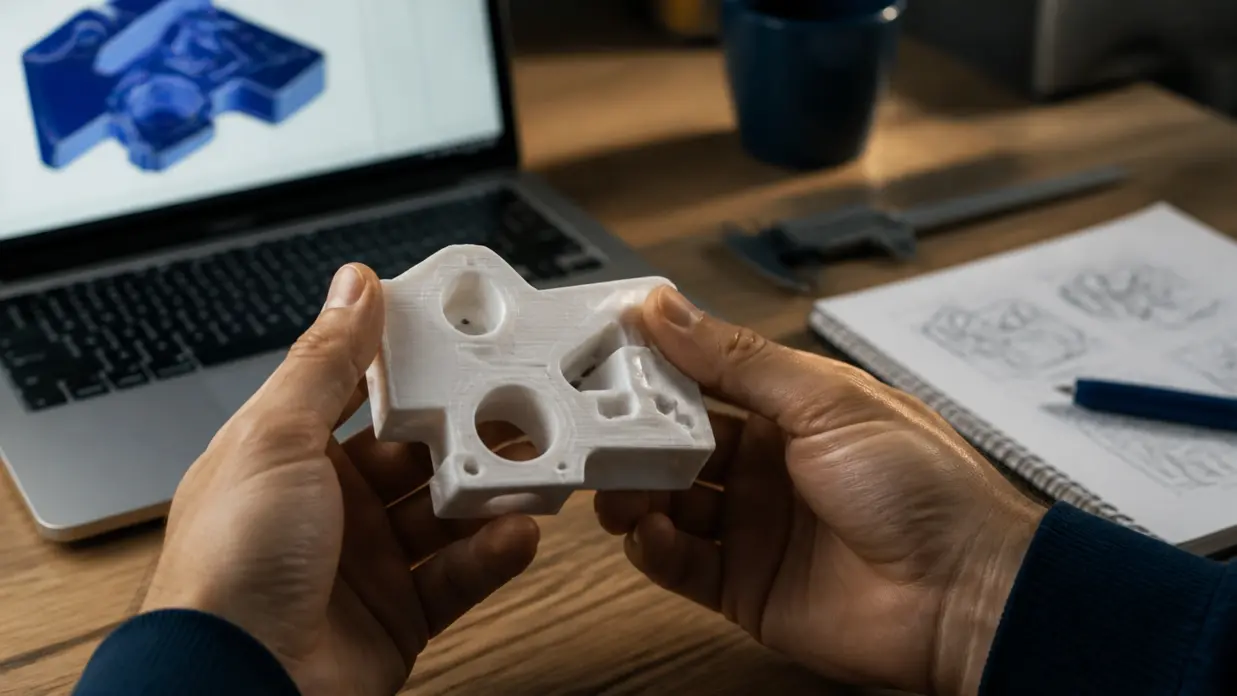
This is one step inside the bigger path from idea to a finished product you can sell. Prototyping sits right in the middle, between sketching your idea and manufacturing it at scale.
The 5 Types of Invention Prototypes
Not every prototype is the same. The right type depends on what you are trying to learn and how much you want to spend. Here are the five most common kinds, from cheapest to most involved.
| Prototype Type | What It Is | Best For | Rough Cost |
|---|---|---|---|
| Sketch or digital model | A drawing or a CAD file on screen | Sharing the idea and getting a quote | $0 to $3,000 |
| Proof of concept prototype | A rough, handmade version | Testing if the core idea works at all | Under $20 to $500 |
| 3D printing prototype | A plastic model printed from your CAD file | Checking shape, fit, and basic function | $50 to $500 |
| Functional prototype | A version that works like the real product | Testing moving parts and real use | $500 to $5,000 |
| Production-ready prototype | Made with final materials and methods | Investor pitches and pre-production | $2,000 to $8,000+ |
A proof of concept prototype answers one question: does the basic idea even work? It can be cardboard, foam, or clay, and it is the first invention prototype most people build. A functional prototype goes further and behaves like the real thing. That matters most when your invention has moving parts or electronics, because a proof of concept prototype can prove the shape works while a functional prototype proves the product works.
Quick takeaway
Start with the cheapest prototype that answers your biggest question. You do not need a production-ready model on day one. You need to learn something for the least money possible.
How to Make a Prototype of an Invention, Step by Step
There is no single right way to make a prototype of an invention. But after years of helping first-time inventors, we have found the same four steps work for almost every physical product. Follow them in order and you will waste far less money.
- Sketch and define what it must do. Draw your invention and write down what it does, who it is for, and why it beats what already exists.
- Turn the sketch into a CAD file. Create a 3D digital model, either yourself or with a designer, so a printer or factory can read it.
- Pick a prototyping method and build it. For most inventions, start with 3D printing because it is fast and cheap.
- Test, then repeat. Hold it, use it, find the flaws, and build the next version. Plan for three or four rounds.
Step 1: Sketch and define your idea
Before you spend a dollar, spend an hour with a notebook. Draw what your invention looks like. Write down what it does and who needs it. Date and sign every page, because that paper trail can matter later.
It does not have to be pretty. Stick figures are fine. The point is to get the idea out of your head and onto something you can hand to another person.
Step 2: Turn your sketch into a CAD file
Next, your drawing becomes a CAD file, which stands for computer-aided design. This is the 3D digital model a printer or factory needs to build your part. You can learn basic CAD yourself, or hire a freelance designer for $300 to $3,000 depending on how complex the part is.
This file is the heart of the whole product development process. Get it right and every later step gets easier.
Step 3: Pick a method and build
For most first-time inventors, the cheapest path is a 3D printing prototype. You send your CAD file to a printer and a plastic version comes out in hours. A simple print runs $50 to $500. We will compare 3D printing against other methods in the next section.
Step 4: Test, then repeat
Expect to build more than one. Iteration is the norm, not a sign you did something wrong. James Dyson famously built thousands of prototypes of his bagless vacuum over several years before he had a design worth making. You will not need anywhere near that many. But plan for three or four rounds, because each version teaches you something the last one could not.
The 3-T Prototype Test
Before you move to the next version, run the 3-T check: Test it the way a real user would, Touch it to feel size and weight, then Tweak one thing at a time. Changing five things at once means you never learn which fix actually worked.
3D Printing vs CNC Machining: Which Method Fits Your Invention?
The most common question we hear is whether to 3D print or machine a prototype. The honest answer: it depends on your budget, the material, and what you need to learn. Here is a side-by-side look at the four main paths.
| Method | Typical Cost | Best For | What It Won't Tell You |
|---|---|---|---|
| Cardboard or foam mock-up | Under $20 | Size, shape, and feel in your hand | Whether moving parts really work |
| 3D printing (FDM or resin) | $50 to $500 | Form, fit, and quick repeat rounds | True strength of the final part |
| CNC machining | $300 to $3,000 | Metal parts and a near-final feel | Cost at high volume |
| Small-batch molding | $2,000 to $8,000 | Testing the real production material | Little; this is closest to the real thing |

Rapid prototyping is the umbrella term for making models fast, usually with 3D printing. It is brilliant for shape and fit. But a printed plastic part does not behave like a molded or machined one. The layers can be weaker and the surface rougher. So while rapid prototyping is the fastest way to learn, it is not always the most honest test of the final material.
So when does plastic stop being enough? If your product's whole value depends on strength, a clean finish, or how a real material flexes, you will eventually need a CNC machining prototype in the real material. A partner who runs both machining and molding in house can move you up this ladder without restarting from scratch each time.
How Much Does an Invention Prototype Cost in 2026?
The honest answer is that prototype cost depends on complexity, materials, and method. A simple plastic part can cost under $200 to prototype. A complex device with electronics and moving parts can run several thousand. Below is a rough guide for 2026.
| Stage | Typical Cost (2026) | What You Get |
|---|---|---|
| Sketches and notes | $0 to $100 | Your idea on paper |
| CAD design | $300 to $3,000 | A 3D file factories can quote from |
| 3D-printed prototype | $50 to $500 | A plastic version you can hold |
| Functional prototype | $500 to $5,000 | A near-final working model |
| Small-batch molded sample | $2,000 to $8,000 | The real production material |
You do not pay for all of these at once. Plenty of inventors start with a CAD file and a 3D print for under $1,000 total. That is enough to start serious conversations with a manufacturer. For a deeper look at production-stage numbers, our complete 2026 pricing guide for getting a metal part made breaks down the biggest cost drivers.
Can I make a prototype with no money?
Almost. The first steps are free or close to it. Sketch and document your idea for nothing. Build a cardboard or foam mock-up for under $20. Many local libraries and community colleges offer free or cheap access to 3D printers, so a basic model can cost just the price of plastic.
So if you are trying to make a prototype with no money, lean on those free tools first. You can prove your core idea works long before you spend real cash on tooling.
Want a real cost range for your idea?
Send us a sketch or a CAD file and we will give you an honest prototype quote with DFM feedback. Start a no-pressure conversation here.
Do I Need a Prototype Before I Patent My Invention?
No, you do not need a prototype to file a patent. United States patent law does not require you to build your invention first. But here is our take after watching this play out many times: most first-time inventors spend too much on patents too early.
The smarter order for most people is to build a cheap prototype first, then decide on a patent. The question of prototype before patent trips up a lot of inventors, so think of it this way. A prototype tells you whether the idea works. A patent only protects an idea that may turn out to be unbuildable as drawn.
A common middle path is a provisional patent application, which is cheaper and gives you "patent pending" status for a year while you prototype and test. We are a manufacturing company, not patent lawyers, so for anything legally binding talk to a licensed attorney. The USPTO patent basics page is a solid free starting point.
Gut-check before you spend on a patent
Ask yourself: has anyone actually held my invention? If the answer is no, build the prototype first. You will learn more in one week of holding a real version than in six months of paperwork.
How to Find Someone to Build Your Prototype
Once you have a CAD file or even a solid set of drawings, it is time to talk to a real builder. The right partner can make a prototype of an invention faster and cheaper than going it alone. You can hire a freelancer, use a local maker space, or work with an invention manufacturer that handles design, prototyping, and production under one roof.
The best manufacturers send back more than a price. They send DFM feedback. DFM stands for design for manufacturing, which is engineer-speak for small tweaks to your design that make it cheaper and easier to build. Good DFM advice can trim 15 to 30 percent off your final cost.
In our experience helping first-time inventors, the biggest cost saver is not a cheaper shop. It is having one team that catches design problems before they become production problems. With more than 30 years of turnkey manufacturing and 40-plus processes in house, plus in-house R&D and engineering support, that is the kind of coverage we aim to give inventors. And because we run no minimum order quantity, you can start with 10 units instead of 10,000.
The 5-minute test for a good partner
When you first reach out, watch for three things. Do they reply within 24 hours? Do they ask questions about your design instead of just shooting back a number? Are they willing to hop on a call, not just email? Yes to all three is a strong green light.
One warning. Be careful with firms whose whole pitch is "pay us upfront and we will do everything." If a company makes money before your product gets made, their incentives are not aligned with yours. The Federal Trade Commission has published warnings about invention-promotion firms that target first-time inventors. Read those before you sign anything.
Common Prototyping Mistakes (and How to Dodge Them)
We see the same handful of mistakes over and over when people try to make a prototype of an invention. Avoid these and you will save yourself months of headache.
- Jumping straight to expensive tooling. Climb the ladder one rung at a time. A fixable flaw caught on a $150 print is cheap; the same flaw in a $20,000 mold is not.
- Spending big on a patent before a prototype. Build the thing first, protect it second.
- Changing everything at once. Tweak one variable per round so you know what actually improved.
- Ordering too many units on the first run. Lots of inventors get talked into a 10,000-unit first batch. Start with 100 or 500, sell those, learn, then scale. A partner with no minimum order quantity makes this easy.
- Trying to perfect every detail alone. A good injection molding or machining partner will give free advice early that saves you thousands.
The inventors who waste the least money treat their first prototype as a question, not a final answer. Build cheap, learn fast, and only spend real money once the design has earned it.
Frequently Asked Questions
How much does it cost to make a prototype of an invention?
A basic 3D printing prototype usually costs $50 to $500. A functional version with moving parts can run $500 to $5,000. Many inventors get their first model and CAD file done for under $1,000 total, which is enough to start talking to a manufacturer.
How long does it take to make a prototype?
A 3D printing prototype can be ready in three to seven days once your CAD file is done. A more complex functional or machined prototype can take one to several weeks. Most inventors go through three or four rounds before the design is right.
Can I make a prototype with no money?
Almost. Sketching and a cardboard or foam mock-up cost under $20. Many libraries and community colleges offer cheap or free access to 3D printers, so you only pay for plastic. You can prove your core idea works before spending real cash.
Do I need a patent before making a prototype?
No. You can build a prototype before filing anything. Most inventors find it smarter to prototype first, since holding a working version tells you whether the idea is worth protecting. Many file a provisional patent for "patent pending" status while they test.
What is the difference between a proof of concept and a functional prototype?
A proof of concept prototype is a rough version that tests whether the basic idea works at all. A functional prototype behaves like the real product, including moving parts or electronics, so you can test real-world use. Proof of concept comes first.
Is 3D printing good enough for an invention prototype?
For shape, fit, and quick testing, yes. A 3D printing prototype is fast and cheap. But printed plastic can be weaker and rougher than the final part, so if strength or finish is critical, you will eventually need a CNC machining prototype or a molded sample in the real material.
How many prototypes should I build?
Plan for three or four rounds for most products. Each version reveals a flaw the last one hid. Cheap, frequent prototypes beat one expensive bet, since a few hundred dollars of prints surface the same problems that costly tooling would catch much later.
Do I need an engineer to make a prototype?
Not always. You can learn basic CAD yourself or hire a freelance designer. But an engineer or a manufacturer with DFM, meaning design for manufacturing feedback, can spot costly design issues early and often saves you more than they cost.
What is rapid prototyping?
Rapid prototyping is making physical models quickly, most often with 3D printing. It lets you test and revise a design in days instead of weeks, which is why it is the go-to first step for inventors who expect several rounds of changes.
How do I turn a prototype into a real product?
Once your prototype works, send it and your files to a manufacturer for a quote and DFM feedback. They build a production sample for your approval, then run a small first batch. A turnkey partner can handle tooling, production, finishing, and packaging under one roof.
Ready to build your invention prototype?
Send us a sketch, a description, or a CAD file, and we will give you a real cost range and honest DFM feedback. No charge for the first conversation, and we sign NDAs. From a single prototype to a full production run, we handle it under one roof with no minimum order quantity.
Get a Prototype Quote