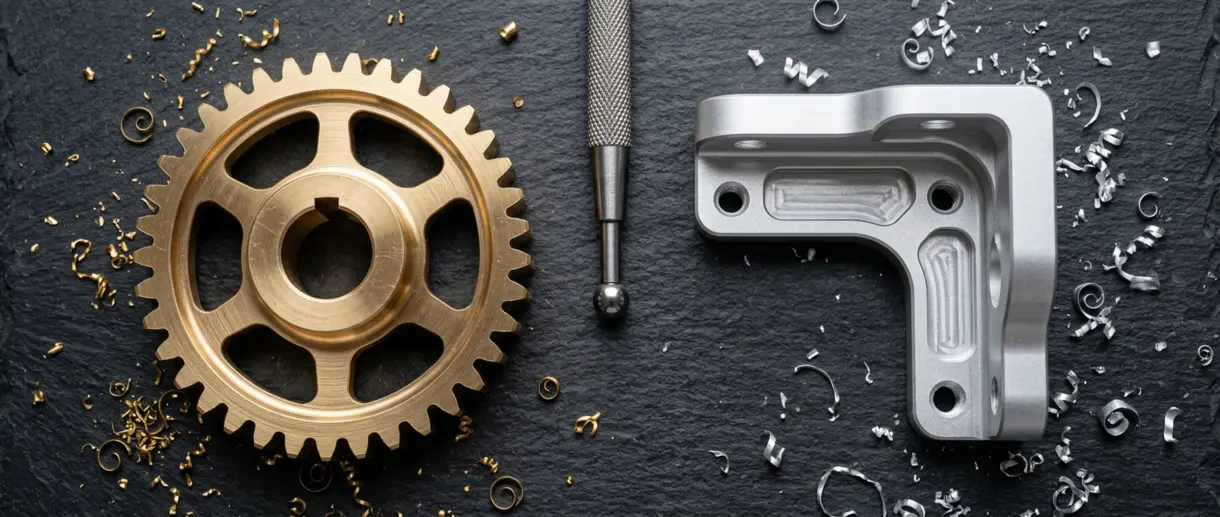
Is Aluminum Softer Than Brass?
Yes, aluminum is softer than brass in most commonly used alloy grades. A typical free-machining brass like C360 measures around 100-120 HB on the Brinell hardness scale, while general-purpose aluminum alloys like 6061-T6 sit around 95 HB and pure aluminum (1100 series) drops to just 23-32 HB. The exception is high-strength aerospace aluminum such as 7075-T6, which can reach 150 HB and actually exceed many brass grades.
So the short answer is: for the alloys most engineers and sourcing managers deal with daily, brass is the harder metal and aluminum is the softer one. But the full picture depends on which specific alloy you're comparing, how it's been heat-treated, and what your part actually needs to do.
Quick Answer
Is brass or aluminum softer? Aluminum is softer in most standard grades. Common brass alloys range from 80-150 HB (Brinell), while common aluminum alloys range from 23-150 HB. Only heat-treated aerospace-grade aluminum (like 7075-T6) approaches or exceeds brass hardness.

How Is Metal Hardness Measured?
Before comparing brass vs aluminum hardness numbers, it helps to understand what those numbers actually mean. Hardness is a metal's resistance to being dented, scratched, or permanently deformed. Engineers use three main scales to measure it, and each one works a little differently.
Brinell Hardness (HB)
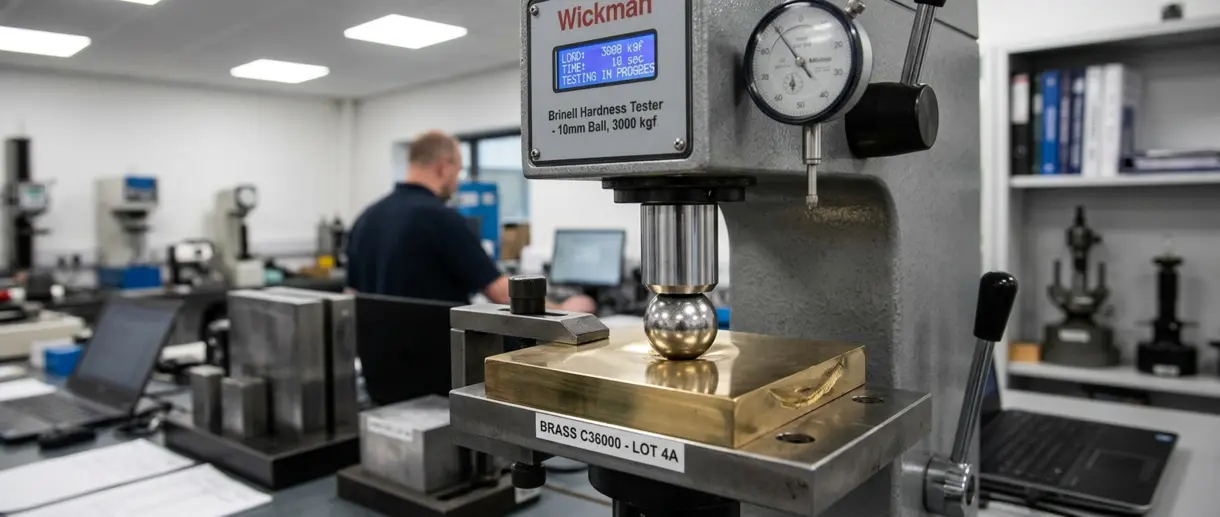
The Brinell test presses a hardened steel or tungsten carbide ball into the metal surface under a known load. The size of the dent left behind determines the hardness number. Bigger dent means softer metal, smaller dent means harder metal. Brinell is the most commonly referenced scale for brass and aluminum alloys in manufacturing, governed by ASTM E10.
Vickers Hardness (HV)
The Vickers test uses a tiny diamond pyramid pressed into the surface. It works on the same principle as Brinell but can measure much smaller areas and thinner materials. Vickers numbers and Brinell numbers are often close to each other for softer metals, which is why you'll see both used in brass and aluminum datasheets.
Mohs Hardness Scale
Mohs is a simpler scratch-resistance scale from 1 (talc) to 10 (diamond). It's less precise than Brinell or Vickers, but it gives a quick sense of where metals sit relative to everyday materials. Brass scores about 3-4 on the Mohs scale. Aluminum sits at roughly 2.5-3. For reference, a copper penny is about 3 and a steel nail is about 6.5.
Brass vs Aluminum Hardness by Alloy Grade
Saying "brass is harder than aluminum" is true as a general rule, but alloy grade changes everything. A heat-treated 7075 aluminum part can actually be harder than some brass alloys. Here's a grade-by-grade breakdown using data from MatWeb and standard engineering references.
| Material | Common Grade | Condition | Brinell (HB) | Vickers (HV) | Mohs (approx.) |
|---|---|---|---|---|---|
| Aluminum (Pure) | 1100 | Annealed | 23-32 | 25-35 | 2.5 |
| Aluminum (General Purpose) | 6061-T6 | Heat-treated | 95 | 85-100 | 2.75 |
| Aluminum (Aerospace) | 7075-T6 | Heat-treated | 150 | 150-180 | 3.0 |
| Brass (Free-Cutting) | C360 / C36000 | Half-hard | 100-120 | 100-120 | 3.0-3.5 |
| Brass (Cartridge) | C260 | Half-hard | 100-130 | 105-135 | 3.0-3.5 |
| Brass (Naval) | C464 | Hard | 120-150 | 120-150 | 3.5-4.0 |
Key Takeaway
Common brass grades (C360, C260) are roughly 3-5x harder than pure aluminum and about 20-30% harder than 6061-T6, the most popular aluminum alloy in CNC machining. But 7075-T6 aluminum closes the gap entirely and matches or beats several brass grades. Always compare specific alloys, not just "brass" versus "aluminum" in general.
Is Brass Stronger Than Aluminum?
Hardness and strength are related but they're not the same thing. Hardness is about resisting dents and scratches. Strength is about resisting pulling forces (tensile strength) and bending before permanently deforming (yield strength). So how strong is brass compared to aluminum?
In most common grades, brass is stronger than aluminum in absolute terms. But aluminum has a much better strength-to-weight ratio because it's about one-third the weight of brass. That's why aerospace and automotive engineers often pick aluminum even when brass is technically "stronger" on paper.
| Property | Brass C360 | Aluminum 6061-T6 | Aluminum 7075-T6 |
|---|---|---|---|
| Tensile Strength (MPa) | 340-470 | 290-310 | 510-570 |
| Yield Strength (MPa) | 140-310 | 240-275 | 430-500 |
| Density (g/cm³) | 8.5 | 2.7 | 2.81 |
| Strength-to-Weight Ratio | Low | High | Very High |
Here's a detail that often gets overlooked: 7075-T6 aluminum is actually stronger than C360 brass in both tensile and yield strength. So saying "is aluminum stronger than brass" depends completely on which aluminum you're talking about. For general-purpose 6061, brass wins. For aerospace-grade 7075, aluminum wins by a wide margin.
Is Brass a Soft Metal?
Brass sits in the middle of the hardness spectrum. It's softer than steel, but harder than pure copper, pure aluminum, gold, silver, lead, and tin. Calling brass "soft" only makes sense when you're comparing it to hardened steels or tool steels. Compared to most non-ferrous metals, brass is actually one of the harder options.
That's what makes brass so popular for precision parts like valve seats, gears, bushings, electrical connectors, and decorative hardware. It's hard enough to resist wear in sliding contact, but soft enough to machine cleanly without excessive tool wear. Think of it as the Goldilocks zone: not too soft, not too hard, just right for a huge range of engineering applications.
In our experience machining both metals across 30+ years of turnkey manufacturing, brass produces some of the cleanest cuts and tightest tolerances of any non-ferrous metal. The chips break short and clean, the surface finish comes out smooth, and dimensional stability stays consistent across long production runs.
How Hardness Affects CNC Machining
If you're an engineer or sourcing manager evaluating brass and aluminum for a CNC project, the hardness difference has real consequences on the shop floor. It affects which tools you use, how fast you can cut, and what kind of surface finish you'll get.
Tool Selection and Wear
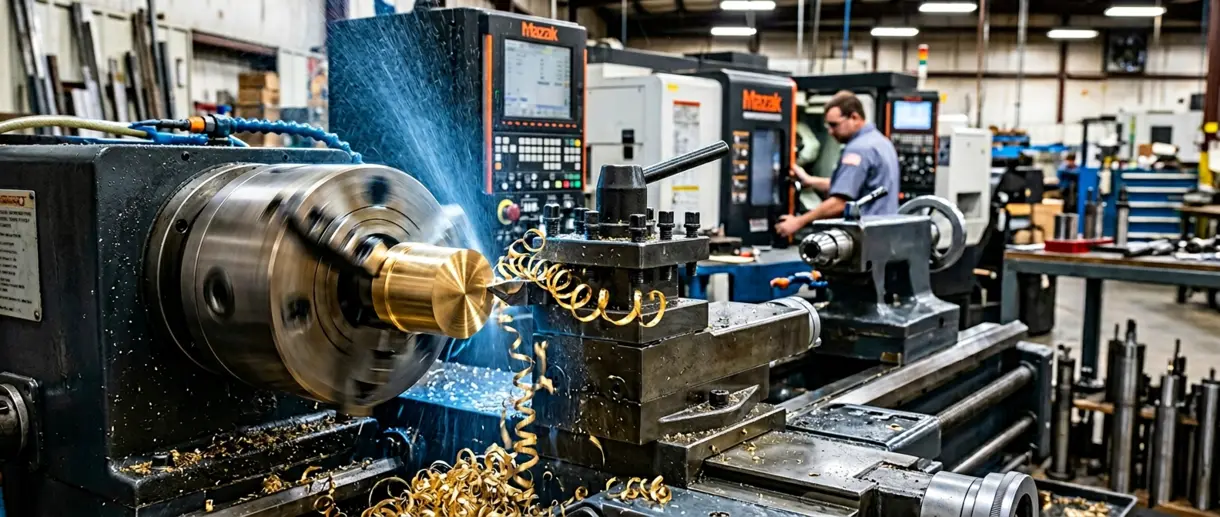
Brass is harder than aluminum, so you might assume it eats through cutting tools faster. But brass actually machines very predictably. The chips break short and don't stick to the tool. Carbide inserts (YG-grade) are the standard choice for brass and they last a long time because brass cuts clean.
Aluminum is softer, but it's stickier. The chips are long and stringy, and aluminum has a tendency to weld itself onto the cutting edge of the tool. This is called a "built-up edge" and it ruins surface finish fast. That's why aluminum CNC milling and CNC turning often use polished, coated carbide tools or sometimes even polycrystalline diamond (PCD) tooling to prevent material from gumming up.
Cutting Speed and Surface Finish
Aluminum's softness allows much higher cutting speeds than brass. You can often run aluminum at 500-800+ surface feet per minute (SFM) versus 250-350 SFM for brass. That speed advantage means shorter cycle times and lower per-part costs when machining aluminum, which is one reason aluminum dominates high-volume production.
On the other hand, brass delivers a naturally smoother surface finish straight off the machine. If your part needs a fine finish for sealing surfaces or cosmetic appearance, brass often requires less post-machining polishing than aluminum does.
| Machining Factor | Brass (C360) | Aluminum (6061-T6) |
|---|---|---|
| Typical Cutting Speed (SFM) | 250-350 | 500-800+ |
| Feed Rate (mm/rev) | 0.1-0.3 | 0.15-0.5 |
| Chip Type | Short, broken, easy to evacuate | Long, stringy, can tangle |
| Built-Up Edge Risk | Low | High (needs sharp tools and coolant) |
| Surface Finish (as-machined) | Excellent (smooth, clean) | Good (may need secondary finishing) |
| Tool Life | Long | Moderate (adhesion wear) |
Brass vs Aluminum: Full Properties Comparison
Hardness is just one property. When you're choosing between brass and aluminum for a real project, you need the full picture. This table compares the most important engineering and commercial properties side by side.
| Property | Brass (C360) | Aluminum (6061-T6) | Winner |
|---|---|---|---|
| Hardness (Brinell HB) | 100-120 | ~95 | Brass |
| Density (g/cm³) | 8.5 | 2.7 | Aluminum (3x lighter) |
| Tensile Strength (MPa) | 340-470 | 290-310 | Brass |
| Strength-to-Weight Ratio | Low | High | Aluminum |
| Corrosion Resistance | Good (excellent in saltwater) | Good (excellent when anodized) | Tie (depends on environment) |
| Thermal Conductivity (W/m·K) | 115 | 167 | Aluminum |
| Electrical Conductivity (% IACS) | 26% | 43% | Aluminum |
| Machinability | Excellent (clean chips, smooth finish) | Excellent (fast cutting speeds) | Tie (different strengths) |
| Raw Material Cost | Higher ($3-5/lb typical) | Lower ($1-2/lb typical) | Aluminum |
| Appearance | Gold/warm tone | Silver/neutral tone | Depends on design intent |
| Wear Resistance | Higher | Lower (needs coating for wear apps) | Brass |
| Surface Finishing Options | Chrome plating, nickel plating, PVD, polishing | Anodizing, powder coating, painting, PVD, e-coating | Aluminum (more options) |
Aluminum has more surface finishing options available, including Type II and Type III anodizing per MIL-A-8625, which can significantly increase its surface hardness and wear resistance. This is one way engineers close the hardness gap between aluminum and brass in finished parts.
When to Choose Brass Over Aluminum (and Vice Versa)
The right metal depends on what the part actually needs to do, not just which one is harder. We recommend using what we call the "Brass-or-Aluminum Decision Matrix" below. Match your project requirements to the recommended material.
| Your Project Needs... | Choose Brass | Choose Aluminum |
|---|---|---|
| Wear resistance in sliding/rotating contact | ✓ | |
| Lightweight structure | ✓ | |
| Decorative gold-tone appearance | ✓ | |
| Heat dissipation (heat sinks, enclosures) | ✓ | |
| Saltwater / marine environment | ✓ | |
| High-volume, cost-sensitive production | ✓ | |
| Fine threads and small precision features | ✓ | |
| Aerospace or weight-critical applications | ✓ | |
| Electrical connectors and terminals | ✓ | |
| Anodized or powder-coated finish needed | ✓ | |
| Bushings, bearings, valve seats | ✓ | |
| Structural housing or enclosure | ✓ |
Meco's Recommendation
If you're unsure, start with aluminum. It's lighter, cheaper, machines faster, and handles most general-purpose applications well. Switch to brass only when you specifically need its higher wear resistance, corrosion performance in marine environments, superior surface finish for precision sealing faces, or its distinctive gold appearance. Both metals are available across Meco's CNC machining, die casting, investment casting, and sand casting capabilities.
Can Brass and Aluminum Be Used Together?
This is a common concern that most brass vs aluminium guides skip over. When brass and aluminum are in direct contact in the presence of moisture, they can suffer from galvanic corrosion. Brass acts as the cathode (the "winner") and aluminum acts as the anode (the "loser"), which means the aluminum corrodes faster than it normally would.
In practical terms, this means a brass fitting screwed directly into an aluminum housing can seize up over time as the aluminum corrodes around the joint. The Fastenal galvanic corrosion guide documents this phenomenon clearly.
If your design requires both metals in the same assembly, isolate them with a non-conductive gasket, coating, or sealant. Alternatively, use fasteners made from a metal that sits between brass and aluminum on the galvanic series (like stainless steel) to reduce the voltage difference. This is an important consideration for any multi-material product and one of the reasons a turnkey manufacturing partner that handles design, material selection, and assembly under one roof can catch problems before they reach production.
How Meco Machines Both Brass and Aluminum
Meco is an IATF 16949:2016 certified turnkey manufacturer with 30+ years of experience machining both brass and aluminum across CNC turning, CNC milling, casting, forging, and assembly processes. Our facilities in Thailand (20,000 m²) and China (16,000 m²) produce millions of precision parts per year in materials ranging from brass C360 and C464 to aluminum 6061, 7075, and ADC12.
Whether your project calls for a brass valve body with tight sealing tolerances or a lightweight aluminum electronics housing that needs anodizing, Meco's engineering team provides DFM feedback with every quote to help you select the right material before tooling begins. Quotes are returned in under 24 hours, and we scale from 10-piece prototypes to 10 million+ production runs with no minimum order quantity.
If you're evaluating brass or aluminum for an upcoming project, contact Meco's engineering team for material guidance and a detailed quote. We also maintain a detailed breakdown of CNC machine costs if you're benchmarking production economics.
Frequently Asked Questions About Brass and Aluminum Hardness
Is aluminum softer than brass?
Yes, aluminum is softer than brass in most commonly used alloy grades. Typical brass alloys like C360 measure 100-120 HB on the Brinell hardness scale, while the most popular aluminum alloy for machining, 6061-T6, measures around 95 HB. Pure aluminum (1100 series) is significantly softer at just 23-32 HB. The only exception is aerospace-grade 7075-T6 aluminum, which can reach 150 HB and match or exceed many brass alloys.
Is brass a soft metal?
Brass is a medium-hard metal. It's softer than steel but harder than copper, aluminum, gold, silver, and lead. On the Mohs scale, brass scores about 3-4, compared to steel at 6-6.5 and aluminum at 2.5-3. This "middle ground" hardness is exactly why brass is popular for precision machined parts: it's hard enough to resist wear in sliding applications but soft enough to machine cleanly.
What is the Brinell hardness of brass?
The Brinell hardness of brass typically ranges from 80 to 150 HB, depending on the alloy and temper. Free-cutting brass C360 measures about 100-120 HB in half-hard condition. Cartridge brass C260 ranges from 100-130 HB. Naval brass C464 can reach 120-150 HB. According to MatWeb's materials database, the average Brinell hardness across all brass grades is approximately 81 HB, with the full range spanning from 37 to 155 HB.
Is brass harder than steel?
No, brass is significantly softer than steel. Most carbon and alloy steels range from 120 to 300+ HB on the Brinell scale, while brass typically falls between 80 and 150 HB. Hardened tool steels can exceed 600 HB. This large hardness gap is why steel is far more difficult and expensive to machine than brass, and why brass is preferred for parts that need good machinability and corrosion resistance rather than maximum hardness.
Is brass harder than copper?
Yes, brass is harder than pure copper. Pure copper measures about 35-45 HB on the Brinell scale, while most brass alloys range from 80-150 HB. Adding zinc to copper (which is what creates brass) increases hardness, strength, and machinability. This is why brass replaced pure copper in many industrial applications where wear resistance and dimensional stability are needed.
Is copper softer than aluminum?
It depends on the alloy. Pure copper (35-45 HB) is harder than pure aluminum (23-32 HB), but softer than heat-treated aluminum alloys like 6061-T6 (95 HB) or 7075-T6 (150 HB). In most manufacturing contexts where alloyed metals are used, the common aluminum alloys are actually harder than pure copper, while being significantly lighter and less expensive.
Which is easier to machine, brass or aluminum?
Both are considered excellent for CNC machining, but they're "easy" in different ways. Brass produces cleaner chip formation, smoother surface finishes, and lower built-up edge risk, making it ideal for precision parts. Aluminum allows much higher cutting speeds (500-800+ SFM versus 250-350 SFM for brass), which means shorter cycle times and lower cost per part. For high-volume production, aluminum is generally faster and cheaper to machine. For precision and finish quality, brass has the edge.
Can brass and aluminum be used together without corrosion?
Brass and aluminum can be used together, but direct contact in the presence of moisture can cause galvanic corrosion. Aluminum acts as the anode and corrodes faster than normal when touching brass. To prevent this, separate the two metals with a non-conductive gasket, barrier coating, or sealant. Using intermediate fastener materials like stainless steel can also reduce the galvanic potential.
Is brass stronger than aluminum?
Common brass alloys like C360 have higher absolute tensile strength (340-470 MPa) than general-purpose aluminum alloys like 6061-T6 (290-310 MPa). However, aerospace-grade aluminum 7075-T6 (510-570 MPa) is stronger than most brass grades. Aluminum also has a much higher strength-to-weight ratio because it is roughly three times lighter than brass, which is why it dominates weight-critical applications in aerospace and automotive.
What is the hardness of aluminum on the Mohs scale?
Pure aluminum scores approximately 2.5-2.75 on the Mohs hardness scale. Alloyed and heat-treated aluminum grades like 6061-T6 and 7075-T6 score slightly higher, around 2.75-3.0. For comparison, brass scores about 3-4, copper scores about 3, and steel scores 6-6.5 on the Mohs scale. Mohs is a scratch-resistance scale and is less precise than Brinell or Vickers for engineering applications.
Need Brass or Aluminum Parts Machined to Spec?
Choosing the right material is half the battle. Getting it machined accurately, finished properly, and delivered on time is the other half. Meco handles both, from material selection guidance through finished, inspected parts shipped to your door.
With 30+ years of turnkey manufacturing experience and IATF 16949:2016 certified quality, Meco machines brass (C360, C464) and aluminum (6061, 7075, ADC12, A380) across CNC turning, milling, casting, forging, and assembly.
- 40+ In-House Processes: CNC machining, die casting, investment casting, sand casting, forging, stamping, welding, surface finishing, and mechanical assembly under one roof.
- IATF 16949:2016 Certified: Automotive-grade quality applied across every industry. 99.99% quality rate. 99.8% on-time delivery.
- DFM Feedback with Every Quote: Material selection guidance, tolerance optimization, and manufacturability review included as standard.
- Prototype to Mass Production: From 10 pieces to 10 million+. No minimum order quantities.
- Global Logistics: Warehousing in the U.S. (Ohio and Florida), Canada, Japan (Tokyo and Osaka), and Thailand.
Submit your drawings and let Meco's engineering team recommend the right material and process for your project.
Request a Quote Today