6061 vs 6063 Aluminum: Strength, Extrusion & CNC

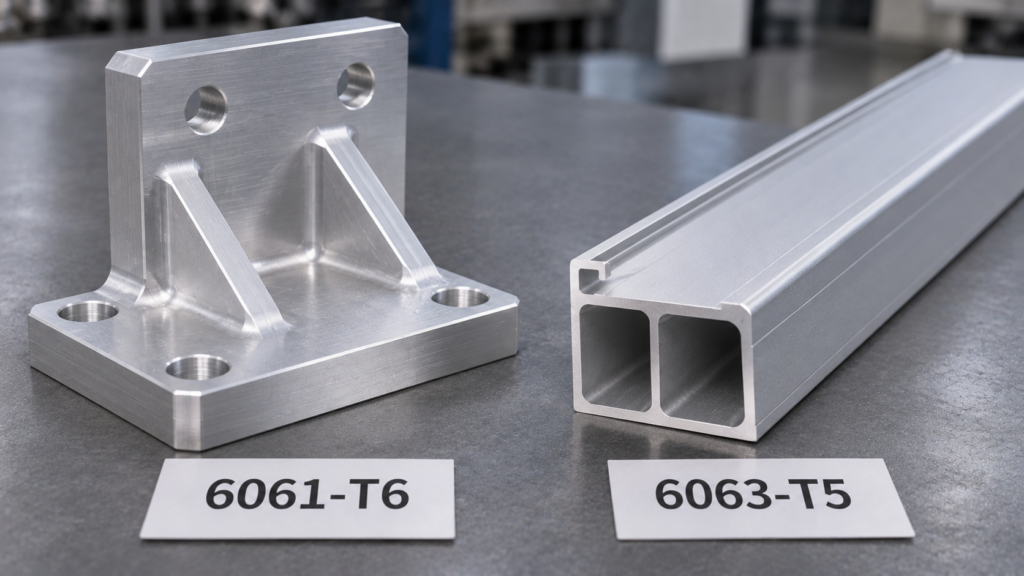
6061 vs 6063 aluminum comparison with a CNC-machined structural bracket and thin-wall hollow extrusion
Meco Whole Product Manufacturing Engineering Technical Guide

${articleTitle}

Source: ${window.location.href}  |  Generated: ${todayStr}
${clone.innerHTML}
`); frameDoc.close(); // Wait briefly for images and fonts inside the clean document before opening the PDF dialog const frameImages = Array.from(frameDoc.images); const imagePromises = frameImages.map(img => { if (img.complete) return Promise.resolve(); return new Promise(resolve => { img.onload = resolve; img.onerror = resolve; }); }); Promise.race([ Promise.all(imagePromises), new Promise(resolve => setTimeout(resolve, 1800)) ]).then(() => { if (btnSpan) btnSpan.textContent = originalText; printFrame.contentWindow.focus(); printFrame.contentWindow.print(); }); }); } });
Short answer

For 6061 vs 6063 aluminum, choose 6061 when strength and substantial CNC machining matter most. Start with 6063 when you need a detailed, thin-wall extrusion with an attractive, consistent anodized finish. Both alloys are light, corrosion resistant, weldable and heat treatable.

The temper matters as much as the alloy. Published typical yield strengths are about 276 MPa for 6061-T6, 145 MPa for 6063-T5 and 215 MPa for 6063-T6. These are comparison values, not guaranteed design minimums for every stock size.

A long aluminum rail with slender walls needs to come out of the extrusion die straight and with a finish the customer will see. A CNC-machined equipment mount faces a different test: it must hold its load and fit the parts bolted to it.

Both parts could use a 6000-series alloy, but choosing by the number on the drawing alone can waste money. The better question is which properties the finished part actually needs, from the first extrusion run through custom aluminum extrusion, machining and finishing.

This comparison focuses on the choices that change an engineering drawing or purchasing quote. For a full specification of 6061-T6, T651 and T6511 by stock type, use Meco's 6061 aluminum properties guide. The emphasis here is 6061 versus 6063 for the same project.

Key takeaways

  • Strength: 6061-T6 is usually the stronger reference temper. Always compare it against the named 6063 temper, not just the alloy number.
  • Extrusion: 6063 is often easier to extrude into slim, complex profiles, but wall thickness still depends on the die and profile design.
  • Finish: Both can take Type II anodizing. Choose 6063 first for long, cosmetic surfaces where consistency is critical.
  • CNC: 6061-T6 is a practical choice for heavily machined brackets, plates and housings. 6063 is also machinable.
  • Cost: Compare the finished part, including extrusion die, machining, anodizing, scrap, lot size and inspection.

6061 vs 6063 Aluminum: What Is the Difference?

6061 is the more strength-led, general-purpose manufacturing alloy; 6063 is the more extrusion- and appearance-led choice. Both belong to the heat-treatable aluminum-magnesium-silicon family. They share low density and useful corrosion resistance, but their composition ranges and common product forms are not identical.

6061 has more alloying additions that help it reach higher strength after appropriate heat treatment. The leaner chemistry of 6063 helps metal flow through detailed extrusion dies and supports attractive finishing on visible sections. The product shape and temper still affect the final result.

Decision factor6061 aluminum6063 aluminum
Primary advantageHigher strength potential; widely stocked in plate, bar, tube and extrusionBetter extrusion flow and surface consistency for many visible profiles
Common comparison temperT6 or T651/T6511 for the specified stock formT5 and T6 in extruded profiles
Typical usesCNC-machined mounts, brackets, machinery parts, structural sectionsWindow frames, decorative rails, trim, hollow sections and heat-sink profiles
Custom extrusionPossible, but demanding thin walls may need redesign or a different alloyOften the first candidate for fine detail and thin hollow sections
AnodizingGood, with appearance to be checked on samplesOften more uniform for decorative anodized surfaces
WeldingGenerally weldable; heat-affected strength requires design reviewGenerally weldable; heat-affected strength requires design review
CNC machiningCommon choice for general precision partsUseful for profile end features, drilled ports and light machining
Selection tendencies, not absolute material guarantees. Confirm alloy, temper and product form on the drawing.

One useful distinction

6061 is not always the better choice just because it is stronger. If your section has adequate strength already, the ease of making the extrusion and its surface finish may matter more.

How Much Stronger Is 6061 Than 6063?

Published typical yield strength helps compare material options, but it is not a safe substitute for the guaranteed minimum on your purchase specification. Yield strength is the stress at which a metal starts to take a permanent set rather than springing back.

The widely quoted 276 MPa versus 145 MPa comparison is 6061-T6 against 6063-T5. If the design can use 6063-T6 instead, the reference yield rises to about 215 MPa. The strength gap becomes smaller.

Common reference temperTypical yield strengthTypical tensile strengthInterpretation
6061-T6276 MPa (40 ksi)310 MPa (45 ksi)Strength-led structural and machining reference
6063-T5145 MPa (21 ksi)185 MPa (27 ksi)Commonly specified for appearance-led extrusions
6063-T6215 MPa (31 ksi)240 MPa (35 ksi)Higher-strength 6063 option for the right extrusion
Representative typical tube and pipe values from Kaiser Aluminum. Design minimums vary by standard, thickness and product form.

These figures come from Kaiser Aluminum's technical data. Standards for extruded profiles can set different minimum values by wall thickness. For example, Meco's aluminum extrusion alloy matrix lists relevant specified minimums rather than using one typical value for every section.

Does 6061 also make a part stiffer?

Not by much if you keep the same shape. Both alloys have an elastic modulus of about 69 GPa (10 million psi). That property describes how much the part bends under load before permanent deformation.

If deflection is the problem, adding a rib or changing the section may help more than switching from 6063 to 6061. If permanent deformation or the load limit is the problem, the higher yield strength of a suitable 6061 temper can matter.

Why do T5, T6 and product form matter?

T5 means the extruded material was cooled after hot forming and then artificially aged. T6 means solution heat treatment followed by artificial aging. In practice, the processing route and test requirements depend on the product specification.

Do not substitute a 6061-T651 plate for a 6061-T6511 extrusion, or assume a 6063-T6 profile has the properties of 6063-T5. Ask for the correct standard, temper, thickness range and mill certificate before approving a strength-critical order.

Does 6063 Make Thinner and More Detailed Extrusions?

6063 usually gives the extrusion engineer more freedom for narrow walls, small hollow channels and decorative profiles. Metal must flow through the die at a controlled rate. Thin webs and uneven wall thickness make that harder, especially when several hollow cells must fill evenly.

6061 can also be extruded into hollow and custom shapes. The question is whether a specific die, press, billet and cross-section can produce the required wall thickness economically. Your extruder has to check that, not a generic alloy chart.

What makes a thin-wall profile difficult?

  • Long unsupported thin webs can bend or twist as the metal leaves the die.
  • Big differences between thick and thin walls can give uneven metal flow.
  • Deep narrow slots may require fragile die details or a revised opening.
  • Large profile size can raise the practical minimum wall thickness.
  • Quenching, stretching and cut-to-length operations can change straightness.

The Australian Aluminium Council extrusion manual shows how minimum-wall guidance varies with the kind of section and alloy family. Its example is a design-screening tool, not a universal guarantee for a particular press.

How should you specify a custom extrusion?

Send the complete cross-section with the dimensions that affect assembly. Identify the surfaces used for mounting, the critical cavities, the visible finish faces and any post-extrusion holes or machining.

One project may need an appearance-grade 6063 window rail. Another may need a stronger 6061 extrusion that receives CNC machining on its end faces. If the cross-section can be simplified, that can change the cost more than a small difference in raw metal price.

Section comparison of a slim 6063 extrusion concept and a thicker structural aluminum profile with realistic wall paths
Thin hollow sections favor easy metal flow, while thicker load paths serve different structural requirements.

Which Alloy Gives a Better Type II Anodized Finish?

Both 6061 and 6063 can receive Type II sulfuric-acid anodizing. This process grows a protective aluminum-oxide layer on the surface. It is commonly used for corrosion protection and decorative finishes, including clear and dyed appearances.

6063 is often preferred when a long, visible extrusion must have a consistent surface. Its chemistry and extrusion surface can make decorative anodizing easier to control. Hydro's 6063 alloy guidance describes its strong anodizing response and use in visible architectural profiles.

Does that mean 6061 anodizes poorly?

No. 6061 can produce a useful, attractive anodized finish, and it is widely used where the part also needs strength or machining. But the visible color and texture may differ from a 6063 profile. Tool marks, grain structure, surface preparation and batch conditions all affect the result.

For a cosmetic assembly, ask the finisher to review a representative production sample before approving a large order. Name the alloy, temper, finish method, target appearance, coating requirements and any masked contact surfaces.

Read Meco's anodized aluminum comparison for the difference between bare metal and a finished oxide layer. The team can also review coating selection through surface finishing services.

Close architectural view of satin anodized aluminum window extrusions fitted with glazing seals and clear glass
Long visible window profiles make anodized finish consistency part of the finished product specification.

Is 6061 or 6063 Better for CNC Machining?

For a part that starts as bar or plate and needs extensive pocketing, drilling and facing, 6061-T6 is often the simpler sourcing choice. It is widely stocked and is familiar to machine shops. The specific cutting plan still depends on the tool, geometry and workholding.

6063 can also be CNC machined, especially after extrusion, when the work is limited to holes, slots, cut ends, threads or local mating faces. Softer tempers can be more prone to gummy chip formation. Neither alloy guarantees a fixed surface finish or machine cycle time.

When should you extrude first and machine second?

Suppose a long enclosure rail needs the same hollow shape along its full length and two accurate mounting holes at each end. Extruding most of the section and machining only those ends may save material and cutting time compared with milling the whole rail from solid stock.

For a short, thick bracket with pockets on several faces, a 6061 bar or plate machining route may need no dedicated extrusion die. It can be better for prototypes or lower-volume runs. Meco's custom CNC machining team can compare both routes against a drawing.

Aluminum extrusion held in a low-profile fixture with drilled mounting holes and a precisely finished cut end
Extrusion creates the constant section; secondary machining adds holes and mounting features at specific locations.

What about tolerance and surface finish?

State the functional datums, mating-hole position, flatness and surface finish only where the part needs them. Extruded dimensions follow a product standard and vary with profile size. Secondary CNC machining can control specific features more closely, but it does not make the whole extrusion a precision-machined part.

Allow for wall deflection when clamping a thin 6063 profile. On longer 6061 sections, residual stress and stock straightness also affect machining. A stable fixture and sensible machining sequence matter more than a single alloy label.

How Do 6061 and 6063 Compare for Welding and Corrosion?

Both are generally weldable by suitable commercial methods. For heat-treated parts, welding creates a heat-affected zone near the joint. Local strength can drop, so the original T5 or T6 yield value should not be applied blindly across the welded assembly.

This matters for a welded support frame. The load path may go through the weld, the surrounding heat-affected metal or a separate fastened joint. The right design check is on the assembly after fabrication, not only on the unwelded coupon data.

6061 and 6063 also have good general atmospheric corrosion resistance. Neither should be assumed immune to every wet or chloride-rich environment. Check surface finish, joint crevices, dissimilar-metal contact and expected service conditions, especially for outdoor equipment.

Hydro's 6061 data sheet notes that welding can reduce strength in the T6 weld region. The design and welding procedure should be qualified for the part's actual duty.

Choosing an extrusion alloy for a real drawing? Send Meco your section, critical load areas and required finish. We can review the extrusion and secondary machining route before quoting.

Talk to an engineer

Which Costs Less: 6061 or 6063 Aluminum?

There is no dependable one-number answer. A supplier may quote 6063 more competitively for a long, detailed custom extrusion because it can be easier to press. Another supplier may quote 6061 more economically for a machined part because common stock sizes are available and no new die is needed.

The total should include raw stock, die making, minimum run charges, cut length, machining, anodizing, inspection, packing and scrap. Paying less per pound for metal does not guarantee a cheaper finished part.

Cost driver6061 route to check6063 route to check
Raw materialStock bar or plate availability; extrusion billet availabilityExtrusion billet and section availability
ToolingCNC tools and fixtures; extrusion die if neededCustom extrusion die and profile-specific tooling
Process timeHeavy pocketing from solid stock may add cycle timeGood section flow may reduce extrusion effort; machining can still be required
FinishingAnodizing prep and cosmetic acceptanceAnodizing appearance control over long visible surfaces
Scrap and inspectionMachining removal, flatness, feature locationExtrusion straightness, cut edges, surface appearance
Order quantityStock machining can suit prototype or low volumeDedicated extrusion may spread die cost over long repeat runs
Cost comparison checklist. Request quote-specific values rather than applying a universal material price ratio.

Example: two ways to make the same mounting rail

Consider a 1,000 mm equipment rail with a continuous channel and four accurate end holes. A custom 6063 extrusion could make the channel in one repeated shape, followed by cutting, end drilling and anodizing. If the rail also carries a high structural load, 6061 or a changed section may be justified.

The right quote compares equal function and finish. A stronger material does not earn its cost if a less expensive section already meets the loads. An attractive thin wall does not help if it bends too much in service.

How Should You Choose Between 6061 and 6063?

Use the following short decision order before freezing the drawing. It helps separate a genuine material requirement from a preference that can be solved by geometry or finishing.

Design priorityStarting choiceEngineering check
High yield strength and load-bearing machined features6061-T6 or specified 6061 stock temperCheck actual load path, stock form and guaranteed minimum
Thin-wall hollow profile with long visible faces6063-T5Confirm wall feasibility, extrusion tolerance and finish
More strength but 6063-style extrusion required6063-T6Check available profile and minimum strength for its thickness
Heavy CNC machining from bar or plate6061-T6/T651, by formReview residual stress, fixturing and stock availability
Type II decorative anodized appearance6063 as an early candidateApprove appearance sample and finishing specification
Welded structureEither, if design permitsCheck heat-affected zone and required post-weld properties
Starting choices for drawing review; not a substitute for engineering signoff or material certification.

For a new extrusion, send three items together: the 2D section, the finished assembly loads and the surface-finish expectation. Add the annual volume, expected cut lengths and key mounting dimensions. Those inputs help the supplier quote a real manufacturing route rather than a guess based on alloy names.

Meco's materials hub places 6061 and 6063 in the wider selection of wrought aluminum grades. Use this comparison to decide between these two; use the broader hub if a third alloy may meet the need better.

Need a manufacturable aluminum section?

Meco can review your alloy choice alongside the full extrusion, CNC machining and finishing plan.

  • Compare 6061 and 6063 against load and appearance needs.
  • Review thin walls, profiles and functional datums.
  • Plan secondary machining and anodizing before production.
  • Quote to your drawing, finish and required quantity.
Talk to an engineer

About the author

Meco Engineering Team

The Meco Engineering Team draws on over 30 years of turnkey manufacturing experience across aluminum extrusion, CNC milling, CNC turning, surface finishing and mechanical assembly.

Our engineers work daily with sourcing managers, product designers and manufacturing engineers to balance cost, tolerance and lead time from prototype through mass production.

For alloy comparisons, we review mechanical requirements alongside section design, machinability, finishing and stock form.

  • Specialisms. Aluminum alloys, custom extrusion, machining DFM and anodizing.
  • Equipment. CNC machining equipment and CMM inspection systems.
  • Quality systems. FAI, PPAP, CMM inspection and full material traceability.
  • Reviewed by. Meco process engineering and quality leads.

Meet the engineering team or talk to an engineer directly.

IATF 16949:2016 certified. 30+ years in turnkey manufacturing. 40+ in-house processes. Global production with North American support.

References

  1. Kaiser Aluminum, Soft Alloy Tube and Pipe Technical Data. Representative alloy data and manufacturing design guidance.
  2. Hydro, 6063 alloy for extruded profiles. Representative alloy data and manufacturing design guidance.
  3. Hydro, 6061 alloy extrusion data sheet. Representative alloy data and manufacturing design guidance.
  4. Australian Aluminium Council, Aluminium Extrusion Manual, December 2023. Representative alloy data and manufacturing design guidance.

Strength values above are typical reference data, not guaranteed minimums for every extrusion size, temper or standard. Confirm design-critical values using the applicable specification and mill test report.