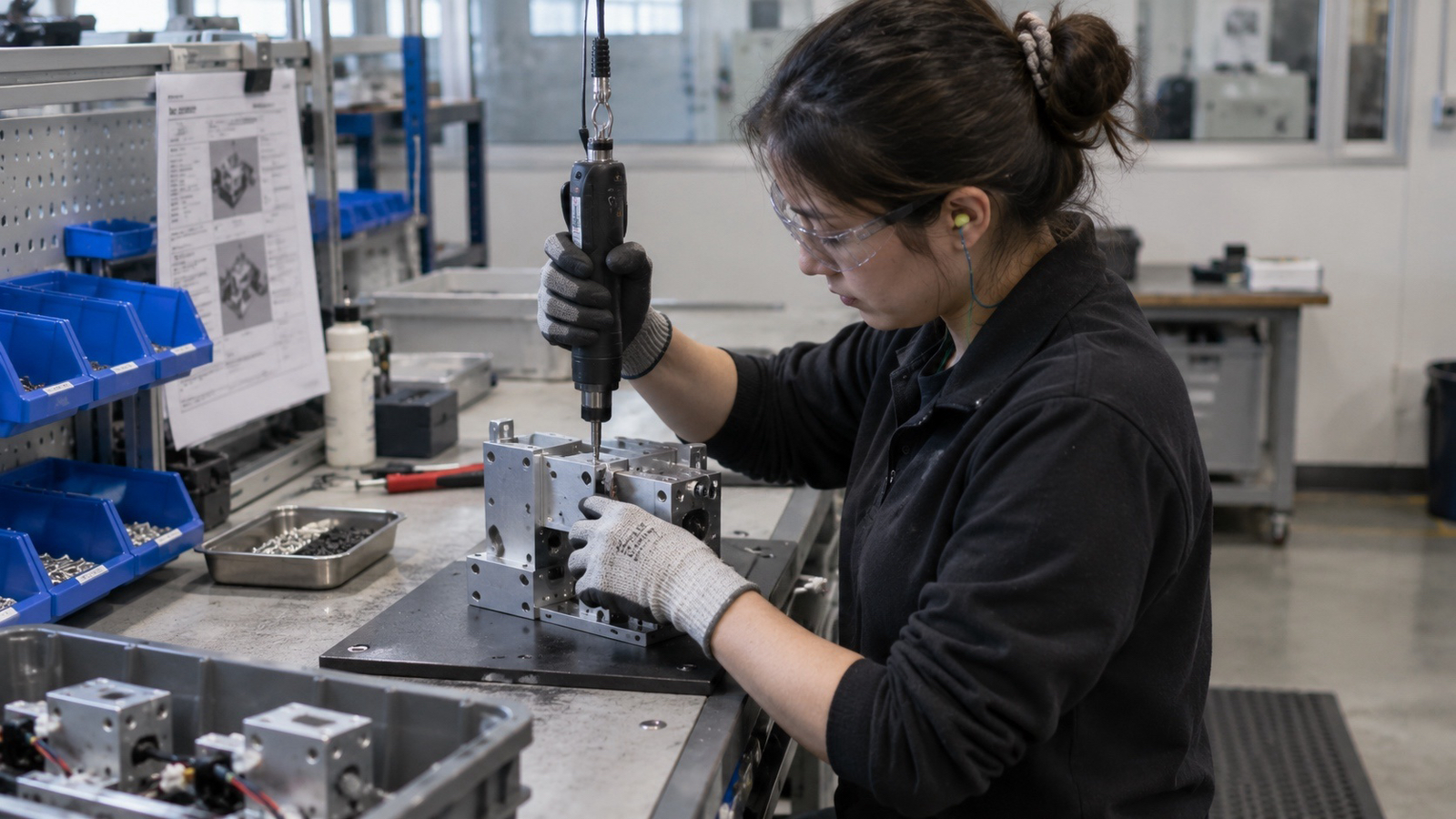
Sub assembly services turn a group of loose parts into one tested, traceable module that is installed into a larger product later.
Final assembly combines those modules and remaining components into the complete sellable product.
Sub assembly services are outsourced manufacturing programs that join a group of parts into one finished module, which then gets fitted into a larger product later. Final assembly is the last step, where those modules and remaining parts become the complete unit you ship. The short version of sub assembly vs final assembly: a sub-assembly is a building block with its own part number, and final assembly is the building.
That distinction sounds academic until you are the one signing purchase orders. Where you draw the line between the two decides how many suppliers you manage, how early you catch defects, and who pays when something does not fit.
Key takeaways
- A sub-assembly has its own part number, inspection record, and defined acceptance criteria.
- Final assembly creates the complete unit; sub-assembly creates a module used inside it.
- Outsourcing works best when it reduces supplier handoffs and gives one party responsibility for the joint.
- Start with consignment when the build is new, then consider turnkey supply after the process is stable.
- Use the SCOPE Check to compare strategic value, supplier complexity, defect ownership, demand, and equipment cost.
What Are Sub Assembly Services?
Sub assembly services cover the sourcing, joining, testing, and packaging of a module that is not yet a sellable product. The supplier builds it, verifies it, and delivers it ready to drop into your next stage.
The key word is ready. A real sub assembly manufacturing program hands you something you can install without re-inspecting every fastener.
Sub-Assembly in One Sentence
Think of a desk drawer slide. The rails, ball bearings, retainer, and stop are joined into one working slide before anyone goes near a desk. That slide is the sub-assembly. The desk is the final assembly.
What Is a Sub Assembly in Manufacturing?
A sub assembly is any group of two or more components joined into a single unit that carries its own part number and its own inspection record. It sits one level below the finished product in your bill of materials, the parts list that describes what goes into what.
That part number matters more than people expect. It means the module can be costed, tested, stocked, and traced on its own, separately from everything around it.
A subassembly can also contain other subassemblies. A control panel holds a wired switch module, which holds a terminated cable, and each level can have its own drawing.
What Are Some Examples of Sub Assemblies?
Sub assembly examples show up in almost every finished product. Common ones include:
- Wire harness sub-assembly: cut, crimped, and loomed wiring with connectors fitted and continuity tested.
- Engine or powertrain module: a cylinder head, crankshaft, or pump group built up before it meets the block.
- Gearbox or drive unit: shafts, bearings, and gears pressed and shimmed to a set backlash.
- Control panel: an enclosure fitted with switches, relays, terminal blocks, and internal wiring.
- Battery pack module: cells, busbars, sensors, and a housing joined and electrically verified.
- Vehicle door module: a regulator, motor, latch, and seal built onto a carrier plate.
- Pump and motor group: a motor coupled to a pump head with seals and fasteners torqued to spec.
Each one leaves the workstation as a single item with a single label, not as a pile of parts.
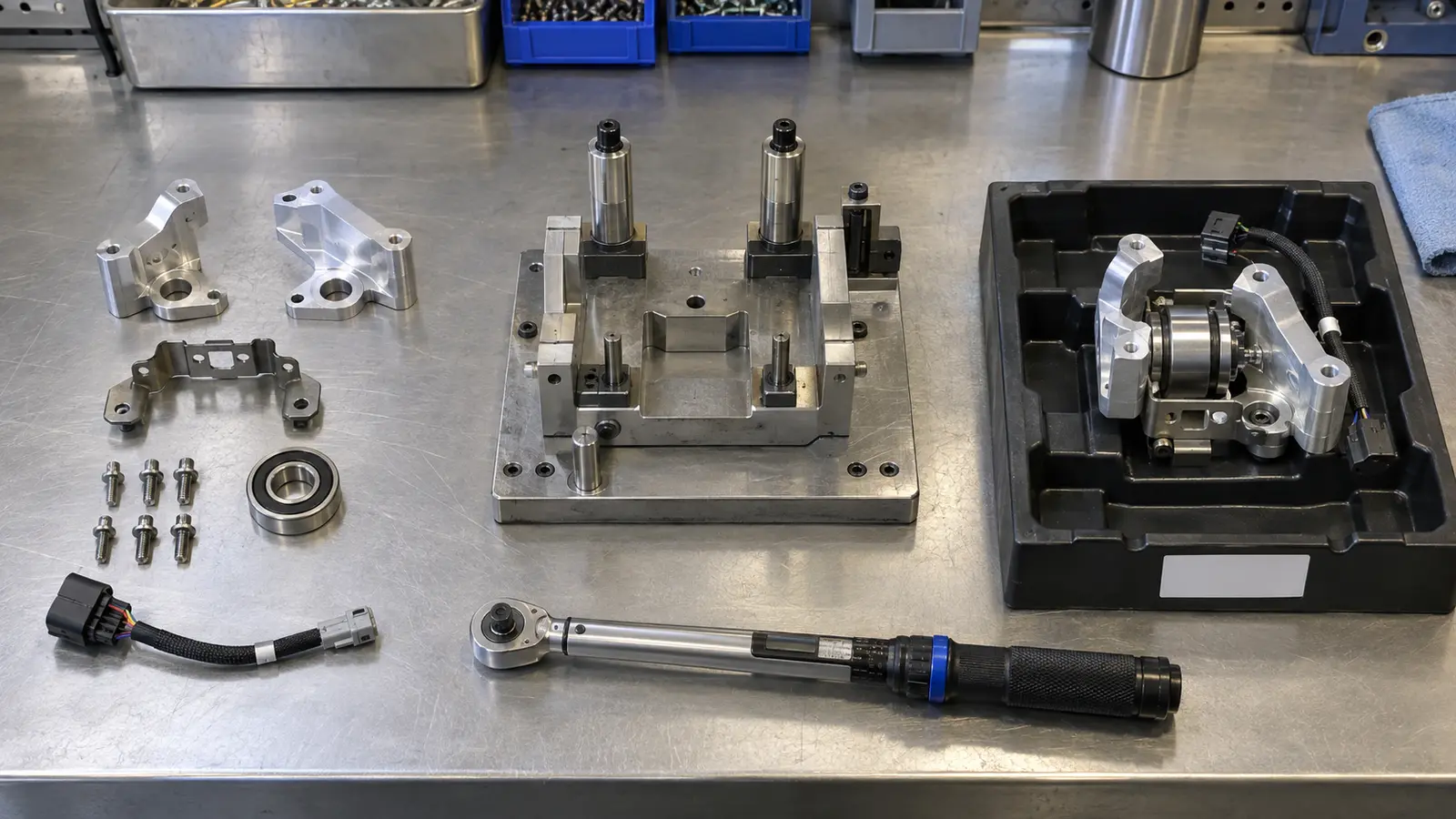
Sub Assembly vs Final Assembly: What Is the Difference?
The difference between assembly and sub-assembly is scope and position. Sub-assembly produces an intermediate module; final assembly produces the sellable unit and usually adds the outer housing, the last connections, and the packaging.
Here is how the two compare across the factors that actually change your costs.
| Factor | Sub-Assembly | Final Assembly |
|---|---|---|
| What it produces | A working module, not sellable on its own | The complete, sellable product |
| Position in the parts list | A mid-level node with its own part number | The top level, the finished good |
| Typical part count | Roughly 3 to 60 components | Several modules plus loose parts |
| Who receives it | Your own line, or another supplier | Your distributor or end customer |
| Testing performed | Function, torque, continuity, leak, or fit checks on the module | Full system test, safety and compliance checks |
| Packaging | Returnable trays, dunnage, line-side kits | Retail or shipping cartons, manuals, accessories |
| Traceability record | Lot or serial trace for that module only | Serial trace tying every module to one unit |
| Best stage to outsource first | Usually yes, lower risk, faster payback | Usually later, after the module work proves out |
Is a Sub Assembly a Finished Good?
Not for you, but usually yes for your supplier. Accounting treats the same object differently depending on who holds it.
The assembler books it as a finished good and invoices it. You receive it as a purchased component and consume it into work in progress. That mismatch is normal, and it is worth agreeing on the wording before the first invoice arrives.
Why Do Manufacturers Use Subassemblies?
Because splitting the build changes the economics, not just the workflow. Five effects do most of the work.
Fewer suppliers and fewer purchase orders. A module built from parts across several vendors becomes one line item from one source. Every removed supplier removes a receiving step, an inspection step, and a payment cycle.
Defects surface earlier. A misaligned hole found at the module stage costs one module. Found at final assembly, it can stop a line.
Builds run in parallel. Modules get made while other work continues, which shortens total cycle time instead of stretching one long sequence.
Line-side flow gets simpler. Your operators handle a handful of tested modules rather than hundreds of loose parts, which cuts picking errors.
Surge capacity becomes someone else's problem. When demand spikes, the assembler adds a shift. You do not hire.
Cost pressure is usually what starts the conversation. Structure is what makes the saving hold.
What Does a Contract Sub-Assembly Program Actually Include?
A contract sub-assembly program should cover far more than joining parts. If the scope stops at the build step, the sourcing, inspection, and logistics risk quietly stays with you.
What Should Be in Your Sub-Assembly Scope of Work
Component sourcing and kitting. Design for assembly review before fixtures are cut. Fixture and line build with error-proofing. The build itself, with controlled torque and calibrated tooling. Functional or dimensional test with recorded results. Packaging, labelling, and delivery to your schedule.
Two of those deserve a closer look, because they are where money is won or lost.
Kitting and sub-assembly go together. Kitting means gathering every part for one build into one tray in build order, so the operator never hunts for a washer.
Design for assembly review comes first, though. Our engineers look at the stack-up, the fastener choice, and the build order before any tooling is cut, and design changes at that stage typically remove 15 to 30% of unit cost. Paper is cheap. Steel is not.
Mechanical Sub-Assembly
Mechanical sub-assembly joins metal and plastic parts without electronics. The method has to match the joint, not the habit of the shop.
Meco runs twelve in-house joining methods, including orbital, punch, press, and blind riveting, hydraulic press assembly, shrink fitting, programmable adhesive dispensing, and spot, TIG, and MIG welding to AWS D1.1. Threaded fastening is torque-controlled to ISO 5393, the test method for power assembly tools.
Our complete guide to mechanical assembly walks through each method and when to pick it, and the mechanical assembly services page covers tolerances and quality checks.
Contract Electro-Mechanical Assembly
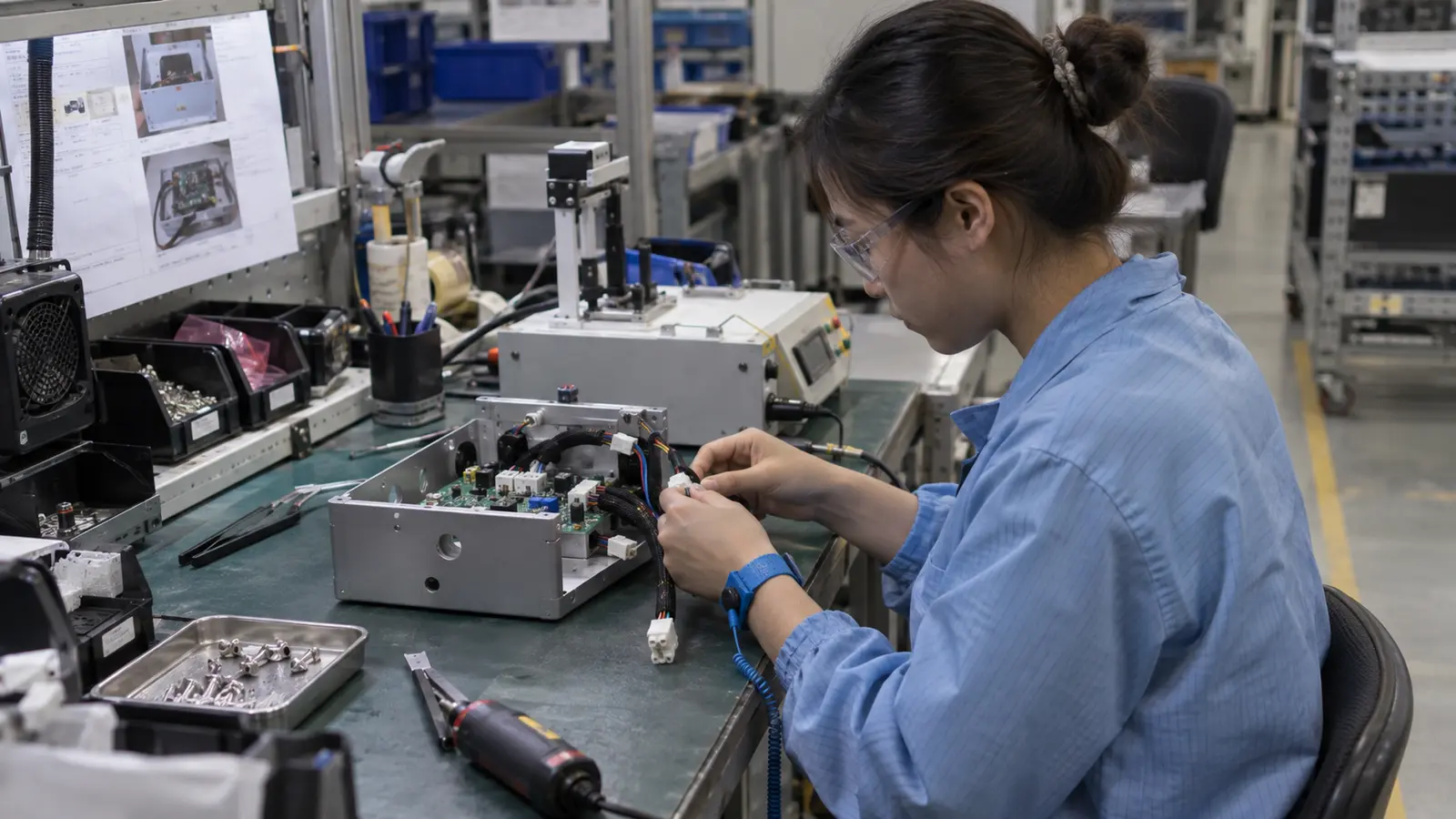
Contract electro-mechanical assembly combines electrical and mechanical parts into a module that does something when powered. Think a populated circuit board married to a metal enclosure and a cable harness.
Static is the hidden risk here, and it does not announce itself. Damage from a static discharge often shows up as a field failure months later, not as a reject on the bench.
All of Meco's electronics work happens in ESD-safe areas built to IEC 61340-5-1, the standard for electrostatic discharge control programs. If a supplier cannot name the standard its ESD program follows, that is a real answer to a real question.
When the module gains a full enclosure, power supply, and external connectors, it stops being a sub-assembly and becomes box build assembly. Our PCB design and assembly line covers both ends of that range.
How Do You Decide What to Outsource? The SCOPE Check
Most guidance on when to outsource sub-assembly stops at "focus on your core competency," which is true and useless. You need something you can run on a specific module this week.
We use a five-question test called the SCOPE Check. Score each question from 1 to 5, then add them up.
| Letter | Question to ask | Points toward outsourcing | Points toward keeping it in-house |
|---|---|---|---|
| S trategic value | Is this module why customers choose us? | It is ordinary work any competent shop could do | It holds your patent, your secret process, or your reputation |
| C omplexity of vendor chain | How many suppliers touch this module today? | Four or more, spread across regions | One or two, both local and reliable |
| O wn the defect | If it fails, can we prove whose fault it is? | Blame would land between two suppliers | One party clearly owns the whole joint |
| P redictability of demand | How steady is the volume? | Spiky, seasonal, or growing fast | Flat and easy to staff for |
| E quipment and fixture cost | What would in-housing cost in capital? | New presses, fixtures, or test rigs needed | You already own the tooling and it is paid off |
How to Score the SCOPE Check
Score 20 to 25 and the module is a strong outsourcing candidate; start quoting it. Score 12 to 19 and it is worth a trial build with one supplier before committing. Score under 12 and keep it in-house for now, then re-score whenever your volume or supplier mix changes.
Run the test on your three highest-part-count modules first. Those are almost always where the vendor sprawl is worst.
Have a module worth scoring? Send the bill of materials, drawings, annual volume, testing needs, and current supplier split. Meco will return a quote with design-for-assembly feedback in under 24 hours.
Review My Sub-AssemblyWho Owns the Problem When a Sub-Assembly Fails?
This is the question that decides whether outsourcing helps you or just moves your headache. Almost no one asks it during the quote.
Picture a bracket from one supplier that will not seat cleanly against a casting from another. Nobody notices until final assembly, when the fasteners will not pull the joint flush.
Both suppliers then measure their own part, find it inside tolerance, and send you the report. Both are telling the truth. The problem lives in the space between two drawings that were never checked against each other, and there is no one to escalate to, because no single party owns the joint.
Here is our honest opinion, and it is the one thing we would want a sourcing manager to take from this article. Consolidate the joint boundary before you consolidate on price. Getting the parts and the joining under one quality system does more for your scrap rate than shaving a few percent off a piece price.
That is why Meco makes components and assembles them under the same IATF 16949:2016 system. Machining, casting, stamping, moulding, and assembly all sit inside one set of manufacturing capabilities, so a fit problem has one root-cause owner instead of a debate.
Worth being clear about what this section is: a description of a common failure pattern, not a specific customer story. The mechanism is what matters, and you have probably lived it.
Turnkey vs Consignment: Who Buys the Parts?
Every contract sub-assembly quote uses one of two models, and the difference is simply who owns the components.
Consignment. You buy and ship the parts, the assembler builds. You keep control of sourcing and pricing, and you keep the risk of a shortage stopping the line.
Turnkey. The assembler buys every line on the bill of materials, verifies incoming material, builds, and invoices you one price per finished module. One purchase order replaces many.
Build to print assembly can run under either model. It just means the assembler builds exactly to your drawings without changing the design.
We recommend most first programs start on consignment and convert to turnkey once the build is stable. You learn how the supplier works while your existing supply chain still functions, and the switch later is straightforward. The full contract assembly guide for 2026 compares both models in more depth, and the contract assembly services page shows how each is quoted.
How Do You Choose Sub Assembly Companies?
Capability lists all read the same. These seven questions separate the suppliers who can do the work from the ones who can describe it.
- Which joining methods do you own in-house? Subcontracted welding or riveting adds a handoff and a second quality system.
- What standard does your torque control follow? A specific answer such as ISO 5393 beats "we use torque tools."
- What is your ESD program built to? Only relevant for electronics, but non-negotiable when it is.
- Can you make the parts as well as join them? This determines who owns a fit problem.
- What inspection equipment verifies the first article? Ask for the measurement capability, not just a promise of quality.
- What is your minimum order quantity? A hard minimum tells you whether they want a pilot run or only volume.
- What can you not do? The most useful question on the list.
Ask This Before You Sign
"What kind of work do you turn down?" A supplier that answers plainly is telling you the truth about its limits, which means you can trust what it claims it can do. A supplier that says yes to everything has told you nothing at all.
Certification is a fast first filter. IATF 16949:2016 applies automotive-grade process control, traceability, corrective action, and supplier management discipline to the assembly program.
Sub Assembly Services at Meco
Meco has spent more than 30 years building modules and finished products for OEMs, and we make the components too. That combination is the whole argument.
Programs run from 10 pieces to 10 million plus, with no minimum order quantity, so a pilot build and a mass-production ramp use the same supplier. First article and in-process dimensional checks run on CMM equipment to ±0.002 mm, and quotes come back in under 24 hours with design-for-assembly feedback included at no cost.
Finished modules ship through our warehousing and fulfilment network, with stock held in Ohio, Florida, Canada, Japan, and Thailand. That gives North American buyers local availability on globally produced parts.
If your project needs the parts made as well as joined, that sits under product assembly services. If you are still costing the component stage, our 2026 guide to metal part costs is the better starting point.
Bottom line: sub-assembly is usually the right place to start outsourcing, because it is reversible, measurable, and it fixes vendor sprawl before it touches your finished product.
Plan Your Assembly Program
Meco reviews your bill of materials, build sequence, joining methods, testing, volume, and packaging, then proposes a practical consignment or turnkey assembly route.
- Design feedback. DFA notes included with every quote.
- Integrated production. Components and assembly under one supplier.
- Flexible volume. From 10 pieces to 10 million.
- Quality records. FAI, PPAP, CMM, torque, and functional reports available.
- Response time. Quotes returned in under 24 hours.
Review contract assembly models, explore full product assembly, or send the program for review.
Talk to an Assembly EngineerReferences
External assembly and quality standards referenced in this guide.
- American Welding Society. AWS D1.1 Structural Welding Code.
- International Organization for Standardization. ISO 5393 Rotary Tools for Threaded Fasteners.
- International Electrotechnical Commission. IEC 61340-5-1 Electrostatics.
- International Automotive Task Force. IATF 16949 Automotive Quality Management System.
