
The main types of welding used in industrial manufacturing include MIG, TIG, stick, flux-cored, submerged arc, plasma arc, laser, resistance, electron beam, ultrasonic and friction stir welding.
They differ in how energy reaches the joint, whether filler metal is needed, achievable production speed and suitability for each material and part design.
Welding creates permanent joints by applying heat, pressure or both. Some processes melt the base metal; others form a solid-state bond without melting it. The methods support products ranging from fabricated machinery frames to medical devices and vehicle assemblies.
Choosing a welding process is not only about making a strong joint. Material, section thickness, fit-up, throughput, distortion, access, cost and inspection requirements all matter.
This guide explains the major types of welding used in industrial manufacturing. It compares the processes, common joint designs, typical defects and practical decisions that affect sourcing and production.
It is written for engineers, manufacturing teams and OEM buyers. The process descriptions focus on manufacturability and finished-part requirements rather than hobby equipment.
Key takeaways
- MIG and flux-cored welding: productive choices for many structural and repeat production joints.
- TIG welding: controlled heat and a clean bead for thin or appearance-sensitive components.
- Laser and resistance welding: automated joining suited to accessible, repeatable industrial assemblies.
- Solid-state processes: ultrasonic and friction stir welding join certain materials without bulk melting.
- Selection: confirm material, joint geometry, volume, heat sensitivity, qualification and quality requirements.
What Is Welding?
Welding is a permanent joining process that uses heat, pressure or both. Fusion welding melts material at the joint and may add filler metal. Solid-state welding creates a bond through pressure, vibration or controlled plastic deformation without fully melting the workpieces.
ISO 4063 classifies welding and allied processes using reference numbers. Industrial buyers will most often encounter a smaller set of arc, beam, resistance and solid-state methods. The ISO 4063 standard provides the formal naming framework.
The Welding Industry in 2026: Key Numbers
Before diving into individual processes, here is a snapshot of the welding industry that affects process selection, labor availability, and lead times across North America.
The American Welding Society-backed workforce data projects a need for 320,500 new welding professionals in the United States by 2029 . Labor availability is one reason OEMs evaluate repeatable robotic and automated welding cells alongside manual processes.
The Business Research Company's 2026 Welding Products Market Report estimates the global welding products market at $18.46 billion in 2026 , compared with $17.26 billion in 2025. These are market estimates, not welding costs or Meco sales figures.
The Major Types of Welding Processes
Below is a complete breakdown of every major welding process used in modern manufacturing. We group them into arc welding methods, high-energy beam methods, resistance methods, and solid-state/specialty methods.
MIG Welding (GMAW : Gas Metal Arc Welding)
MIG welding is the workhorse of industrial manufacturing. A continuously fed consumable wire electrode creates an arc between the wire and the workpiece. A shielding gas , usually argon, CO₂, or a mix , protects the molten weld pool from atmospheric contamination.
MIG is fast. It offers high deposition rates, which means more filler metal is laid down per minute than with most other arc processes. It works well on mild steel, stainless steel, and aluminum in gauges from about 0.6 mm up to 13 mm and beyond. It is the easiest arc process for beginners to learn because the wire feeds automatically , the operator only needs to manage travel speed, gun angle, and distance.
MIG welding works well where a repeatable fillet or groove weld must be deposited quickly. Meco provides gas-shielded welding services within its broader fabrication and welding offering; confirm the production cell and qualification details for each project.
TIG Welding (GTAW : Gas Tungsten Arc Welding)
TIG welding uses a non-consumable tungsten electrode to create the arc. The welder feeds a separate filler rod into the weld pool by hand while an inert shielding gas , typically pure argon , protects the joint. A foot pedal controls the amperage in real time, giving the operator precise heat control.
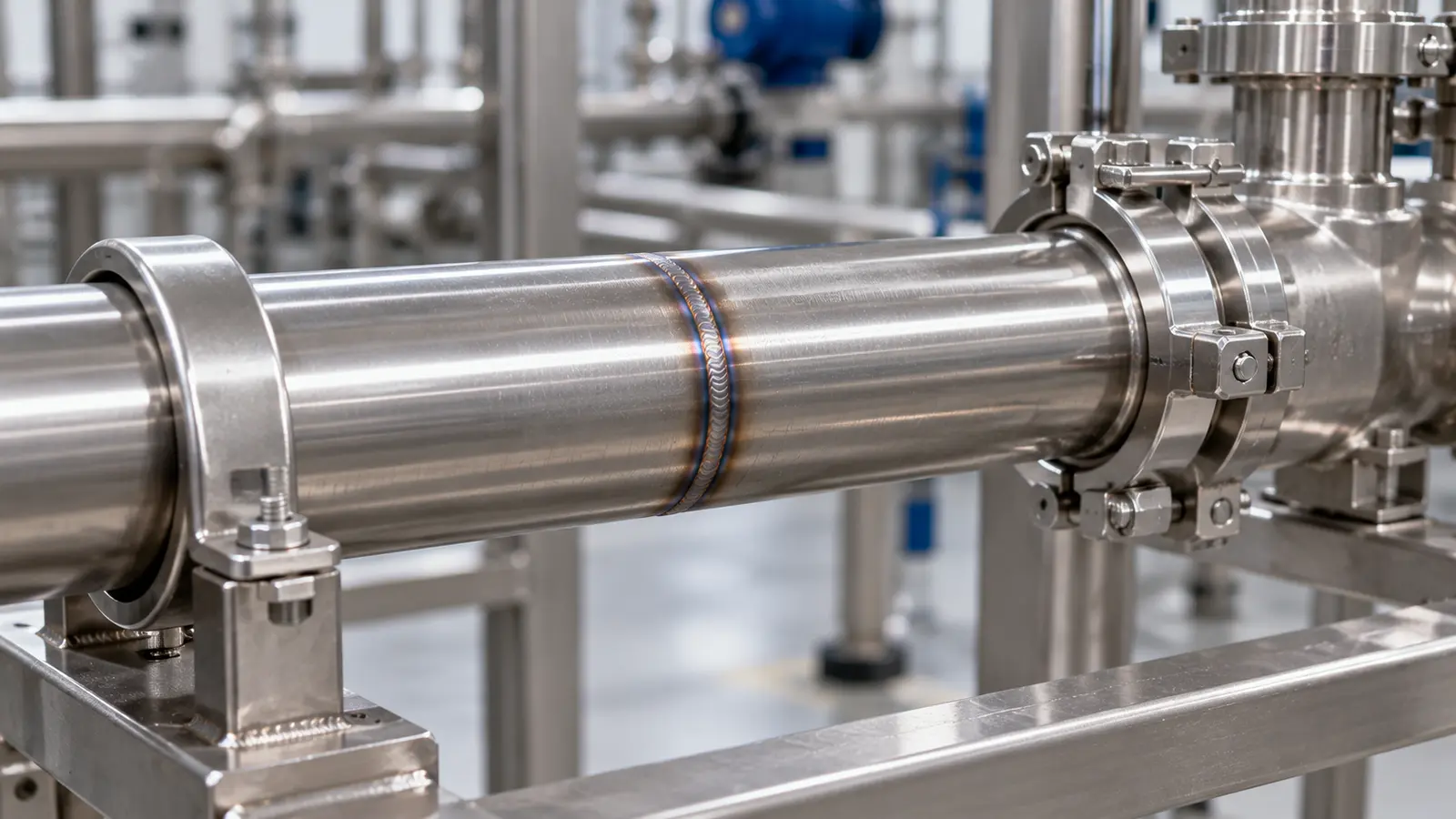
TIG produces the cleanest, most precise welds of any common arc process. The bead is smooth, spatter-free, and often requires no post-weld grinding. It is the standard for thin-gauge stainless steel (under 3 mm), aluminum, titanium, copper, and exotic alloys. Industries that demand cosmetic or critical welds , aerospace, medical devices, food equipment, and architectural metalwork , rely heavily on TIG.
TIG welding often suits thinner stainless steel or aluminum parts, especially when surface appearance and controlled heat input matter. Meco offers TIG welding as part of its custom fabrication capabilities.
Stick Welding (SMAW : Shielded Metal Arc Welding)
Stick welding is the oldest and most portable arc process still in wide use. A flux-coated consumable electrode (the "stick") creates an arc with the workpiece. As the electrode melts, the flux coating generates a shielding gas and a layer of slag that protects the weld pool.
Stick welding requires minimal equipment , just a power source, an electrode holder, a ground clamp, and electrodes. It works outdoors, in wind, in rain, and on dirty or rusty metal. That makes it the default choice for construction sites, pipeline work, field repairs, and structural steel erection. It handles a wide range of metals including carbon steel, stainless steel, and cast iron.
The downsides are lower deposition rates (the welder must stop and replace each electrode as it is consumed), heavy slag that must be chipped and wire-brushed after every pass, and a higher skill requirement than MIG. Stick welding is rarely used in high-volume manufacturing because it is too slow, but it remains essential for maintenance, repair, and field work.
Flux-Cored Arc Welding (FCAW)
Flux-cored welding is similar to MIG , it uses a continuously fed wire electrode. The difference is that the wire is tubular and filled with flux. The flux generates its own shielding gas as it burns, so FCAW can run with or without an external gas supply.
Self-shielded FCAW (no gas) works well outdoors and in windy conditions , a major advantage over MIG. Gas-shielded FCAW (with external gas) provides cleaner welds and is used indoors for structural steel and heavy fabrication. FCAW offers higher deposition rates than Stick and approaches MIG speed on thick materials. It is common in shipbuilding, structural steel, pipeline welding, and heavy equipment manufacturing.
The main limitations are slag (which must be removed between passes) and higher fume generation compared to MIG. FCAW wire is also more expensive per pound than solid MIG wire.
Submerged Arc Welding (SAW)
Submerged arc welding feeds a consumable wire electrode beneath a blanket of granular flux. The arc burns entirely beneath the flux layer , no visible arc, no spatter, and virtually no fumes. The flux melts to form a protective slag that peels away easily after cooling.
SAW is widely used on long seams in thick materials, such as pressure vessels, large structural beams and wind tower sections. Because granular flux must cover the arc, welding position and access affect where the process can be used.
Plasma Arc Welding (PAW)
The constricted arc supports a concentrated heat source and a narrower weld profile than many conventional TIG applications. PAW can be configured for micro-plasma, melt-in or keyhole welding, depending on the material and joint requirements.
The constricted arc gives PAW higher energy density, deeper penetration, and a narrower heat-affected zone than TIG. PAW operates in three modes: micro-plasma (for materials as thin as 0.025 mm), melt-in mode (similar to TIG but faster), and keyhole mode (for single-pass full-penetration welds on plate up to about 10 mm). It is used in aerospace engine components, medical equipment, coated steels, and electronics.
The primary limitation is equipment cost. PAW torches, power sources, and control systems are more expensive than TIG. Operator training requirements are also higher.
Laser Welding (LBW)
Laser welding uses a focused beam of coherent light to melt and fuse metals. The beam can be generated by a fiber laser, CO₂ laser, or Nd:YAG laser. Fiber lasers dominate modern manufacturing due to their efficiency, beam quality, and low maintenance.
Laser welding produces deep, narrow welds with a minimal heat-affected zone (HAZ). That translates to very low thermal distortion , critical for thin sheet metal assemblies and parts with tight flatness tolerances. The process is extremely fast and highly automatable, making it ideal for high-volume production. It is the method of choice for EV battery module assembly, precision electronics, and thin-gauge automotive components.
Laser welding suits repeatable thin-gauge assemblies when joint fit-up and beam access can be controlled. Meco provides laser welding services integrated with other fabrication processes.
Resistance Welding (Spot, Seam, and Projection)
Resistance welding joins overlapping metal sheets by passing a high electrical current through them while clamping them between copper electrodes. The electrical resistance at the joint interface generates enough heat to form a fused nugget , all in a fraction of a second.
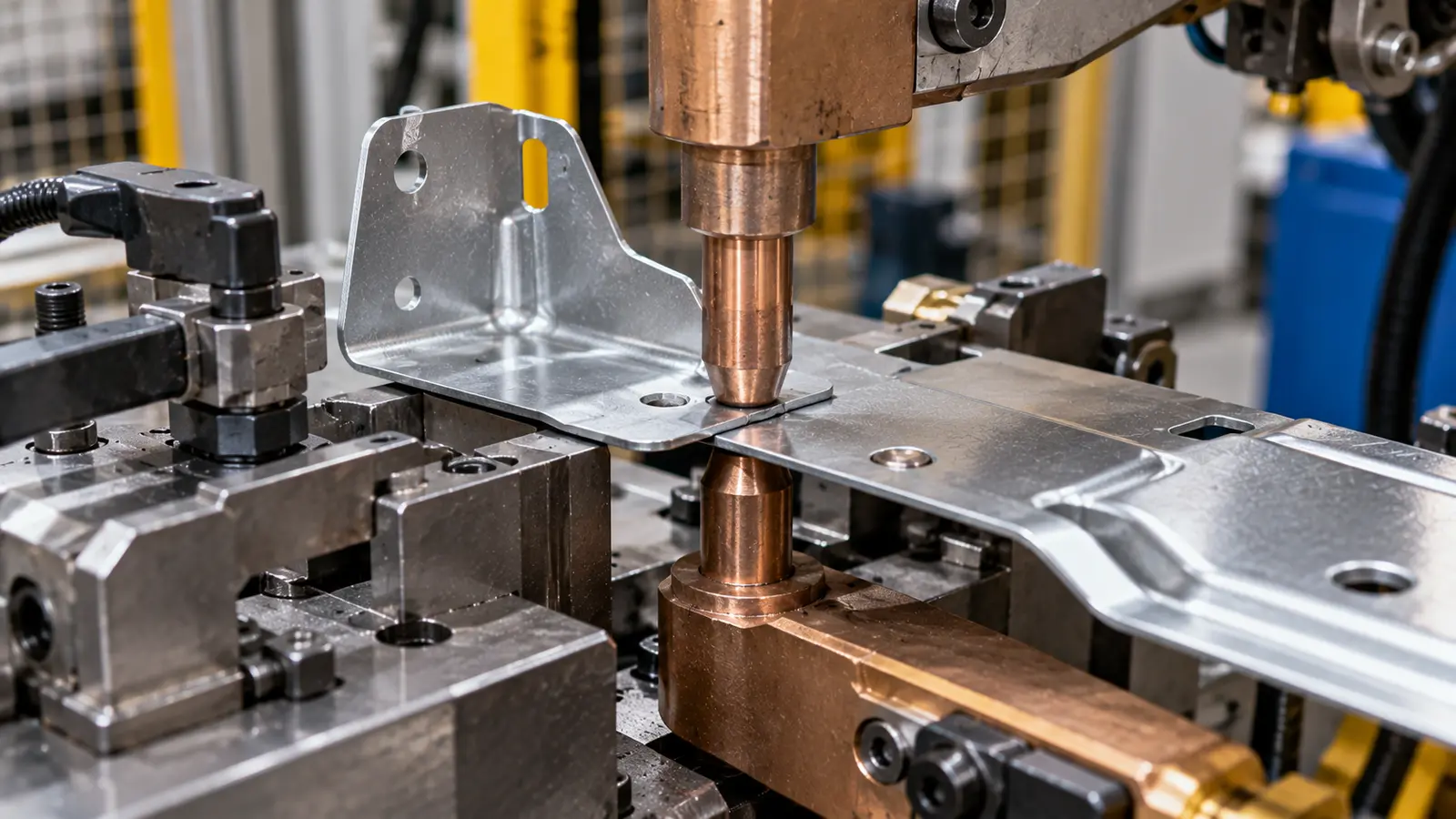
Spot welding (RSW) is the most common variant. Two pointed electrodes squeeze the sheets together and fire a pulse of current, creating a single weld "spot." Seam welding uses wheel-shaped electrodes that roll along the joint to create a continuous, leak-tight seam. Projection welding concentrates the current at raised points stamped into one part.
Meco offers resistance welding for sheet-metal production. The joint layout must provide physical access for the electrodes and a stable clamping surface.
Electron Beam Welding (EBW)
Electron beam welding uses a focused beam of high-velocity electrons to generate intense heat at the joint. The process takes place in a vacuum chamber to prevent the beam from scattering. EBW produces extremely deep, narrow welds , depth-to-width ratios of 25:1 are possible , with a tiny heat-affected zone.
EBW is used for critical aerospace and defense components, nuclear reactor parts, and high-precision medical implants where weld quality and structural integrity are paramount. It can weld materials that are difficult to join by other methods, including refractory metals and dissimilar metal combinations. The limitations are high equipment cost, the need for a vacuum environment (which restricts part size), and slower cycle times.
Ultrasonic Welding (USW)
Ultrasonic welding uses high-frequency mechanical vibrations (typically 20–40 kHz) to create a solid-state bond between parts. The parts are clamped together under pressure, and the ultrasonic vibrations generate friction at the interface. This friction produces localized heat that softens the material just enough to bond , but well below the melting point.
Ultrasonic welding is the standard for joining thermoplastics (polyethylene, polypropylene, ABS, nylon) and thin metal foils (copper, aluminum, nickel). It is fast (cycle times under one second), clean (no fumes, filler, or flux), and highly automatable. Applications include automotive wire harnesses, battery tab connections, medical device filters, sensor housings, and consumer product packaging.
Friction Stir Welding (FSW)
Friction stir welding generates heat through a rotating non-consumable tool that plunges into the joint line and "stirs" the softened material together. It is a solid-state process , the metal never fully melts, which eliminates porosity, solidification cracking, and other fusion-weld defects.
FSW is particularly suited to selected aluminum structures, including panels and some battery-related assemblies. Because the rotating shoulder must maintain contact with the material, rigid backing and fixtures are essential. Design qualification is still needed to assess defects, fatigue and joint performance.
MIG vs. TIG Welding: Head-to-Head Comparison
MIG and TIG are the two most frequently compared welding processes. The table below summarizes their key differences for sourcing managers and engineers choosing between them.
| Factor | MIG (GMAW) | TIG (GTAW) |
|---|---|---|
| Arc / heat source | Consumable wire electrode + shielding gas | Non-consumable tungsten + separate filler rod |
| Speed | Fast , high deposition rate | Slow , manual filler feed |
| Precision | Good | Excellent , best for thin material |
| Weld appearance | Good; may need grinding for cosmetic finish | Excellent; clean, smooth bead, often no cleanup |
| Material thickness | Medium to thick (1 mm – 25 mm+) | Thin to medium (0.5 mm – 6 mm typical) |
| Skill level | Beginner-friendly | Advanced , two-hand coordination + foot pedal |
| Cost per weld | Low | High (slower cycle time, higher labor) |
| Heat-affected zone | Larger , more distortion risk | Smaller , less distortion |
| Automation | Excellent , easy to robotize | Good , robotic TIG common for precision work |
| Best applications | Structural steel, auto frames, production welding | Aerospace, medical, food equipment, thin stainless/aluminum |
For a deeper comparison , including material-specific guidance and process selection support , see Meco's gas shielded welding services page.
Types of Welding Joints
A welding joint is the configuration of the workpieces where they are joined. There are five basic joint types. The right joint depends on geometry, load requirements, and torch access.
| Joint Type | Configuration | Strength | Common Uses |
|---|---|---|---|
| Butt joint | Two pieces aligned edge-to-edge in the same plane | Highest (with full penetration) | Pipe welding, plate fabrication, pressure vessels |
| Lap joint | Two overlapping pieces, one on top of the other | Good (fillet or spot weld) | Sheet metal assembly, automotive panels, spot-welded enclosures |
| Tee joint | One piece perpendicular to another, forming a "T" | Good (fillet weld both sides) | Structural frames, brackets, stiffeners |
| Corner joint | Two pieces meeting at a right angle at their edges | Moderate to good | Box frames, enclosures, housings |
| Edge joint | Two pieces side-by-side with edges aligned | Low to moderate | Sheet metal flanges, thin panels, low-load applications |
Joint design affects weld quality, access, inspection, and cost. A butt joint with full penetration is the strongest configuration but requires more preparation and filler material. Your design engineer should choose the joint that meets the structural requirement at the lowest cost , and your manufacturer should flag joint design issues during DFM review.
Where a welded joint forms part of a larger fabrication, also review how it will be installed and finished. See our sheet metal assembly guide for related forming, fastening and assembly decisions.
Choosing between welding methods? Send your drawing, material, expected volume and joint requirements. Meco can review a suitable joining approach and its related fabrication steps.
Discuss Your ProjectWhat Is Tack Welding?
Tack welding is not a separate process. It is a technique used within any arc welding method. A tack weld is a short, temporary weld (typically 10–25 mm long) used to hold parts in position before the final weld is made. Think of it as a metal clamp that keeps everything aligned.
Tack welds must be strong enough to resist thermal stresses during final welding but small enough to be fully consumed into the final bead. Poor tack welding , welds that are too large, placed incorrectly, or contain defects , is a common root cause of fit-up problems and weld defects in production. Proper spacing, size, and placement of tack welds should be specified in the welding procedure.
Common Welding Defects and How to Prevent Them
Even the best welding process produces defective joints if process parameters, materials, or technique are off. The table below covers the most common defects, their causes, and prevention. For a detailed visual guide, ESAB's welding defect reference is an excellent resource.
| Defect | Description | Common Causes | Prevention |
|---|---|---|---|
| Porosity | Gas pockets trapped in solidified weld metal | Contaminated base metal, moisture, insufficient shielding gas | Clean surfaces, check gas flow, use dry electrodes |
| Undercut | Groove melted into base metal along the weld edge, not filled | Excessive travel speed, too-high amperage, wrong torch angle | Reduce heat input, slow travel speed, adjust angle |
| Incomplete fusion | Weld metal does not fully bond to base metal or previous pass | Low heat input, fast travel, improper joint preparation | Increase amperage, slow down, ensure proper fit-up |
| Cracking | Fractures in the weld or heat-affected zone | High residual stress, hydrogen contamination, rapid cooling | Preheat, use low-hydrogen electrodes, control cooling |
| Spatter | Droplets of molten metal scattered around the weld | High wire-feed speed, wrong voltage, contaminated wire | Optimize voltage/wire speed, anti-spatter spray, clean wire |
| Distortion | Warping from uneven thermal expansion | Excessive heat input, wrong sequence, poor fixturing | Balanced welding sequence, intermittent welding, proper fixtures |
Quality at Meco
Inspection plans should match the product specification, joint criticality and applicable codes. Meco can support welding programs with dimensional verification, material traceability and appropriate inspection documentation.
What Is Weldability?
Weldability describes how easily a material can be welded to produce a sound, defect-free joint under production conditions. High-weldability materials (like mild steel, 304 stainless, and 6061 aluminum) tolerate a wide range of process parameters and rarely crack. Low-weldability materials (like high-carbon steel, cast iron, and some titanium alloys) require preheat, post-weld heat treatment, or special filler metals.
The single most important indicator for steel weldability is the carbon equivalent (CE). Steels with a CE below 0.40 are generally easy to weld. Steels with a CE above 0.60 require preheat and careful process control. When specifying a material for a welded assembly, always confirm weldability with your manufacturing partner before finalizing the design. Meco's engineering team reviews material-to-process compatibility as part of every DFM analysis.
How to Choose the Right Welding Process: Five Factors
A practical way to compare welding methods is to check five factors: material, application, throughput, cost and heat sensitivity. This is an editorial decision checklist, not a proprietary Meco certification or formal standard.
Five-factor welding process checklist
M , Material: What metal (or plastic) are you joining? Each material has different thermal properties and weldability.
A , Application: What is the joint's function? Structural load, pressure containment, cosmetic appearance, or electrical conductivity?
T , Throughput: How many parts per hour/day/month? Low volume favors manual TIG; high volume favors MIG, laser, or resistance.
C , Cost: What is your total cost target per joint , including labor, consumables, equipment, and post-weld finishing?
H , Heat Sensitivity: Can the part tolerate thermal distortion? Thin sheet metal and tight-tolerance assemblies need low-HAZ processes (laser, TIG, resistance).
Worked Example: You are sourcing a stainless steel (304) medical device enclosure from 1.5 mm sheet metal. Apply M-A-T-C-H: Material = 304 stainless, weldable but heat-sensitive at thin gauge. Application = cosmetic enclosure, must be smooth with no visible spatter. Throughput = 500 units/month. Cost = moderate; can justify quality over speed. Heat sensitivity = high , distortion on 1.5 mm must be minimal. The answer: TIG welding for prototyping and low volume, transitioning to laser welding if volume increases. MIG would be too hot and too messy for this application.
| Primary Factor | Best Process | Why |
|---|---|---|
| Thin material + cosmetic finish | TIG or Laser | Precise heat control, clean bead, minimal distortion |
| High volume + sheet metal overlap | Resistance (Spot) | Sub-second cycle, no consumables, easily automated |
| Structural steel + speed | MIG or FCAW | High deposition rate, strong joints, excellent automation |
| Outdoor / field work | Stick or self-shielded FCAW | No shielding gas tanks needed, wind-tolerant |
| Thermoplastics or thin foils | Ultrasonic | Solid-state bond, no heat damage, sub-second cycle |
| Deep penetration, critical joint | Electron Beam or SAW | Very high energy density, narrow HAZ, strongest joints |
| Dissimilar metals or aluminum panels | Friction Stir | Solid-state, no melting, no porosity, near-parent strength |
Welding Process Quick-Reference Table
Use this table as a side-by-side comparison of all major welding processes covered in this guide.
| Process | Abbreviation | Speed | Precision | Best Materials | Automation | Cost |
|---|---|---|---|---|---|---|
| MIG | GMAW | Fast | Good | Steel, aluminum, stainless | Excellent | Low |
| TIG | GTAW | Slow | Excellent | All metals, esp. thin gauge | Good | High |
| Stick | SMAW | Slow | Fair | Steel, stainless, cast iron | Poor | Low |
| Flux-Cored | FCAW | Fast | Good | Steel, stainless, nickel alloys | Good | Medium |
| Submerged Arc | SAW | Very fast | Good | Carbon steel, low-alloy steel | Excellent | Low (at volume) |
| Plasma Arc | PAW | Medium | Excellent | Stainless, titanium, nickel | Good | High |
| Laser | LBW | Very fast | Excellent | Steel, aluminum, thin gauge | Excellent | Medium–High |
| Resistance (Spot) | RSW | Very fast | Good | Steel, aluminum sheet | Excellent | Very low |
| Electron Beam | EBW | Medium | Excellent | Refractory metals, superalloys | Good | Very high |
| Ultrasonic | USW | Very fast | Good | Thermoplastics, thin metal foils | Excellent | Low |
| Friction Stir | FSW | Medium | Excellent | Aluminum, copper, soft alloys | Excellent | High |
How Welding Fits into Turnkey Manufacturing
Welding is rarely a standalone service. In turnkey manufacturing, welded joints are one step in a multi-process workflow that typically includes laser cutting or stamping of blanks, CNC bending or forming, welding, CNC machining of post-weld features (tapped holes, mating surfaces), surface finishing (powder coating, plating, anodizing), and final mechanical assembly .
For broader sourcing decisions, our guide to industrial manufacturing explains how individual processes fit into full production programs. Meco also offers custom fabrication and welding services.
Coordinating welding with machining, finishing and assembly can reduce handoffs and clarify responsibility for dimensional control. Whether it improves cost or lead time depends on the program and supply chain.
Meco integrates fabrication, welding, CNC machining, finishing and assembly through its manufacturing network and facilities in Thailand and China. Requirements for joints, inspection and documentation should be confirmed at the quote stage.
Plan Your Welding Project
Share your drawings and joint requirements. Meco can review process suitability, fabrication constraints and related manufacturing operations.
- Process range. TIG, MIG, laser and resistance welding.
- DFM support. Review of fit-up and access.
- Integrated production. Machining, finishing and assembly.
- Quality documentation. Inspection planning and traceability.
Explore fabrication and welding capabilities before requesting your quote.
Discuss Your ProjectReferences and sources
- ISO 4063, Welding and allied processes, nomenclature of processes and reference numbers
- American Welding Society, U.S. welding workforce projections
- The Business Research Company, Welding Products Market Report 2026
- AWS D1.1, Structural Welding Code, Steel
- ESAB, Common Weld Defects and How to Prevent Them
