Blow Molding Services — From Design to Finished Plastic Parts
Meco delivers complete blow molding services for custom bottles, containers, tanks, and hollow plastic components. From small-run prototypes to high-volume production.
- Extrusion, injection, and stretch blow molding under one roof.
- Parison programming for even walls in PVC, PP, PE, and PET.
- Trimming, drilling, labeling, and leak testing before shipment.
What Is Custom Blow Molding?
Last updated: August 2026
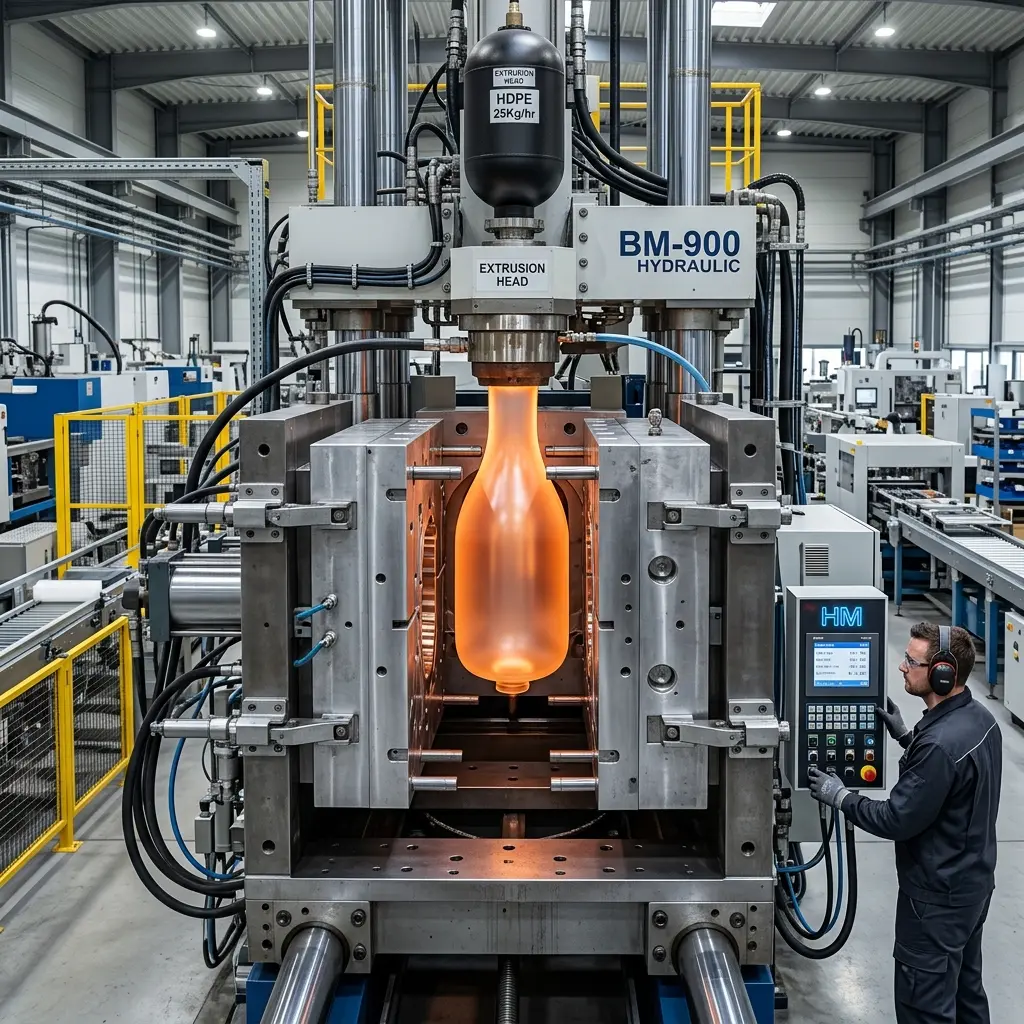
Blow molding is a process that inflates hot plastic with compressed air inside a closed mold until it takes the shape of the cavity. Because the air makes the cavity, the part comes out hollow in one piece, with no seam to weld and no core to pull.
Blow molding is one of five plastic processes we run in house, alongside injection molding, plastic extrusion, thermoforming, and 3D printing. A blow-molding-only supplier will always quote you a blow mold. We tell you when a different process makes your part cheaper. We cut our own tooling with CNC machining, then add surface finishing and assembly. New to outsourcing? See how contract manufacturing lowers your landed cost, or read what blow molding is in full.
Process
Blow Molding
Extrusion, injection, and injection stretch blow molding for hollow parts.
Standards
GB/T 13510
Blow molded plastic products specifications, applied to every part drawing.
Typical Tolerance
0.5 mm
On molded dimensions, with wall thickness held to roughly ±3 to 5%.
Tooling
Aluminum Molds
Cut in house. Far cheaper than an injection tool for the same envelope.
Swipe for all four
Three Types of Blow Molding, and When to Use Each
Extrusion blow molding is the workhorse for tanks, ducts, and large containers. Injection blow molding wins on small, dimensionally accurate bottles. Injection stretch blow molding is what makes clear, pressure-rated PET bottles. We quote whichever suits your part.
| Type | How It Works | Best For | Volume | Handles / Complex Shapes | Typical Resins |
|---|---|---|---|---|---|
| Extrusion Blow Molding (EBM) | A molten tube, the parison, is extruded, clamped in the mold, and inflated | Tanks, ducts, jerricans, large hollow parts | Low to high | Yes, handles and offset necks are straightforward | HDPE, PP, PVC |
| Injection Blow Molding (IBM) | A preform is injection molded onto a core, then transferred and blown | Small precision bottles, vials, pharma packaging | High | No, limited to simple shapes | PP, PE, PET |
| Injection Stretch Blow Molding (ISBM) | The preform is stretched axially then blown, biaxially orienting the polymer | Clear, strong, pressure-rated bottles | High | No | PET |
| Multi-Layer Co-Extrusion | Several polymer streams form a layered parison before blowing | Fuel tanks, chemical containers needing a barrier | Medium to high | Yes | HDPE with EVOH barrier |
Scroll inside the table to see every column
Why OEMs Pick Meco for Custom Blow Molding
We own the factories, cut the molds, blow the parts, test them, and assemble them. One supplier, one purchase order, one engineer on your program.
Five Processes, One Roof
Blow molding, injection, extrusion, thermoforming, and 3D printing in one place. If your part is wrong for blow molding, we say so before you pay for a tool.
We Build Our Own Molds
Blow molds designed and cut in house with CNC machining, usually in aluminum with beryllium copper pinch-off inserts for faster cooling and clean weld lines.
Parison Control, Not Guesswork
Programmed parison thickness compensates for corner thinning and long draws, so the finished tank passes drop and burst tests without adding weight everywhere.
Molding to Finished Product
Trimming, drilling, labeling, and leak testing, then product assembly and global warehousing. See whole product manufacturing.
Swipe for all four
What We Check in Your Blow Molded Design
Most blow molding problems are wall thickness problems in disguise. These are the first things our engineers look at when your file arrives, and the changes that save the most money before the tool is cut.
| What We Check | What Good Looks Like |
|---|---|
| Blow Ratio | The widest section no more than about three times the parison diameter. Beyond that the material thins too far and the corners go weak. |
| Corner Radii | Generous radii everywhere. Plastic stretches thinnest at sharp corners, so a tight corner is where the part will fail a drop test. |
| Wall Uniformity | Even walls achieved by parison programming rather than by adding weight. Uneven cooling is the main cause of warpage. |
| Pinch-Off Design | A clean, well-supported pinch-off line where the mold closes, so the weld seam is strong and the flash trims off cleanly. |
| Draft and Parting Line | Draft on all vertical faces and a parting line placed where the witness mark will not be seen or sealed against. |
| Tolerance Callouts | 0.5 mm on molded dimensions, wall thickness at roughly ±3 to 5%, per GB/T 13510. Tight callouts kept only on the features that mate or seal. |
Scroll inside the table to see every row
General design guidance. Your part gets specific numbers back with your quote.
Industries We Blow Mold Plastic Parts For
Meco delivers advanced custom plastic blow molding solutions for industrial and commercial applications. Our versatile blow molding capabilities produce lightweight, durable, and precisely engineered hollow components, optimized for strength, consistency, and cost-efficient production across diverse sectors.
Aerospace
Aerospace: Precision blow-molded housings, ducting, and reservoirs are produced with high-strength polymers that meet stringent aerospace specifications. Lightweight and durable, these components deliver performance and reliability under extreme temperature and pressure conditions. See our aerospace parts manufacturing.
Automotive
Automotive: Meco manufactures fuel tanks, washer reservoirs, air ducts, and fluid containers using multi-layer blow molding technology. Our automotive components meet strict dimensional, chemical, and impact resistance requirements for both passenger and commercial vehicles. See our automotive parts manufacturing.
Heavy Equipment
Heavy Equipment: Large blow-molded enclosures, hydraulic fluid tanks, and protective housings for heavy machinery are engineered for long-term durability, vibration resistance, and high mechanical strength, tailored for construction, mining, and agricultural equipment. See our heavy equipment manufacturing.
Home Appliances
Home Appliances: Custom blow-molded components such as water containers, air ducts, and structural housings are designed for lightweight efficiency, consistent performance, and sleek integration into modern appliance assemblies. See our home appliance manufacturing.
Industrial
Industrial: Durable blow-molded tanks, manifolds, and protective covers are produced for demanding industrial systems. With uniform wall thickness and tight tolerance control, these parts ensure reliability in chemical handling, process automation, and fluid storage. Read our guide to industrial manufacturing, or see the full list of Meco capabilities.
Light Manufacturing
Light Manufacturing: Cost-effective blow-molded containers, packaging enclosures, and lightweight structural parts are customized for consumer and commercial production lines, balancing strength, flexibility, and visual appeal for repeatable mass production. See our light manufacturing services.
Medical
Medical: High-purity blow-molded bottles, reservoirs, and housings are manufactured using medical-grade resins in controlled conditions. Our components offer precise capacity, biocompatibility, and sterility for medical devices and healthcare packaging applications. See our medical equipment manufacturing.
Telecommunications
Telecommunications: Blow-molded protective covers and cable management ducts are manufactured for outdoor and high-performance telecommunication systems. These parts provide electrical insulation, weatherproofing, and mechanical protection for signal and power lines. See our telecom manufacturing.
Office Furniture
Office Furniture: Lightweight structural elements, chair backs, and support housings are blow-molded for ergonomic comfort and long-term strength. The process allows complex curves and hollow geometries for sleek design and manufacturing efficiency. See our commercial furniture manufacturing.
Custom Electronics
Custom Electronics: Precision blow-molded enclosures and cable housings offer durable, non-conductive protection for sensors, IoT devices, and power systems, engineered for compact geometries, aesthetic form, and dependable performance. Pair them with PCB assembly and box build.
Blow Molding — Materials & Capabilities
Supported plastic materials for blow molding are PVC, PP, PE, and PET. Need a different process? See our full plastic materials list.
| Material | Why It Is Chosen | Typical Blow Molded Parts |
|---|---|---|
| PE (HDPE / LDPE) | The most widely blow molded resin. Tough, chemical resistant, holds up at low temperatures, easy to process | Fuel tanks, jerricans, hydraulic reservoirs, milk and detergent bottles |
| PP | Higher heat resistance than PE, good clarity in random copolymer grades, light | Hot-fill containers, appliance water tanks, air ducts |
| PVC | Excellent clarity and chemical resistance, low oxygen permeability, flame retardant grades | Clear bottles, chemical containers, packaging |
| PET | Biaxially oriented in stretch blow molding for clarity plus burst strength | Beverage bottles, pressure-rated containers, jars |
Scroll inside the table to see every column
Process: Blow Molding. Standards: GB/T 13510 Blow Molded Plastic Products Specifications.
Ready to Price Your Blow Molded Part?
Send a STEP file with your capacity, resin, and volume. You get tooling cost, part cost, and design feedback back fast. NDAs signed as standard.
Custom Blow Molding FAQs
What is blow molding used for?
Blow molding is the process of choice for hollow, one-piece plastic parts: bottles, containers, fuel and hydraulic tanks, air ducts, reservoirs, and structural housings. Compressed air inflates hot plastic against the mold wall, so the part comes out hollow without a core, a weld, or an assembly step.
Blow molding vs injection molding: which do I need?
If the part is hollow and enclosed, blow molding is almost always cheaper, because there is no core to pull and no need to mold two halves and join them. If the part is solid, has ribs, bosses, or precise mating features, use injection molding. Blow molding holds around 0.5 mm on molded dimensions where injection molding holds 0.05 mm, so precision features are the deciding factor.
What is the difference between extrusion and injection blow molding?
Extrusion blow molding (EBM) extrudes a molten tube called a parison, clamps it in the mold, and inflates it. It handles large parts, handles, and complex shapes. Injection blow molding (IBM) first injection molds a preform on a core rod, then blows it, which gives better neck and dimensional accuracy on small bottles but cannot produce handles. Injection stretch blow molding (ISBM) adds an axial stretch to biaxially orient PET for clear, pressure-rated bottles.
What tolerances can blow molding hold?
Roughly 0.5 mm on molded dimensions, with wall thickness typically controlled to about ±3 to 5%, in line with GB/T 13510. Neck and finish dimensions on injection blow molded parts are tighter because the neck is injection molded rather than blown. Tighter tolerances are possible but cost cycle time and secondary operations, so we only apply them where the part needs them.
How do you control wall thickness?
Through parison programming, which varies the extruded tube's thickness along its length so material lands where the part stretches most. Corners and deep draws thin out naturally, so we thicken the parison at those points instead of adding weight to the whole part. This is what keeps a tank light and still passing drop and burst tests.
How much does a blow mold cost compared to an injection mold?
Substantially less for the same part envelope. Blow molds are usually machined from aluminum with beryllium copper pinch-off inserts, they carry no core, no complex ejection system, and far lower clamp pressure, so both the material and the machining hours drop. This is why a large hollow part that would need a very expensive injection tool is often blow molded instead. Exact pricing depends on part size, cavity count, and finish.
Can you produce multi-layer or barrier parts?
Yes. Multi-layer co-extrusion blow molding builds the parison from several polymer streams at once. A typical automotive fuel tank uses an HDPE structure with an EVOH barrier layer at the centre to stop hydrocarbon permeation, plus a regrind layer to control material cost. The same approach works for chemical containers and packaging that needs an oxygen or moisture barrier.
What materials can Meco blow mold?
PVC, PP, PE, and PET. HDPE is the most common choice for tanks and industrial containers because of its toughness and chemical resistance, PP suits hot-fill and higher-temperature parts, PVC gives clarity with good barrier performance, and PET is used with stretch blow molding for clear pressure-rated bottles. Food-contact, UV-stabilised, and medical-grade compounds are available.
What finishing and testing do you provide?
Trimming and deflashing, drilling and punching, labeling and printing, and leak testing, followed by custom finishing and assembly. Parts leave the plant ready to use, not as raw mouldings that your line then has to process.
Where does Meco manufacture, and what quality system do you run?
Blow molding is produced in our Thailand and China facilities and managed from Canada, backed by over 30 years of manufacturing experience. Our quality system is IATF 16949:2016 certified, which is built on all ISO 9001:2015 requirements, and parts are checked against GB/T 13510. More about Meco.
How to Get Started
Upload a STEP or IGES file with capacity, resin, and volume. Tell us where the part must seal, mount, or be labeled. NDA first if you prefer.
We confirm the right blow molding type, review blow ratio, radii, and pinch-off, recommend a resin, and price tooling and parts. New to sourcing? See how to find a manufacturer.
We cut the mold in house, tune the parison program, and ship first samples with dimensional and leak test reports for your sign-off.
Full production with in-process checks, then trimming, labeling, leak testing, assembly, and global warehousing.
Learn More About Plastic Manufacturing
Guides written by our engineering team on process choice, tooling, and cost.
What Is Blow Molding?
How a parison becomes a bottle, tank, or duct, the three process types, and what each one costs.
Read the guide →
What Is Plastic Injection Molding?
The alternative for solid, precise parts: how it works, resin choice, design rules, and cost.
Read the guide →
What Is Contract Manufacturing?
How an integrated supply chain from tooling to assembly lowers your landed cost per part.
Read the guide →Swipe for all three guides
