Injection Molding Materials
More than fifty thermoplastics, from commodity PP through PEEK, molded in our own factories on tooling we cut ourselves. Resin, tool and part come from one supplier.
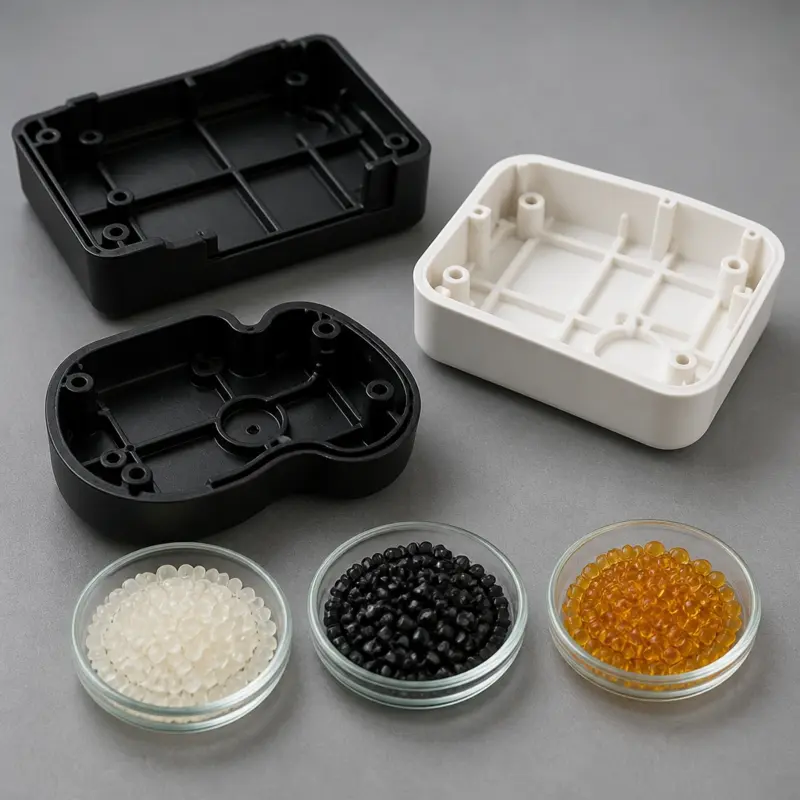
What Materials Are Used in Injection Molding
Injection molding runs on thermoplastics. The nine that cover most production work are ABS, PC, PVC, PP, PE, PA (nylon), POM, TPU and PEEK, with blends and glass filled versions of each.
Everything below is what goes through our presses. For the process and tooling, see custom injection molding and plastic injection molding. For grades on other routes, start at the materials hub.
Resins
50+ Grades
Nine core families in routine production, plus glass filled, flame retardant and UV stabilised compounds.
Feedstock
Dried Pellet
Virgin resin as default. Regrind percentage is agreed in writing before the first production run.
Molded Tolerance
±0.05 mm
Standard on molded features. Machined features on the same part hold ±0.01 mm.
Documentation
CoA and RoHS
Resin lot certificates, REACH and RoHS declarations, conflict minerals reporting.
Swipe to see all four
Resin Families We Mold
Filler changes a resin more than the base polymer name suggests. A 30% glass nylon and an unfilled nylon behave like two different materials on the press, in the tool and in the part.
| Family | Grades We Run | Why It Gets Specified | Finish Options | Typical Parts |
|---|---|---|---|---|
| ABS | General purpose, high impact, plating and FR grades | Cheapest engineering resin that molds cleanly and takes a cosmetic finish without secondary work | Textured tool finish, paint, chrome plate | Housings, bezels, knobs, consumer enclosures |
| PC and PC-ABS | Optical, FR and glass filled PC, PC-ABS blends | Impact strength that survives a drop test, plus optical clarity nothing else on this table matches | Polished tool for clarity, frosted, hard coat | Lenses, diffusers, guards, instrument covers |
| Polypropylene | Homopolymer, copolymer, talc and glass filled | Lowest cost per part, chemical resistance, and the only family that survives a living hinge | Molded in colour, textured, rarely painted | Closures, hinged lids, tanks, interior trim |
| Polyethylene | HDPE, LDPE | Toughness and moisture resistance at commodity pricing, with almost nothing that attacks it chemically | Molded in colour, flame treat before printing | Containers, caps, bins, bumpers |
| PVC | Rigid and flexible compounds, high and low plasticizer content | Excellent electrical insulation and chemical resistance at a low material cost, with dimensions that stay put over time | As molded, welded or solvent bonded assemblies | Electrical housings, valve components, chemical resistant fittings |
| Nylon (PA) | PA6, PA66, PA12, 15% to 50% glass filled | Wear and fatigue resistance under load, especially in glass filled grades running hot | As molded, occasionally painted | Gears, bushings, clips, under bonnet parts |
| POM (Acetal) | Homopolymer and copolymer, low friction grades | Sliding parts that must not gall, and the best dimensional stability of the crystalline resins | As molded only, resists paint and adhesive | Gears, cams, latches, fuel system parts |
| Elastomers | TPU, TPE, TPV in 40A to 90A hardness | Soft touch and sealing, usually overmolded onto a rigid substrate in a two shot tool | Matte or grained tool finish | Grips, seals, bellows, cable strain reliefs |
| High Temperature | PEEK, PEI, PPS, PBT | Continuous service above where ABS and nylon give up, plus steam and solvent exposure | As molded, machined features where needed | Bearings, connectors, sterilisable components |
Scroll inside the table for every row and column
What Each Resin Demands on the Press
Wall thickness is a material property as much as a design choice. Go thicker than the resin likes and you get sink and voids. Go thinner and the cavity will not fill. Drying is the other half, and it is where most first article failures start.
| Resin | Workable Wall | Drying | Molding Notes |
|---|---|---|---|
| ABS | 1.2 to 3.5 mm | 2 to 4 h at 80 C | The easy one. Wide process window, low shrink, holds a texture well |
| PC | 1.0 to 3.8 mm | 3 to 4 h at 120 C, critical | Molds hot and needs generous radii. Skipped drying shows as splay and brittle parts |
| PC-ABS | 1.2 to 3.5 mm | 2 to 4 h at 90 C | Most of the impact strength of PC in a wider process window and at lower cost |
| Polypropylene | 0.9 to 3.8 mm | Not required | Fills thin walls easily but shrinks and warps. Ribs need care on flat panels |
| HDPE | 0.8 to 3.0 mm | Not required | Highest shrink here. Expect a long cool and dimensions that settle over hours |
| PVC | 1.5 to 4.0 mm | Not required, moisture stable | Narrow thermal window. Running the barrel too hot or holding material too long releases HCl and degrades the resin, so dedicated screws and tight purge procedures are standard |
| Nylon PA6 and PA66 | 0.8 to 3.0 mm | Dry to below 0.2% moisture | Very fluid when hot, so flash is a constant. Parts gain dimension as they absorb humidity |
| Glass filled nylon | 1.0 to 3.0 mm | Dry to below 0.2% moisture | Directional shrink warps flat sections. Abrasive, so tool steel and gate wear are real costs |
| POM | 0.8 to 3.0 mm | 2 to 3 h at 80 C | High shrink and unforgiving of thick sections. Degrades if held hot in the barrel |
| PBT | 1.0 to 3.0 mm | 2 to 4 h at 120 C | Fills thin walls well. Glass filled grades warp if cooling is not balanced |
| TPU | 1.5 to 3.0 mm | 2 to 3 h at 90 C | Sticky in the tool, so ejection needs designing early. Bonds to PC and ABS in two shot work |
| PEEK | 1.0 to 3.5 mm | 3 h at 150 C | Needs a hot tool and a hot barrel. Material cost dominates the part price, so scrap hurts |
Scroll inside the table for every row and column
Resin Property Data
Numbers for the unfilled grade of each resin, which is where a selection conversation starts. Fillers move most of these substantially: 30% glass in nylon roughly doubles stiffness and raises service temperature, at the cost of directional shrink and tool wear.
| Resin | Tensile StrengthMPa | Notched ImpactIzod, kJ/m² | Max Service Temp°C, continuous | Chemical Resistance | Moisture Absorption% at saturation | Achievable Tolerance |
|---|---|---|---|---|---|---|
| ABS | 40–50 | 10–25 | 70–80 | Poor | 0.3 | ±0.05 mm |
| PC | 60–70 | 60–85 | 115–130 | Fair | 0.15 | ±0.05 mm |
| PC-ABS | 50–60 | 40–55 | 85–95 | Poor | 0.2 | ±0.05 mm |
| PP copolymer | 25–40 | 15–40 | 80–100 | Excellent | <0.01 | ±0.10 mm |
| HDPE | 20–30 | 15–30 | 80 | Good | <0.01 | ±0.10 mm |
| Rigid PVC | 35–55 | 3–10 | 60 | Excellent | 0.05 | ±0.08 mm |
| PA6 / PA66 | 70–85 | 5–10 dry | 100–120 | Good | 1.5–8 | ±0.10 mm |
| PA66 30% GF | 150–180 | 10–15 | 130–150 | Good | 0.8–1.5 | ±0.10 mm |
| POM | 60–70 | 6–12 | 90–100 | Excellent | 0.2 | ±0.08 mm |
| PBT | 50–60 | 4–8 | 120–140 | Good | 0.08 | ±0.05 mm |
| PET | 55–75 | 3–6 | 100–110 | Good | 0.1 | ±0.05 mm |
| PMMA | 60–75 | 1.5–3 | 65–85 | Poor | 0.3 | ±0.05 mm |
| TPU / TPE | 10–45 | No break | 80–100 | Good | 0.3–1 | ±0.15 mm |
| PEI | 85–105 | 4–8 | 170–180 | Good | 0.25 | ±0.05 mm |
| PEEK | 90–100 | 5–8 | 240–250 | Excellent | 0.1 | ±0.05 mm |
Scroll inside the table for every row and column
How to Choose an Injection Molding Resin
Name the one thing the part cannot fail at, and let that pick the family. Everything after that is trade offs you can price. Cost per part is rarely the deciding factor on its own, because the tool, the cycle time and the scrap rate move more money than the pellet price does.
Volume then decides whether molding is even the right route. Below roughly a thousand parts a year the tool rarely pays for itself, and 3D printing or thermoforming usually wins. We will say so rather than sell you a mold.
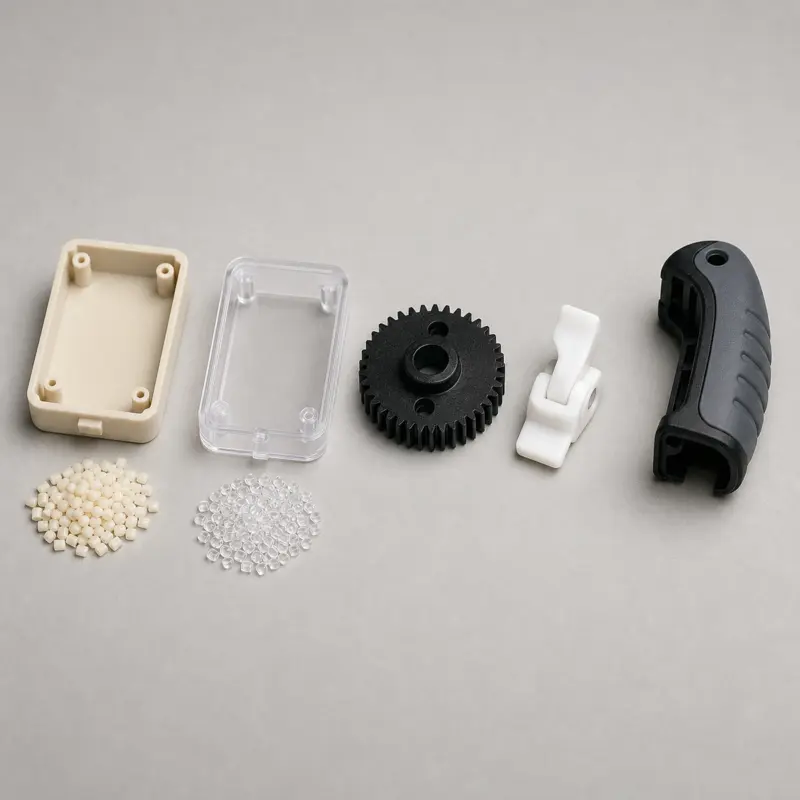
| If Your Priority Is | Look At | Route |
|---|---|---|
| Lowest cost per piece | PP copolymer, HDPE, general purpose ABS | Injection molding |
| Impact strength or clarity | PC, PC-ABS, PMMA for optics only | Polished or textured tool |
| Gears, cams and sliding wear | POM, PA66, 30% glass filled nylon | Molding with machined key features |
| A hinge that flexes for years | PP copolymer, gated to flow across the hinge | Single cavity or family tool |
| Soft grip or a seal face | TPU or TPE over a PC or ABS substrate | Two shot molding |
| Heat, steam or solvents | PEEK, PEI, PPS, PBT for electrical | High temperature tooling |
| Electrical insulation or chemical exposure | Rigid PVC, PVC compounds with UL flame ratings | Injection molding, welded assemblies |
| Outdoor and UV exposure | ASA, UV stabilised PP, never bare ABS | Molding in colour, no paint |
| Metal strength in a small part | Stainless and low alloy steel feedstock | Metal injection molding |
Swipe the table sideways for every column
What Follows the Resin Lot Into Production
Plastic traceability runs to the resin lot and the colour batch, because two lots of the same grade name can behave differently on the press. These are the records tied to your parts.
Resin Lot Certificates
Certificate of analysis from the resin maker for the lot that ran your parts, naming grade, filler content and melt flow index.
Regrind and Colour Control
Regrind percentage fixed in the process sheet and held there. Masterbatch loading and colour approval recorded against a signed plaque.
Dimensional Records
First article inspection, CMM data on nominated features and in process checks that confirm every dimension settled where the tool assumed.
Compliance Files
REACH and RoHS declarations plus conflict minerals reporting. Food contact and medical declarations where the grade carries them from the supplier.
Swipe to see all four
Injection Molding Materials FAQ
What materials are used in injection molding?
Thermoplastics, and in practice nine families cover most production: ABS, PC, PVC, PP, PE, PA (nylon), POM, TPU and PEEK. Meco molds all nine plus blends such as PC-ABS and filled compounds, more than fifty grades in total. Commodity resins take the largest share by volume because they are cheap and mold fast, while engineering resins get specified when heat, wear or load rules them in.
Which plastic is cheapest to injection mold?
Polypropylene, with polyethylene close behind. Both are low cost per kilogram, fill thin walls easily and cool quickly, which shortens cycle time and drops the cost per part again. ABS costs more per kilogram but often lands cheaper overall on a cosmetic part, because it needs no painting and scraps less. Pellet price is only one of four levers, alongside cycle time, cavity count and scrap rate.
Which plastic is strongest for injection molding?
It depends which kind of strength you mean. PEEK holds the highest strength at temperature and is the answer for continuous hot service. Glass filled nylon gives the best stiffness and load capacity for the money, which is why it dominates structural molded parts. Polycarbonate wins on impact, absorbing a drop that would shatter a stiffer resin. Specify the failure mode you are designing against and the answer narrows quickly.
Can I change resin after the mold has been cut?
Only within a narrow band. The cavity is machined oversize by that resin's shrinkage, so moving from ABS at 0.6 percent to POM at 2 percent puts every dimension out. Swapping between resins with similar shrinkage, such as ABS and PC-ABS, is usually workable with a process change. Anything wider needs steel adjustment or a new tool, which is why we lock the grade before cutting and leave critical dimensions steel safe when the choice is still open.
Does resin need to be dried before molding?
Most engineering resins do. Nylon, PC, PBT, POM, TPU and PEEK all pick up moisture from the air, and molding them wet causes splay marks, bubbles and a permanent drop in mechanical strength that no inspection of the surface will catch. Nylon needs to be below 0.2 percent moisture before it reaches the screw. Polypropylene, polyethylene and PVC do not absorb meaningful moisture and need no drying, which is one more reason they are cheap to run.
Should I use ABS or polycarbonate?
ABS for most cosmetic housings, PC when the part has to survive impact or transmit light. PC costs noticeably more per kilogram, molds hotter, and demands proper drying, so it carries a higher process cost as well as a higher material cost. PC-ABS is the middle option and is often the right one: it keeps most of the impact performance, molds in a wider window and prices between the two.
Is PVC suitable for injection molded parts?
Yes, for parts where electrical insulation, chemical resistance and low material cost matter more than impact strength or heat resistance. Rigid PVC molds well but runs a narrower thermal window than ABS or PP: hold it too hot or too long in the barrel and it degrades and releases hydrochloric acid gas, so we run it on dedicated screws with tight purge procedures. It has weaker UV resistance and impact strength than most engineering resins, so parts stay indoors or get a protective finish where they are exposed outdoors.
How does resin choice affect the tolerance I can hold?
Considerably. Amorphous resins such as ABS and PC shrink evenly and predictably, so they hold tighter tolerances more easily. Semi crystalline resins such as POM, nylon and PP shrink more and vary more with process conditions, which widens the achievable band. Our standard is 0.05 mm on molded features. The resin property table gives the achievable band per resin. Where one dimension has to hold tighter than the resin allows, we mold near net and machine that feature afterwards.
Do molded parts come with material documentation?
Yes. Resin certificates of analysis, REACH and RoHS declarations, conflict minerals reporting, PPAP packages, first article inspection and CMM results are all available on request, traceable to the resin lot and colour batch that produced your shipment. Where a grade carries food contact or medical documentation from the supplier, we pass that through with the parts.
Getting to the Right Resin
A STEP file, plus service temperature, load, chemical exposure and annual volume. Send it through the quote form. The environment matters more than the geometry at this stage.
Our engineers model how the chosen resin fills and cools, flag thick sections that will sink, and confirm the gate position before any steel is committed.
Where a cheaper grade would perform identically, you get both costed within 24 hours, tooling and piece price separated, so the decision is made on numbers.
Further Reading on Molded Plastics
Three guides on how the process works, when a mold is the wrong answer, and what separates one molder from another.

What Is Plastic Injection Molding
The full cycle from pellet to ejected part, plus where tooling cost comes from and how it spreads across volume.
Read the guide →
Injection Molding vs Thermoforming
Where the crossover sits on volume, wall thickness and tooling cost, and which parts belong on a cheaper route.
Read the guide →
How to Choose a Molding Supplier
What to ask about tooling ownership, DFM depth and quality systems before you commit to a mold.
Read the guide →Swipe for all three guides
