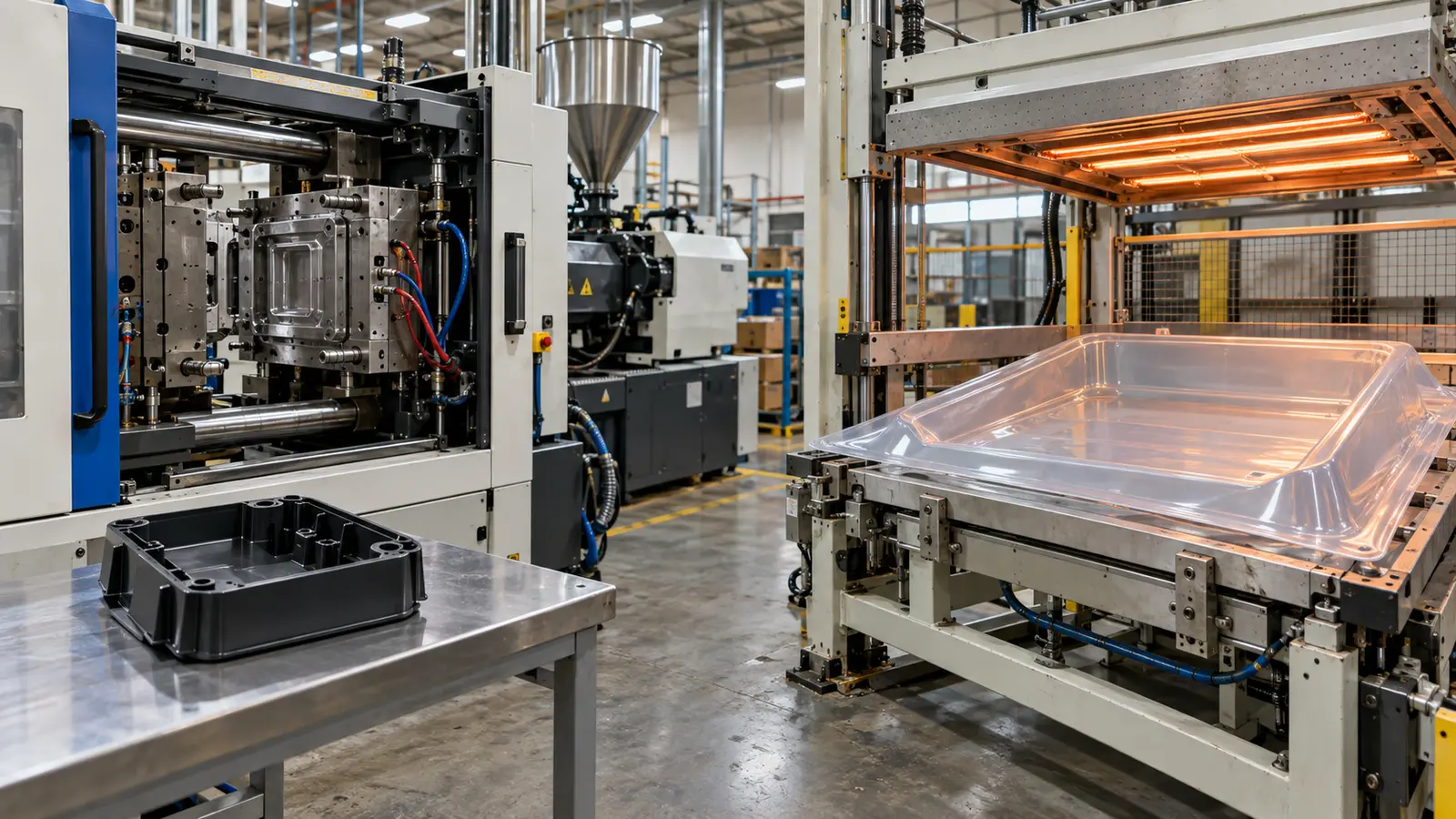
Injection molding pushes melted plastic into a closed, two-part metal mold. It holds tight tolerances of about ±0.05 mm and wins on cost above roughly 10,000 parts a year. Thermoforming heats a flat plastic sheet and shapes it over a one-sided mold. Its tooling costs far less, and it usually wins below about 3,000 parts a year.
The practical choice depends on part size, geometry, tolerance, expected lifetime volume, tooling budget and how much the design may still change.
Key takeaways
- Injection molding pushes melted plastic pellets under high pressure (10,000 to 30,000 psi) into a precisely machined, two-sided steel or aluminium mold. It makes parts with tight tolerances (±0.05 to ±0.1 mm) and controlled wall thickness. It suits small to medium complex parts above 5,000 units a year.
- Thermoforming heats a flat plastic sheet until it is soft, then shapes it over a one-sided mold using vacuum, air pressure, or force. Tooling costs far less, often one-fifth to one-tenth as much, and arrives sooner. It suits large parts below 3,000 to 5,000 units a year.
- Tooling cost is the biggest difference: injection molds run USD 3,000 to over USD 100,000, while thermoforming tools run USD 2,000 to USD 30,000.
- Volume decides the economics: thermoforming wins below about 3,000 parts a year, and injection molding wins above about 10,000. In between, you need to run the break-even math.
- Many product programmes use both processes together, with thermoforming for large panels and enclosures and injection molding for the small, detail-rich parts inside.
If you are starting a new plastics project, the choice often comes down to two processes: injection molding and thermoforming. Both shape thermoplastics into working parts. Both are used in industries from automotive to medical devices. And both have fans who will tell you their favourite is the obvious answer.
The truth is not that simple. Choosing between injection molding and thermoforming is not about picking a winner. It is about matching the process to your part's shape, your yearly volume, your timeline, and your budget. Get that match right and you save months of development time and tens of thousands of dollars in tooling. Get it wrong and you either overbuild a simple part or underbuild a complex one.
This guide breaks down both processes with the numbers engineers actually need: tolerances, draft angles, tooling costs, materials, and a clear way to run the math yourself.
What Is Injection Molding?
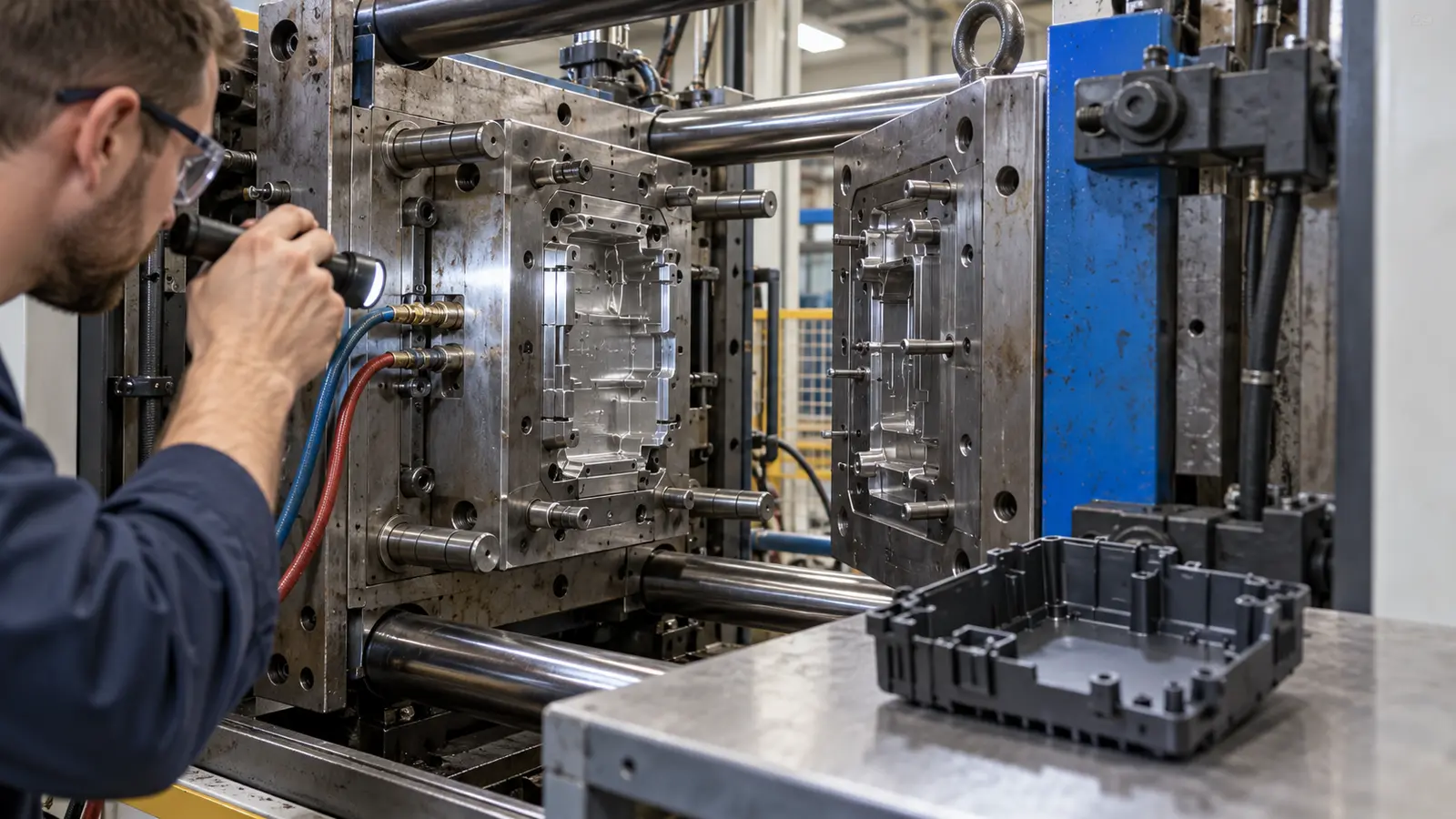
Injection molding starts with small plastic pellets fed into a heated barrel. A turning screw melts the material and pushes it under high pressure, usually between 10,000 and 30,000 psi, into a precisely machined, two-sided steel or aluminium mold. The melted plastic fills every cavity, channel, and tiny feature of the mold before it cools and hardens. The mold opens, ejector pins push the part out, and the cycle repeats. Depending on part size and complexity, one cycle takes from 15 seconds to more than two minutes.
Because the plastic goes in as a liquid and is squeezed hard against both halves of the tool, injection molding makes parts with very even wall thickness, tight measurements, and finished surfaces on every side. It is the main way small and medium plastic parts get made in large numbers. The global injection molded plastics market was worth about USD 362 billion in 2025 and is projected to reach USD 481 billion by 2033, on steady demand across automotive, electronics, medical, and consumer goods.
For the step-by-step version of the process, read our guide on how plastic injection molding works. For the material side of the decision, see our plastic injection materials page, which covers 50+ engineering-grade resins.
What Is Thermoforming?
Thermoforming works in a completely different way. Instead of injecting melted plastic into a closed mold, the process starts with a flat sheet of thermoplastic, extruded to a set gauge, that is heated until it becomes soft and bendy. The softened sheet is then laid over or into a one-sided mold, where vacuum, positive air pressure, or mechanical force shapes it to the mold's contour. Once it cools, the formed part is trimmed out of the surrounding sheet to its final size.
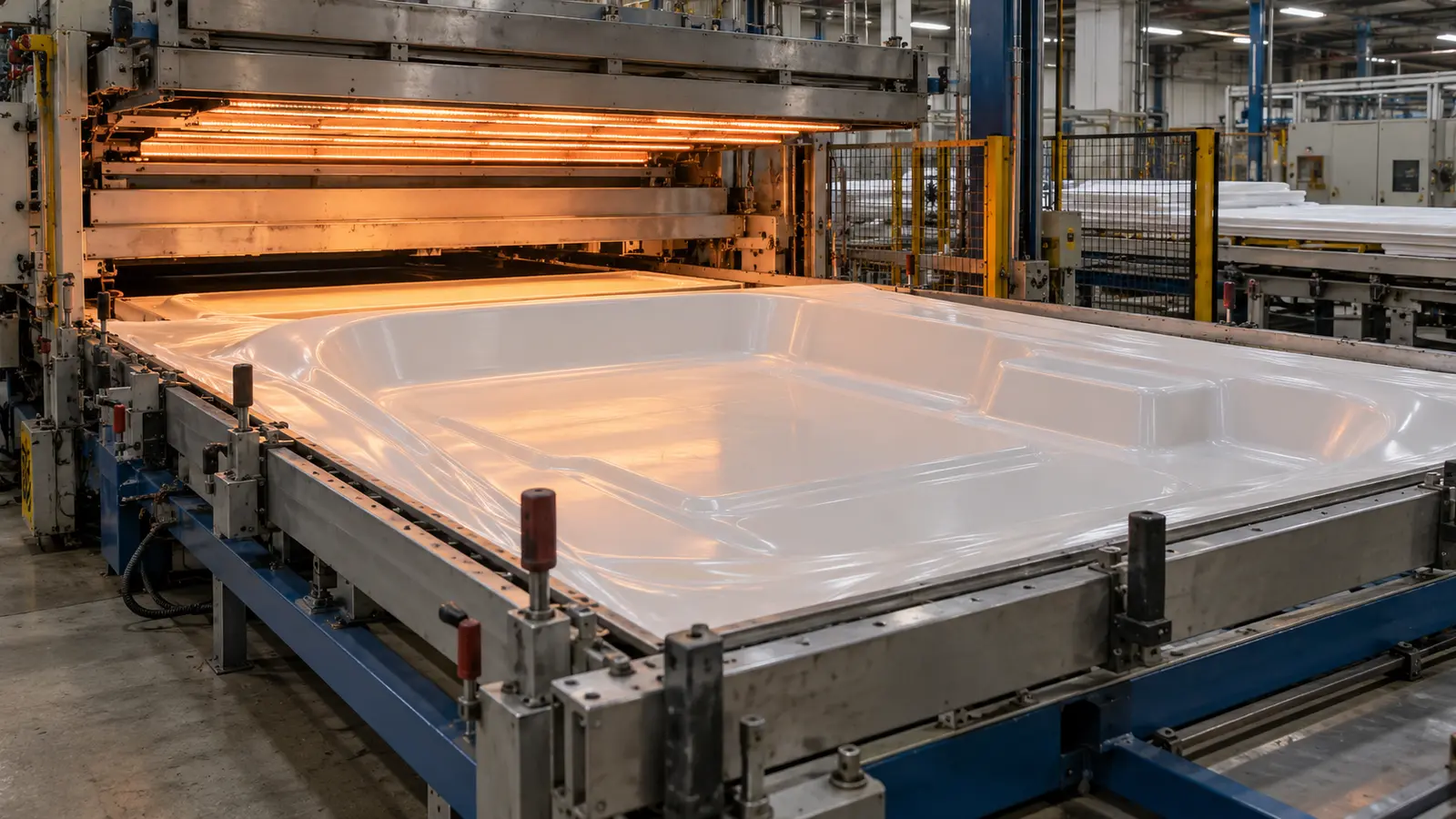
There are three main thermoforming methods, each suited to a different level of detail. Vacuum forming uses suction to pull the heated sheet against the mold surface. It is the simplest and cheapest version, and it works well for large parts that do not need sharp definition. Pressure forming adds compressed air, up to 50 psi or more, to push the sheet harder into the mold, reaching surface detail and corner definition that rivals injection molding in many applications. Twin sheet forming heats two sheets at once and presses them against opposing molds, fusing them where they meet to create hollow, double-walled structures used for air ducts, pallets, and rugged enclosures.
The thermoformed plastics market grew from about USD 15.98 billion in 2024 to USD 17.22 billion in 2025 and is projected to reach USD 28.25 billion by 2034, driven mainly by packaging, automotive interior panels, and medical device housings.
Meco runs thermoforming in-house alongside plastic extrusion, blow molding, and plastic 3D printing. You can see the full list on our capabilities page, and our packaging work on the thermoformed blister page.
What Is the Difference Between Injection Molding and Thermoforming?
The differences between these two processes cover tooling, tolerances, wall thickness control, draft requirements, materials, and production economics. The sections below break down each factor with the specific numbers engineers need.
Tooling: Cost, Complexity, and Lead Time
Tooling is where the cost difference is biggest, and it is often the single thing that decides the answer.
Injection molds are precision tools. They are usually CNC machined from hardened tool steels such as P20 or H13, or from aluminium for lower-volume prototype tools. They have to account for both halves of the part, the runner system that feeds plastic in, cooling channels, ejector pins, and sometimes side-actions or lifters for undercuts. A simple single-cavity injection mold might cost USD 3,000 to USD 30,000. A multi-cavity production mold for a complex part can pass USD 100,000 and take 12 to 20 weeks to build and qualify.
Thermoforming tools, by contrast, are single-sided. Because the process uses fairly low pressure instead of the extreme forces in injection molding, tools can be machined from aluminium, cast from epoxy or composite, or even made from heat-resistant wood for short prototype runs. Thermoforming tooling usually costs USD 2,000 to USD 30,000, often one-fifth to one-tenth of an equivalent injection mold, with lead times of 4 to 8 weeks.
This gap has knock-on effects. When a design change is needed mid-programme, changing or replacing a thermoforming tool is faster and cheaper. With injection molding, even a small change to the mold, such as moving an ejector pin, adjusting a gate location, or re-cutting a surface, can cost thousands and add weeks to the timeline.
Tolerances and Dimensional Control
Injection molding holds tighter tolerances. Because melted plastic is forced under high pressure into a fully closed, precisely machined cavity, the same part comes out the same way every time. Typical tolerances for injection molded parts fall within ±0.05 mm to ±0.1 mm for standard features, with ±0.01 mm possible on critical dimensions using tightly controlled processes and high-quality tooling.
Thermoforming tolerances are naturally wider. The process stretches a flat sheet over a one-sided mold, so wall thickness changes as the material thins during forming, especially in deep draws and around corners. Standard thermoforming tolerances are typically ±0.5 mm to ±1.5 mm, with tighter control possible through pressure forming and precise trimming. Where looks matter more than exact size, that is often perfectly acceptable. For parts needing tight fits, mating surfaces, or snap features, injection molding is the stronger choice.
Wall Thickness and Part Geometry
Injection molding lets engineers set wall thickness exactly. Even wall thickness, usually 0.5 mm to 4 mm depending on the polymer, is a core design rule, and the process can also produce sections of varying thickness, ribs, bosses, living hinges, and internal features that thermoforming simply cannot make. Both sides of the part carry the mold's surface finish, and features such as snap-fits, threaded inserts, and fine textures can be moulded directly into the part.
Thermoforming starts with a sheet of even gauge, but forming naturally thins the material, especially in deep-draw areas, sharp corners, and vertical walls. A sheet that starts at 3 mm thick might thin to 1.5 mm or less in heavily drawn sections. Engineers have to allow for that during DFM analysis. Thermoforming excels at large, fairly shallow parts with generous radii. It is less suited to deep draws past a 3:1 depth-to-width ratio, sharp internal corners, or parts that need controlled thickness variation.
Draft Angles
Both processes need draft so the part can release from the mold, but the amounts differ. Injection molding usually needs 1° to 2° of draft on vertical surfaces, with some designs allowing as little as 0.5° on short features given the right surface finish and ejection strategy.
Thermoforming needs more. For male (plug) molds, where the part forms around the outside of the tool, minimum draft angles of 3° to 6° are standard because the material shrinks onto the mold as it cools and grips it tightly. For female (cavity) molds, where the material draws into the tool, 1.5° to 2° is usually enough, since the part shrinks away from the mold surface as it cools.
Materials
Both processes work with thermoplastics, but the starting form and the range differ. Injection molding uses pellets or granules and can run an exceptionally broad material library, including ABS, PP, PE, PC, PA (Nylon), POM, TPU, TPE, PBT, PEEK, PC-ABS blends, and glass-filled or mineral-filled engineering compounds. That flexibility makes injection molding the default for parts that need specific strength, heat, or chemical performance.
Thermoforming uses extruded sheet, so it is limited to plastics that can be made into sheet and formed well. Common options are ABS, HDPE, PP, PVC, PC, PET, PETG, acrylic (PMMA), and HIPS. That covers a lot of jobs, but thermoforming cannot easily handle heavily filled engineering resins, multi-material overmolding, or the full range of specialty polymers open to injection molding.
Volume and Cost Per Part
Volume is the clearest dividing line. Thermoforming's low tooling cost makes it attractive below roughly 3,000 to 5,000 parts a year. At those quantities, spreading an injection mold's cost across so few parts keeps the per-part number too high, and thermoforming's simpler setup wins on total programme cost.
Once volumes climb past 5,000 a year, injection molding's faster cycles and multi-cavity tooling start to pay back the bigger tooling bill. At 10,000 or more parts a year, injection molding almost always costs less per part. Multi-cavity molds running 16, 32, or even 100+ cavities can turn out huge quantities with very little extra cost per unit.
The crossover point moves with part size, complexity, and material. Large parts favour thermoforming at higher volumes than small parts do, because thermoforming tooling cost grows gently with size, while injection mold costs climb steeply as the part and the required clamp tonnage get bigger.
Injection Molding vs Thermoforming: Head-to-Head Comparison
| Factor | Injection Molding | Thermoforming |
|---|---|---|
| Tooling cost | USD 3,000 to 100,000+ | USD 2,000 to 30,000 |
| Tooling lead time | 12 to 20 weeks | 4 to 8 weeks |
| Typical tolerances | ±0.05 to ±0.1 mm | ±0.5 to ±1.5 mm |
| Ideal annual volume | 5,000+ parts/year (clear win above 10,000) | 250 to 5,000 parts/year (clear win below 3,000) |
| Part size sweet spot | Small to medium | Medium to large |
| Wall thickness control | Precise (0.5 to 4 mm, even) | Varies (thins during forming) |
| Draft angles | 1° to 2° | 1.5° to 6° depending on mold type |
| Shape complexity | High (both sides, ribs, bosses, undercuts) | Moderate (one-sided features) |
| Material range | Broad (pellets: ABS, PC, PA, PEEK, TPE, filled resins) | Narrower (sheets: ABS, PP, PVC, PET, HDPE, PC) |
| Surface finish | Both sides carry the mold finish | One side carries the mold finish |
| Secondary operations | Minimal (parts eject nearly finished) | Trimming always needed; may need drilling or bonding |
| Design change cost | High (steel mold rework) | Low (aluminium tool rework) |
How Do You Calculate the Break-Even Point?
Most guides stop at "it depends on volume." That is not much help when you are the one signing off on the tooling. Here is the actual sum, and you can run it with your own quotes in about two minutes.
Two things people forget in this sum. First, thermoformed parts nearly always need trimming, and sometimes drilling or bonding, so put those costs into the thermoforming per-part figure before you divide. Second, compare against the volume you will actually order over the tool's life, not your best-case forecast. If your break-even is 6,100 parts and you are forecasting 7,000, that is not a comfortable margin.
What If You Land Between 3,000 and 10,000 Parts?
This is the zone most guides skip, and it is where plenty of real projects sit. Below 3,000, thermoforming is nearly always right. Above 10,000, injection molding nearly always is. In between, the answer genuinely depends on your part, and you have to do the arithmetic above rather than trust a rule of thumb.
Three things tip the balance inside that band. If your part is small and simple, the mold is cheap, so break-even arrives early and injection molding wins near the bottom of the range. If your part is large, the mold is expensive, so break-even arrives late and thermoforming can still win at 8,000 or 9,000 units. And if your design is still changing, thermoforming's cheap tool rework is worth real money, because one mid-programme change to a steel mold can wipe out a year of per-part savings.
Not sure which process fits? Send your CAD files, target volume and material requirements. Our engineers can review the design and recommend a practical process before tooling begins.
Ask Our EngineersWhat Is the Best Use Case for Injection Molding?
Injection molding is the stronger process when your project involves small to medium parts with complex three-dimensional geometry, tight tolerances below ±0.1 mm, features such as snap-fits, living hinges, bosses, or threaded inserts, volumes above 5,000 parts a year and especially above 10,000, multi-material or overmolding needs, or engineering-grade polymers with specific strength and heat demands.
It is the standard process for parts in automotive interiors, telecom housings, consumer electronics, medical device assemblies, and anything that has to repeat the same result across millions of cycles. You can see the full scope on our custom injection molding services page.
What Is the Best Use Case for Thermoforming?
Thermoforming fits better when you need large parts such as dashboards, equipment enclosures, or fridge liners, volumes below 3,000 to 5,000 a year, fast tooling of 4 to 8 weeks instead of 12 to 20, a smaller upfront spend, room for frequent design changes, or thin-walled trays, blisters, and protective covers.
It also works well for prototyping and bridge production, getting real parts into testing while an injection mold is still being built. That matters in industrial equipment and lighting programmes where the enclosure is large and volumes are modest.
When We Would Talk You Out of an Injection Mold
Meco runs both processes, so we have no reason to push you toward the more expensive one. There are clear cases where we will tell you an injection mold is the wrong buy.
If your yearly volume is genuinely under 3,000 and unlikely to grow, the mold will not pay for itself, and you will have spent five figures to save nothing. If your design is still moving, buying steel tooling early is the most expensive way to discover a mistake. If your part is bigger than about 600 mm in any direction and mostly a shell, the clamp tonnage and mold size push costs up far faster than thermoforming does. And if your launch date is inside twelve weeks, the tooling lead time alone will make the decision for you.
In any of those cases we would rather quote a thermoforming tool now and an injection mold later, when the numbers actually support it. Our R&D engineering team gives that read on every quote.
What Is a Hybrid Approach, and When Does It Make Sense?
In practice, plenty of products do not fall neatly into one camp. A growing number of manufacturers use both processes in the same programme. Thermoforming handles the large outer panels, enclosures, and covers, where surface area matters more than precision. Injection molding produces the smaller, detail-rich pieces, the brackets, clips, connectors, and internal structure that need tight tolerances and snap-fit engagement.
This is common in automotive interiors, where a thermoformed dashboard panel joins dozens of injection molded sub-parts. It is common in medical equipment, where device enclosures are thermoformed for size and cost while internal parts are molded for precision. And in home appliances, thermoformed liners and panels pair with molded handles, switches, and bezels.
Part consolidation is the other reason to look at thermoforming. Because a single formed sheet can cover a large area, one thermoformed panel can sometimes replace several molded pieces plus the fasteners holding them together. Fewer parts means fewer tools, less assembly labour, and fewer things to go wrong.
The key is a partner with both processes in-house, plus the operations that follow, including trimming, mechanical assembly, surface finishing, and inspection, so one team owns the whole programme instead of splitting it across vendors. That is what our turnkey manufacturing model is built for.
What Are the Sustainability Differences?
Environmental performance matters more in process selection every year, and the two methods differ in real ways.
Thermoforming creates trim scrap, the material cut away from the sheet to free the finished part. In a well-planned programme this runs 15% to 40% of the original sheet, depending on part shape and how tightly parts nest together. The good news is that most of this scrap is clean, single-polymer waste. It can be reground and re-extruded into new sheet with very little loss of properties, which makes a fairly tidy closed loop.
Injection molding creates waste through runners and sprues, the channels that carry melted plastic to the cavities. Hot runner systems remove that waste completely, though they add to tooling cost. Cold runner waste can usually be reground and blended back into virgin material at 15% to 25% without hurting performance. Injection molding also tends to use less material per part overall, because wall thickness is controlled exactly, while thermoforming sometimes carries more material than the part needs simply because the starting sheet is one even gauge.
Both processes benefit from the shift toward recycled and bio-based plastics. Suppliers keep expanding their post-consumer recycled (PCR) and post-industrial recycled (PIR) resins for both processes, so you have more ways to hit sustainability targets without giving up part performance.
What Are the Key DFM Guidelines for Each Process?
Whichever process you pick, an early DFM review prevents expensive mistakes. Here is what matters most for each.
DFM for Injection Molding
Keep wall thickness even wherever you can, because sudden changes cause sink marks, voids, and warping. Use ribs instead of thick blocks to add stiffness, and keep rib thickness at 50% to 70% of the nominal wall so you do not get sink on the opposite face. Give every vertical face enough draft, at least 1° per side and more for textured surfaces, since an SPI-A2 texture may need 3° or more. Place gates to keep flow length short and to keep weld lines out of visible or load-bearing areas. Avoid sharp internal corners, using an inside radius of at least 0.5 times the wall thickness to cut stress and help the plastic flow.
DFM for Thermoforming
Design with generous radii, at least 1.5 times the sheet thickness on inside corners. Avoid deep, narrow draws. A depth-to-width ratio below 1:1 is ideal, and anything past 3:1 gets very difficult. Use ribs, corrugations, or domed sections to stiffen large flat areas. Allow for material thinning in deep sections when you run your strength calculations. Put trim lines where they will not cut through formed features, and set draft to match the tool type, 3° to 6° for male tools and 1.5° to 2° for female tools.
| Design Parameter | Injection Molding | Thermoforming |
|---|---|---|
| Wall thickness | 0.5 to 4 mm (even preferred) | Varies; starts even, thins during forming |
| Minimum inside radius | 0.5× wall thickness | 1.5× sheet thickness |
| Rib thickness | 50% to 70% of nominal wall | Not applicable (use corrugations or domes) |
| Draft angle (minimum) | 1° to 2° per side | 1.5° to 2° (female mold) / 3° to 6° (male mold) |
| Max depth-to-width ratio | Limited by flow length, not forming depth | Ideal below 1:1; difficult above 3:1 |
| Undercuts | Possible with side-actions or lifters | Generally not possible |
| Textured surfaces | Both sides (add 1.5° draft per 0.025 mm of texture depth) | Mold side only |
Either way, bringing your manufacturing partner in early, ideally at concept or preliminary design, pays for itself. A proper DFM review can cut per-part cost by 15% to 30% through better material choice, smarter wall thickness, and simpler tooling, while also getting you to first article sooner.
What Is the Best Way to Decide Between These Two Processes?
When the answer is not obvious, run your project through these five checks in order of impact.
Start with production volume. Under 3,000 parts a year, thermoforming almost certainly costs less overall. Above 10,000 a year, injection molding usually does. Between 3,000 and 10,000, use the break-even formula and include tooling, per-part cost, and secondary operations.
Next, look at part size. Parts larger than roughly 600 mm in any direction tend to favour thermoforming, because the clamp tonnage and mold cost for a big injection molded part rise sharply.
Then judge geometric complexity. If the part needs features on both sides, varying wall thickness, snap-fits, threaded bosses, or undercuts, injection molding is probably necessary. If it is mainly a shell, panel, or enclosure with one-sided features, thermoforming is a strong candidate.
Check tolerance requirements. If critical dimensions have to stay inside ±0.1 mm, injection molding is the reliable choice. Thermoforming can reach ±0.5 mm with careful control, which is plenty for many structural and cosmetic parts.
Finally, weigh time to market. If speed matters, and it usually does, thermoforming's 4-to-8-week tooling against injection molding's 12-to-20-week timeline can settle the question on its own, especially for launches tied to a fixed window.
The Decision at a Glance
Choose thermoforming when you need large parts, low volumes under 5,000 a year, fast tooling in 4 to 8 weeks, a small upfront spend, or room for frequent design changes.
Choose injection molding when you need tolerances below ±0.1 mm, complex geometry with ribs, bosses, and undercuts, volumes above 10,000 a year, engineering-grade materials, or features on both sides of the part.
Use both when your product programme includes large panels and enclosures alongside small, detail-rich components, as many automotive, medical, and appliance programmes do.
Quick Glossary
| Term | What It Means |
|---|---|
| Draft angle | A slight slope on a vertical wall that lets the finished part slide off the tool without scraping or sticking. |
| Undercut | A feature such as a hook or side hole that traps the part on the mold. It needs an extra moving piece in the tool to release. |
| Cavity | The hollow space inside a mold that gives the part its shape. A multi-cavity mold makes several parts per cycle. |
| EAU | Estimated Annual Usage, meaning how many parts you expect to buy in one year. It is the main input to the break-even sum. |
| Clamp tonnage | The force a molding machine uses to hold the two mold halves shut against injection pressure. Bigger parts need more tonnage and bigger machines. |
| Gauge | The thickness of the plastic sheet a thermoformer starts with. Thin gauge suits packaging; heavy gauge suits panels and enclosures. |
| Regrind | Scrap plastic ground back into pellets or flakes so it can be reused in new parts. |
| DFM | Design for Manufacturability, a review that adjusts a design so it is cheaper, faster, and more reliable to make. |
References
- Grand View Research, Injection Molded Plastics Market Market context cited in the injection molding overview.
- Fortune Business Insights, Thermoformed Plastics Market Market context cited in the thermoforming overview.
Process ranges in this guide are general engineering reference points, not quotations. Final tooling, tolerance, lead-time and unit-cost decisions should be confirmed against the actual part design, resin, volume and production plan.
Choose Before You Tool
Meco can review your part, expected volume and material requirements before you commit to injection tooling or a thermoforming tool.
- DFM review. Process and geometry feedback before tooling.
- Both plastics routes. Injection molding and thermoforming under one manufacturing partner.
- Quality system. IATF 16949:2016 certified.
- Flexible scale. No minimum order and production from 10 to 10M+ units.
- IP protection. NDA available on request before drawings or files are shared.
Explore Meco manufacturing capabilities or review our whole product manufacturing approach.
Request a Manufacturing Review