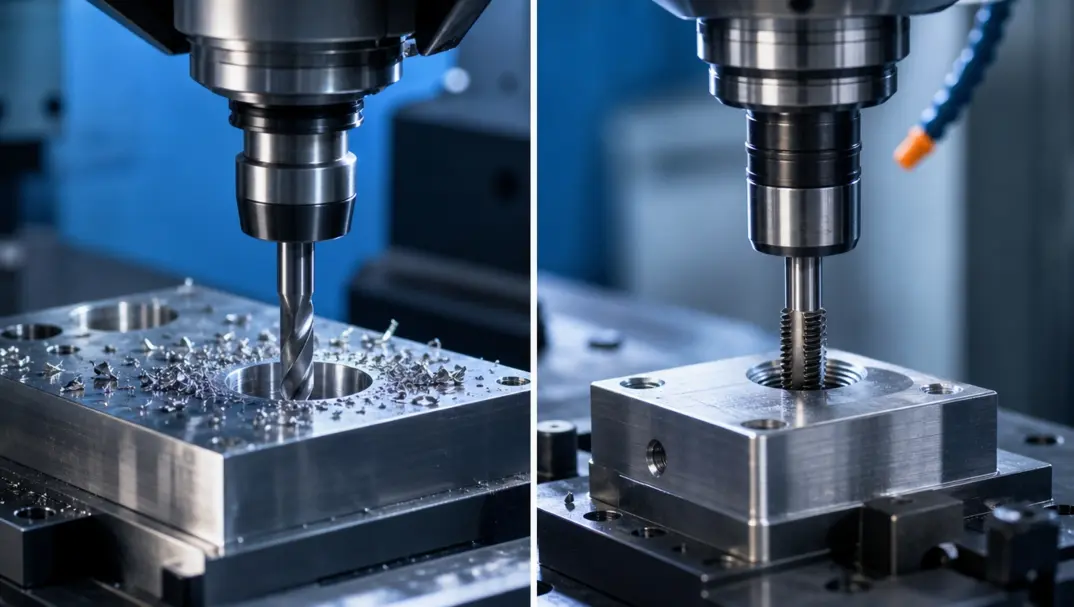
CNC Drilling vs Tapping: The Short Answer
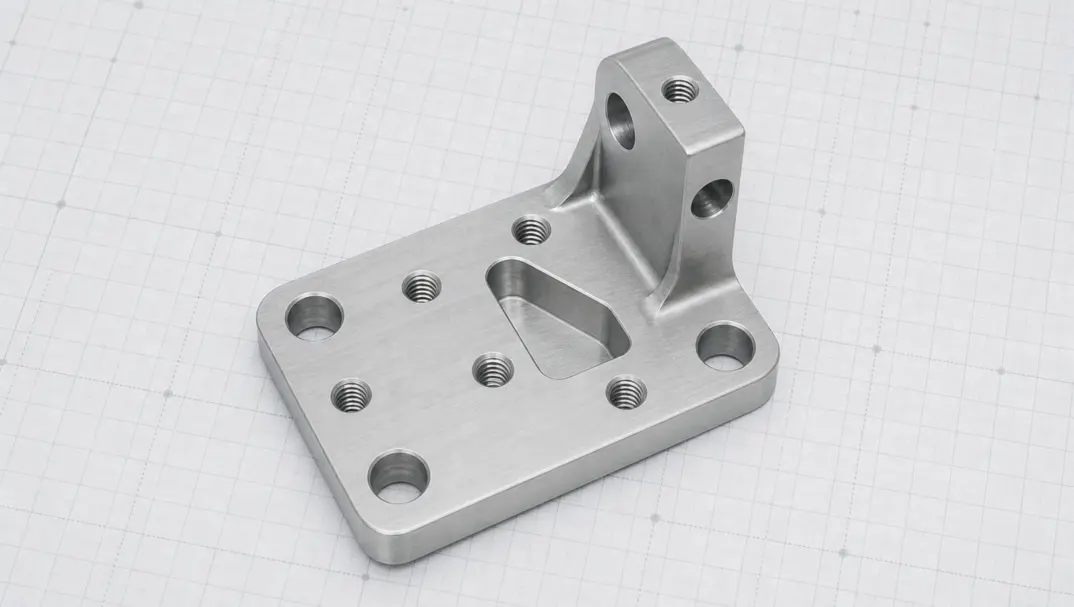
CNC drilling makes a smooth, round hole in a part. CNC tapping cuts threads (the spiral grooves) on the inside of that hole so a bolt or screw can grip it. You almost never choose one over the other. You drill first, then tap, in the same setup on the same machine.
The real question most engineers and sourcing managers are asking is this: when does your part need a tapped hole versus just a drilled hole, and what's that decision going to cost you? This guide walks through it in plain English, with the tolerances each process can hold, the trade-offs against thread milling, real per-hole cost ranges, and a clear decision table at the end.
We run drilling and rigid tapping on the same CNC setups every day at Meco, so the rules below come from real production parts, not theory.
What Is CNC Drilling?
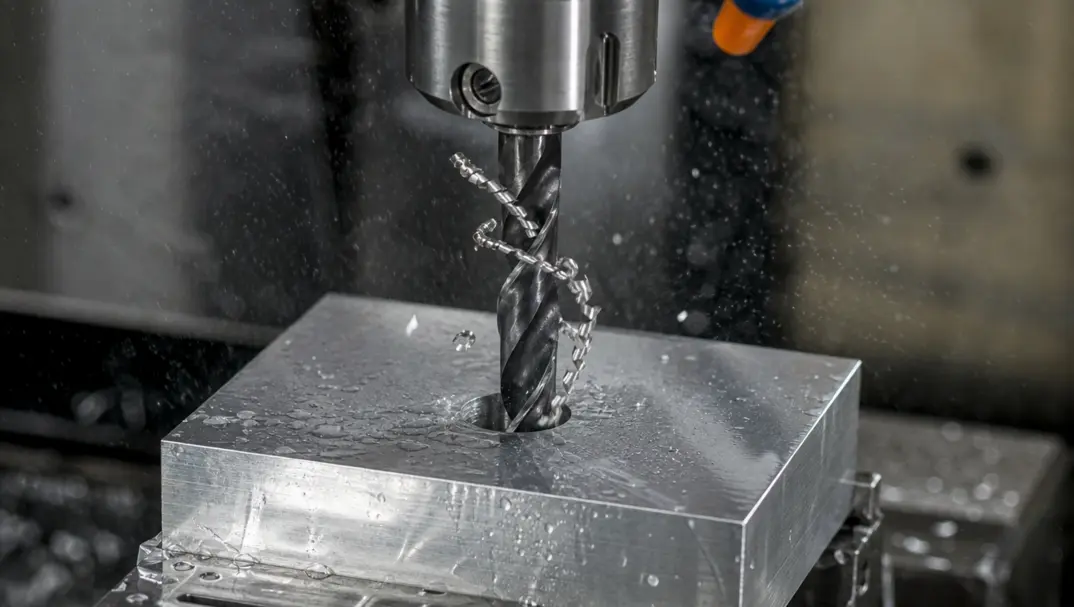
CNC drilling is the process of cutting a round hole into a part using a spinning drill bit guided by a CNC machine. The machine controls the position, depth, and feed rate so every hole comes out in the same spot, at the same size, on every part.
It's the fastest way to put a hole in metal or plastic. A standard hole in aluminum takes a couple of seconds. That speed is why drilling is almost always the first step whenever a part needs a hole, threaded or not.
How CNC Drilling Works
The drill bit spins at a programmed speed (called RPM) and pushes down into the material at a programmed feed rate. As it cuts, metal chips spiral up the flutes (the grooves along the side of the bit) and out of the hole.
For shallow holes, the drill goes straight in and straight out. For deeper holes, the machine uses a peck drilling cycle, where the bit drills a small amount, pulls out to clear chips, then goes back in. Peck drilling stops chips from packing into the hole and breaking the bit.
What Tolerances CNC Drilling Holds
Standard CNC drilling holds about ±0.03 to ±0.05 mm on the hole diameter. In ISO 286 terms (the international standard that grades hole and shaft tolerances), that's roughly an H9 to H10 grade. The H number just tells you how loose or tight the fit is. Lower is tighter. Good enough for a clearance hole where a bolt just passes through. Not tight enough for a press fit, a bearing seat, or a dowel pin.
The accuracy gets limited by three things the machine can't fully eliminate. Runout is a tiny wobble in how the drill spins (even 0.01 mm of wobble produces measurably oversized holes). Deflection is the drill bending sideways under cutting force, especially on small or deep drills. Thermal expansion is the drill and the part getting hot and growing slightly during long runs. Together they're why drilling alone can't hit ultra-precise sizes.
If you need tighter than that, you drill first and then add a finishing step. Reaming brings the hole to about ±0.01 mm (H7). Boring with a single-point tool can push it tighter than ±0.005 mm. Each step adds cost, so only spec it where the part actually needs it.
What Is CNC Tapping?
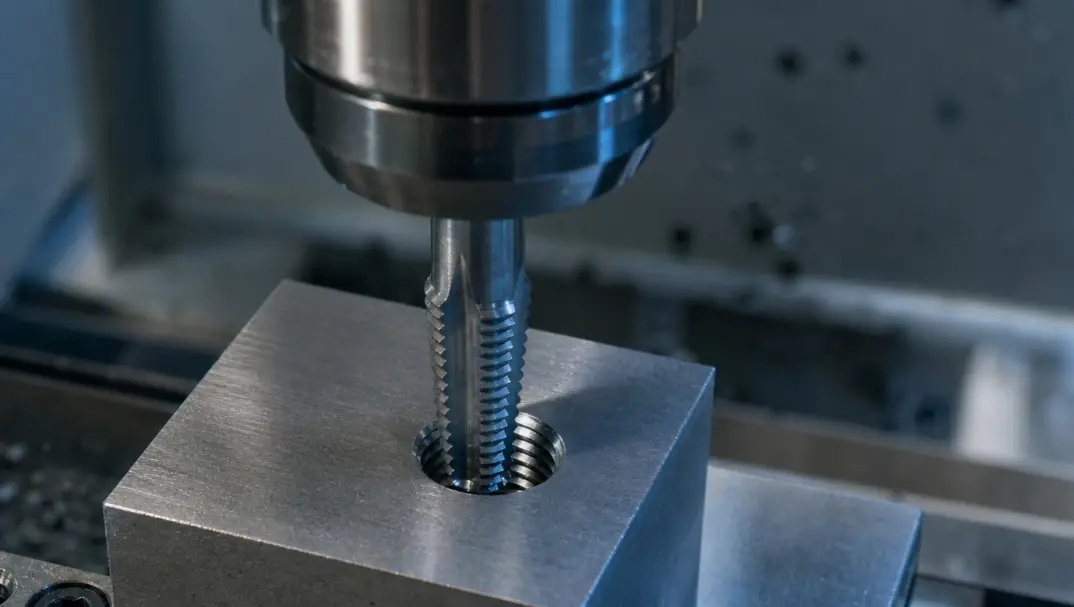
CNC tapping cuts internal threads inside an already-drilled hole. A tap is a tool that looks like a hardened screw with cutting edges along its sides. As the tap turns into the hole, those edges carve threads into the wall, leaving a hole that can accept a bolt or screw.
Tapping always needs a drilled hole first. The drilled hole has to be a very specific size, called the tap drill size, so there's enough material left for the tap to cut clean threads without breaking. You can find tap drill sizes on any standard tap drill chart, like the one from University of Florida's design lab. The drill size standards themselves come from ASME B94.11M, the spec that covers twist drills.
How Rigid Tapping Works
On a modern CNC machine, tapping is almost always done as rigid tapping. The spindle's rotation and the down-feed are perfectly synchronized by the machine controller. One full turn of the spindle equals exactly one thread's worth of downward movement.
This matters because if the rotation and feed get out of sync, even slightly, the threads come out wrong. The tap can also break or strip the hole. Older tapping methods (called floating or tension-compression tapping) allowed the tap a little float to compensate, but rigid tapping is faster and more accurate.
Plain English: What "Rigid Tapping" Actually Means
"Rigid" doesn't mean the tap is stiff. It means the CNC machine's spindle and Z-axis are locked together so they move in perfect sync. Almost every modern CNC mill we run at Meco does rigid tapping by default. It's faster, more reliable, and gives better thread quality than the older methods.
Cut Taps vs Form Taps (and When to Use Each)
There are two main types of taps. A cut tap works like a tiny lathe tool, slicing thread shapes out of the wall and producing chips. A form tap (also called a roll tap or thread forming tap) doesn't cut at all. It presses and rolls the material into a thread shape, with zero chips.
Form taps last much longer (up to 20x longer than cut taps, according to Harvey Performance) and produce stronger threads because the metal grain isn't cut, just reshaped. They're our go-to for blind holes in aluminum and ductile steels, because there are no chips to get stuck at the bottom of the hole.
Cut taps are still the right call for harder steels and brittle materials where form tapping would crack the thread.
CNC Drilling vs Tapping: Side-by-Side Comparison
Here's the comparison at a glance. This is the table to use when someone hands you a drawing and asks "drilled or tapped?"
| Factor | CNC Drilling | CNC Tapping |
|---|---|---|
| What it does | Creates a round hole | Cuts threads inside an existing hole |
| Cycle time per hole | 1-3 seconds | 2-5 seconds (after drilling) |
| Typical diameter tolerance | ±0.03 to ±0.05 mm (H9-H10) | Class 2B or 6H thread fit (standard) |
| Surface finish (Ra) | 3.2 to 6.3 µm | 1.6 to 3.2 µm on thread flanks |
| Tool type | Twist drill, spot drill, gun drill | Cut tap or form tap, sized to thread |
| Hole size limits | Effectively unlimited with right tool | Each thread size needs its own tap |
| Best for | Clearance holes, dowel locations, fluid passages | Threaded fastener holes for bolts and screws |
| Required before the other? | No (always the first step) | Yes - tapping always needs a drilled hole first |
Quick note on Class 2B and 6H. Those are the standard thread fit classes for tapped holes. 2B is the imperial spec (like a 1/4-20 bolt going into a tapped hole), and 6H is the metric equivalent (like an M6 bolt). Both mean "normal commercial fit," which is what almost every assembled fastener uses.
How Drilling and Tapping Work Together in One Setup
Here's the part most online articles skip. On a modern CNC machine, drilling and tapping aren't two separate jobs. They run back-to-back in the same program.
The machine drills hole one, then drills hole two, then drills hole three. Then it changes to the tap, comes back to hole one, and taps it. Then hole two. Then hole three. One setup, one fixture, one operator.
That's why we treat CNC drilling and CNC tapping as a paired capability at Meco. You're not paying for two trips through the shop. You're paying for one CNC cycle that does both. This is one of the reasons 3-axis CNC machining is so efficient for high-volume parts with lots of threaded holes.
Blind Holes vs Through Holes: Why It Changes Everything
A through hole goes all the way through the part. A blind hole stops part way down, with material still at the bottom. The difference sounds small. It isn't.
Through holes are easy. Chips drop right out the bottom. Tapping is fast, taps last longer, and the hole rarely jams. Blind holes are harder. Chips have nowhere to go. They pack into the bottom of the hole, push back against the tap, and break it.
| Feature | Through Hole | Blind Hole |
|---|---|---|
| Chip removal | Easy - chips fall out the bottom | Hard - chips trap in the hole |
| Recommended tap | Spiral point (gun) tap, cut or form | Spiral flute tap, or form tap |
| Risk of tap breakage | Low | High if wrong tap is used |
| Thread depth available | Full hole length | Limited - need clearance at bottom |
| Cost impact | Baseline | 10 to 20% higher per hole |
Our rule of thumb: for blind holes in aluminum or ductile steel, we use a form tap. No chips, no breakage, longer tool life. For blind holes in harder steels, we use a spiral flute cut tap, which lifts chips up and out instead of pushing them down.
How Material Choice Changes the Decision
Aluminum and mild steel get most of the airtime in articles like this one. The reality is that the right answer changes a lot once you leave those two materials.
Stainless steel work-hardens as you cut it, which means a dull tap quickly gets duller, and the threads get rougher with every part. We replace stainless taps more aggressively, often at 60-70% of the life we'd get in mild steel. Form tapping is doable in 304 and 316L but the torque demand is high.
Titanium is the trickiest. It has low thermal conductivity (per Sandvik Coromant's aerospace machining data), which means heat stays at the cutting edge instead of dissipating. Taps wear out fast, and broken taps inside expensive titanium parts mean scrap. For titanium, we often recommend thread milling instead of tapping for anything over M6, especially in blind holes.
Brass and bronze are easy. They cut clean, chips break short, and even cut taps last a long time. Brass is one of the few materials where rigid tapping is genuinely fast and forgiving.
Engineering plastics (PEEK, POM, nylon, PA) tap surprisingly well. The challenge is that plastic threads strip easily under load. For load-bearing connections in plastic parts, we usually recommend a brass threaded insert pressed into a drilled hole instead of cutting threads directly.
Where Thread Milling Fits In (And When to Use It Instead)
Thread milling is the third option, and it's worth knowing about. Instead of a tap that matches one thread size, a thread mill is a small cutting tool that spirals around inside the hole and carves the threads out a little at a time.
The big advantage is flexibility. A single thread mill can cut a range of thread sizes (as long as the pitch matches), so you don't need a separate tool for every thread. It also can't break inside the hole the way a tap can, and if a thread runs out of tolerance, the operator can adjust the program instead of buying a different tool.
The trade-off is speed. According to Kennametal, tapping is about twice as fast as thread milling for a typical 1/4-20 thread. So for high-volume production, tapping wins on cost. For prototypes, custom thread sizes, large diameters, or tough-to-machine materials, thread milling wins.
Quick Rule: Tap or Thread Mill?
Use tapping when you have a lot of holes at a few standard thread sizes (think: M6 and M8 hole patterns on a bracket at 10,000 parts a year). Use thread milling for low volumes, large threads over about 3/4 inch, custom or non-standard threads, hard materials, or any time a broken tap inside the part would mean scrap.
Thread milling runs on the same machines we use for CNC milling, so it's not a separate capability. It's just a different tool path.
The Contrarian Take: Thread Milling Is Oversold for Most Production
Tooling vendors and trade publications have been pushing thread milling as the modern, flexible alternative to tapping for the better part of a decade. Coverage in outlets like Modern Machine Shop regularly frames thread milling as the future-proof choice.
For prototypes, aerospace work, custom threads, hard materials, and large-diameter threads, they're right. Thread milling is a genuinely better tool for those jobs.
But here's where we disagree with the dominant narrative. For the 80% of OEM production parts that use standard M3 through M10 fastener holes at meaningful volume, rigid tapping is still about 2x faster and 30-40% cheaper per part. The cost gap doesn't go away when volumes go up. It widens.
The "thread milling is the future" story is real. It's also oversold for buyers running steady production programs with standard threads. If you have a 50,000-part annual run with eight M6 holes per part, don't let anyone talk you into thread milling all 400,000 holes. Rigid tap them, save the money, and put the savings into a tighter dowel tolerance somewhere it actually matters.
The right answer isn't "thread mill everything" or "tap everything." It's matching the process to the part, and that's exactly what a DFM review is for.
What These Operations Cost You (Tolerance, Time, and Money)
This is where buyers get burned. Over-specifying tolerance on a drawing is one of the most common (and expensive) mistakes we see.
What Each Process Can Hold (Tolerance Table)
| Process | Diameter Tolerance | Surface Finish (Ra) | When to Use |
|---|---|---|---|
| Drilling only | ±0.03 to ±0.05 mm (H9-H10) | 3.2 to 6.3 µm | Clearance holes, fluid passages |
| Drilling + Reaming | ±0.01 mm (H7) | 0.8 to 1.6 µm | Dowel pins, bearing seats, press fits |
| Drilling + Boring | ±0.005 mm or better | 0.4 to 1.6 µm | High-precision bores, large diameters |
| Tapping (thread) | Class 2B / 6H standard fit | 1.6 to 3.2 µm on flanks | Standard threaded fastener holes |
| Thread Milling | Adjustable to Class 3B / 4H | 0.8 to 1.6 µm on flanks | Tight-tolerance threads, custom pitches |
The most expensive mistake we fix in DFM review? An engineer specs H7 on every hole on a drawing because that's the default in their CAD library. The reality is that maybe two of those holes (the dowel locations) need H7. The other twelve are clearance holes for bolts. Relaxing those twelve to ±0.05 mm (drilling only) cuts machining cost by roughly 25% with zero impact on how the part assembles.
What Each Operation Actually Adds to Your Per-Part Cost
This is the question most articles dodge. Here are realistic ranges based on typical CNC production runs of 500 to 10,000 units, for an M6 hole in aluminum 6061 on a standard 3-axis CNC mill. Take these as ballpark numbers, not quotes. Per-hole cost varies a lot with material, depth, total part complexity, and quantity.
| Feature | Approximate Cost per Hole (USD) | Why |
|---|---|---|
| Drilled clearance hole | $0.02 - $0.05 | Fastest cycle, basic tooling, no finishing |
| Drilled + reamed to H7 | $0.08 - $0.15 | Adds 15-30 seconds and a tool change |
| Drilled + bored (precision) | $0.25 - $0.60 | Multiple passes, slower cycle, CMM inspection |
| Drilled + rigid-tapped M6 | $0.10 - $0.20 | One extra tool change, low scrap risk in aluminum |
| Drilled + thread-milled M6 | $0.20 - $0.40 | ~2x cycle time of tapping, but no broken-tool scrap risk |
| Deep hole (gun drilled, over 10x diameter) | $1.50 - $5.00+ | Specialized tooling and slower cycle |
The lesson buried in these numbers: a tapped hole is roughly 5x the cost of a drilled clearance hole. Across a busy bracket with 20 holes, that's the difference between a $1.00 feature cost and a $4.00 feature cost. Multiply by 50,000 parts a year and the spec sheet is suddenly worth real money.
For a deeper look at how holes, threads, and machining time roll into a final quoted price, see our breakdown in how much CNC machining costs.
Common Problems (and How to Avoid Them)
Three problems cause maybe 90% of the issues we see on drilled and tapped parts. Here's the short version.
Why Taps Break in Blind Holes
Most blind-hole tap failures come from one of three causes. Chips packing at the bottom and pushing back on the tap. The tap drilled hole being too small (not enough clearance for the thread to form). Or running the tap too fast for the material.
Fixes: use a form tap or a spiral flute tap. Make sure the tap drill size matches the chart. Slow down 10 to 20% for harder materials.
Drill Wandering and Hole Drift
If a drill isn't started straight, it'll wander as it goes deeper. The hole comes out off-center or angled. On parts where hole position matters (which is most parts), the fix is to spot drill first. A spot drill creates a tiny cone that guides the bigger drill in straight.
Skip the spot drill. Pay later.
Chip Buildup in Deep Holes (Peck Drilling)
Any time the hole is deeper than about three times the drill diameter, chips start to pack and the bit can overheat or break. Peck drilling solves it by pulling the bit out every few millimeters to clear chips. For very deep holes (over 10x diameter), we switch to deep hole drilling with a gun drill, which has internal coolant flow to flush chips out.
How to Spec Drilled and Tapped Holes on a Drawing (DFM Checklist)
If you're putting a quote package together, run through this checklist before you send the drawings out. It'll save you cost and headaches.
- Only spec H7 where you actually need a precision fit. Bolt clearance holes can be ±0.05 mm or larger.
- Use standard drill sizes. Non-standard diameters force special tooling.
- Use standard thread sizes (M3, M4, M5, M6, M8, M10 for metric; 4-40, 6-32, 8-32, 10-32, 1/4-20 for imperial). Custom threads are expensive.
- Call out blind vs through on every threaded hole. Add a thread depth callout for blind holes.
- Leave room at the bottom of blind tapped holes. Specify drilled depth at least 1.5x the thread depth so chips and the tap nose have somewhere to go.
- Keep depth-to-diameter ratios below 3:1 where possible. Deeper holes are doable but cost more.
- Ask for DFM feedback. A 15-minute review with your manufacturer before the drawings are released catches most issues.
This kind of design optimization is built into the quoting workflow on every turnkey manufacturing program we run. Most of the cost savings on a CNC part don't come from haggling on price. They come from cleaning up the spec sheet.
When to Pick Drilling, Tapping, or Thread Milling (Decision Matrix)
One table to summarize the whole article. Find the feature type in your part, look across, and you'll have the right call.
| Feature Type | Recommended Process | Tolerance Target | Notes |
|---|---|---|---|
| Bolt clearance hole | Drilling only | ±0.05 mm (H9) | Cheapest option, fast cycle |
| Dowel pin hole | Drilling + Reaming | ±0.01 mm (H7) | Add 15-30 sec per hole |
| Bearing seat | Drilling + Boring | ±0.005 mm | Reserve for critical fits |
| Standard threaded fastener hole (M3-M12) | Drilling + Rigid Tapping | Class 6H / 2B | Use form tap for blind holes in aluminum |
| Large threaded hole (over 3/4 inch) | Drilling + Thread Milling | Class 6H or tighter | Tap would need huge machine torque |
| Custom or non-standard thread | Drilling + Thread Milling | Adjustable | Avoids custom tap cost and lead time |
| Deep hole (over 10x diameter) | Gun drilling, then ream or bore | ±0.01 mm | Specialized process and tooling |
| Prototype with thread tolerance unknown | Drilling + Thread Milling | Adjustable to spec | Easy to tune fit on first article |
| Titanium threaded hole (M6 or larger) | Drilling + Thread Milling | Class 6H | Tap breakage risk in Ti is real |
| Load-bearing thread in plastic | Drill + brass insert | Insert manufacturer spec | Cut threads in plastic strip too easily |
One last thing worth saying. In our experience, the right answer for most production parts is the simplest one: drill the clearance holes, drill and rigid-tap the fastener holes, and only get fancy when the design actually calls for it. Over-engineering hole specs is where budgets quietly bleed.
Frequently Asked Questions About CNC Drilling vs Tapping
What's the main difference between CNC drilling and tapping?
CNC drilling creates a smooth round hole in a part using a spinning drill bit. CNC tapping cuts internal threads (spiral grooves) inside that drilled hole so a bolt or screw can grip it. Drilling always happens first, then tapping. The two operations usually run back-to-back in the same CNC setup, so a single machine produces both the hole and the threads in one cycle.
Can you tap a hole without drilling first?
No. Tapping always needs a pre-drilled hole called a tap drill hole. The drilled hole has to be the correct size, smaller than the final thread diameter, so that there's enough material left for the tap to cut clean threads. Trying to tap solid material would just break the tap immediately.
What tolerance can CNC drilling hold?
Standard CNC drilling holds about ±0.03 to ±0.05 mm on the hole diameter, which is roughly an H9 to H10 grade per ISO 286. That's good enough for clearance holes where a bolt just passes through. For tighter tolerances like H7 (±0.01 mm), the drilled hole needs a finishing step like reaming or boring. The cost goes up by roughly 1.5x to 2x for the tighter spec.
What's the tolerance on a tapped hole?
A standard tapped hole holds Class 2B (imperial) or 6H (metric) thread fit, which is the default for most fastener holes. Tighter classes like 3B or 4H are possible but harder to hold consistently with tapping. For tighter thread tolerance, thread milling is usually the better choice because the operator can adjust the fit by tweaking the CNC program.
Is tapping faster than thread milling?
Yes, tapping is roughly twice as fast as thread milling for standard threads. A 1/4-20 thread tap can be cut in about 4 to 5 seconds, while thread milling the same feature takes closer to 8 to 10 seconds. That speed advantage is why tapping is the default for high-volume production with standard thread sizes. Thread milling becomes the better choice for low volumes, large threads, custom pitches, or tough materials where a broken tap would scrap the part.
When should you thread mill instead of tap?
Thread mill instead of tap when threads are larger than about 3/4 inch in diameter, when the material is hard or expensive (so a broken tap would scrap the part), when threads are custom or non-standard sizes, or when the thread tolerance needs to be tighter than a standard tap can hold. Thread milling is also a smart choice for prototypes because the fit can be adjusted in software instead of buying a new tap.
How do you tap a blind hole without breaking the tap?
Use the right tap geometry. For aluminum and ductile steels, a form tap (also called a roll tap) creates no chips and almost never breaks. For harder steels, use a spiral flute tap, which pulls chips up and out of the hole instead of pushing them down. Always drill the hole deeper than the thread depth, ideally 1.5x deeper, so chips and the tap nose have somewhere to clear. Slow the tap speed for harder materials.
What is rigid tapping and why does it matter?
Rigid tapping is a CNC tapping method where the spindle's rotation and the Z-axis (down-feed) are perfectly synchronized by the machine controller. One full rotation equals exactly one thread of vertical travel. This produces cleaner threads, faster cycle times, and fewer broken taps compared to older floating or tension-compression tapping methods. Almost every modern CNC mill runs rigid tapping by default.
What's the difference between a cut tap and a form tap?
A cut tap (or cutting tap) slices the thread shape out of the hole wall and produces metal chips, just like a tiny lathe tool. A form tap (also called a roll tap or thread forming tap) doesn't cut at all. It presses and reshapes the material into a thread, with zero chips. Form taps last up to 20 times longer and produce stronger threads because the metal grain stays intact, but they only work in ductile materials like aluminum, low-carbon steel, and copper. Cut taps are still needed for brittle or very hard materials.
What drill size do you use before tapping?
The drill size depends on the thread size and the type of tap. For a standard cutting tap on a metric M6 x 1.0 thread, you drill at 5.0 mm. For an imperial 1/4-20 thread, you drill at #7 (0.201 inches). Form taps need a slightly larger drilled hole than cut taps because they displace material instead of removing it. Always check a current tap drill chart for your specific thread size and tap type before machining.
Need Drilled or Tapped Parts? Let Meco Handle Both.
We run CNC drilling and rigid tapping on the same setups every day, so you get one quote, one lead time, and one accountable partner for the whole part - not a sourcing puzzle. From a 10-piece prototype to a 10-million-unit production run.
30+ years of turnkey manufacturing experience and IATF 16949:2016 certified quality, applied to every part we ship.
- 40+ In-House Processes: CNC drilling, tapping, milling, turning, reaming, thread milling, and full secondary finishing all under one roof.
- 0.01 mm Precision: ISO 2768 and ISO 286 compliance with CMM inspection and full traceability.
- DFM Feedback with Every Quote: Engineering review included as standard, quotes returned in under 24 hours.
- Prototype to Mass Production: 10 pieces to 10 million-plus. No minimum order quantities.
- IATF 16949:2016 Certified: 99.99% quality rate, 99.8% on-time delivery.
Send us your drawings and we'll show you where to tighten tolerance, where to relax it, and how to consolidate your CNC work into one accountable supplier.
Request a Quote Today