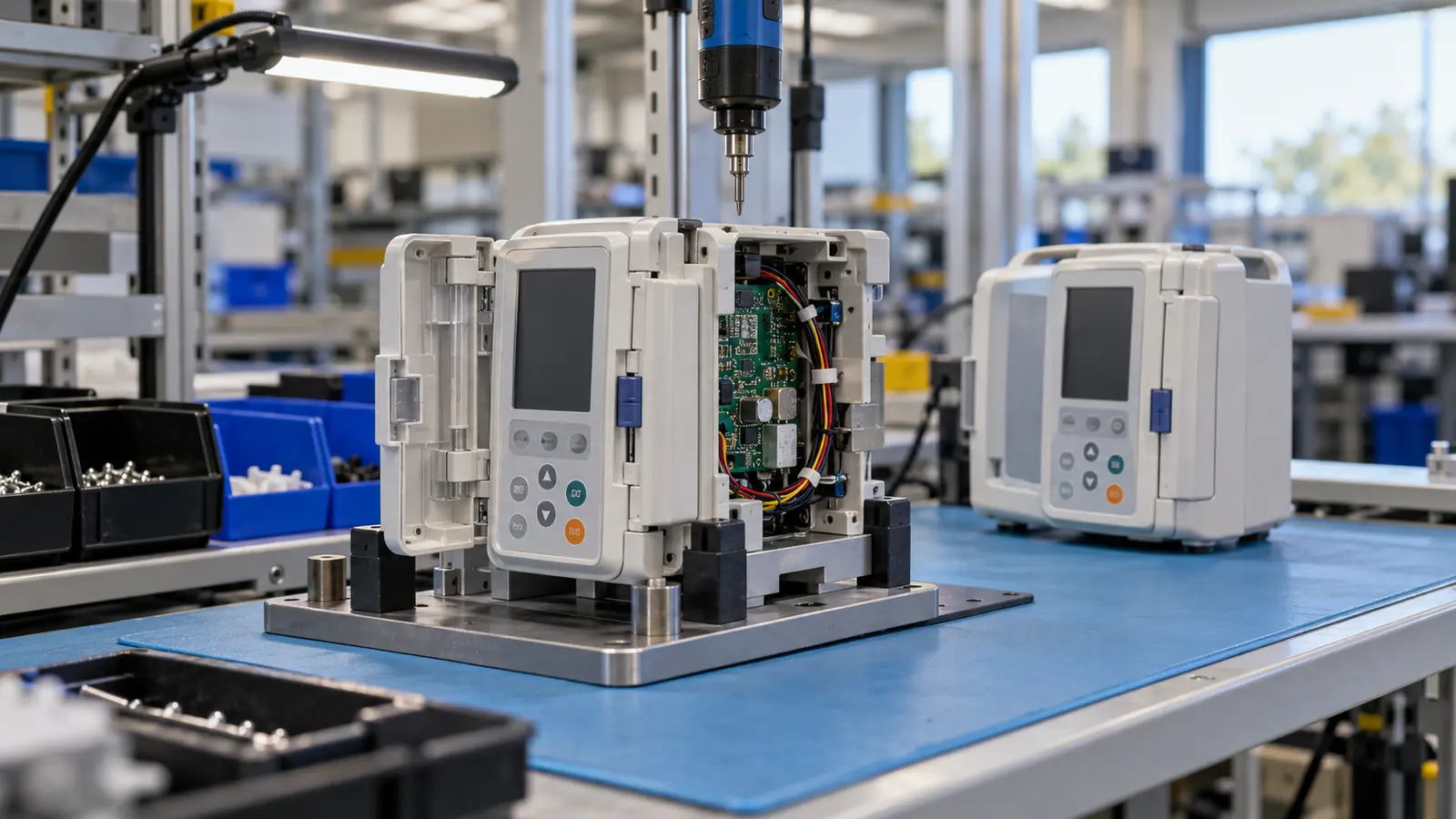
Medical device assembly automation uses controlled systems to fasten, dispense, test and package components into finished devices with repeatable operations and traceable records.
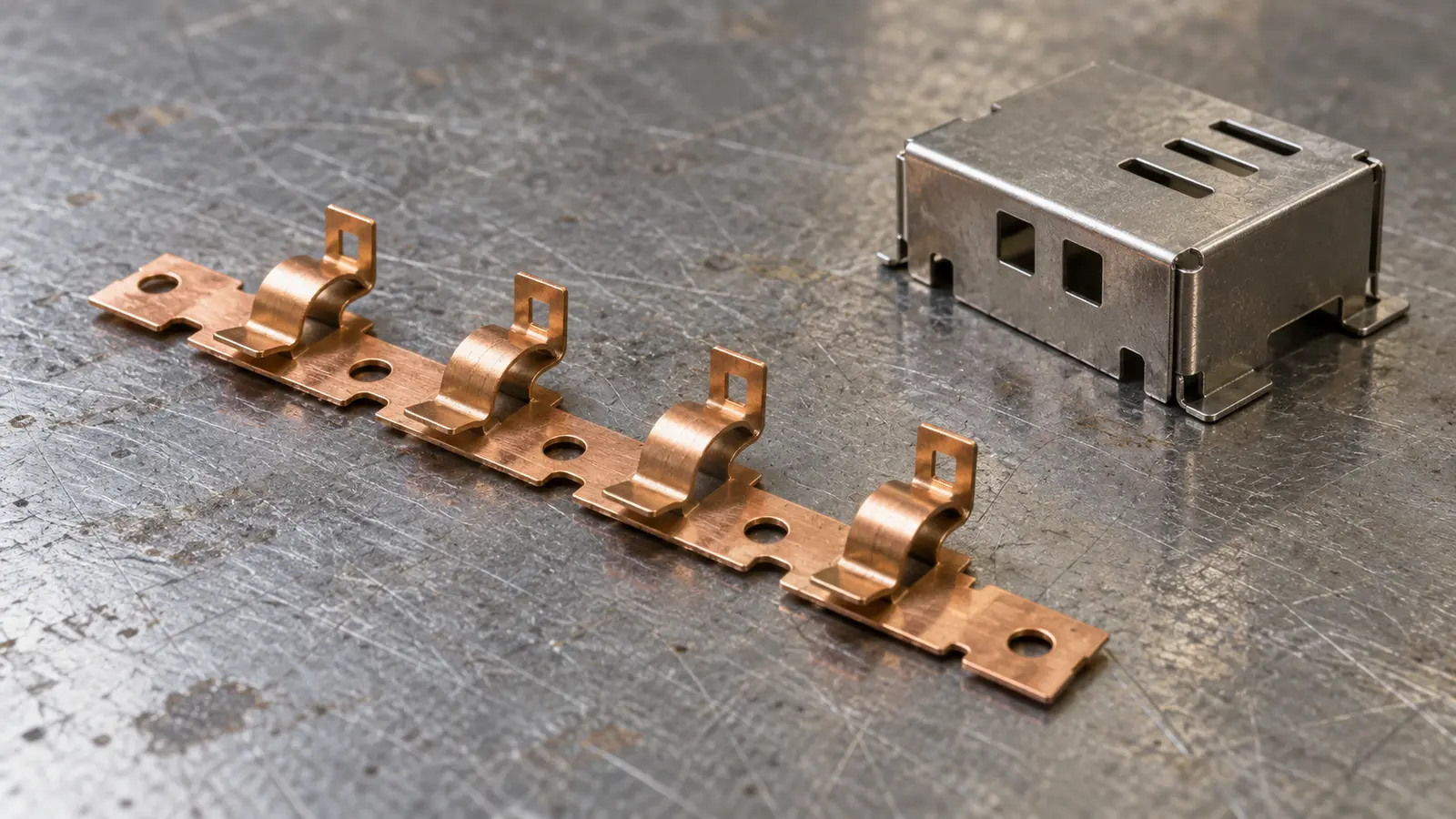
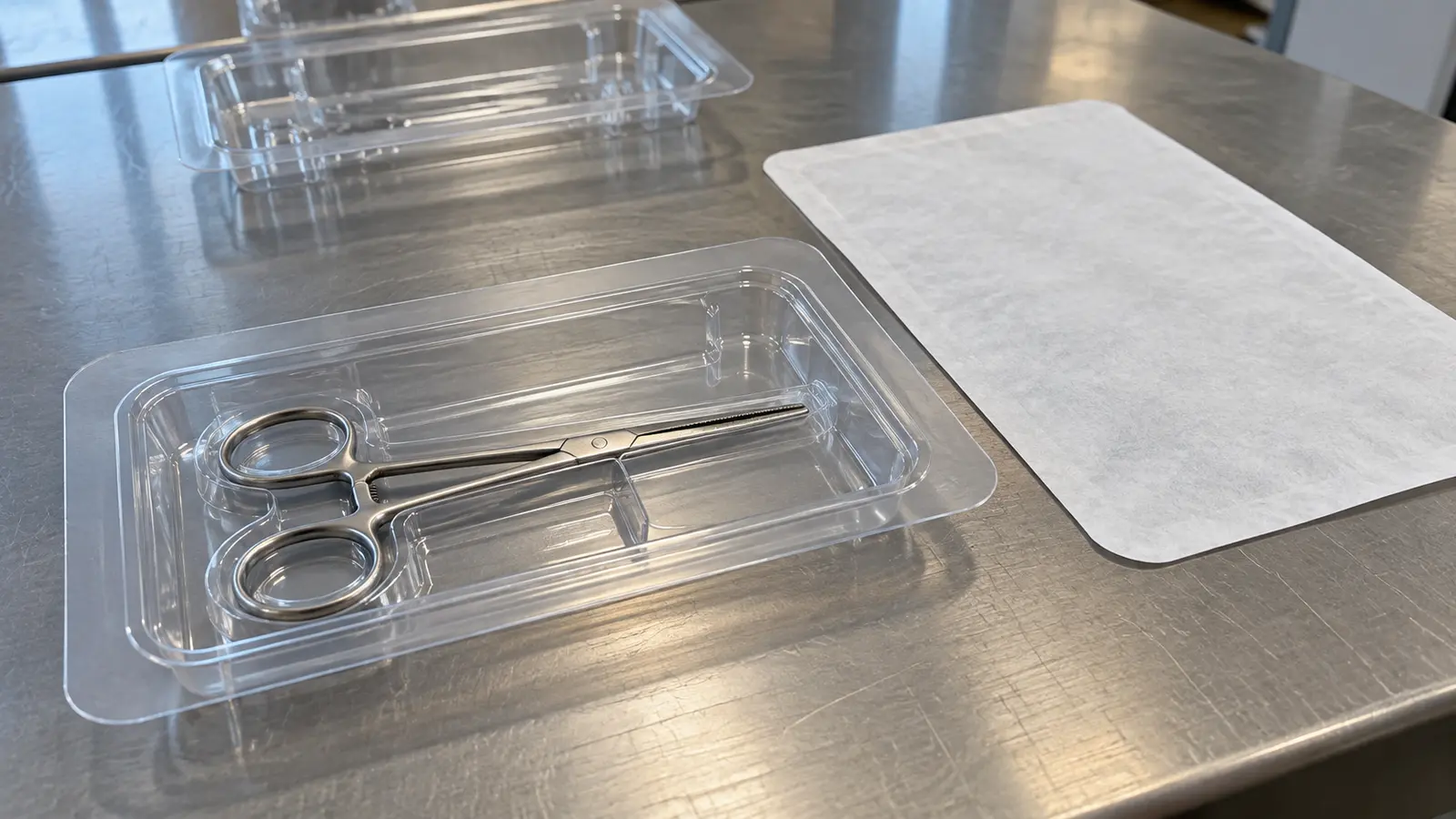
Metal stamping supplies repeated contacts, clips and shielding. Thermoforming supplies protective trays, while sterile barrier performance depends on device-specific materials and validated processes.
Medical device assembly automation uses automated and semi-automated systems to join, fasten, dispense, test and package medical device components.
Repeatable operations can reduce human error, improve throughput and capture the process records needed for a controlled device build.
A finished medical device is rarely a single machined or molded part. CNC machined components, stamped metal elements, molded plastics, electronic subassemblies, adhesive bonds and fasteners must work together.
The assembly and packaging phase turns those components into a functional product, with documented torque values, dispense volumes and inspection results. Sterility, where required, depends on a suitable validated packaging and sterilization process.
This article covers automated assembly, medical metal stamping and medical device thermoforming. It is the third article in a four-part series on medical manufacturing.
For the complete overview of CNC processes and materials, explore medical CNC machining. The development pathway is covered in medical device prototyping to production.
Key takeaways
- Assembly control. Automation can improve repeatability and capture fastening, dispensing and inspection records.
- Stamped components. Progressive and transfer dies produce repeated contacts, clips, shielding and instrument blanks.
- Packaging design. Thermoformed trays protect and orient devices. Sterile barrier performance depends on validated materials and processes.
- Traceability. Link component lots, build records and final release checks across the workflow.
- Turnkey coordination. Fewer supplier handoffs can reduce delays and documentation work, with specialist requirements agreed for each program.
What Is Medical Device Assembly Automation?
Medical device assembly automation uses controlled machinery and process systems to turn components into finished products with documented repeatability.
It includes mechanical fastening, adhesive dispensing, welding, soldering, functional testing, labeling and packaging. The process and work environment must be selected for the device and its applicable good manufacturing practice requirements.
The core advantage of automation is process consistency as well as speed. Controlled fastening and dispensing can reduce operator variation, while suitable handling controls can limit contamination.
For example, a drawing or assembly specification might require a fastener torque of 0.45 Nm. A torque-controlled driver can record the actual value with a timestamp and serial number, giving objective evidence that the step met its specified limit.
A manual process can also be controlled and documented. The difference is how reliably the selected tools and record system capture each operation.
For medical device original equipment manufacturers (OEMs), three factors shape the decision to automate:
- Volume. Compare setup and equipment costs with the required output. Hundreds to thousands of units per month may justify evaluating automation, but there is no universal break-even quantity.
- Risk. Reduce operator-dependent variation on assembly steps that affect safety or device function.
- Traceability. Define the torque, dispensing and inspection records that the OEM quality team needs before choosing the system.
What Assembly Processes Are Used in Medical Device Manufacturing?
Medical device assembly combines mechanical, adhesive, thermal and electronic joining processes.
The combination depends on the design, materials, production volume and regulatory classification. The table below summarizes common processes and their medical applications.
| Assembly Process | How It Works | Medical Applications |
|---|---|---|
| Automatic screwdriving with torque control | Servo-driven or pneumatic drivers apply fasteners to a programmed torque value with real-time monitoring and digital logging. | Instrument handle assemblies, diagnostic device housings, reusable device closures |
| Computerized adhesive dispensing | Precision volumetric or time-pressure dispensers apply adhesives, sealants, or lubricants in controlled volumes along programmed paths. | Catheter bonding, lens bonding in endoscopes, housing seals, sensor potting |
| Orbital (spin) riveting | A forming head orbits around a rivet shank to create a permanent joint without excessive heat or vibration. | Instrument pivots, forceps hinges, reusable device joints |
| Press riveting and hydraulic press assembly | Controlled force presses components together or forms rivet heads with monitored force-displacement curves. | Bearing insertion, pin assembly, snap-ring installation |
| Precision welding (spot, TIG, laser) | Localized heat joins metal components. Spot welding for sheet assemblies, TIG for structural joints, laser for micro-joints. | Battery tab welding, instrument sub-assemblies, hermetic enclosure sealing |
| Shrink-fitting (thermal assembly) | Thermal expansion and contraction creates interference fits without adhesives or fasteners. | Shaft-hub assemblies, press-fit bearings in motorized instruments |
| ESD-safe electronic assembly | PCB assembly and integration with an ESD control program appropriate to the electronic components. | Patient monitoring electronics, diagnostic circuit boards, implantable pulse generators |
| Automatic kit packaging | Devices and accessories are arranged in custom trays, checked for completeness, and sealed using the qualified packaging process. | Surgical instrument kits, procedure trays, implant delivery systems |
Meco's mechanical assembly services include the following joining and assembly methods:
- Riveting. Orbital, punch, press and pull (blind) riveting.
- Press and thermal assembly. Hydraulic press assembly and shrink-fitting.
- Welding. Spot, TIG and MIG welding, with the method selected for the joint and material.
- Controlled fastening and dispensing. Automatic screwdriving with torque control and computerized adhesive dispensing.
- Production integration. Automatic and semi-automatic assembly lines, kit packaging and ESD-safe electronics integration.
The process table describes medical manufacturing methods in general. Specialist steps such as laser micro-welding, implantable electronics or sterile barrier validation require a separate review of the device program.
Component tolerances and final assembly tolerances are different requirements. Meco's CNC machining reference is ±0.01 mm, while its standard injection molding reference is ±0.05 mm.
Those values do not establish the fit of a finished device. The engineering review must also cover datum references, mating features, material variation and tolerance stack-up.
Why Does Automation Matter for Medical Device Assembly?
Automation can improve repeatability, reduce handling and capture records in medical device assembly.
Each benefit depends on a defined process, suitable controls and verification of the finished build.
Repeatability and operator variation
A manual operator applying adhesive with a syringe may produce slight changes in bead width, placement or volume between units and shifts. An automated dispenser follows a programmed path and controlled dispense setting.
For devices where bond integrity affects function or patient safety, that repeatability supports process control. The adhesive, surface preparation, cure and inspection method still need to meet the device specification.
Handling and contamination control
Every handling step can introduce particulate, microbial or chemical contamination. Reducing manual contact can help control those sources.
For devices that will be terminally sterilized, assembly controls must support the specified cleanliness and bioburden limits. Automation does not itself establish cleanliness or replace a validated sterilization process.
Digital records and traceability
Torque drivers, vision inspection systems and dispense controllers can generate timestamped records linked to a unit or batch. These records help quality teams check that each defined operation was completed within its limits.
Manual assembly can be documented through operator logs and batch records. Automated capture can provide more detailed records when the system is configured and verified correctly.
The FDA's Quality Management System Regulation (QMSR) became effective on 2 February 2026. It governs applicable medical device quality systems, including the manufacturing controls and records used for finished devices.
Automation can also increase inspection coverage and reduce human error. A risk-based review should determine which operations need full inspection, which need process validation and which can use a controlled manual method.
What Is Medical Metal Stamping?
Medical metal stamping uses progressive or transfer dies to cut, form, bend and draw sheet metal into precision components.
It suits flat or formed parts needed in high volumes with repeatable features and low conversion cost. Examples include battery contacts, electromagnetic interference (EMI) shielding cans, connector terminals, surgical blade blanks, retractor components, clip features and lead frames for implantable electronics.
Where CNC machining suits complex 3D geometry in small to medium volumes, stamping suits 2D and 2.5D geometry in medium to very high volumes.
The processes are complementary. A surgical instrument might combine a machined handle, a stamped blade blank and a stamped spring clip, joined through controlled assembly.
Progressive die stamping
A continuous metal strip passes through a series of die stations. Each station performs an operation such as piercing, blanking, bending, forming or coining.
The part stays attached to the carrier strip until the final station separates it. Progressive stamping suits repeated components needed in quantities of thousands to millions per year.
Transfer stamping
A mechanical transfer system moves separate blanks between die stations. This approach can accommodate larger parts and more complex forming operations than a carrier-strip layout.
Typical examples include deep-drawn enclosures and complex bracket geometry.
Fine blanking
Fine blanking produces a high proportion of smooth, sheared edge and can reduce secondary machining or deburring. Edge finishing may still be required by the part specification.
It can be selected where edge quality affects function or safety, such as a blade blank or locking mechanism component. The required edge condition must be defined rather than assumed from the process name.
Materials for Medical Metal Stamping
| Material | Typical Gauges | Medical Applications |
|---|---|---|
| Stainless Steel (301, 302, 304, 316L, 17-7 PH) | 0.05 to 3.0 mm | Surgical blade blanks, clips, springs, retractor arms, shielding |
| Titanium (Grade 1, Grade 2) | 0.1 to 1.5 mm | Implant clip features, fixation plates (stamped and secondary machined) |
| Beryllium Copper (C17200) | 0.05 to 1.0 mm | Connector terminals, contact springs in diagnostic equipment |
| Phosphor Bronze (C510, C521) | 0.05 to 1.0 mm | Battery contacts, spring clips, flexible conductors |
| Aluminum (1100, 3003, 5052) | 0.3 to 3.0 mm | EMI shielding, equipment housings, light-gauge brackets |
| Brass (C260 sheet; grade selected for forming) | 0.1 to 2.0 mm | Electrical terminals, fittings, non-patient-contact connectors |
Tolerance targets need to be agreed for each stamped feature. A specification of ±0.025 mm for a fine-blanked feature, ±0.075 mm for a progressive-die feature or ±0.013 mm for a micro-stamped feature requires its own tooling and process-capability review.
These values are examples of drawing requirements, not universal process limits or a Meco capability guarantee. Material thickness, feature size, springback, die wear and the inspection method affect what can be held.
Meco's metal parts stamping and progressive stamping capabilities process aluminum, steel, stainless steel, brass, bronze and copper across punching, bending, drawing, forming and progressive-die operations.
How Do Stamped Components Integrate into Medical Device Assemblies?
Stamped parts become functional device components when their fit, joining method and inspection steps are planned with the complete assembly.
They are rarely used in isolation. A manufacturer that coordinates stamping and assembly can reduce handoffs while keeping part revisions and build requirements connected.
Battery contacts and connector terminals
Contacts may be stamped from beryllium copper or phosphor bronze, then inserted into molded plastic housings. The assembly plan can include insertion-force monitoring, contact-deflection checks and electrical continuity testing.
Plastic injection molding provides the repeatable housing geometry needed for contact insertion. The subassembly then becomes part of a diagnostic device or patient monitor through box build assembly.
Surgical instrument components
Blade blanks, jaw inserts and pivot plates may be stamped from stainless steel. Grinding, sharpening or precision drilling can add the required final features before riveting, pinning or welding joins the complete instrument.
The stamped part provides the near-net-shape blank. CNC turning and CNC milling add the precision features that the selected part requires.
EMI shielding and electronic integration
Thin-gauge stainless steel or aluminum shielding cans can be soldered or mechanically attached to a printed circuit board (PCB) assembly. Their fit, grounding contact and clearance to nearby components matter to the finished device.
Meco supports PCB assembly and electronics integration in ESD-safe environments. The IEC 61340-5-1 standard defines requirements for an electrostatic discharge control program.
These operations can form part of complete box build assembly programs, with the board, shielding, wiring and enclosure checked as a system.
Planning a complete device build? Share the component drawings, target volume and assembly requirements. An engineer will review the process route and advise on the next step.
Talk to an EngineerWhat Is Medical Device Thermoforming?
Medical device thermoforming heats plastic sheet and forms it over a tool to create trays, blisters and clamshell packages.
These packages hold and protect devices during handling, storage, shipping and opening. For a sterile device, the tray must work with its lidstock and the validated sterilization process to maintain the sterile barrier.
Thermoforming creates the tray geometry. Forming alone does not make a package sterile or establish a validated sterile barrier system.
ISO 11607-1:2019 sets requirements for materials and packaging systems intended to maintain the sterility of terminally sterilized medical devices until use.
Thermoformed trays sealed with Tyvek or medical-grade paper lidstock are used for surgical instruments, implant delivery systems and procedural kits. DuPont's Tyvek medical packaging information describes compatibility with common sterilization methods, including steam under controlled conditions.
The tray resin, lidstock, coating and sealing process must be compatible with the chosen sterilization cycle. A suitable material combination still needs validation for the specific device and packaging system.
Medical Thermoforming Materials
| Material | Key Properties | Typical Applications |
|---|---|---|
| PETG | Clear, easy to thermoform; sterilization compatibility depends on grade and cycle | Instrument trays, implant blisters, device clamshells |
| HIPS (High Impact Polystyrene) | Cost-effective, good formability, opaque | General medical trays, non-sterile device packaging, internal dunnage |
| PVC | Good clarity, chemical resistant, broad processing window | Blister packs, clamshells, tray inserts |
| PP | Lightweight and chemically resistant; suitable grades can support steam sterilization | Trays and packaging where the grade and formed geometry are qualified for the sterilization cycle |
| PET | Dimensionally stable; barrier performance depends on the complete package | Thermoformed blisters, sealed packaging systems |
Meco's thermoformed blister capabilities process PVC, PP, PE and PET for packaging applications.
For structural housings beyond packaging, its injection molding capabilities cover engineering polymers including ABS, PP, PE, PC, PC-ABS and PA (nylon). Material grade and device-specific requirements must be reviewed for the proposed use.
The companion article on medical plastics machining explains material and part requirements when housings or polymer components need machined features.
Combining machining, stamping, assembly and packaging planning connects the complete manufacturing workflow. Sterilization compatibility, sterile sealing and packaging validation must be established separately where the device program requires them.
How Does Thermoformed Packaging Integrate into the Medical Device Workflow?
Thermoformed packaging is a designed part of the device system, with defined support, sealing and opening requirements.
- Device support. The pocket geometry holds the device securely and limits movement during shipping.
- Barrier integrity. The seal and materials maintain the required sterile barrier over the specified shelf life.
- Aseptic presentation. The opening method allows the device to be presented without contaminating it.
Surgical instrument kits
Multi-cavity trays hold each instrument in a dedicated pocket. The tray is loaded, checked visually or by a vision system for completeness, then sealed with suitable lidstock.
Ethylene oxide (EtO) or gamma sterilization may be selected where the device and materials are compatible. The tray, lidstock and seal form a sterile barrier only when the complete process is validated.
Implant delivery systems
Thermoformed blisters can protect and orient an implant and its delivery instruments. The package is sealed and sterilized using the validated method.
Labeling can include lot identification, expiration date and a Unique Device Identification (UDI), where applicable. These records connect the packaged device to its manufacturing and release history.
Single-use procedural kits
Disposable instruments, drapes, sponges and other consumables can be arranged in a single tray. Completeness checks confirm that the specified items are present.
A kit can reduce preparation steps at the point of use. Its contents, packaging and sterilization compatibility must be assessed together rather than assumed from individual components.
Packaging validation
ISO 11607-2:2019 covers validation requirements for forming, sealing and assembly processes. Packaging evaluation also addresses material suitability, seal strength, integrity and protection through distribution and storage.
- Seal performance. Establish acceptable seal strength and verify integrity.
- Distribution resistance. Assess handling risks such as vibration, drops and compression using the relevant test plan.
- Shelf life. Evaluate aging and barrier performance over the claimed storage period. Accelerated aging supports the assessment, with real-time aging used to confirm it.
Packaging verification and validation must be completed as required before commercial release. The OEM must define the applicable acceptance criteria and responsibilities with its manufacturing and packaging partners.
Why Does Turnkey Integration of Machining, Stamping, Assembly, and Packaging Matter?
Coordinating machining, stamping, finishing, assembly and packaging reduces supplier handoffs and connects the records for the finished build.
When processes are split across suppliers, each transfer can add:
- Quality risk. Incoming inspection, handling damage or contamination.
- Lead time. Shipping, receiving and time waiting for the next process.
- Documentation work. Purchase orders, material certificates and lot records that need to be reconciled.
A turnkey program can connect the machined component, stamped spring clip, finished surfaces, assembled device and packaging plan through one point of accountability.
Linked lot records make it easier to trace materials and operations across those stages. Some specialist steps may still require qualified external providers, so the route and release responsibilities should be agreed before production.
Meco operates 40+ manufacturing processes across its Thailand and China production sites. Its manufacturing and warehousing footprint includes 20,000 m² in Thailand, 16,000 m² in China and 3,000 m² of warehousing in Canada.
Additional warehouses are located in Ohio and Florida in the U.S., Tokyo and Osaka in Japan, and Thailand. This network supports production planning, stock management and delivery across North America and Asia.
The workflow can start with R&D engineering and prototyping, then connect CNC turning, milling and 5-axis machining with stamping, surface finishing, assembly and packaging.
Global logistics supports just-in-time (JIT) delivery and vendor-managed inventory (VMI). Meco's formal quality certification is IATF 16949:2016. Device-specific regulatory requirements and any sterile processing must be agreed for the individual program.
For OEMs managing multi-component programs, whole product manufacturing can reduce supplier coordination and provide connected documentation. Meco's supply-chain model identifies a potential lead-time reduction of 30 to 50%, depending on the program and transfer steps.
As a planning reference, Meco's metal stamping range is 5,000 to 10 million+ parts, with typical lead times of 4 to 10 weeks. Its CNC machining reference covers 1 to 10,000 parts with lead times of 1 to 3 weeks.
These are process references, not a finished medical device release schedule. Tool qualification, inspection, assembly validation and packaging requirements must be included in the program plan.
The metal part manufacturing cost guide gives context for tooling and conversion costs when comparing machined and stamped components.
Plan Your Medical Device Build
Share your drawings, bill of materials, volume and assembly requirements. Meco can review the manufacturing route and identify the next engineering steps.
- Components. CNC machining, stamping and plastic molding
- Assembly. Controlled fastening, dispensing and joining
- Finishing. Surface treatments selected for the parts
- Packaging and delivery. Tray planning, kit packing and global logistics
- Scale. No minimum order quantity
References and sources
Regulatory and standards information checked on 7 October, 2026.
- U.S. Food and Drug Administration. Quality Management System Regulation QMSR. Updated 2 February 2026.
- International Organization for Standardization. ISO 11607-1:2019. Materials, sterile barrier systems and packaging systems. 2019 edition, with Amendment 1:2023.
- International Organization for Standardization. ISO 11607-2:2019. Validation requirements for forming, sealing and assembly processes. 2019 edition, with Amendment 1:2023.
- International Electrotechnical Commission. IEC 61340-5-1:2024. ESD control program requirements. Published 21 May 2024.
- DuPont. Tyvek 1073B medical device packaging. Material and sterilization compatibility information.
