
What Is Live Tooling on a CNC Lathe?
CNC live tooling is a powered tool fitted to a CNC lathe turret that spins on its own, so the lathe can drill, mill, tap, and cut slots while the part is still held in the chuck. In plain English, it turns a lathe into a part-time milling machine. That means one setup can finish a part that used to need two machines, which cuts time, scrap, and handling errors.
If you have ever sourced a turned part and watched it bounce between a lathe and a mill, you already know the pain. Setups cost money. Re-fixturing creates errors. And every handoff adds days to the lead time.
Live tooling solves that. It is the reason modern turning shops can quote complex shafts, fittings, and housings as a single-setup job in 2026, even when the part has cross-holes, flats, or off-axis threads.

How Does Live Tooling Work?
On a standard lathe, only the chuck spins. The cutting tool stays still and shaves material off the rotating part. That works great for round features like diameters, faces, and grooves. It does not work for cross-holes, slots, or a flat on the side of a shaft.
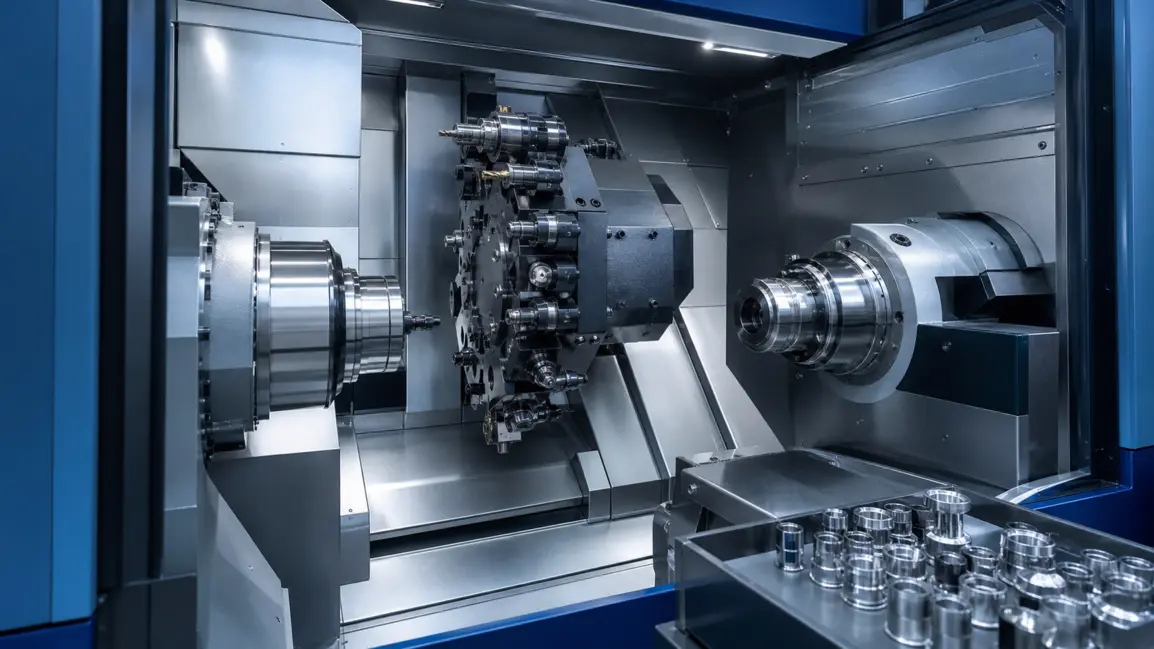
A live tooling lathe fixes that limit. The turret holds powered tool holders that have their own small motor inside, so the cutting tool spins on its own. When the lathe needs to drill a hole into the side of the part, the chuck stops, holds the part at the right angle, and the live tool spins to cut the hole. The whole job stays in one chuck. No second machine. No second setup.
A few key parts make this work, and you will see these terms on every quote sheet:
- C-axis turning: the ability to lock the chuck at an exact angle (instead of just spinning it). This lets the lathe place a hole or slot at a specific clock position on the part.
- Y-axis lathe: a lathe with an extra up-and-down axis on the turret. A normal lathe only moves the tool in two directions (X and Z). A Y-axis lathe adds vertical movement, which means it can mill off-center features properly instead of just on the centerline.
- Sub-spindle turning: a second smaller chuck that grabs the back of the part once the front is finished, so the lathe can machine the other end too. The whole part comes off finished, with both ends done, no flip required.
Put C-axis, Y-axis, and a sub-spindle together with driven tools CNC people call live tools, and you get what the industry calls mill-turn machining or multi-tasking machining. Mazak coined the phrase "done-in-one" to describe it. The name says everything.
BMT vs VDI Live Tool Holders in 30 Seconds
When you read a lathe spec sheet, you will see BMT (Base Mount Tool) or VDI (Verein Deutscher Ingenieure). BMT holders bolt directly to the turret face with four screws and locating keys, giving more rigidity and better finishes on tough parts. VDI holders use a quick-clamp shank, so they swap faster but flex more under heavy cuts. BMT wins on production rigidity. VDI wins on speed of changeover. Most production shops running tight tolerances spec BMT for their hardest jobs.
What Can You Make With Live Tooling?
This is where the lathe stops feeling like a lathe and starts feeling like a small machining cell. With live tool holders mounted in the turret, a single-setup machining run can deliver:
- Cross-holes drilled through the side of a shaft
- Flats and hex features milled onto round stock (think wrench flats on a fitting)
- Tapped threads in any direction, not just on the centerline
- Keyways and slots cut into shafts
- Off-center pockets milled into faces or sides
- Polygon turning for square or hex shapes without removing the part
- Engraved part numbers and serial marks
Here is how that stacks up against a standard turning center.
| Feature | Standard Turning | CNC Live Tooling Lathe |
|---|---|---|
| Round diameters and faces | Yes | Yes |
| Centerline drilling and tapping | Yes | Yes |
| Cross-holes (off the centerline) | No (needs a mill) | Yes |
| Flats, hex, keyways | No (needs a mill) | Yes |
| Off-center milling with Y-axis | No | Yes (Y-axis lathe required) |
| Both ends finished in one cycle | No (flip the part) | Yes (with sub-spindle) |
| Setups required for a complex part | 2 to 4 | 1 |
| Best for | Simple turned parts at any volume | Complex turned parts at medium to high volume |
The Real Cost Savings of Done-in-One Machining
This is the part that matters to anyone signing off on a purchase order. Live tooling looks expensive on the machine spec sheet, because the machines cost more. But the math on the part cost usually swings the other way once you run the numbers.
Every time a part moves from a lathe to a mill, four things happen, and all of them cost money:
- Setup time on the second machine (often 30 to 90 minutes per batch)
- Re-fixturing error, which is the main reason "in-tolerance" parts fail final inspection
- Work-in-process inventory sitting in a tote between machines, taking up floor space
- Scheduling delays, because the mill is rarely free the moment the lathe finishes
A real example from SME's Advanced Manufacturing shows what this looks like in practice. One shop running an aluminum sheave on a basic live tool setup hit a 262-second cycle, three passes, and chatter on the finish. A better-engineered live tool reduced it to a single pass at 172 seconds with a clean finish. Annual savings: roughly $45,000 on one part number alone.
Why "Done-in-One" Matters
Every extra setup is a chance for things to go wrong. By keeping the part in one chuck for the entire job, single setup machining eliminates re-fixturing error, cuts handling time, and locks in the datum (the reference point every measurement is based on). For a typical mid-complexity turned part, switching from a multi-setup workflow to a done-in-one turning workflow can cut total part cost by 15 to 35 percent and lead time by 30 to 50 percent.
When Should You Spec Live Tooling? The 5-Question Test
Not every turned part needs live tooling. A simple shaft with two diameters and a thread does not need it. But the moment a drawing has features that sit off the centerline, the math changes fast. Use this quick test on your next drawing.
1. Does the part have any feature that is not round?
Flats, hex pockets, keyways, slots, cross-holes, or drilled bolt patterns are all off-center features. If the answer is yes, live tooling becomes a serious option.
2. Are there features on more than one face of the part?
If both the front and the back need machining, a sub-spindle plus live tooling lets you finish both ends in one cycle. Without it, the part has to be flipped and re-fixtured.
3. Is the production volume more than 50 to 100 pieces?
Below 50 pieces, the setup time on a mill-turn machine may not pay back. Above 100 pieces, the per-part savings start to add up quickly. We typically recommend live tooling for any program running 200+ pieces per year.
4. Are the tolerances tight between turned and milled features?
If a cross-hole has to land within a few thousandths of a turned diameter, doing it on the same machine in one setup is the only reliable way to hit that tolerance every time. Two setups will eventually drift.
5. Is lead time critical?
Single setup machining typically removes 30 to 50 percent of total cycle time and even more of the elapsed lead time. If your launch date is tight, live tooling buys you days.
If you answered yes to two or more of these, your part is a strong live tooling candidate. Send us your drawings for a free DFM review and we will tell you exactly how a mill-turn approach would compare to a split lathe-and-mill workflow.
Which Industries Use Live Tooling Most?
Live tooling shows up everywhere turned parts have non-round features, which is most of modern manufacturing. Here is where it earns its keep.
| Industry | Typical Parts | Key Live Tooling Operations |
|---|---|---|
| Automotive | Drive shafts, steering components, fuel injectors, EV battery terminals | Cross-holes, flats for wrenches, off-center tapping |
| Aerospace | Fittings, fasteners, hydraulic manifolds, actuator bodies | Polygon machining, off-center bolt patterns, tapped threads |
| Medical | Bone screws, surgical tool handles, implant blanks | Keyways, hex drives, micro cross-holes |
| Industrial / Hydraulics | Valve bodies, manifolds, couplings, pump shafts | Cross-drilling, wrench flats, multi-face threading |
| Telecom & Electronics | RF connectors, antenna housings, sensor barrels | Off-center milling, slots, serial number engraving |
| Heavy Equipment | Hydraulic fittings, pin assemblies, gear blanks | Cross-holes, keyways, polygon turning |
You can see the pattern. Any industry that uses round-bodied parts with off-axis features benefits from a live tooling CNC lathe. That is most of them.
Design for Manufacturability (DFM) Rules for Live-Tooled Parts
If you design parts and you want the manufacturer to use live tooling instead of a split lathe-and-mill workflow, your drawing has to make that possible. Five quick rules will save you a lot of back-and-forth on quotes.
1. Group your off-center features on the same end when you can. If all cross-holes and flats are reachable from one chuck position, the live tool can hit them in a tight cycle. If you scatter them across opposite ends without a clear plan, the part may need a sub-spindle handoff (still possible, just costlier).
2. Keep cross-holes perpendicular to the turning axis whenever possible. Angled cross-holes need a Y-axis lathe with a B-axis tilt, which is a more specialized machine. Perpendicular holes run on almost any live tooled lathe.
3. Watch your milled feature depth. Live tool spindles are smaller than full milling machine spindles. Deep pockets or heavy stock removal can chatter. As a rule of thumb, keep milled feature depth under 1.5 times the cutter diameter for clean finishes.
4. Specify tolerance only where you need it. Live tooling holds tight tolerances (often within 0.01 mm) on related features that are cut in the same setup. But over-tolerancing every dimension drives up cost and may force the shop to add inspection steps that the machine itself does not need.
5. Talk to your manufacturer early. The single biggest cost-saver in turned parts is a 15-minute DFM call with a real engineer before the drawing is locked. Meco includes DFM feedback with every quote as part of our R&D engineering workflow.
Live Tooling vs 5-Axis Mill: Which Is Right for Your Part?
This is the question we get most often, and the honest answer is: it depends on the shape of the part, not the complexity. There is a simple rule that works almost every time.
If the part is mostly round with some off-center features (think shafts, fittings, pins, manifolds, fasteners), a live tooling CNC lathe wins. The part is held by its strongest feature, the round diameter, and every cut is supported. You also get faster cycle times because the spindle never stops between operations.
If the part is mostly prismatic with some round features (think housings, brackets, blocks with bored holes), a 5-axis CNC machining center wins. The part needs full multi-axis access, and a lathe chuck is not the right way to hold a block.
Where it gets interesting is in the middle. For parts that are 70 percent round and 30 percent prismatic, a Y-axis mill-turn lathe will almost always beat 5-axis on cost, especially at production volume. But for the 30/70 split the other way, 5-axis is faster. For a deeper look at when 5-axis is the right call, see our guide to complex multi-axis machining.
How to Source Live-Tooled Parts From a Manufacturing Partner
Once you have decided live tooling is right for your part, the next question is how to make sure your manufacturer actually delivers on it. Use this short checklist before you place the order.
- Confirm the machine type. Ask whether the shop will run your job on a Y-axis sub-spindle lathe or a basic live tool lathe. The difference shows up in your tolerances.
- Ask about turret style. BMT turrets give better rigidity for tough materials. VDI turrets are fine for lighter cuts and faster changeovers.
- Request a DFM review with the quote. A real partner will tell you which features to combine and which to redesign. If they just quote the print without comment, that is a warning sign.
- Ask about in-process inspection. Single-setup parts should still be checked at the right points. CMM inspection and SPC data should be standard.
- Verify quality certification. For automotive, aerospace, and medical programs, you want a partner with IATF 16949:2016 certification, which builds on the ISO 9001 quality foundation.
For a wider look at vendor selection, our guide on evaluating a CNC machining partner walks through the full process. And if you are still working through the math, our CNC machining cost breakdown shows how setup count drives the bottom line.
Meco runs IATF 16949:2016 certified Y-axis sub-spindle lathes inside both our Thailand (20,000 m²) and China (16,000 m²) facilities, with U.S. engineering support and warehousing across North America and Asia. We quote turned parts in under 24 hours with DFM feedback included, and we scale from 10 pieces to 10 million plus. Explore our full CNC turning services or our custom CNC machining capabilities to see how live tooling fits into the bigger picture.
Frequently Asked Questions About CNC Live Tooling
What is the difference between live tooling and driven tools?
There is no real difference. "Live tooling" and "driven tools CNC" describe the same thing: a powered, rotating tool mounted in a CNC lathe turret that spins independently of the chuck. Different machine builders and regions just prefer different names. Mazak, Haas, and Okuma tend to say "live tooling." European builders and some textbooks say "driven tools." Either way, the function is identical.
Can a live tool lathe replace a CNC milling machine?
For round-bodied parts with some off-center features, yes. A Y-axis lathe with live tooling can finish most shafts, fittings, and manifolds in a single setup without ever touching a mill. For prismatic parts like housings and brackets, no. The lathe chuck is not the right way to hold a block, so those parts still belong on a 3, 4, or 5-axis milling machine. Most production shops run both side by side.
What is the difference between BMT and VDI live tool holders?
BMT (Base Mount Tool) holders bolt directly to the face of the turret with four screws and locating keys, giving more rigidity and better surface finishes on tough cuts. VDI (Verein Deutscher Ingenieure) holders use a quick-clamp shank, so they swap faster between jobs but flex slightly more under heavy loads. Production shops running tight tolerances on hard materials usually choose BMT. Job shops doing lots of changeovers often prefer VDI.
What is a Y-axis lathe used for?
A Y-axis lathe adds vertical tool movement to the normal X and Z axes of a standard lathe. That extra axis lets the live tooling reach off-center features properly, instead of being stuck on the centerline of the part. With a Y-axis, the lathe can mill flats, slots, keyways, and pockets that sit off-axis on a round part. It is the single biggest upgrade you can spec on a live tooling CNC lathe.
What does sub-spindle turning mean?
Sub-spindle turning means the lathe has a second smaller chuck opposite the main one. After the front of the part is finished, the sub-spindle grabs it and pulls it off the main chuck so the back can be machined in the same cycle. The part comes off the machine completely finished, both ends done, with no flip and no second setup. It is one of the biggest contributors to true done-in-one turning.
Is live tooling worth the extra cost?
For round parts with any off-center features and volumes above roughly 100 pieces, yes. Live tooling typically removes 30 to 50 percent of total lead time and 15 to 35 percent of part cost by eliminating the second-machine setup, the re-fixturing errors, and the work-in-process delay. For very simple turned parts (just diameters and threads) at low volume, a standard turning center is still the cheaper choice.
What is mill-turn or multi-tasking machining?
Mill-turn machining (also called multi-tasking machining) is the combination of turning and milling on a single CNC machine. It uses a lathe spindle as the base, then adds C-axis indexing, Y-axis movement, live tooling, and often a sub-spindle so the machine can do everything a lathe and a mill would do, in one cycle. The whole approach is sometimes called "done-in-one turning" because the part comes off finished in a single setup.
How do I know if my part needs live tooling?
Use the 5-question test: Does the part have any non-round features? Are there features on more than one face? Is the volume above 100 pieces? Are the tolerances tight between turned and milled features? Is lead time critical? If you answer yes to two or more, your part is a strong candidate for a live tooling CNC lathe. A quick DFM review from your manufacturer will confirm whether mill-turn machining beats a split lathe-and-mill workflow on cost.
Need Live-Tooled Parts Built Right the First Time?
Coordinating separate vendors for turning, milling, and finishing adds lead time, raises scrap rates, and creates quality gaps at every handoff. Meco runs Y-axis sub-spindle live tooling lathes in-house alongside 40+ other manufacturing processes, so your turned and mill-turned parts move from raw bar to finished product under one accountable partner.
With 30+ years of turnkey manufacturing experience and IATF 16949:2016 certified quality, Meco delivers the kind of single-setup, done-in-one workflow that OEM programs need to hit cost, tolerance, and launch targets.
- 40+ In-House Processes: CNC turning, mill-turn, 3/4/5-axis milling, surface finishing, heat treatment, and mechanical assembly under one roof.
- IATF 16949:2016 Certified: Automotive-grade quality applied across every industry. 99.99% quality rate. 99.8% on-time delivery.
- DFM Feedback With Every Quote: Engineering review included as standard. Quotes returned in under 24 hours.
- Prototype to Mass Production: From 10 pieces to 10 million plus. No minimum order quantities.
- Global Logistics: Manufacturing in Thailand and China. Warehousing in the U.S. (Ohio and Florida), Canada, Japan (Tokyo and Osaka), and Thailand.
Send us your turned-part drawings and our engineering team will tell you exactly how a live tooling approach compares to a split lathe-and-mill workflow on cost, lead time, and tolerance.
Request a Quote Today