Aluminum CNC Specialists

Aluminum CNC Machining Services

Our aluminum CNC machining services provide fast‑turn, high‑accuracy components with excellent surface quality and reliable dimensional stability.

Meco delivers precise 3–5 axis machining with ±0.01 mm tolerances, helping you move from prototype to production with consistent quality.

Precise aluminum CNC parts with fast lead times and clean finishes.

±0.01 mm tolerances across 3–5 axis machining.

Aluminum CNC machining services

Why Aluminum Is Ideal for CNC Machining

Aluminum is one of the most sought after materials for CNC machining because it delivers a rare combination of performance, versatility, and cost efficiency. Its natural properties allow engineers and manufacturers to achieve tight tolerances, clean surface finishes, and stable dimensional accuracy across both prototypes and full scale production.

Key Advantages of Aluminum

Aluminum provides an excellent strength to weight ratio, ideal for high‑performance applications.
Aluminum machines quickly with clean chip removal, enabling fast and cost‑effective production.
Excellent for heat‑dissipating parts such as housings and heat sinks.
The natural oxide layer protects aluminum from environmental degradation.

How Meco Maximizes These Advantages

3/4/5‑axis systems allow complex geometry machining with precision.
ISO‑aligned workflows ensure consistency from prototype to production.
Tolerances down to ±0.01 mm with stable quality across industries.

Whether you need lightweight aluminum parts, highly machinable aluminum components, or engineered aluminum prototypes, Meco provides the precision and reliability required for today’s most demanding applications.

Meco’s Aluminum CNC Machining Capabilities

Meco delivers end‑to‑end aluminum CNC machining with the precision, flexibility, and process depth needed for both simple components and complex parts.

Core CNC Processes

Precision & Machine Envelopes

Precision Specs
  • ±0.01 mm accuracy
  • Ra 0.4 μm finish
Machine Envelopes
  • Turning: ⌀ 360 × 1000 mm
  • 3/4/5 Axis: 1016 × 508 × 635 mm

What It Means for You

  • High accuracy for sealing surfaces and precision fits
  • Lower lead time due to fewer setup changes
  • Stable repeatability across production runs
  • Capability for complex geometries and multi‑step parts

With a complete range of machining processes under one roof, Meco ensures your aluminum CNC machining project is executed with precision and efficiency.

CNC Process Comparison Table (For Aluminum Parts)

Process Best For Features Advantages Limits
CNC Turning Round parts Shafts, pins, threads High concentricity Not for complex shapes
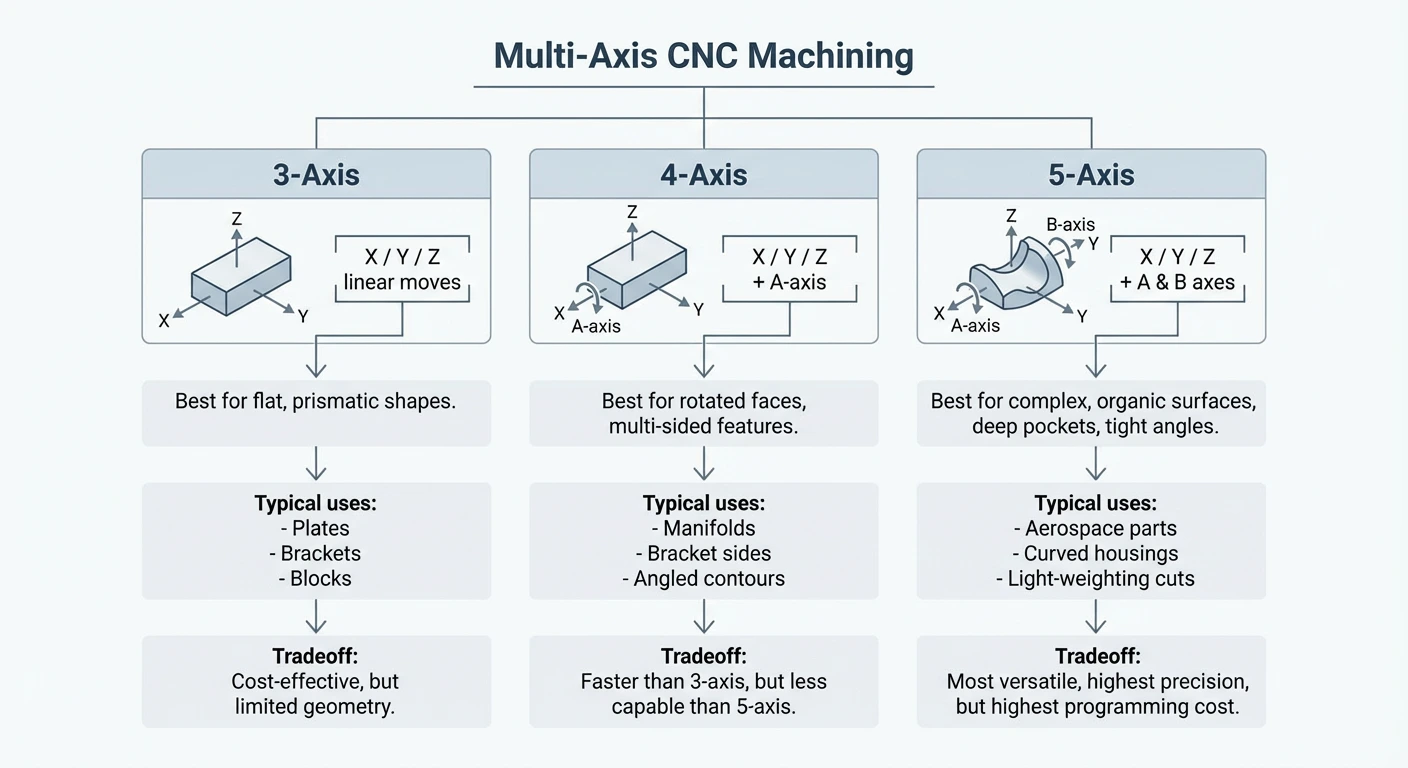
3‑Axis Milling Flat/moderate parts Pockets, slots Cost‑effective Multiple setups
4‑Axis CNC Multi‑side machining Manifolds, angled faces Fewer setups No full undercuts
5‑Axis CNC Complex geometry Curves, deep pockets Highest precision More programming
CNC Drilling Holes & patterns Blind/through holes Consistent quality Tool length limits
CNC Tapping Threading Internal threads Fast & accurate Tool‑size limits
Multi‑Axis Machining Diagram
× Multi‑Axis Machining Diagram Enlarged

Supported Aluminum Alloys

Aluminum is widely used across CNC machining because it offers a strong combination of machinability, strength, and corrosion resistance. We support a wide range of industry‑standard alloys for both prototyping and production.

Common Aluminum Alloys for CNC Machining

  • 6061 – Most versatile, great strength, corrosion resistance, excellent machinability.
  • 7075 – High‑strength alloy for aerospace & performance components.
  • 2024 – Excellent fatigue resistance for structural/high‑stress parts.
  • 5052 – Highly formable, ideal for sheet‑based or bent components.
  • 6082 – High‑strength alloy similar to 6061 for load‑bearing structures.

These alloys are industry standards. Final selection depends on strength, weight, tolerances, and cost requirements.

How Meco Helps You Choose

  • Balance strength vs. weight
  • Improve machinability & reduce cycle time
  • Avoid unnecessary cost or over‑engineering
  • Match alloy to functional requirements
  • Ensure compatibility with machining & finishes

Why Alloy Selection Matters

  • Machining speed & cost
  • Weight & rigidity
  • Surface finish quality
  • Corrosion resistance
  • Heat transfer capability
  • Long‑term reliability

Whether you need lightweight structures, precision housings, or thermally efficient parts, the right aluminum alloy ensures performance without added cost.

Aluminum Alloy Comparison Table

A general industry‑standard comparison (not specific to Meco). Useful for selecting the right alloy.

Alloy Strength Machinability Corrosion Applications Notes
6061 Medium Excellent Good General‑purpose parts, housings Most versatile, cost‑effective
7075 Very High Good Moderate Aerospace, high‑stress parts Strongest commonly machined alloy
2024 High Good Low–Moderate Aircraft fittings, structural Excellent fatigue resistance
5052 Moderate Fair Excellent Sheet metal, bent components Great for bending & welding
6082 High Good Good Structural frames EU equivalent to 6061

What This Table Helps You Compare

  • Strength & load capability
  • Machinability & cost impact
  • Corrosion resistance
  • Typical industry applications
  • Design‑critical notes

How to Use This Table

  • 6061: General purpose CNC parts
  • 7075: Highest strength
  • 2024: Fatigue‑sensitive parts
  • 5052: Sheet & bent parts
  • 6082: EU equivalent to 6061

Aluminum CNC Parts We Produce

Aluminum is widely used because it machines quickly, holds tight tolerances, and provides excellent strength‑to‑weight performance. Meco produces aluminum parts across industries including automotive, aerospace, electronics, industrial equipment, medical, telecom, appliances, heavy machinery, and lighting.

Below are common categories of aluminum CNC parts we frequently manufacture.

Common Aluminum CNC Components

  • Housings & Enclosures – For electronics, instruments, and communication devices.
  • Brackets, Mounts & Supports – Lightweight structural components.
  • Heat Sinks & Thermal Components – Fins and thermal hardware.
  • Manifold Blocks & Fluid Components – Internal passages via 3/4/5‑axis CNC.
  • Frames, Plates & Panels – Flat or contoured milled parts.
  • Shafts, Pins & Cylindrical Parts – Tight‑tolerance turned components.
  • Precision Prototypes – Fast development‑stage machining.
  • Housings & Enclosures
  • Brackets & Mounts
  • Heat Sinks
  • Manifold Blocks
  • Frames & Plates
  • Shafts & Pins
  • Prototypes

Industries We Support

What You Can Expect

  • Tolerances to ±0.01 mm
  • Finishes to Ra 0.4 μm
  • Clean multi‑axis features
  • Efficient cycle times
  • Consistency from proto to production

Whether you need simple brackets or highly complex aluminum geometries, Meco delivers precise aluminum CNC machining supported by strong engineering guidance and reliable quality.

Precision, Quality & Standards

Consistent accuracy is critical when machining aluminum parts for industries such as automotive, aerospace, medical devices, and industrial equipment. Meco’s CNC machining workflow is built around strict process control, ISO‑aligned standards, and continuous quality verification—ensuring every aluminum component meets its intended tolerance, finish, and performance requirements.

Tolerance & Capability Table

Capability Specification What It Means for Aluminum Parts
Machining Accuracy ±0.01 mm Ideal for bearing fits, sealing surfaces, tight tolerance stacks
Surface Finish Ra 0.4 μm Suitable for electronics housings, polished machined surfaces
Turning Capacity ⌀ 360 × 1000 mm Supports long or large‑diameter aluminum shafts and cylinders
3/4/5‑Axis Envelope 1016 × 508 × 635 mm Medium‑sized housings, enclosures, and structural aluminum components
DFM Integration Early feedback, optimized setups Improved stability, lower cost, fewer revisions
Quality Standards ISO 2768, ISO 286, IATF 16949:2016 Predictable, automotive‑grade quality

Surface Finishes for Aluminum CNC Machining

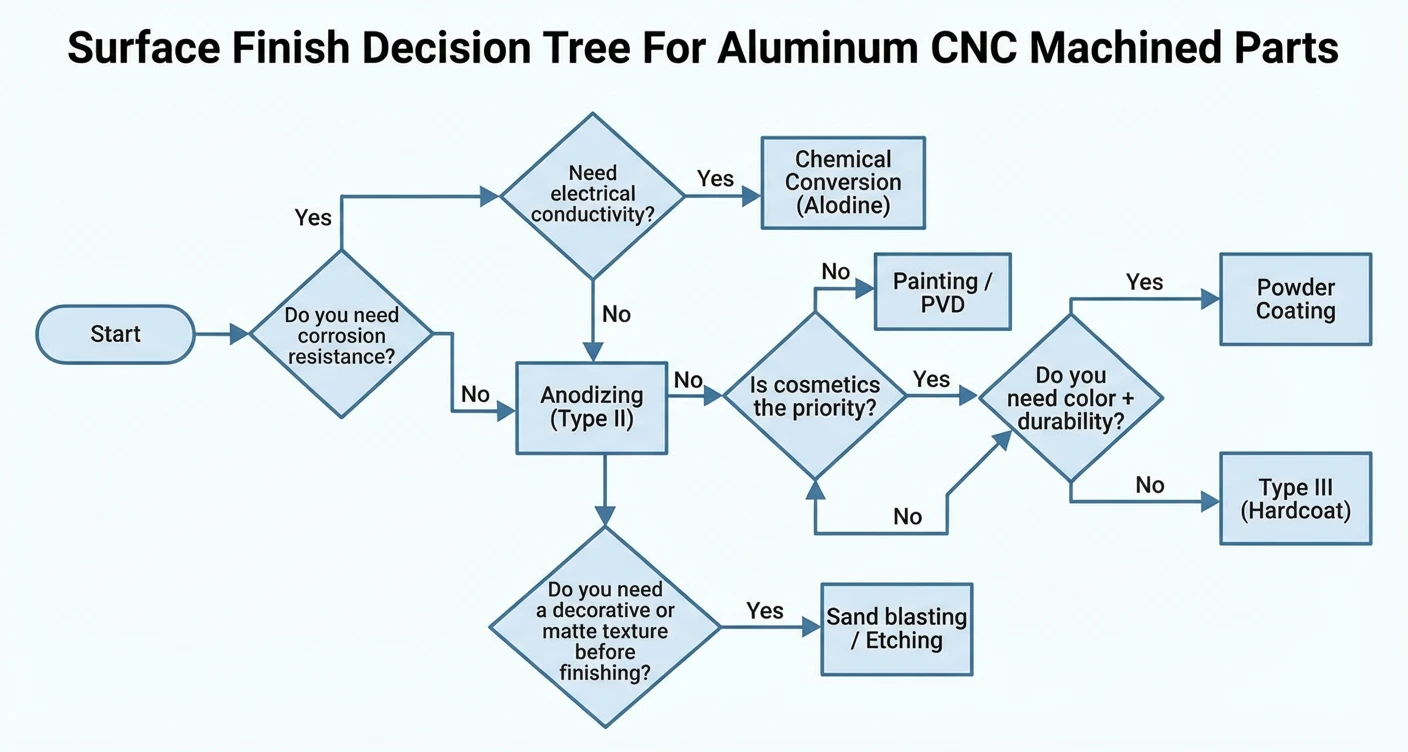
Aluminum components often require post‑machining finishing to improve durability, corrosion resistance, conductivity, or appearance. Meco provides a wide range of aluminum‑compatible surface treatments, allowing you to match each finish to your functional or aesthetic needs.

Aluminum Surface Treatments Available at Meco

Finishing Processes

  • Anodizing (Type I, II, III Hardcoat)
  • Chemical Conversion Coating (MIL‑DTL‑5541F)
  • Chrome Plating
  • Nickel Plating
  • Electroless Nickel Plating
  • PVD (Physical Vapor Deposition)
  • Powder Coating
  • Painting
  • E‑Coating
  • Sandblasting / Etching
Surface Finish Decision Tree
Surface Finish Decision Tree Enlarged

Why Choose Meco for Aluminum CNC Machining

Eight core strengths that deliver accuracy, consistency, speed, and reliability.

Precision Capabilities You Can Trust

Machining accuracy to ±0.01 mm and surface finishes to Ra 0.4 μm.

Ideal for sealing surfaces and tight‑tolerance assemblies.

Precision Accuracy

±0.01 mm accuracy and Ra 0.4 μm surface finishes.

Surface Finishes

Anodizing, conversion coating, powder coating, painting, PVD, and more.

Advanced 3/4/5‑Axis

Ideal for complex aluminum geometries.

Full Processes

Turning, milling, drilling, tapping, finishing.

Materials Expertise

Optimize functionality without over‑engineering cost.

DFM & Production

Early DFM guidance stabilizes long‑run quality.

Cost & Global Network

Competitive pricing from Thailand and China.

Supply‑Chain & Scaling

Full lifecycle support, from prototypes to production.

Frequently Asked Questions (Aluminum CNC Machining)

What aluminum alloys can be CNC machined?
Most industry‑standard aluminum alloys can be CNC machined, including:
  • 6061
  • 7075
  • 2024
  • 5052
  • 6082
The best alloy depends on strength, weight, corrosion resistance, cosmetic requirements, and cost.
What tolerances can you achieve on aluminum parts?
Meco can hold aluminum CNC tolerances down to ±0.01 mm, with surface finishes as smooth as Ra 0.4 μm depending on geometry and machining setup.

This precision is ideal for sealing surfaces, complex features, and tight tolerance stacks.
What surface finishes are available for aluminum CNC machining?
Meco offers a full selection of aluminum‑ready finishing options:
  • Anodizing (Type I, II, III)
  • Chemical conversion coating (Alodine / MIL‑DTL‑5541F)
  • Chrome plating
  • Nickel & electroless nickel plating
  • PVD coatings
  • Powder coating
  • Painting
  • E‑coating
  • Sandblasting or etching (prep)
These finishes improve durability, corrosion resistance, appearance, conductivity, and part performance.
How long does aluminum CNC machining take?
Lead time depends on:
  • Part complexity
  • Quantity
  • Surface finish requirements
  • DFM optimizations
  • Material availability
Aluminum machines quickly and efficiently, often leading to shorter machining times than many metals.

Meco’s streamlined workflow — with DFM, in‑process QC, and global production — helps reduce overall lead time.
Do you offer both prototype and production aluminum machining?
Yes. Meco supports:
  • Rapid aluminum prototypes
  • Small and medium batch runs
  • High‑volume production
  • Multi‑process aluminum assemblies
The same ISO‑aligned workflow applies across all volumes for consistent quality and documentation.
How much does aluminum CNC machining cost?
Aluminum CNC machining cost depends on:
  • Geometry and complexity
  • Machining time
  • Alloy selection
  • Surface finish requirements
  • Quantity ordered
Aluminum is generally cost‑efficient because it machines quickly, reduces cycle time, and lowers tooling wear.

Request a Quote for Aluminum CNC Machining

Upload your CAD file — our engineers will review it, provide DFM insights, and send a fast, accurate quotation.

Request a Quote